

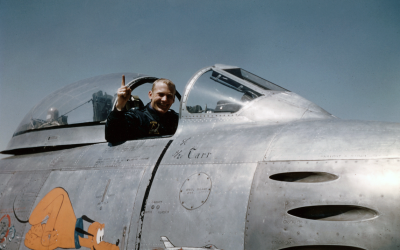
At about twenty to eight on the evening of 15 May 1941, after a day of weather bad enough to keep everyone waiting, a small silver aeroplane with no propeller took off from RAF Cranwell and flew for seventeen minutes.
It was not the first jet aircraft to fly. It was not the second either. But it was the one that started the line of engines which eventually replaced the piston engine in nearly everything that matters — and the man whose idea it was had, six years earlier, been unable to find five pounds to renew the patent.
Quick Facts
- Aircraft: Gloster E.28/39, serials W4041/G and W4046/G
- Designer: George Carter, Gloster Aircraft Company
- Specification: E.28/39 — the 28th Experimental specification issued in 1939, not a date
- Engine: Power Jets W.1, centrifugal-flow turbojet, 860 lbf
- First flight: 15 May 1941, RAF Cranwell — pilot Gerry Sayer, 17 minutes
- Top speed, first series: About 350 mph at 25,000 ft
- Survivor: W4041/G, Science Museum, London, alongside its original engine
- Order of jet flight: Third in the world, after the He 178 and He 280
Let us be honest about who was first
British accounts have a habit of sliding past this, so it is worth stating plainly. The world’s first turbojet flight was the Heinkel He 178 on 27 August 1939, flown by Erich Warsitz at Rostock, days before the invasion of Poland. The He 280, the first jet fighter, flew under jet power on 2 April 1941 — also before the E.28/39.
The Caproni Campini N.1 of August 1940 is sometimes credited as first, and the FAI did record it that way, but only because the He 178 flight was secret. In any case the N.1 was a motorjet: a piston engine driving a compressor, with a burner in the duct. There was no turbine extracting energy from the exhaust, which is the thing that makes a turbojet a turbojet.
So the E.28/39 was the third jet aircraft to fly, and Britain’s first. The test pilot John Grierson, who flew the second airframe, put the real claim better than any patriotic version could.
The five pounds
Frank Whittle worked out the principle in 1929, as a 22-year-old RAF officer, and applied for his patent in January 1930. Armstrong Siddeley turned it down. British Thomson-Houston agreed the physics were sound but would not spend sixty thousand pounds finding out.
Because the Air Ministry was not interested, the patent was never classified secret — so Whittle kept the rights. And then, in January 1935, while he was at Cambridge and broke, the renewal fee fell due. The Ministry declined to pay it. He could not. The patent lapsed.
Power Jets Ltd was registered in March 1936 on an initial subscription of two thousand pounds. The financier Lancelot Law Whyte, who met Whittle in September 1935, recorded the pitch that convinced him: reciprocating engines were exhausted, they had hundreds of parts jerking to and fro, and the engine of the future would produce two thousand horsepower with one moving part.

The engine and the aeroplane
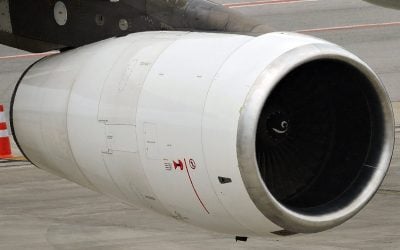
The W.1 was a centrifugal-flow turbojet: a single double-sided compressor, ten reverse-flow combustion chambers wrapped around the turbine to keep the engine short, and a single-stage axial turbine. It produced 860 pounds of thrust at 16,500 rpm.
George Carter’s airframe around it was deliberately minimal — a low-wing monoplane with a nose intake, the duct split to pass either side of the cockpit, and a steerable nosewheel. There was no radio, no cockpit heating and no pressurisation. Provision was made for four Browning machine guns. None were ever fitted.

Before Cranwell there were the hops. In April 1941, at Gloster’s own aerodrome at Brockworth, using a deliberately non-airworthy ground-running engine, Whittle himself taxied the aircraft to sixty miles an hour and Gerry Sayer got it briefly airborne three times, for two or three hundred yards each. General Hap Arnold of the US Army Air Forces watched one of those demonstrations, which turned out to matter a great deal.
Archive film of the April 1941 taxi trials — the aircraft’s first movements under jet power.
One myth to leave behind: it is sometimes claimed Sayer exceeded 500 mph on that first flight. He did not. The first flight series topped out around 350 mph. The 505 mph figure belongs to 1944, with a much later engine in the same airframe.
What happened to everyone
Gerry Sayer did not live to see what he had started. On 21 October 1942 he took off from RAF Acklington in a Hawker Typhoon to test a gunsight over the Druridge Bay ranges, in company with a second Typhoon. Neither returned. A mid-air collision is presumed. His body was never recovered.
The second airframe, W4046, first flew in March 1943 and was demonstrated to Churchill at Hatfield that April. It was destroyed later the same year when an aileron jammed at high altitude — traced, eventually, to the wrong type of grease in the control runs. Squadron Leader Douglas Davie baled out from 33,000 feet and survived, badly frostbitten on the way down.
Whittle fared no better commercially than he had in 1935. Power Jets was nationalised in March 1944, for £135,000, which he reluctantly accepted; he resigned in February 1946 over government policy. He received no royalties from the invention. In 1951 the United States paid his firm’s successor four million dollars for around two hundred patents.
The Power Jets engine that made it possible.
The line that followed
The W.1X ground engine and a set of drawings were flown to America in a B-24 in October 1941, the direct result of Arnold having watched those taxi hops. General Electric turned it into the I-A, which powered the Bell XP-59A Airacomet, the first American jet, in October 1942. The whole American jet industry traces back through that shipment.
In Britain the W.2 became the Rolls-Royce Welland, and the aeroplane became the Gloster Meteor — the only Allied jet fighter to see operational service in the war, chasing V-1s from July 1944. The Welland ran 180 hours between overhauls. The German Jumo 004 managed twenty-five to thirty-five. Germany flew first; Britain built the engine that lasted.

Grierson, flying the second aircraft in 1943, described the sensation that everyone who has flown a jet since takes entirely for granted.
W4041 is still in London, in the Science Museum, with the engine that flew it that evening at Cranwell. It is a small aeroplane and easy to walk past. Almost everything that flies fast today is descended from it.
Contemporary film of the Gloster E.28/39, Britain’s first jet aircraft.
Sources: John Grierson in Flight International (13 May 1971), Frank Whittle’s James Clayton Lecture (IMechE, 1945), Science Museum Group, Imperial War Museum, Thunder & Lightnings

0 Comments