
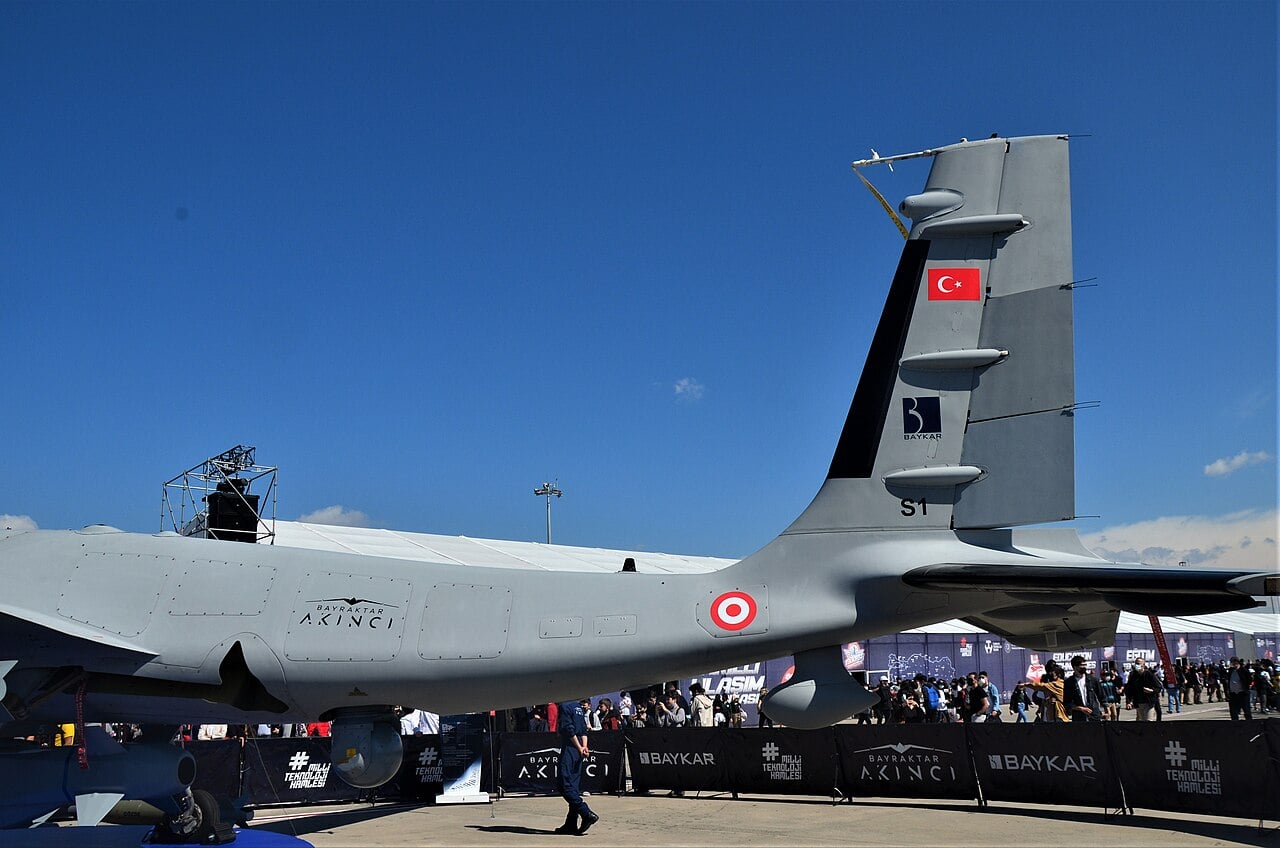
A propeller-driven drone took off from a test centre in Tekirdag on Friday, flew out over the Black Sea, and put a ballistic missile through a ship more than 250 kilometres away. Then it turned round and flew home along its planned route.
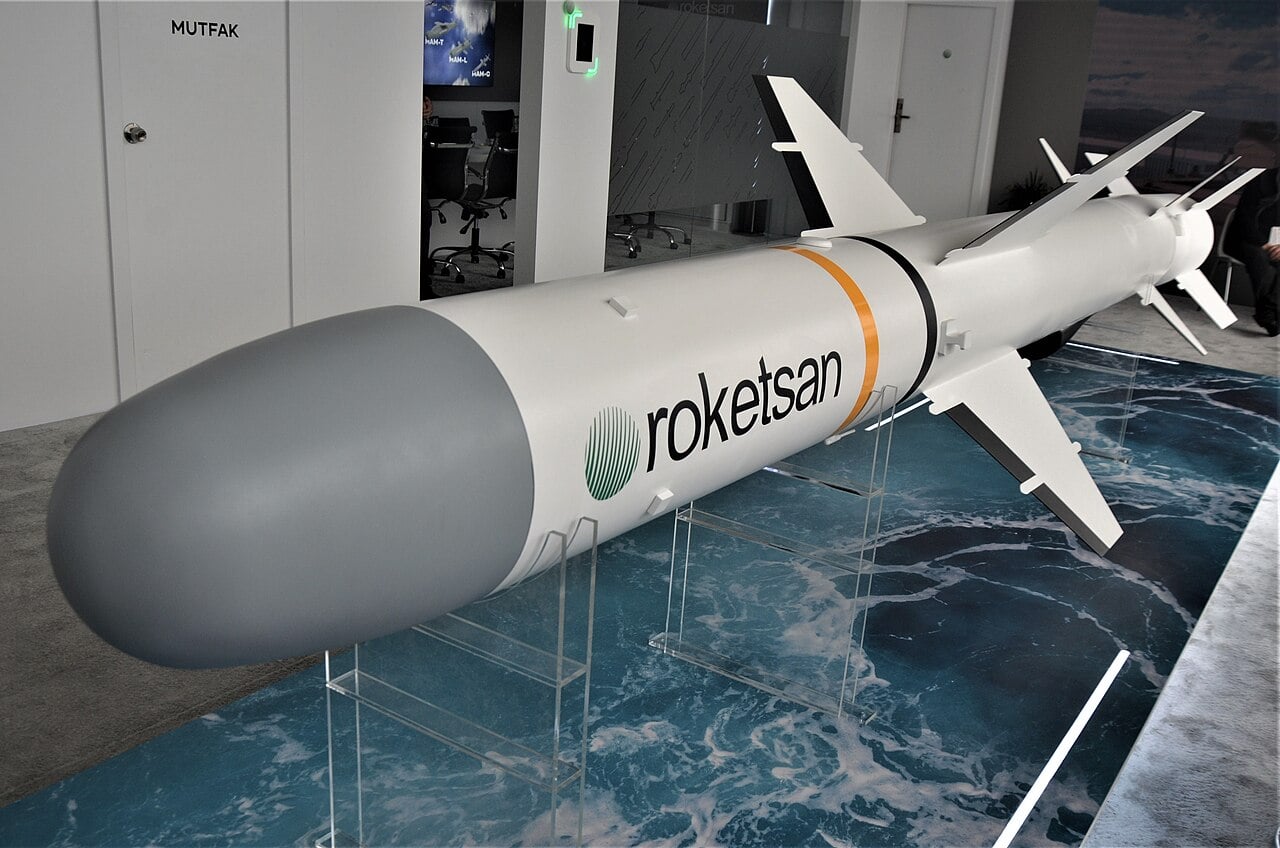
That is not how ballistic missiles are normally delivered. It is the sort of job that has historically needed a heavy bomber or a fast jet with a long tanker tail behind it. Baykar released the footage on 11 September, and it marks the first live firing of Roketsan’s supersonic UAV-300 — the İHA-300 in Turkish service — from an unmanned aircraft.
The aircraft was a Bayraktar Akinci, the high-altitude, long-endurance unmanned combat air vehicle that Baykar has been steadily turning into a flying weapons rack.
Quick Facts
The aircraft: Bayraktar Akinci, a HALE unmanned combat aerial vehicle designed, developed and produced by Baykar
The weapon: Roketsan UAV-300 (İHA-300) supersonic air-launched ballistic missile
The shot: A maritime target struck with a direct hit more than 250 km (155 miles) away, off the coast of Sinop
Route: Took off from the Corlu Flight Training and Test Centre, Tekirdag; transited to the Black Sea test area; returned to Corlu
Guidance: GNSS and inertial navigation in mid-course, television seeker in the terminal phase
Footage released: 11 September 2026, by Baykar and chief technology officer Selcuk Bayraktar
In service: The first three Akinci entered service with the Turkish Armed Forces on 29 August 2021
A Drone With a Ballistic Missile Under Its Wing
The distinction matters. An air-launched ballistic missile is not a cruise missile: it climbs, arcs and comes down steeply and fast, which makes it far harder to intercept than something flying a flat subsonic profile. Roketsan designed the UAV-300 to reach beyond 500 kilometres depending on the launch platform’s flight profile — the higher and faster you release it, the further it goes.
Guidance is a two-stage affair. GNSS and inertial navigation fly it through the mid-course, then a television seeker takes over for the terminal run, which is what allows a direct hit on a specific ship rather than an area effect. Roketsan lists its intended targets as radars, armoured vehicles, air-defence systems and command centres — the high-value, heavily defended things you would rather not send a crewed aircraft near.
Baykar chief executive Haluk Bayraktar has described the UAV-300 as the longest-range domestically developed missile yet fired from an indigenous Turkish platform. That claim is his, and worth noting as such, but the range figure demonstrated in the test is not in dispute: the target was over 250 kilometres out.
The Build-Up Was Visible Two Days Earlier
Anyone watching closely could see this coming. On 9 September, Baykar reported a firing test of the smaller İHA-122 — and in that test the Akinci was already carrying a UAV-300 on the wing without launching it. The aircraft used, the prototype PT-5, flew with two UAV-122 rounds on the middle hardpoints and the UAV-300 on the innermost pylon of the starboard wing. Two days later, the big one came off the rail.
The UAV-300 joins an already crowded weapons list. The Akinci has been cleared with the MAM-L and MAM-T guided bombs, TOLUN, the TEBER-81, the Cakir cruise missile, the Eren loitering munition, and the UAV-122 and UAV-230 supersonic missiles. Each integration widens the set of jobs the aircraft can be sent to do.
Why Anyone Outside Turkey Should Care
The commercial context is what gives this test weight. Baykar finances its projects from its own resources, and in 2025 it remained the world’s largest exporter in the unmanned aerial vehicle segment, with an export volume of around $2.2 billion and roughly 90 per cent of revenue coming from abroad. It has signed export agreements with 39 countries — 36 covering the Bayraktar TB2 and 16 covering the Akinci.
So this is not a one-off national capability. It is a capability with a price list. A country that cannot afford a bomber fleet, or the tankers and crews to support one, can now plausibly buy a turboprop drone that lobs supersonic ballistic missiles a couple of hundred kilometres. That is a meaningful shift in who gets to hold distant, defended targets at risk.
Baykar’s own footage of the shot, showing the missile coming off the wing and the terminal seeker view of the hit:
Frequently Asked Questions
What is the UAV-300 missile that the Akinci fired?
How far away was the target in the Akinci test?
Was this the first time an Akinci fired a ballistic missile?
What is the difference between an air-launched ballistic missile and a cruise missile?
What other weapons can the Bayraktar Akinci carry?
How widely exported is the Bayraktar Akinci?
Sources: Baykar Technologies, Roketsan, Defensehere, Defence Turkey, Zona Militar, csavunma, The Aviationist.
0 Comments