
In April 1980 a very ill old man was wheeled into a room at Northrop and shown a model of an aircraft. He had spent his career insisting that the ideal aeroplane was a wing and nothing else — no fuselage, no tail, no drag it did not need — and the industry had spent decades proving it could not be made to work.
Jack Northrop could no longer speak by then. He wrote his reaction instead. According to the account in Air & Space Forces Magazine, the words were: now I know why God has kept me alive for 25 years. He died ten months later, in February 1981, having seen the classified shape of what would become the B-2 Spirit.
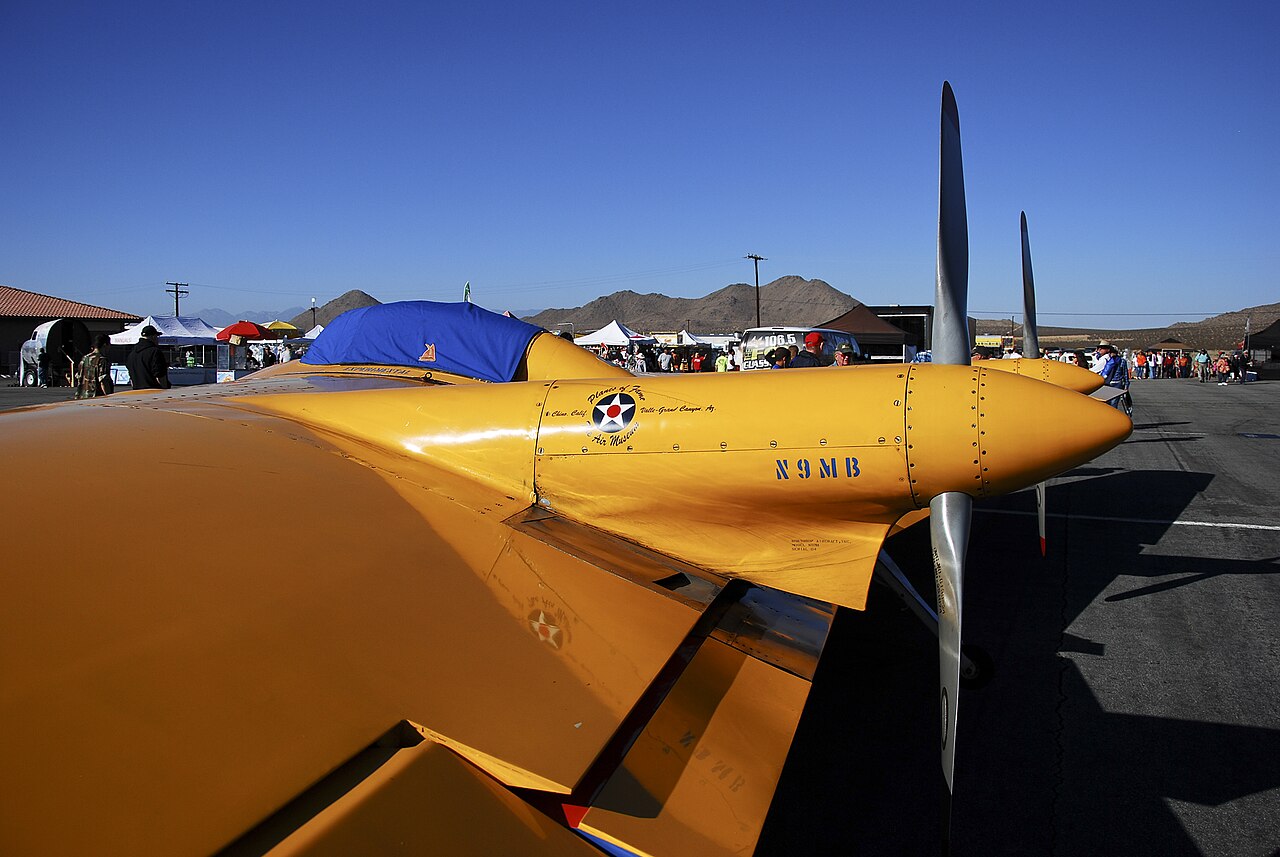
The little yellow aircraft in the photograph above is the reason he was right.
Quick Facts
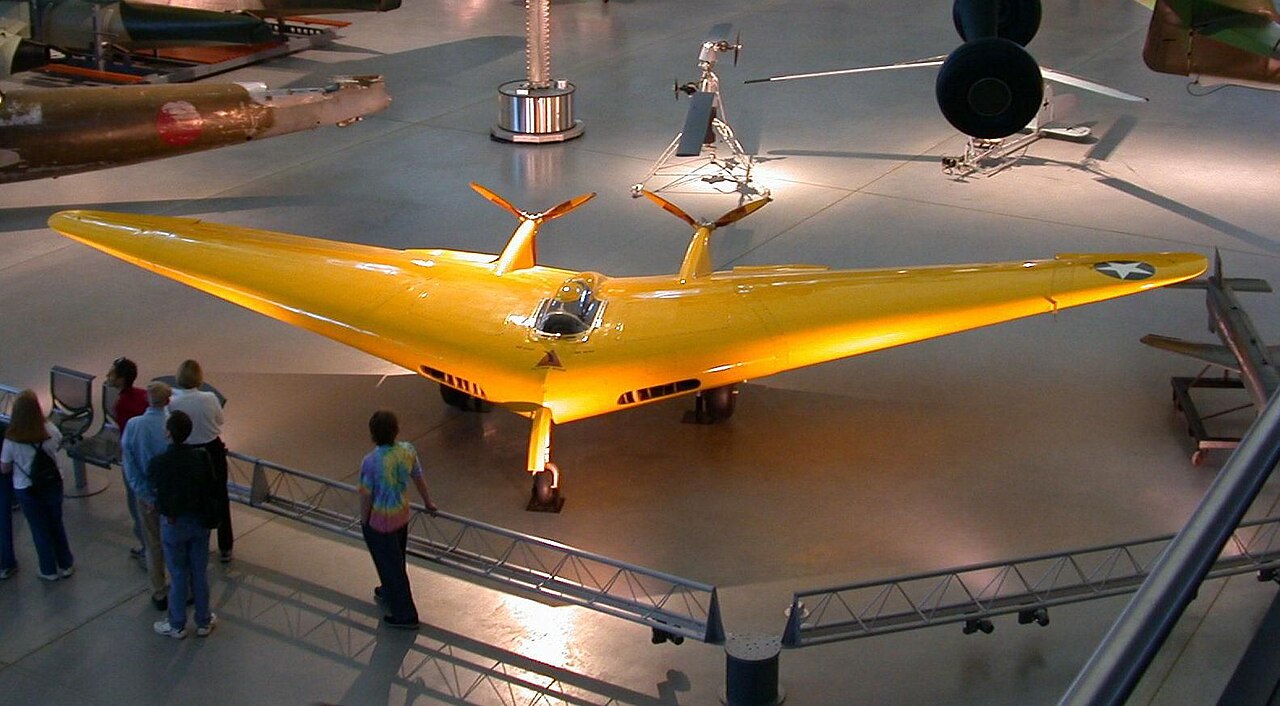
What it was: A roughly one-third-scale flying wing testbed, 60 ft (18 m) span, for the full-size 172 ft (52 m) Northrop XB-35 and YB-35 bombers
First flight: 27 December 1942, Northrop test pilot John Myers
Built: Four aircraft: N-9M-1, N-9M-2, N-9MA and N-9MB
Construction: Partly wooden framework, laminated plywood wing skins, welded tubular steel centre section
Engines: Two 290 hp Menasco C6S-1 Buccaneer inverted air-cooled sixes; the N-9MB used two 300 hp Franklin XO-540-7
First loss: 19 May 1943, near Muroc Army Air Base. Pilot Max Constant killed
Last loss: 22 April 2019, the restored N-9MB, at Norco, California. The pilot was killed
Legacy: Northrop’s all-wing lineage led to the B-2 Spirit, which entered USAF service in 1989
Why a Wing and Nothing Else
The argument for a flying wing is brutally simple. Every part of a conventional aeroplane that is not the wing creates drag without creating lift. Delete the fuselage and the tail, spread the payload and crew inside the wing itself, and you should get more range from the same fuel.
Northrop had been chasing this since 1929, with the twin-boom X-216H, and then more purely with the N-1M of 1939 to 1941. The problem was never the aerodynamic theory. It was control. Without a tail there is nothing to damp yaw and pitch, so an all-wing aircraft wants to wander, and it will happily depart into a spin that a conventional design would shrug off.
In 1941 the Army ordered the XB-35, a 172-foot flying wing bomber. Nobody knew how to fly such a thing, so on 30 October 1941 the contract was confirmed with a one-third-scale trainer attached: the N-9M, built to gather flight data and to teach pilots what a wing without a tail actually does.
Plywood, Menasco Engines and Constant Failure
The N-9M was not a precious prototype. Its framework was partly wood to save weight, its outer wing surfaces were skinned in specially laminated plywood, and the centre section was welded steel tube. It was a flying slide rule.
John Myers took the first one up on 27 December 1942. Over the following five months the aircraft made 45 flights, and nearly every single one ended early because something broke. The Menasco engines were the main culprit, which is a familiar story for any wartime programme forced to use whatever powerplant was available rather than the one it wanted.
Then, on 19 May 1943, with about 22.5 hours on the airframe, the first N-9M entered a right-hand spin, 60 degrees nose down, roughly twelve miles west of Muroc Army Air Base — the place now called Edwards. Max Constant did not get out. The investigation found control reversal: during his recovery attempt the control column had been forced back against his chest, and he could not move it.
That is the flying wing’s original sin in one sentence. The aerodynamics that make it efficient also make it capable of loading up the controls until a pilot physically cannot win.
Restored colour film of the later, jet-powered YB-49 — the aircraft the whole N-9M programme was building toward.
Three Scrapped, One Saved
Three more N-9Ms were built and the programme ran on until the Flying Wing bomber was cancelled. Then every remaining test aircraft was scrapped except the last one, the N-9MB, which was left to rot for more than thirty years.
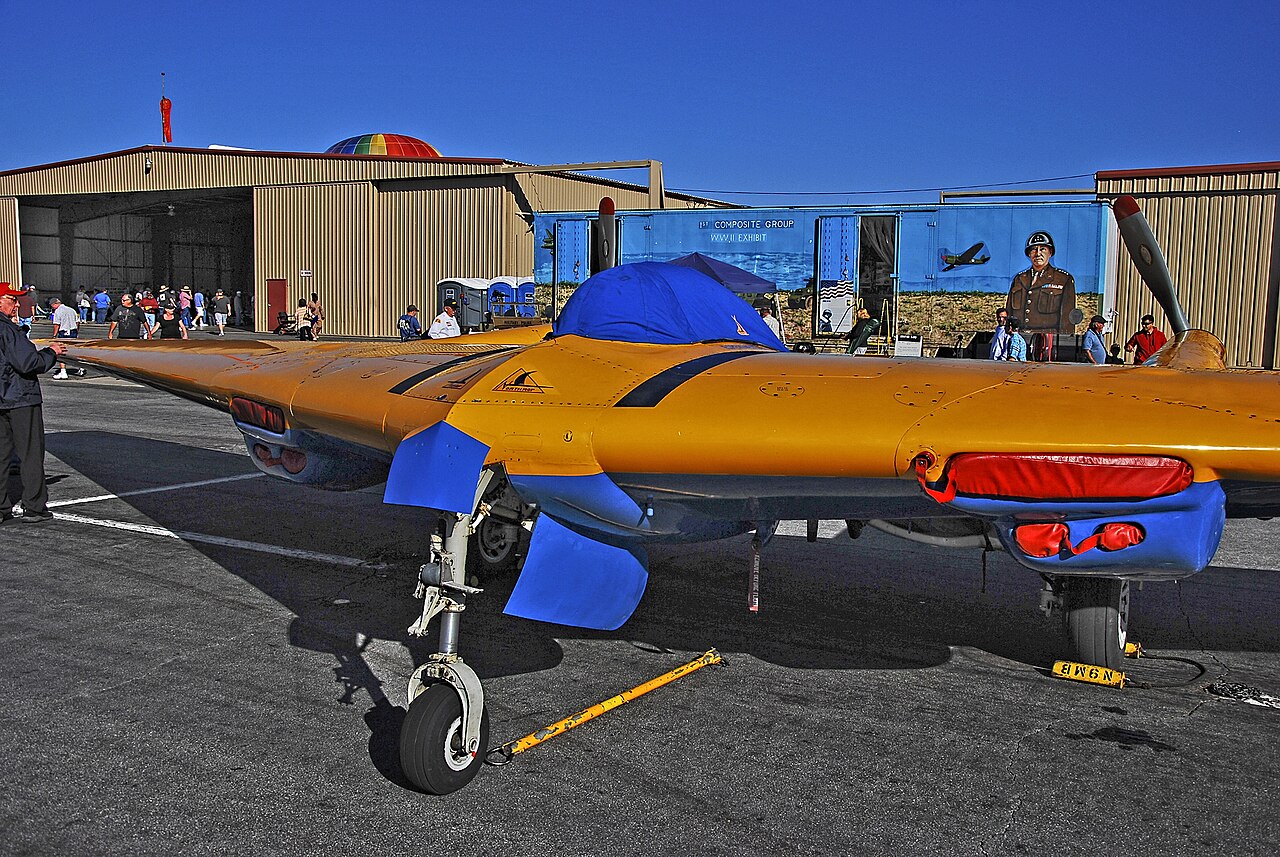
In 1982 the Planes of Fame Air Museum at Chino, California, took it on. Over the next two decades former Northrop employees and volunteers rebuilt it to flight condition — people who had worked on the original programme putting their own aircraft back together. From 1993 the yellow-and-blue wing flew display sequences at airshows every year. It survived an in-flight engine fire in April 2006, was repaired, and flew again at Chino in May 2010.
Norco, 22 April 2019
On 22 April 2019 the N-9MB took off from Chino on a low-altitude test flight following its annual inspection. Witnesses on the ground, at least one of them a qualified pilot, described it flying straight and level at what sounded like normal cruise power when it pitched up into a climb, banked left, and then rolled abruptly to the right.
It came down at 12:10 pm inside the grounds of the California Rehabilitation Center, a state prison at Norco. The pilot was killed. Nobody on the ground was hurt.
The NTSB attributed the accident to the pilot’s loss of control for undetermined reasons. Seventy-six years after Max Constant, the last flying N-9M was lost in a departure from controlled flight that nobody has been able to explain.
The N-9MB flying at Planes of Fame, in footage that can never be repeated.
The Vindication
The flying wing did not fail. It was simply forty years early. What the N-9M could not solve with cables, pulleys and a pilot’s arm strength, the B-2 solved with computers making hundreds of tiny control corrections per second — a fly-by-wire system quietly doing the job a tail would otherwise do.
Stealth then turned the wing’s shape from an efficiency argument into a strategic one: no vertical surfaces means very little to reflect radar back at the transmitter. The configuration Jack Northrop wanted for range turned out to be the configuration you would choose for invisibility.
Every B-2, and every flying-wing drone that followed it, traces back through a 60-foot wooden aeroplane that broke down on 45 flights out of 45 and killed two pilots seventy-six years apart.
Frequently Asked Questions
What was the Northrop N-9M?
How many N-9Ms were built and what happened to them?
Why did the first Northrop N-9M crash?
What caused the 2019 crash of the restored N-9MB?
How is the N-9M connected to the B-2 Spirit?
Why is a flying wing more efficient than a conventional aircraft?
Did Jack Northrop live to see the B-2?
Sources: Air & Space Forces Magazine, National Transportation Safety Board, Planes of Fame Air Museum, Smithsonian National Air and Space Museum, Vintage Aviation News.
0 Comments