
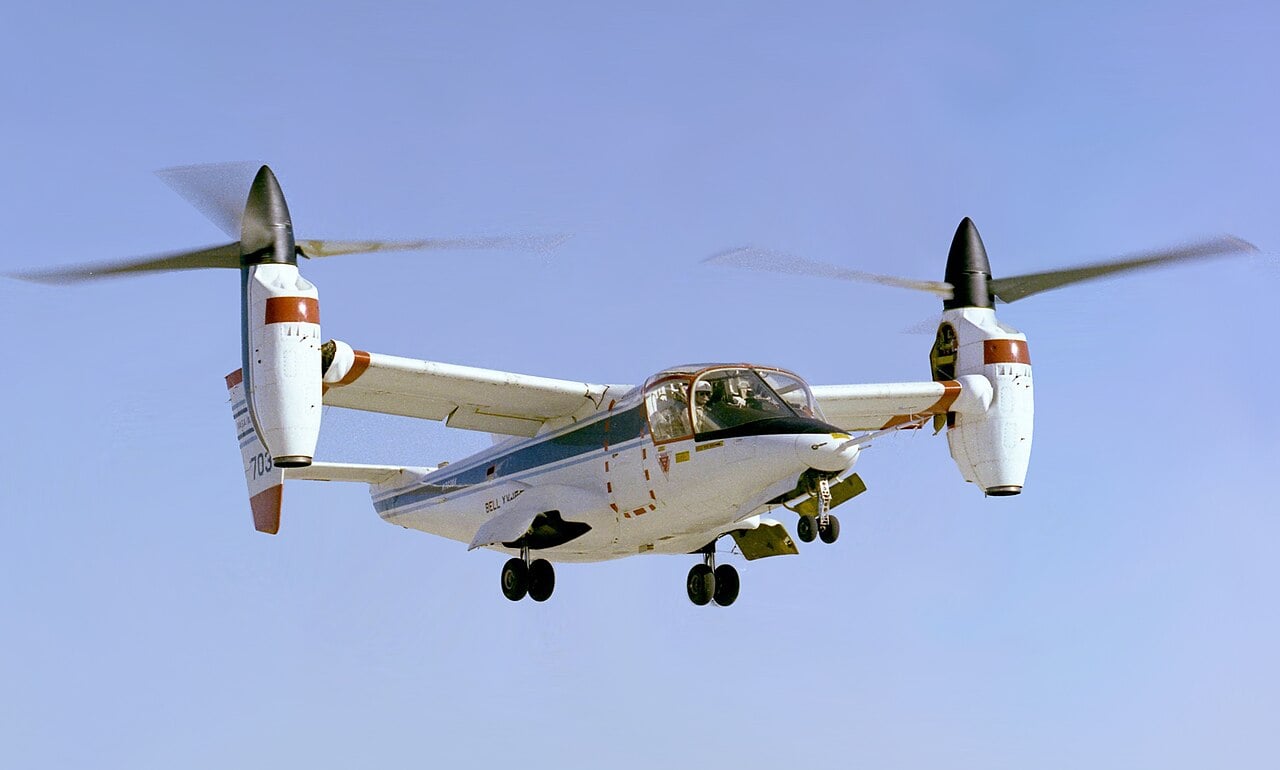
At the 1981 Paris Air Show a small orange-and-white aircraft took off vertically like a helicopter, rotated its engines forward, flew past the crowd like an aeroplane, rotated them back, and stopped in mid-air to bow.
The New York Times, not a publication given to swooning over machinery, wrote: “And if ever there was a lovable plane, it is the Bell XV-15. The machine, the hit of the show, performed a series of maneuvers including bowing to the crowd.”
Two were built. Both survived their programme. Everything that tilts its rotors today — the V-22 Osprey, the AW609, the V-280 and the tilting-rotor air taxis now chasing certification — exists because those two aircraft worked.
Quick Facts
What it was: An experimental tiltrotor research aircraft, the second successful tiltrotor and the first to demonstrate the concept’s high-speed advantage over helicopters
Origin: NASA selected the Bell 301 design; research and development contract issued 31 July 1973
First flight: 3 May 1977, the first of two aircraft, tail number N702NA
Built: Two: N702NA and N703NA
Public debut: 1981 Paris Air Show
Key technique: Shortest take-off distance was achieved with the nacelles set at 75 degrees
Retirement: N703NA flew NASA test operations until September 2003, then went to the Smithsonian National Air and Space Museum
Legacy: Directly informed the Bell Boeing V-22 Osprey and the Bell/Agusta BA609, now the AgustaWestland AW609
The Problem Nobody Could Solve for Forty Years
The idea is old. A design resembling a modern tiltrotor was patented by George Lehberger in May 1930. Germany started the Focke-Achgelis Fa 269 in 1942; it never flew. The Transcendental Model 1-G, a single-seater, began development in 1947, flew in 1954, and was destroyed in a crash in Chesapeake Bay on 20 July 1955 — though the pilot was not seriously hurt.
Then came Bell’s XV-3, first flown in 1955. Like every predecessor, it put the engines in the fuselage and ran driveshafts out to tilting rotor assemblies at the wingtips. That is where the concept kept dying. Those driveshafts, gearboxes and tilting mechanisms carried enormous loads and weighed a great deal, and the weight penalty ate the performance the configuration was supposed to deliver.
Bell engineers Kenneth Wernicke and Bob Lichten looked at the alternatives — slowed rotors, stopped rotors, folding rotors, variable-diameter rotors — and judged them all less promising than fixing the tiltrotor properly.
Move the Engines to the Wingtips
The XV-15’s answer was to stop fighting the driveshafts and delete them. Put the engines out at the wingtips, in the nacelles, and let them tilt with the rotors. Now the shaft between engine and rotor is short and lightly loaded, and the cross-shaft between the two nacelles only has to carry power in the emergency case where one engine fails.
That single change is why the XV-15 worked and the XV-3 did not. It is also the layout every tiltrotor since has used.

Wind Tunnels, Then the Envelope
N702NA first flew on 3 May 1977. After minimal testing at Bell’s own facility it went to Ames Research Center at Sunnyvale, California, where it was mounted in the large Ames wind tunnel and run through simulated flight conditions — a full-size aircraft bolted into a tunnel, which remains one of the more striking things NASA does with aeroplanes.
From there the programme moved to NASA Dryden at Edwards Air Force Base to expand the flight envelope. The aircraft demonstrated what mattered: it could operate as a helicopter, operate as a fixed-wing aeroplane, and transition smoothly between the two without drama. Once that was established it went back to Ames for further work.
The Paris trip was not just theatre. Over the following year Senator Barry Goldwater, Navy Secretary John Lehman and other officials were given guest co-piloting flights — which is a very effective way of turning a research project into a procurement programme.
Period footage of the XV-15 converting between helicopter and aeroplane flight.
A Bolt, and an Aircraft Upside Down
Ship one came to an abrupt end. During a final hover a bolt slipped out of the collective control system on one pylon, which sent that rotor to full pitch. The aircraft rolled inverted, out of control, and crashed upside down.
It was significantly damaged but largely structurally intact, and both the pilot and copilot walked away with minor injuries. The cockpit was salvaged and converted into a flight simulator, which is a reasonably dignified afterlife for a research aircraft.
There is a lesson in that sentence that has nothing to do with tiltrotors. The most sophisticated rotorcraft control system in the world in 1977 was defeated by a fastener coming loose.
What It Became
For the Department of Defense’s Joint-service Vertical take-off/landing Experimental programme, Bell Helicopter teamed with Boeing Vertol and bid an enlarged XV-15. That became the Bell Boeing V-22 Osprey.
Ship two, N703NA, kept working. It flew tests supporting the V-22 and the Bell/Agusta BA609 civil tiltrotor, the aircraft still in development years later as the AgustaWestland AW609. It stayed in NASA test operations until September 2003, and along the way established the practical detail that the shortest take-off run came with the nacelles at 75 degrees rather than straight up.

When it was finally done, N703NA was donated to the Smithsonian National Air and Space Museum in Washington, DC, and flown there from Fort Worth under its own power. A research aircraft that delivers itself to the museum has had a good career.
The aircraft the XV-15 made possible, and what it takes to fly one.
Frequently Asked Questions
What was the Bell XV-15?
Why did the XV-15 succeed when earlier tiltrotors failed?
How many Bell XV-15s were built?
What happened at the 1981 Paris Air Show?
How did the XV-15 lead to the V-22 Osprey?
Where is the Bell XV-15 now?
What nacelle angle gave the XV-15 its shortest take-off?
Sources: NASA, Smithsonian National Air and Space Museum, The New York Times (1981), Bell Helicopter programme histories.
Related Posts
0 Comments