
The United States Air Force has been trying to graduate 1,500 pilots a year for the better part of a decade. It has repeatedly said the number out loud, repeatedly built plans around it, and repeatedly missed it.
On Sunday, Air Education and Training Command announced that this year it will actually get there.
The way it did it is more interesting than the number: it stopped trying to teach everyone to fly on military aeroplanes.
Quick Facts
| Announced | 14 September 2026, by Air Education and Training Command at AFA Air, Space & Cyber |
| Milestone | 1,500 pilot graduates in fiscal 2026, the first time the target has been met |
| Programme | Future of Undergraduate Pilot Training (FUPT), launched spring 2025 |
| First stage | Initial Pilot Training: 120 flying hours over 139 days at one of four civilian flying universities |
| Qualification earned | FAA Part 141 private pilot licence with instrument and multi-engine ratings |
| Second stage | Undergraduate Pilot Training at Columbus, Laughlin, Sheppard or Vance Air Force Bases |
| Pilot shortage | About 2,470 at the end of fiscal 2025 |
| FY2027 flying-hours request | $9.9 billion total, of which $7.4 billion Active Duty, a 22 percent increase |
The constraint was never the students
For years the bottleneck in American military pilot production was not a shortage of people who wanted to fly. It was instructors, and aircraft, and the maintenance capacity to keep those aircraft serviceable enough to fly a syllabus on schedule.
Every hour an experienced instructor spent teaching a student to hold a heading and land an aeroplane was an hour not spent teaching formation, instruments or tactical employment. Every T-6 sortie flown on basic airmanship was a sortie not available to somebody further along.
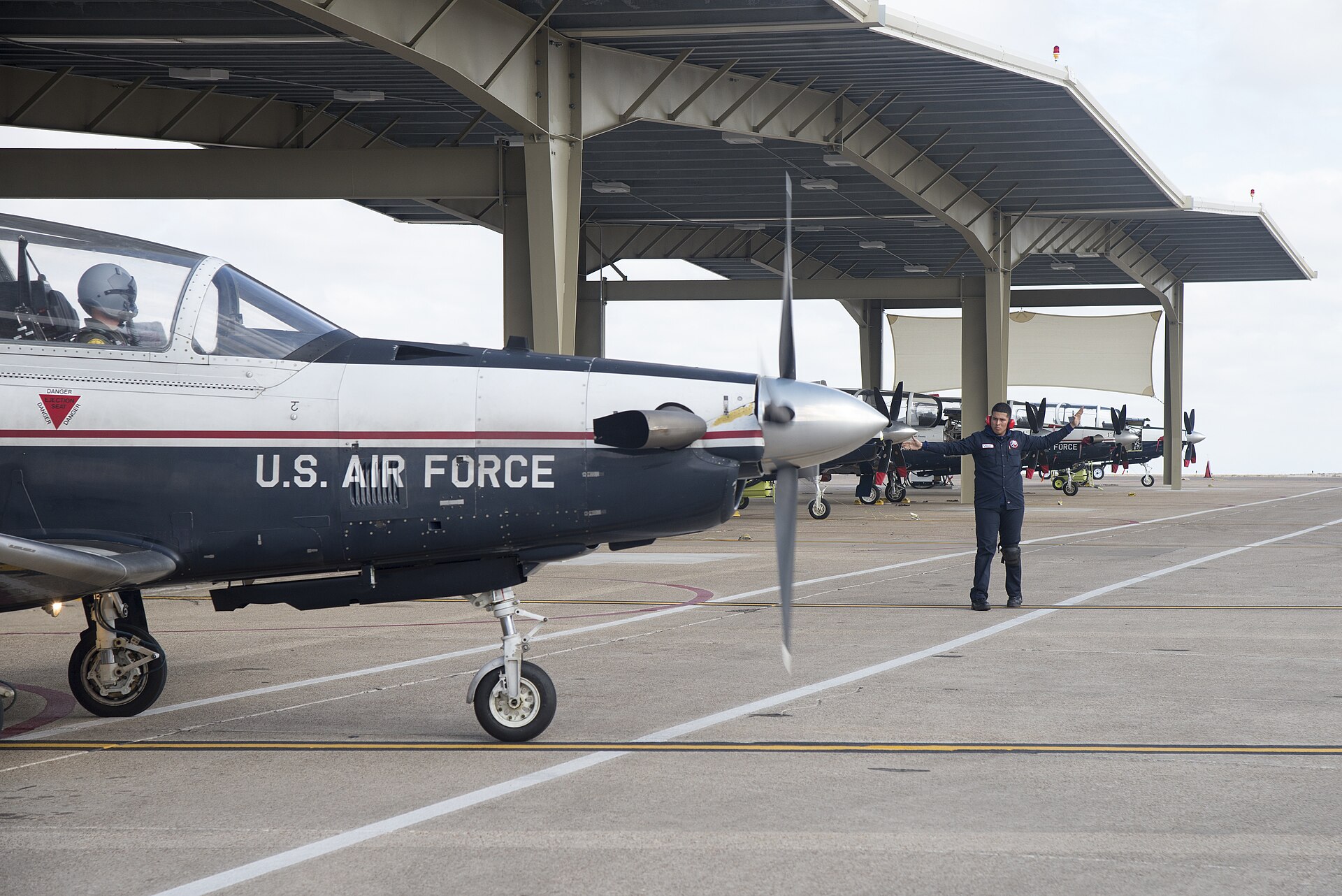
FUPT’s answer is blunt: civilian flying schools already do the basic part extremely well, at scale, and have done for decades. So send the students there first.
A hundred and twenty hours, then the Air Force
Under the new construct, a student spends 120 flying hours across 139 days at one of four flying universities, in a stage called Initial Pilot Training. They finish it holding an FAA Part 141 private pilot licence with instrument and multi-engine ratings, which is a genuinely useful civil qualification in its own right.
Only then do they go to Columbus, Laughlin, Sheppard or Vance, arriving as people who can already fly rather than people who need to be taught to.
The logic is the same one behind every good outsourcing decision ever made: keep the thing only you can do, and buy the rest. Nobody but the Air Force can teach four-ship tactical formation. Plenty of people can teach a crosswind landing.
Now for the harder half
Here is the part that stops this being a victory lap. The pilot shortage stood at roughly 2,470 at the end of fiscal 2025, and production is only one of the three things that created it. The other two are retention and absorption.
Absorption is the unglamorous one and the one senior officers keep flagging. A squadron can only take so many brand-new aviators at once before it runs out of instructors, sorties and supervisory capacity to season them. Graduating 1,500 people into a force that can comfortably absorb 1,100 does not produce 1,500 combat-ready pilots. It produces a queue.
Which is why the training announcement and the budget request are really one story. The Air Force is asking for about $9.9 billion for flying hours in fiscal 2027, of which $7.4 billion is for Active Duty, up 22 percent from $6.1 billion. Another $1.6 billion covers Air National Guard hours and $867 million the Reserve.
Flying hours are not an abstraction. They buy fuel, spares and the consumables that let jets leave the ground. A newly minted pilot posted to a squadron that cannot afford to fly does not become a good pilot, and does become a very attractive airline candidate.
The quiet fix
Wilsbach has also floated something less expensive and possibly more effective: letting pilots stay at one duty location for longer, instead of moving every two or three years.
Ask any military aviator why they left and the answer is rarely the flying. It is the moving, the staff tours, the administrative load, and the slow realisation that the proportion of the job spent in a cockpit is shrinking every year.
Fifteen hundred graduates is a real achievement and AETC is entitled to say so. But the number that actually matters is how many of them are still in a cockpit in 2034.
Frequently Asked Questions
How many pilots does the US Air Force train each year?
What is Future of Undergraduate Pilot Training?
Where do US Air Force pilots learn to fly now?
How big is the US Air Force pilot shortage?
Does training more pilots solve the shortage?
Why does the flying-hours budget matter so much?
Sources: Air Education and Training Command, Air & Space Forces Magazine, US Air Force, House Armed Services Committee testimony.
0 Comments