
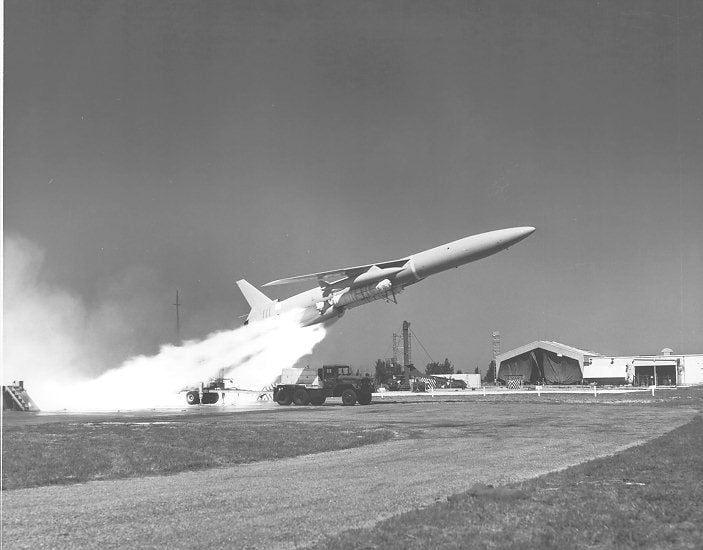
On 5 December 1956 the United States Air Force launched a nuclear-capable cruise missile from Cape Canaveral, sent it towards Puerto Rico, and then lost it.
Not lost as in crashed. Lost as in it kept flying, ignored every command including the self-destruct, outran the fighters scrambled to catch it, crossed the Caribbean, passed the coast of Venezuela and disappeared into the Amazon basin. Nobody has ever established where it came down.
The missile was called the Snark, after a creature in a Lewis Carroll poem that, when you finally catch it, may turn out to be something else entirely and cause you to vanish away. Somebody at Northrop had a sense of humour, and no idea how apt it would turn out to be.
Quick Facts
What it was: Northrop B-62, later SM-62 Snark — America’s first long-range nuclear cruise missile
Weight: About 48,000 lb
Launch: Two rocket boosters off a mobile platform, then turbojet cruise
Guidance: Inertial, corrected by a stellar tracker reading the stars
Operator: Strategic Air Command, 702nd Strategic Missile Wing, Presque Isle AFB, Maine
Declared operational: 28 February 1961
Deactivated: 25 June 1961 — under four months later
Before there were ICBMs, there was this
It is easy to forget how hard the intercontinental problem looked in the early 1950s. Rockets that could throw a warhead between continents did not yet exist. What did exist was aeroplanes, and the obvious idea was to build an aeroplane that flew itself all the way and did not come back.
So Northrop built one. The Snark was 48,000 lb of swept-wing, turbojet-powered aircraft with no cockpit and a thermonuclear warhead in the nose. Two solid rocket boosters shoved it off a wheeled launcher; the jet took it the rest of the way. Strategic Air Command pushed hard for it.
The hard part was never propulsion. It was knowing where you are. Over five thousand miles of open ocean with no landmarks and no satellite navigation, the Snark had to find a target using an inertial platform corrected by a stellar tracker — a device that looked up, found stars, and worked out the missile’s position from them. In 1955 this was close to science fiction, and it behaved like it.
Snark-infested waters
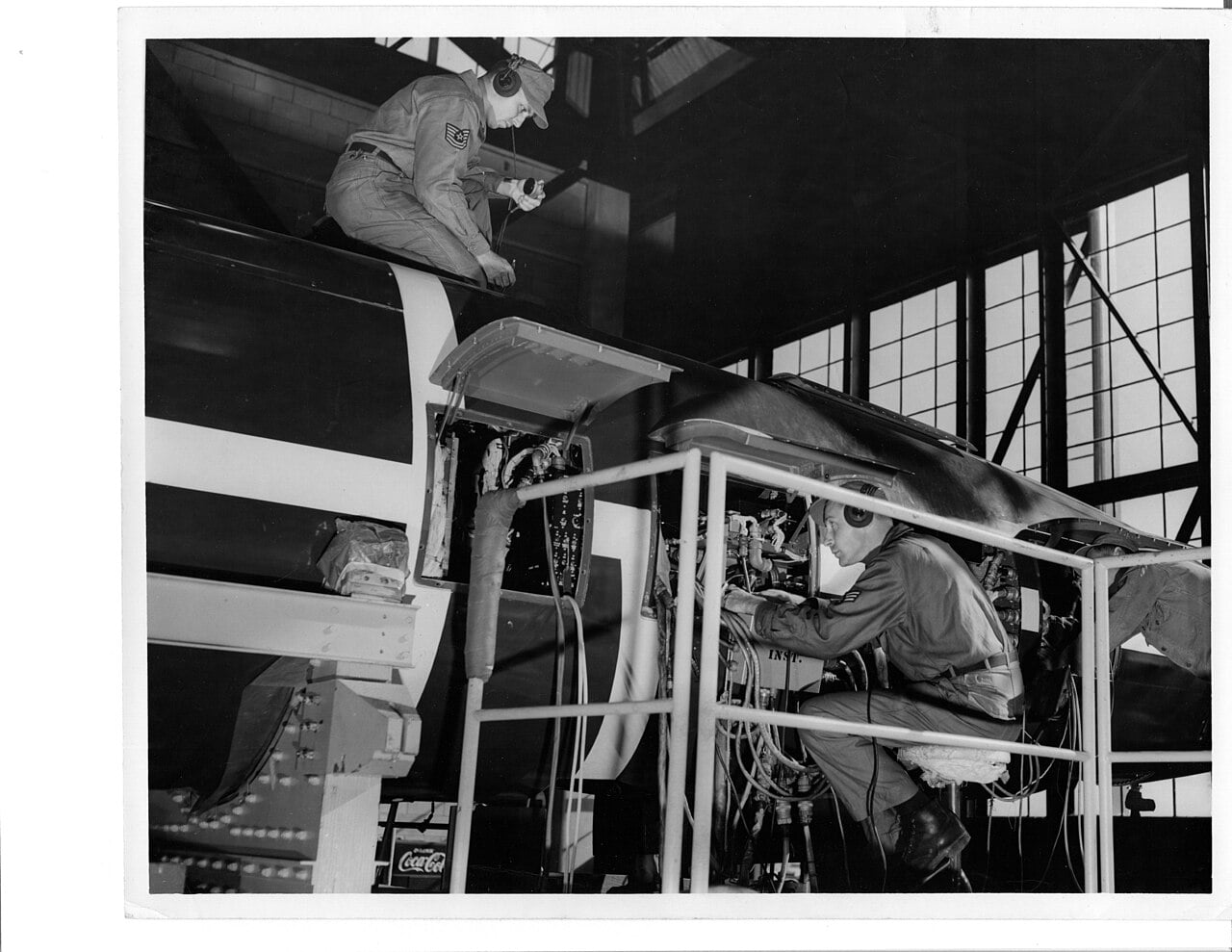
Testing began in New Mexico and moved to the Cape Canaveral Missile Test Annex, where it went badly in ways that are almost impressive.
The first Snark launched at the Cape crashed fifteen seconds after leaving the rail, because its drag chute deployed on the way up. The second refused steering commands five minutes into flight, went out of control and had to be destroyed.
Across 1954 and 1955, Northrop launched eleven Snark A and B models designed to be recovered and reused. The number recovered was zero.
The C models were deliberately flown into the Atlantic at the end of their runs. Between the ones that were ditched on purpose and the ones that went in by themselves, the stretch of ocean off the Eastern Test Range acquired a nickname among the people who worked there: Snark-infested waters.
It is one of the great pieces of engineering gallows humour, and it was entirely earned.
Period USAF film of the Snark programme, from the PeriscopeFilm archive.
The one that got away
The D model was the one with the Mk 1 inertial guidance system, and by late 1956 it was starting to work. Three flights had gone out southeast, turned around over Grand Turk and come home. The third had even landed back on a Cape runway on skids.
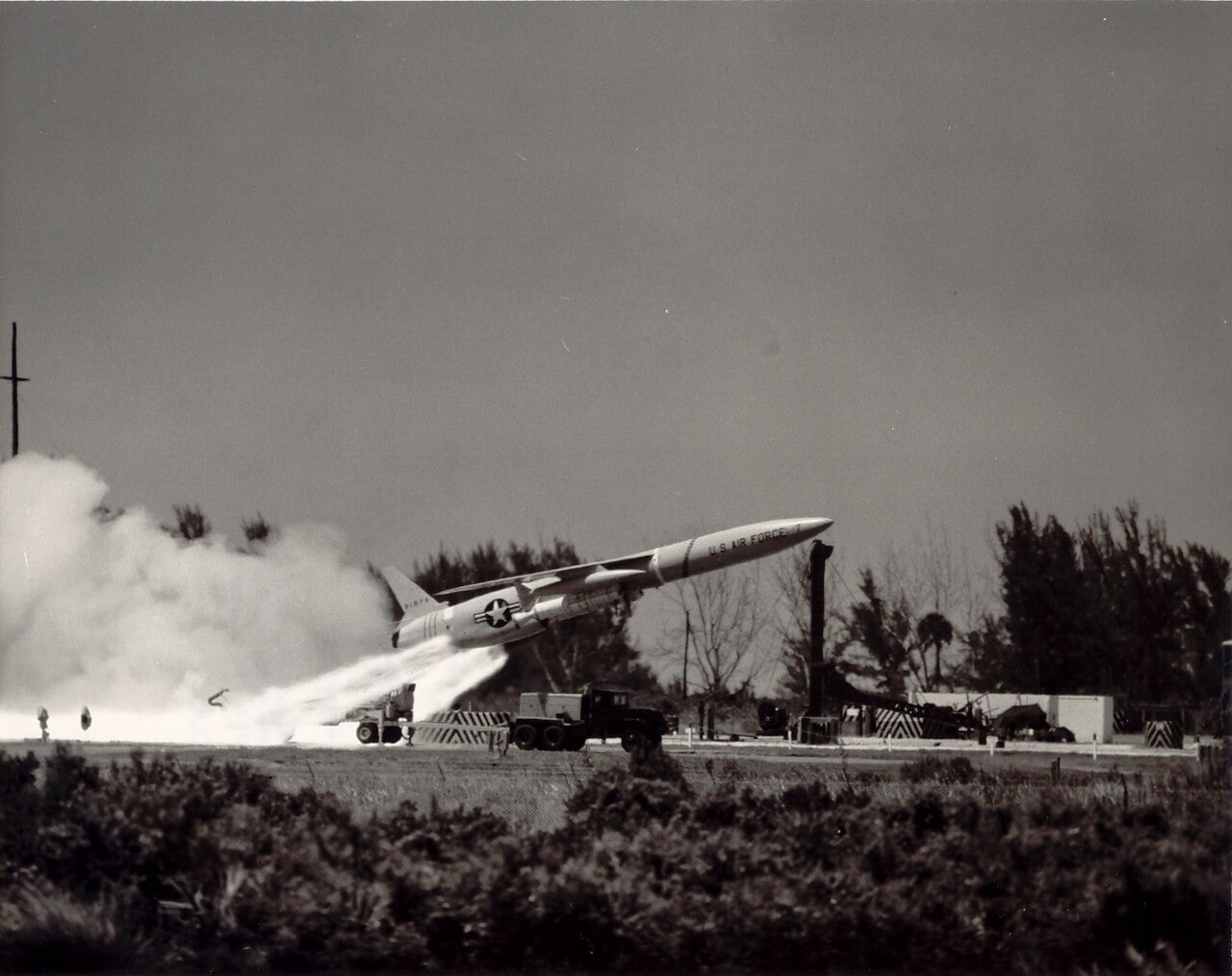
The fourth was Northrop airframe N-3309, USAF serial 53-8172. It launched from Launch Complex 1 on 5 December 1956 with orders to fly towards Puerto Rico, turn, and return.
It went out fine. Then the tracking radars showed it drifting right — eight miles off for every hundred miles flown. Then it stopped accepting commands.
By the time it reached Mayaguana in the Bahamas the range safety officer was told to terminate the flight. The destruct signals did nothing. Stations on Grand Turk, in the Dominican Republic, Puerto Rico and St Lucia were told to track it. Three of them got radar contact. The commands still did nothing.
Someone telephoned Ramey Air Force Base in Puerto Rico and asked for fighters. By the time they were airborne the Snark was gone.
At the last tracking station, according to an account by a man who worked on the range, the four console operators formed what witnesses described as a conga line and took turns marching past the range safety console, each stopping to stab at the destruct button. None of it made any difference.
Someone else rang the State Department, to warn them that a nuclear-capable cruise missile was heading for South America. The State Department’s response is not recorded.
The post-flight analysis found the cause, and it is beautifully mundane. The flight-termination system failed because the missile’s bus-bar voltage had dropped below the level needed to switch the destruct circuit over to its emergency battery. The self-destruct had not been disabled, or jammed, or sabotaged. It had simply run out of electricity. Later Snarks were given a second power bus.
The missile itself was last seen heading southeast over the Amazon. There are reports that a Brazilian farmer found it in the early 1980s, and another that hunters found it in Maranhão and a local television station filmed the wreck. The arithmetic argues against Maranhão: with a maximum range around 2,450 miles it could not have got that far, and would have come down in Amapá, near the border with French Guiana.
Nobody has produced the airframe.
It did work, eventually. Briefly.
The programme did get there. On 31 October 1957 a Snark flew from Florida to Ascension Island in the South Atlantic, making it the first American missile to achieve intercontinental range. On 18 March 1960 the 702nd Strategic Missile Wing put the first Snark on alert at Presque Isle, Maine, pointed across the pole at the Soviet Union.
The wing was declared operational on 28 February 1961.
One month later, on 28 March, President Kennedy’s special defence budget message directed the Snark be phased out. The reasoning was short and brutal: the weapon was obsolete and of marginal military value next to ballistic missiles, with low reliability, no ability to penetrate defences, no positive control, and launch sites that were vulnerable and unprotected.
On 25 June 1961 the 702nd was deactivated. The Snark had been an operational American nuclear weapon for under four months.
Why it matters
It would be easy to file the Snark as a punchline, and the nickname makes that tempting. The more interesting reading is that it was an entirely reasonable idea that arrived about fifty years early.
A subsonic, air-breathing, terrain-hugging cruise missile that navigates itself across an ocean and hits a target without a pilot is not a stupid concept. It is the Tomahawk. The difference is that the Tomahawk had TERCOM, digital computing, GPS and forty more years of miniaturisation, and the Snark had valves, gyroscopes that drifted, and a telescope looking for stars.
The Air Force gave up on the long-range cruise missile for two decades after this, then came back to it in the 1970s and has not stopped since. The Snark was not the wrong answer. It was the right answer, attempted with the wrong century’s electronics.
And somewhere under the canopy in northern Brazil, in all probability, it is still there.
Sources: J. P. Anderson, “The Day They Lost the Snark”, Air Force Magazine, December 2004; US Air Force historical records; Federation of American Scientists; CSIS Missile Threat; GlobalSecurity.org.
Further archive footage of the Snark in testing and on its launcher.
A compilation of USAF Snark material from the 1950s and 1960s.


0 Comments