
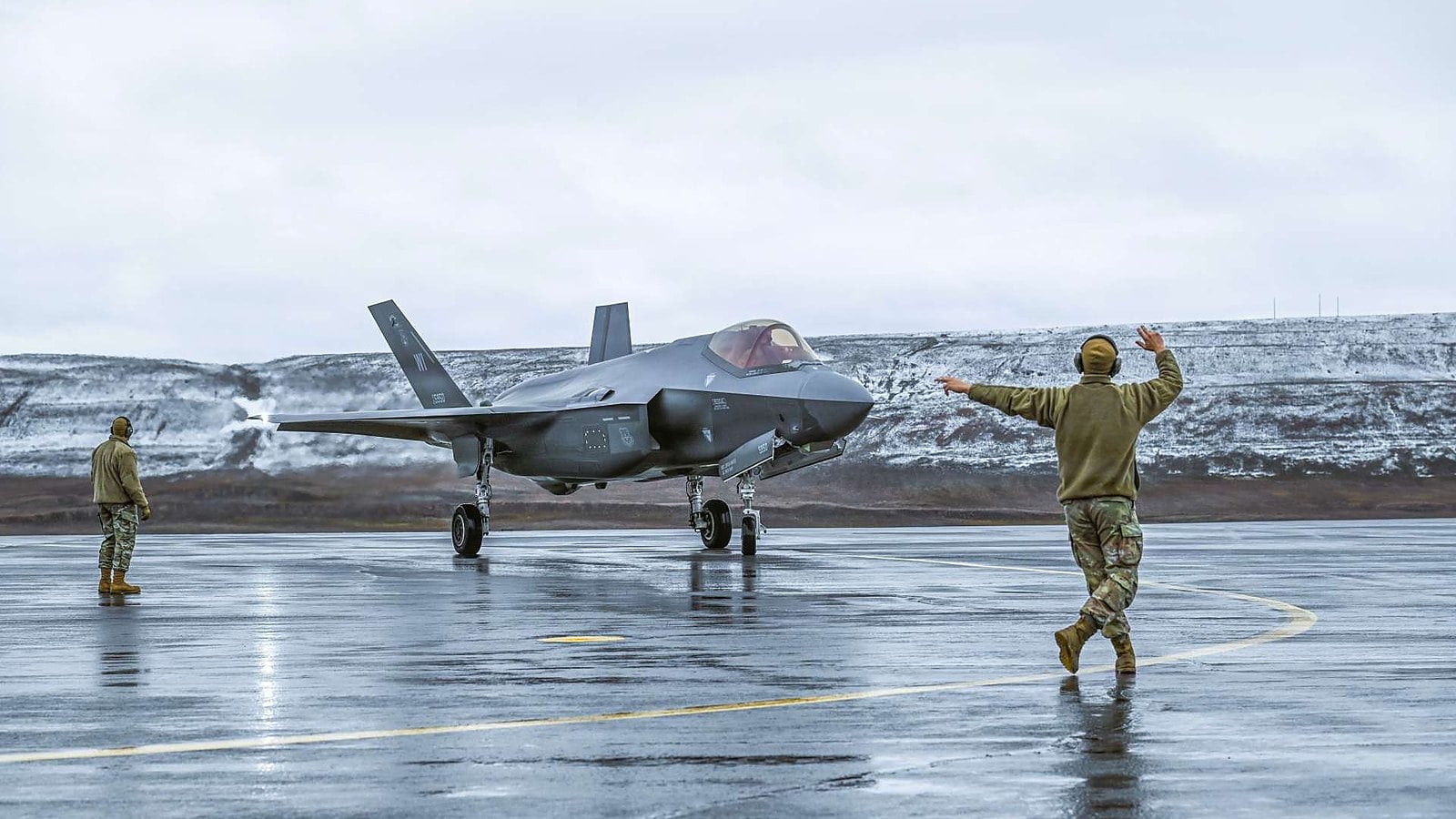
The ramp at Pituffik is wet, grey and running with meltwater. Behind it a ridge of bare rock streaked with old snow. A marshaller in olive fleece walks backwards with both arms up, and an F-35A Lightning II rolls towards him with WI stencilled on the tail. Wisconsin. Some 2,400 miles from its home field at Truax Field in Madison, and 690 miles north of the Arctic Circle.
On 16 September, U.S. Northern Command announced that those sorties had been flown successfully under Operation Arctic Vanguard. The headline is not that the jets got there. It is that they got there, were refuelled, inspected, maintained and launched again, repeatedly, from a base with almost nothing on it.
That distinction is the whole point. Anybody can stage a photo opportunity in the High North. Very few air forces can generate sorties from one.
Quick Facts
Operation: Arctic Vanguard, a recurring NORAD and U.S. Northern Command series in the North American Arctic
Announced: 16 September 2026 by U.S. Northern Command
Aircraft: F-35A Lightning II, Wisconsin Air National Guard 115th Fighter Wing
Location: Pituffik Space Base, northwestern Greenland, about 690 miles north of the Arctic Circle
Also deployed: Eielson AFB F-16s to Goose Bay, Newfoundland and Labrador, for Arctic Vanguard 26-4.2, 13 to 26 September
Framework: The NORAD and USNORTHCOM Nordic Bridge concept
Same week: Two Royal Danish Air Force F-35As landed at Kangerlussuaq on 16 September, a first for the type in Greenland
What Arctic Vanguard Actually Tested
Pituffik Space Base is the old Thule Air Base, renamed in 2023. It sits in northwestern Greenland and owns one of the very few runways in the High Arctic long enough for modern fighter operations. It is also not a fighter base. There is no resident squadron, no fighter maintenance complex, no deep spares bin.
So when the 115th Fighter Wing arrived, the test was logistical rather than tactical. Could the jets be received, serviced, armed, launched and recovered in a place where the weather turns fast, the supply line is measured in thousands of miles, and a part you forgot is not arriving this week? U.S. Northern Command says yes. Official imagery released through the Defense Visual Information Distribution Service on 10 September shows the aircraft taxiing while maintainers work the ramp around them.
There is a second reason the F-35A suits the job. Its radar, electro-optical sensors and data links let it work as a flying sensor node as well as a fighter, which matters over an area where ground radar coverage is thin and the geography is enormous. Pituffik already hosts the Upgraded Early Warning Radar operated by the 12th Space Warning Squadron. Parking a stealth fighter next to a strategic radar gives a commander something the radar alone cannot provide, which is the ability to go and look.
Eielson’s F-16s Took the Long Way Round
The F-35s were not the only jets moving. The Alaskan NORAD Region deployed F-16 Fighting Falcons from Eielson Air Force Base to Goose Bay, Newfoundland and Labrador, for Operation Arctic Vanguard 26-4.2, running 13 to 26 September, with Royal Canadian Air Force strategic airlift carrying the support tail.
Look at that on a map and it is faintly absurd. Combat aircraft from interior Alaska, flown across the whole width of Canada to the Atlantic coast, in order to work forward into Greenland. That is the demonstration: NORAD can pick up fighters on one side of the continent and put them to work on the other, in a region with no convenient diversion airfields and very little margin.
All of it sits under something called the Nordic Bridge concept, which is NORAD and U.S. Northern Command’s attempt to stop treating Arctic operations, exercises and investments as separate exercises that happen to occur in cold places, and start running them as one aligned programme with NATO and the regional partners.
The Same Week, Denmark Landed Its Own F-35s in Greenland
On the same day, a separate strand of Arctic flying produced a genuine first. Two Royal Danish Air Force F-35As touched down at Kangerlussuaq Airport in western Greenland, the first time the type has landed on the island. They flew from Keflavik in Iceland, as part of NATO’s Arctic Sentry activity, and they did not come alone.
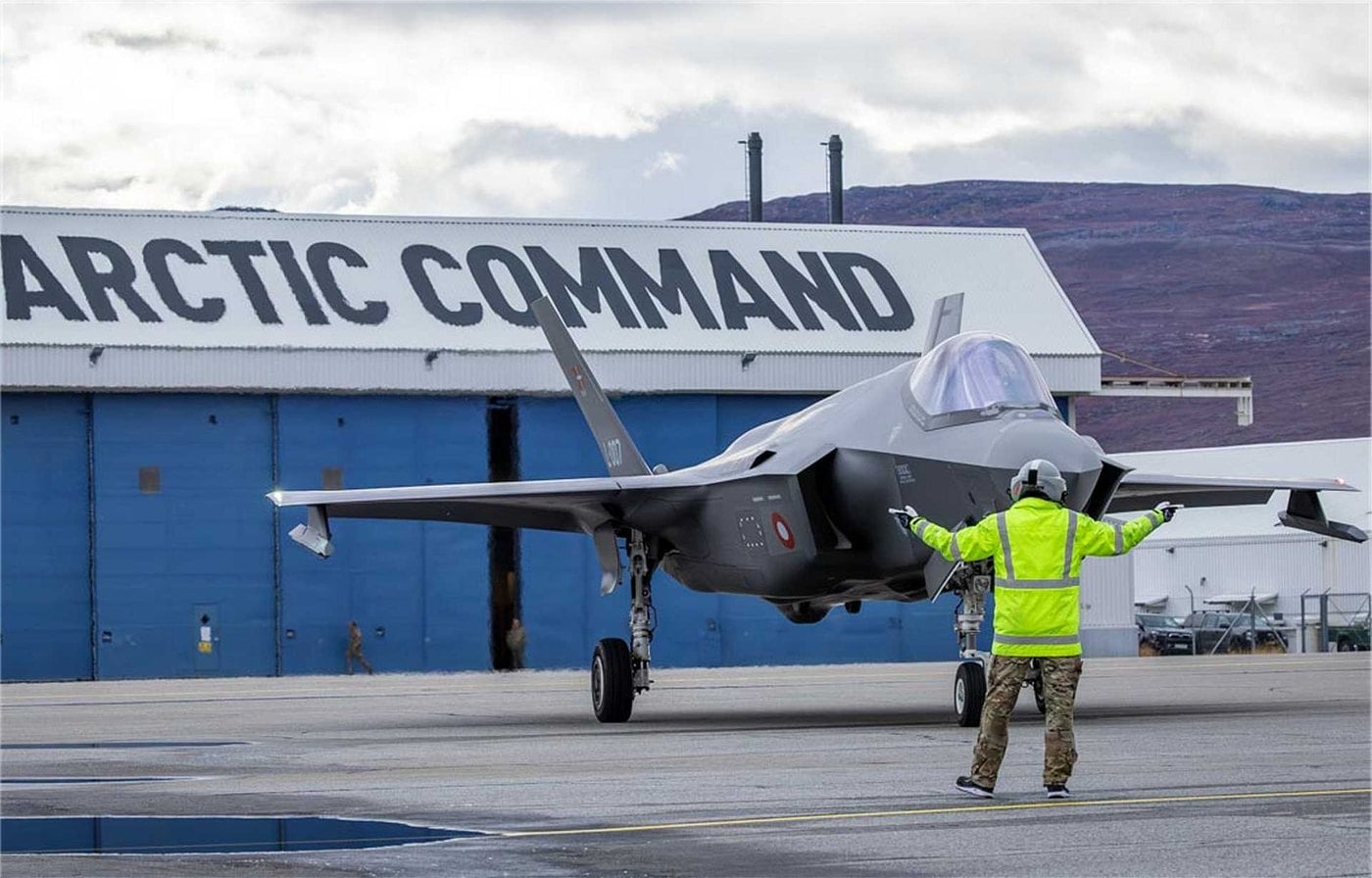
Four U.S. F-16s and two Canadian CF-18s flew in from Goose Bay to join them. A French MRTT tanker topped up the Danish jets out of Iceland. A NATO AWACS provided the airborne picture, and a Danish Challenger sat overhead for search and rescue, which in the Arctic is not a box-ticking exercise but a planning constraint that shapes the route, the fuel load and how long anybody can stay on station.
Add it up and five nations contributed to a single afternoon of flying over Greenland. No one of them supplied every piece. That is the actual capability being built here: not more fighters in the north, but a network in which fighters from one country can be refuelled by a second, controlled by a third and rescued by a fourth.
Why Greenland Keeps Coming Up
Greenland sits precisely where Europe’s Arctic meets the northern approaches to Canada and the United States. Anything coming over the pole passes near it. That was true when Thule was built in the early 1950s, and the map has not changed since.
What has changed is the level of attention. Russia keeps substantial air bases and long-range aviation across its Arctic territories, the region is busier than it has been in decades, and Greenland’s political status has been the subject of a good deal of loud commentary. The military answer to all of that is unglamorous: prove you can operate there, repeatedly, and let everyone watch you do it.
Landing a fighter in Greenland is a photograph. Generating sorties from Greenland for two weeks is a capability. September was about the second thing.
Background on Pituffik Space Base and its role in U.S. Arctic warning and surveillance.
Sources: U.S. Northern Command; NORAD release via DVIDS, 16 September 2026; Army Recognition; Air & Space Forces Magazine; Danish Armed Forces

0 Comments