
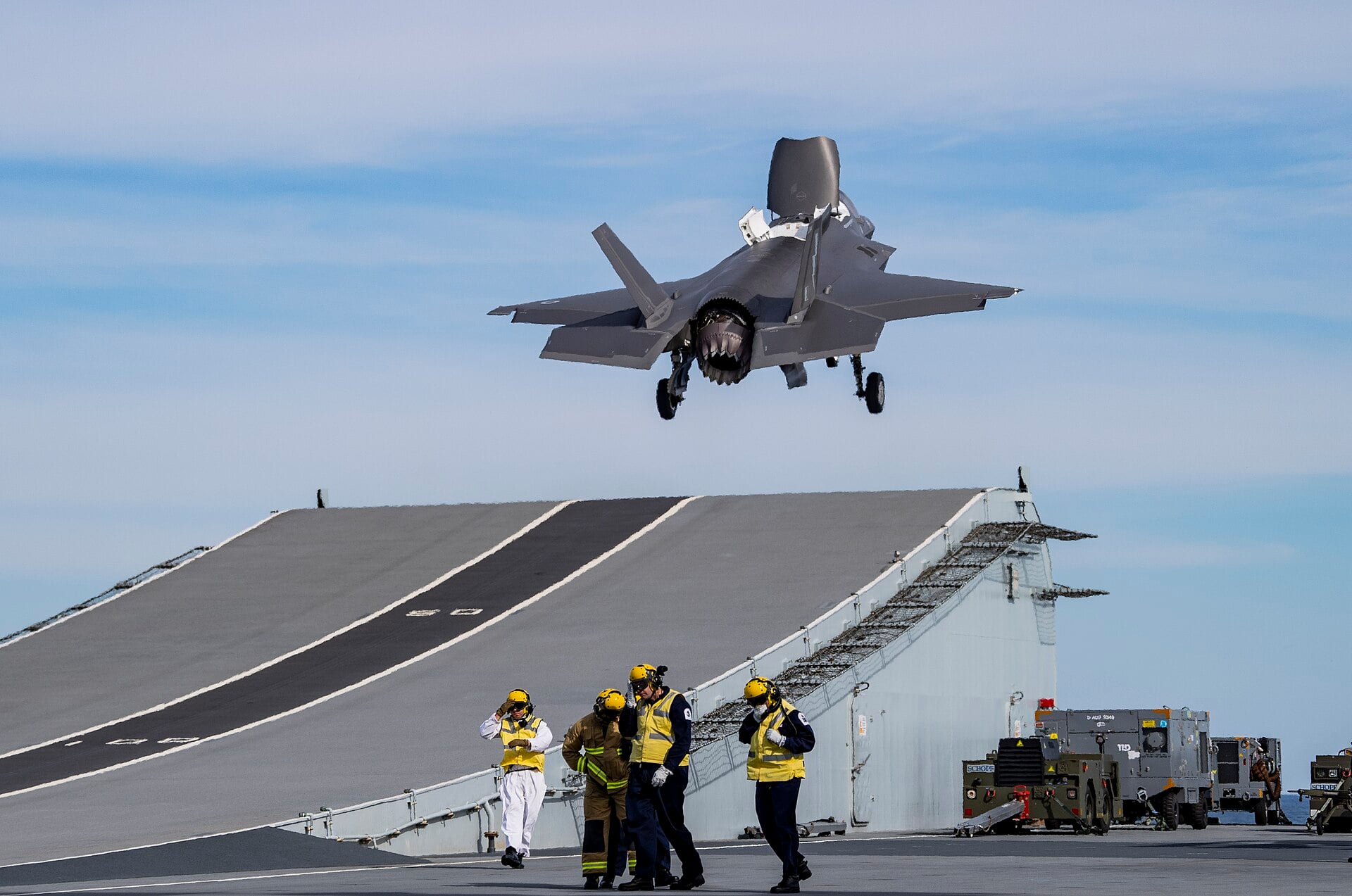
A carrier deck is about 300 metres long, and a loaded fighter needs something closer to a kilometre. That gap is the entire problem of naval aviation, and the world has settled on exactly two answers to it: throw the aeroplane, or tilt the end of the runway upwards.
The throw is the catapult. A shuttle in a slot in the deck grabs the nose gear and accelerates the aircraft to flying speed in two to four seconds. The tilt is the ski-jump, a curved steel ramp with no moving parts at all, which converts part of the aircraft’s forward motion into a positive rate of climb and buys it a few more seconds to accelerate while it is already airborne.
One costs a nuclear plant’s worth of steam or a small power station’s worth of electricity and a large team to run it. The other is a welded steel box structure bolted to the bow. Both work. They just buy you completely different navies.
Quick Facts
- CATOBAR: catapult-assisted take-off but arrested recovery. Operated today by the United States, France and China
- STOBAR: short take-off but arrested recovery. Ski-jump forward, wires aft. Russia, India, China’s Liaoning and Shandong
- STOVL: short take-off, vertical landing. Ski-jump forward, no wires at all. The Royal Navy, Italy, Spain, Turkey and others
- First naval catapult launch under way: Lt Cdr Henry Mustin, 5 November 1915
- Steam catapult: proposed by Cdr C. C. Mitchell RNVR, trialled on HMS Perseus from 1950, in US service on USS Hancock from 1954
- Modern steam catapult: the C-13-1 is 99 m long with a 94 m stroke and can throw 36 tonnes at 140 knots
- Ski-jump origin: a 1973 thesis by Lt Cdr Doug Taylor RN, first trialled at RAE Bedford on 5 August 1977
- Optimum ramp angle: 12 degrees, after HMS Invincible and HMS Illustrious were built with a conservative 7
- The trade: a ski-jump launch cannot match the payload a high-speed catapult shot allows
Three ways to leave a ship
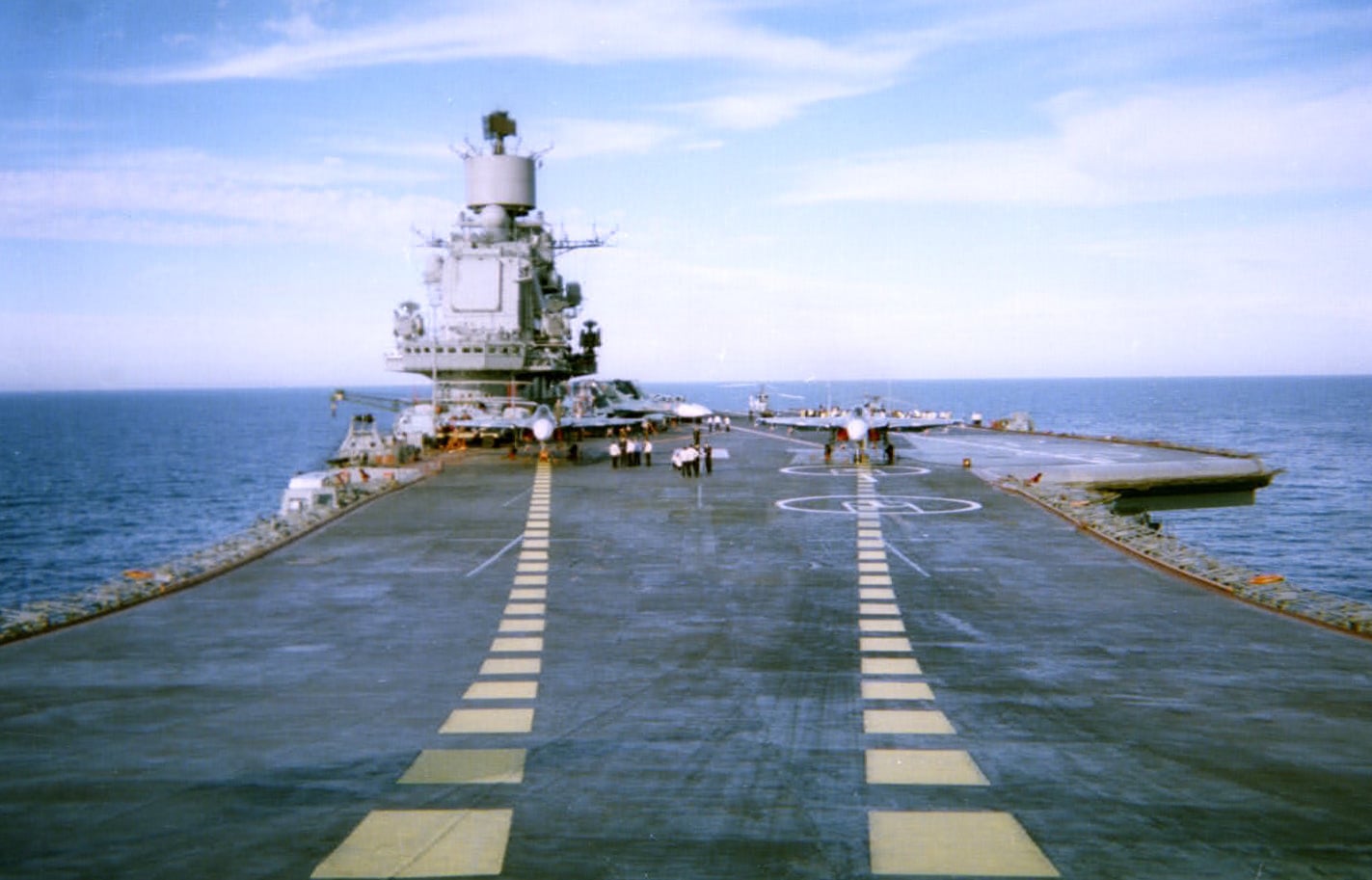
Naval aviation sorts itself into three acronyms. CATOBAR is catapult-assisted take-off but arrested recovery: shot off the bow, hooked on the way back. STOBAR is short take-off but arrested recovery: a conventional tailhook fighter rolls up a ramp under its own power and still catches a wire on landing. STOVL is short take-off, vertical landing: a thrust-vectoring aircraft uses the ramp to get off and then comes back and stops in mid-air.
The dividing line is money and industrial capability, not taste. Catapults are sophisticated, expensive and energy-hungry, and today exactly three countries operate CATOBAR carriers: the United States, France and China. Every other navy that flies fixed-wing aircraft from ships uses a ramp.
Look at a STOBAR deck and what is most striking is what is not there. No catapult slots. No jet blast deflectors rising out of the bow. No steam. Just deck, a curve at the front, and wires at the back.
The catapult: a century of hurling aeroplanes
Catapults are older than carriers. Samuel Langley used a spring catapult for his models and his failed 1903 Aerodrome, and the Wright brothers used a weight-and-derrick arrangement from 1904. The US Navy put Lt Theodore Ellyson on a compressed-air catapult at Annapolis on 31 July 1912, an attempt that nearly killed him when a crosswind pushed the aircraft into the water. He managed a successful launch from a stationary coal barge that November, and on 5 November 1915 Lt Cdr Henry Mustin made the first catapult launch from a ship under way.
Everything has been tried as the power source: weight and derrick, gunpowder, flywheels, compressed air, hydraulics, steam, and solid rocket boosters. USS Langley used compressed air, USS Lexington a flywheel, HMS Courageous hydraulics. A Martin MO-1 was fired off Langley by a gunpowder catapult in December 1924, a method that then spread to cruisers and battleships.
The modern answer came from Commander C. C. Mitchell of the Royal Naval Volunteer Reserve, who proposed a steam system using a slotted cylinder. The motive was British: Royal Navy ships were smaller than their American equivalents, so their catapult runs were shorter, and hydraulic catapults could not launch the new heavier jets. Trials on HMS Perseus from 1950, flown by pilots including Eric “Winkle” Brown, proved it. NATO navies adopted steam catapults based on the British design in the mid-1950s, the US Navy also driven by the need to launch nuclear-armed bombers such as the A-3 Skywarrior and by a fatal fire caused by flammable hydraulic fluid.
The ramp: a thesis nobody believed
The first known use of an angled ramp at sea was 1944, when a crude temporary wooden structure was fitted to HMS Furious so that Fairey Barracudas could stagger into the air carrying 1,600 lb armour-piercing bombs for Operation Tungsten, the attack on Tirpitz. A NACA study in 1952 proposed putting a curved ramp after the catapult to help departing aircraft still further.
The idea that mattered came in 1973. Lt Cdr Doug Taylor of the Royal Navy, studying at Southampton, was asked to write a thesis on a specific problem: the Harrier needed wind over the deck and roughly 299 metres of runway to launch with a full war load, and the Invincible-class through-deck cruisers then under construction had a 200-metre deck. His answer, a curved ramp, was initially met with scepticism. Hawker Siddeley at Kingston and the MoD then verified it with simulation and computer modelling.
The first ski-ramp trial was flown at RAE Bedford on 5 August 1977, more than a year before the first Sea Harrier flew. Within a year ramps had been tried between 6.5 and 20 degrees. HMS Invincible got a conservative 7 degrees, chosen partly so as not to interfere with the firing arcs of the adjacent Sea Dart launcher, and on 30 October 1980 test pilot Lt Cdr David Poole made the first Harrier ski-jump launch at sea. HMS Ark Royal was built with 12 degrees, which proved to be the optimum, and the first two ships were retrofitted. The Sea Dart system was eventually removed entirely.
What the ramp actually does
The aircraft does not fly off the ski-jump. It is thrown off it. Forward momentum is partly converted into vertical velocity by the curve, and the aircraft follows a semi-ballistic trajectory for a few hundred metres while the engines keep accelerating it. By the time the upward velocity has decayed to zero, the wings are doing enough work to hold it up. It never dips below the height of the flight deck.
That last point is the safety argument, and it is a bigger deal than the payload argument. A Harrier leaving a flat American amphibious deck starts flying at about 60 feet above the water and may not have a positive rate of climb, particularly if the ship pitched nose-down during the roll. Off a ramp it will certainly have a positive rate of climb, and momentum carries it to between 150 and 200 feet. If the engine fails during launch, the pilot has roughly three times as long to eject as he would off a flat deck.
The numbers from the 1988 trials are the ones that convinced people. A detachment of US Marine Corps AV-8B Harrier IIs flew from the Spanish carrier Príncipe de Asturias, and takeoff conditions that would have used all 750 feet of a Tarawa-class flight deck needed only 300 feet with the Spanish ship’s 12-degree ramp. The US Marine officer who wrote it up in Naval Aviation News called the improvement nothing short of amazing. The US Navy has still never fitted a ramp to an amphibious assault ship, reportedly because their operations mix helicopters and boats.
STOBAR: the hard version
Putting a conventional tailhook fighter up a ramp is the least forgiving of the three arrangements, and the launch procedure shows it. The pilot runs the engines up to full afterburner while standing on the brakes. Two panels rise out of the deck in front of the main gear to physically hold the aircraft in place. On the command, the brakes come off, the panels drop back into their slots, and the aircraft accelerates up the ramp at maximum thrust.
It works. A MiG-29 going over the ramp of a Kuznetsov-class carrier can be airborne at around 70 knots rather than the roughly 140 knots it would otherwise need, depending on weight and conditions. The Su-33, the MiG-29K and the Chinese J-15 all do this for a living.
The bill arrives in payload. A STOBAR fighter has only its own engines to get to flying speed, so it launches light: less fuel, fewer weapons, or both. Boeing has tested Super Hornet compatibility with Indian ski-jumps, but an aircraft designed around the catapult pays for a ramp launch with fuel or ordnance, and that narrows what the mission can be.
What the catapult buys, and what it costs
A catapult does not care about thrust-to-weight ratio. That is its entire advantage. Aircraft such as the E-2 Hawkeye and the S-3 Viking simply cannot do a rolling takeoff from a carrier deck, because their thrust-to-weight is too low, and without a catapult a carrier air wing loses its airborne early warning and its long-endurance types. Tactical aircraft launch heavier than they otherwise could. A C-13-1 catapult is 99 metres long with a 94-metre stroke and will throw 36 tonnes at 140 knots.
The price is size, complexity and manpower. Steam catapults need a steam plant, a lot of people, and constant maintenance. They also place brutal, abrupt loads on airframes. The electromagnetic answer, EMALS, uses a linear motor to apply gradual and continuous acceleration, which is gentler on the aircraft, offers more control, and is expected to need far less maintenance thanks to solid-state components. It went to sea on USS Gerald R. Ford in 2017, and China has developed a direct-current electromagnetic catapult for the carrier Fujian.
The Royal Navy’s decision is the clearest illustration of the trade. The Queen Elizabeth class was designed as an adaptable carrier, configured for STOVL but capable of being fitted with catapults and arrestor gear later. It was built with a ramp because an electromagnetic catapult was expected to be extremely expensive, and because the ships are electrically propelled by diesel and gas turbine generators and therefore have no way of raising steam for a conventional catapult at all.
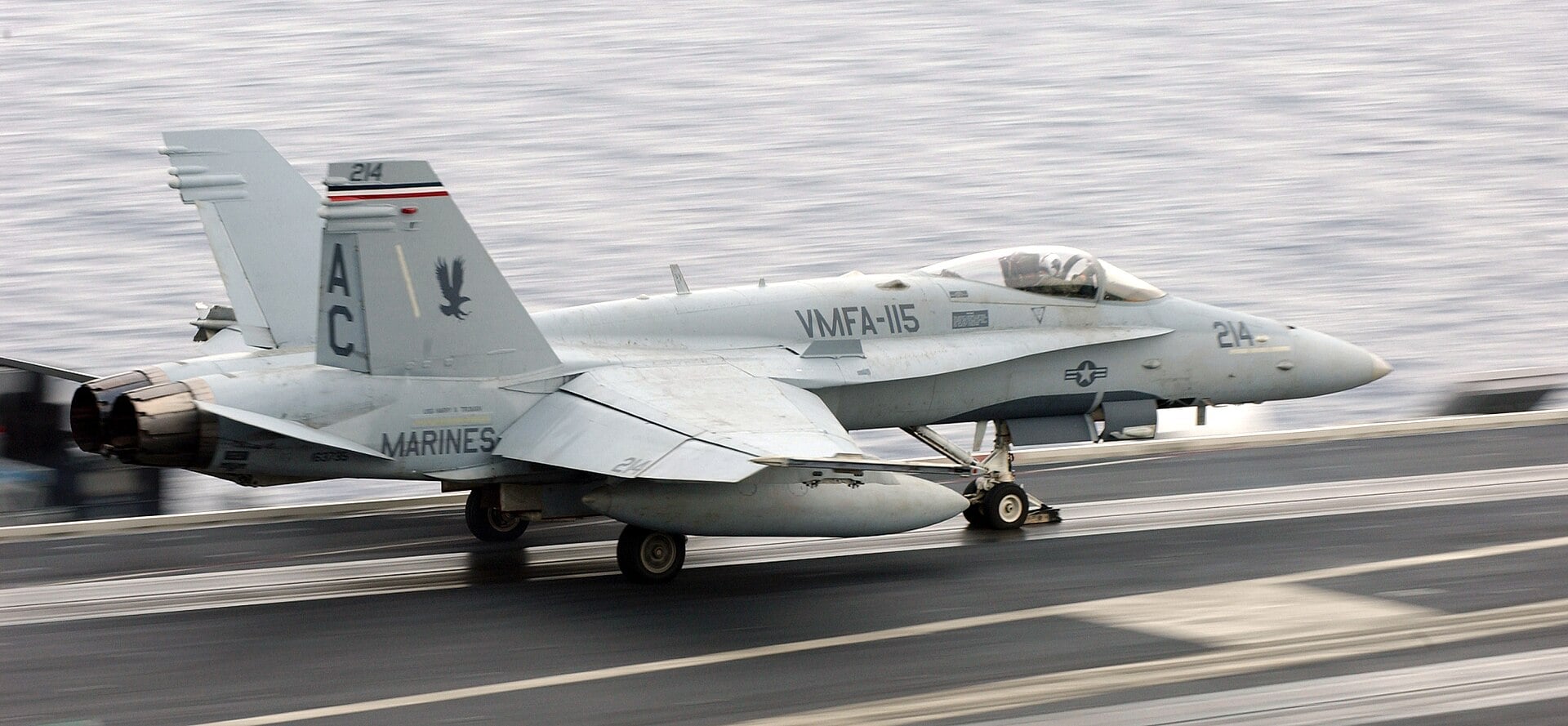
The physical experience at the sharp end is worth watching, because the numbers do not convey what two to four seconds of that acceleration looks like from the deck.
The F-35B and the modern ramp
The QEC ramp is a much more considered object than the Invincible-class one. It is a removable structure added to the forward flight deck rather than built into the bow, so that the ships can in principle be converted later. It was designed by BAE Systems with Lockheed Martin input rather than by the shipbuilders, and it has two subtle curves: a long cubic entry section leading into a second let-down or ellipse section where the aircraft leaves.
The tolerances matter more than they used to. On the Invincible class, small differences in ramp build quality turned out to affect Sea Harrier undercarriage life, because the original design assumed an absolutely smooth surface and minor ruts were enough to crack landing gear. The F-35B has a wide tricycle gear that is more sensitive to small bumps than the Harrier’s tandem arrangement, and the QEC deck is slightly cambered for water runoff, which complicates the join.
Trials began at Patuxent River in 2014 with simulation, on a purpose-built test ramp based on the CVS profile. The first F-35B ski-jump short take-off was flown on 19 June 2015 by BAE Systems test pilot Pete Wilson. By June 2016, 31 test launches had been made at speeds off the end of the ramp ranging from 65 to 95 knots, and a second phase of around 150 launches began in 2017 to explore overspeed and underspeed cases and external and asymmetric loads. When the first jet launched from HMS Queen Elizabeth on 25 September 2018, it was considered a very low-risk part of the programme, and 202 successful launches followed that autumn.
Getting back on is the other half
Launch is only half the argument, and recovery is where STOVL takes its own revenge on the catapult. A vertical landing throws away the lift the wings could be providing, which caps the maximum landing weight, which means a pilot coming home with unused missiles may have to dump them in the sea to get light enough. The British answer is the shipborne rolling vertical landing, developed by the UK team at Patuxent River: combine the vertical landing with a rolling one, keep some wing lift, and bring the weapons home.
None of this makes one system the winner. A catapult buys payload, heavy support aircraft and a full-size air wing, at the cost of a very large, very expensive ship and the people to run it. A ramp buys a smaller, cheaper, simpler ship that can still put fifth-generation fighters over a target, at the cost of what each of those fighters can carry when it leaves.
Which is why the map looks the way it does. Three navies throw their aeroplanes. Everybody else tilts the end of the runway.
Sources: Wikipedia (Ski-jump (aviation); Aircraft catapult), Navy Lookout, “Royal Navy aircraft carrier ski jumps – a history”, Live Science on the first F-35B ski-jump take-off, and The Register’s 2018 interview with Sqn Ldr Andy Edgell.
0 Comments