
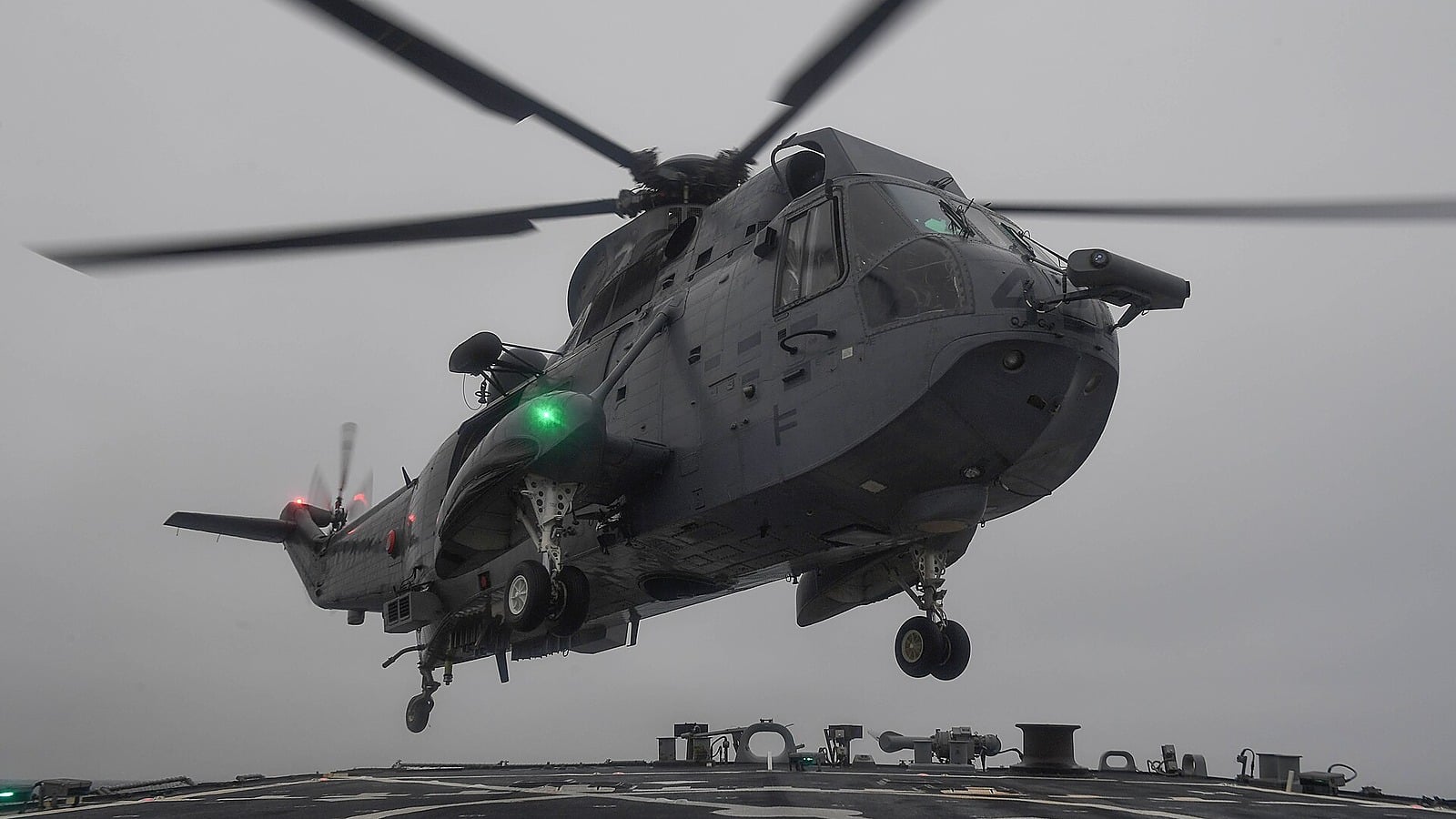
The flight deck of a destroyer escort is roughly the size of a tennis court. In a North Atlantic winter it does not hold still. It rolls through thirty degrees, pitches through eight, and rises and falls a distance best measured in storeys. Now put a nine-and-a-half-ton helicopter on it. At night. Without breaking either one.
For most of the 1950s the honest answer was that you could not. Navies flew helicopters from aircraft carriers, which are large and comparatively steady, and from airfields ashore. A destroyer got a hull-mounted sonar and hoped. The machine that could actually chase a fast nuclear submarine — big, heavy, carrying radar and a dipping sonar and the fuel to stay out for hours — was too much aircraft for a small ship, because nobody had solved the last thirty seconds of the flight.
Canada solved it. The device was engineered at Dartmouth, Nova Scotia, proven off Halifax, and it is the reason a frigate almost anywhere in the world can operate a ten-tonne helicopter today in weather that would once have kept it lashed down in the hangar. The Royal Canadian Air Force calls it Canada’s greatest contribution to the advancement of naval aviation. Its name is the Beartrap.
Quick Facts
- Proper name: Helicopter Hauldown and Rapid Securing Device (HHRSD)
- Developed by: VX 10, the Royal Canadian Navy’s experimental squadron at Shearwater, with Fairey Aviation of Canada, Dartmouth, Nova Scotia
- Engineering development: 1956 to 1962; feasibility demonstrated January 1963
- First hauldown landing: HMCS Assiniboine, 3 December 1963
- First ship operationally ready: HMCS Nipigon, 1967
- Aircraft: Sikorsky CHSS-2 Sea King, later CH-124, about nine and a half tons
- Winch: 60 hp electric motor driving a hydraulic pump; 3,000 psi operating, 4,000 psi rated; constant-tension control
- Securing device: Six-foot square, two beams of spring-loaded steel teeth, fired pneumatically
- Ship motion allowed: Roughly 31 degrees of roll and 8 of pitch, day or night
- Approach to secured: About five minutes
- Adopted by: United States (as RAST), Australia, Japan; the Royal Navy took up the hauldown principle
The last thirty seconds
The difficulty is not hovering over a moving deck. A competent pilot can hold station over a ship all day. The difficulty is the moment of contact, and the minutes after it.
A helicopter landing on a pitching deck arrives with its wheels touching a surface that is accelerating upwards or falling away. Touch down as the stern drops and the aircraft falls after it. Touch down as the stern rises and the deck comes up to meet the undercarriage with real force. Worse, the instant the wheels are down the helicopter stops being an aircraft and becomes nine tons of top-heavy cargo on a wet steel plate that is tilting. Rotor lift is bleeding away. Nothing is holding it. On a carrier there is deck space and a large crew. On a destroyer there is neither.
Then there is what comes next. Even a secured helicopter has to be moved into a hangar barely larger than itself, on a deck that is still rolling, by people working within a few feet of a spinning tail rotor. Every navy that tried it in the 1950s came to the same conclusion: the manual handling was more dangerous than the landing.
A walkthrough of the hauldown problem and the Canadian answer to it.
Shearwater’s answer
The work was done by VX 10, the Royal Canadian Navy’s experimental squadron at Shearwater on the Nova Scotia coast, with the engineering carried out by Fairey Aviation of Canada at Dartmouth, a few minutes up the road. It was not a quick programme. The initial experimentation and engineering development ran from 1956 to 1962, six years of work on a problem with no precedent, using trial flight decks bolted to the frigate HMCS Buckingham and the destroyer escort HMCS Ottawa.
Roll-damping fins were tried and found insufficient. An early version of the device had no hauldown cable at all, and the trials showed why one was needed: without a positive downward pull, a pilot has no way of knowing he is over the right square foot of deck, and nothing stops the aircraft drifting in the instant before touchdown.
By January 1963 VX 10 had demonstrated that a Sea King could be landed on a small destroyer. HMCS Assiniboine went through a conversion at Victoria Machinery Depot during 1962 and 1963 that turned her into a destroyer helicopter escort — reclassed DDH 234 on 28 June 1963 — and she came out of the yard with the redesigned Beartrap installed.
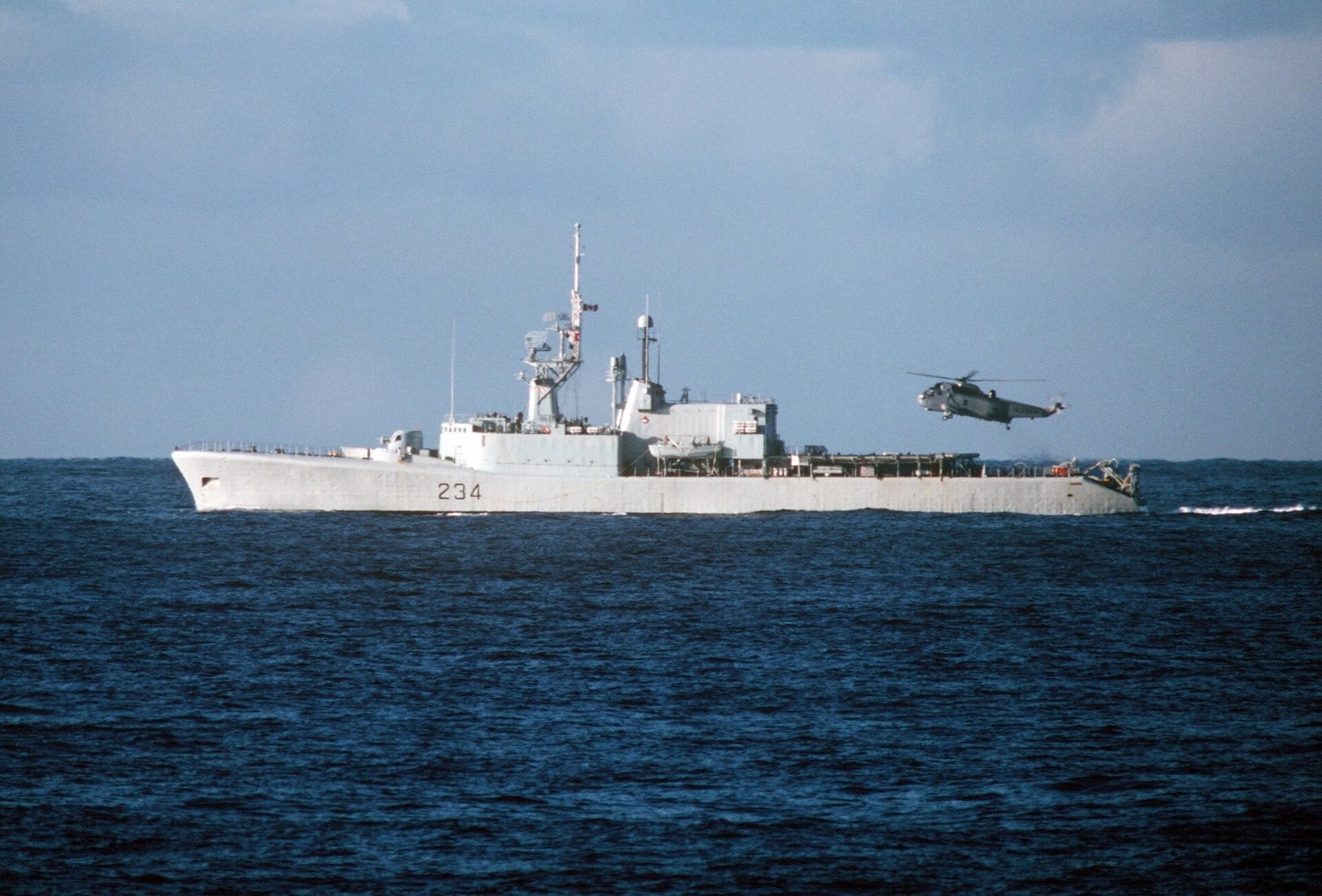
How it actually works
The sequence is worth walking through slowly, because the elegance is in the order of operations.
The helicopter comes to the hover about fifty feet above the stern. A crewman lowers a thin wire messenger cable through a tube in the aircraft’s belly. On deck, a handler catches it with grounded tongs — a helicopter in the hover builds a static charge that will knock a man off his feet — and shackles it to a much heavier hauldown cable running to a winch below deck.
The messenger is then reeled back up, pulling the main cable into the helicopter, where pins inside the probe lock it in place. Microswitches sense the lock, release the messenger and stop the winch. The aircraft is now tethered to the ship.
This is the part that makes the whole thing work. The winch does not simply pull. A 60-horsepower electric motor drives a hydraulic pump, running the system at 3,000 psi against a 4,000 psi rating, and a constant-tension control compares the actual cable tension against a set value many times a second, paying cable out or hauling it in to hold that tension as the ship moves beneath. The helicopter is not being dragged down. It is being held, firmly and continuously, against a point on a deck that will not stay still.
What the pilot feels is a steady centring force. He no longer has to guess where the deck is. He flies the aircraft down the cable.
At touchdown the Beartrap itself takes over. The rapid securing device is a six-foot square in the middle of the landing spot, containing two parallel beams fitted with steel, spring-loaded teeth. They fire pneumatically and clamp onto the main probe under the helicopter’s belly, locking it against movement fore and aft and port and starboard. A second probe forward of the tail wheel comes down onto a grid and secures the tail.
The aircraft is now bolted to the ship. And because the whole six-foot unit runs on rails down the centreline of the flight deck, it can then drag the helicopter straight into the hangar without a single person laying a hand on it. Start to finish, approach to secured, takes about five minutes.
The published operating limits tell you what that bought: roughly 31 degrees of roll and 8 of pitch, day or night. Sources differ slightly on the exact figures — some give the clearance as sea state 6 with 30 degrees of roll and 9 of pitch — but the order of magnitude is not in dispute. It is weather in which the unaided answer had always been no.
3 December 1963
Two dates from that winter get confused, and they are different events.
On 27 November 1963 a production Sea King made the first operational landing on a destroyer’s deck, using Assiniboine’s new platform. That was the aeroplane proving it could be done at all.
On 3 December 1963, on the same ship, came the first hauldown landing. That was the system proving it.
Assiniboine then spent the best part of two years deliberately looking for bad weather, which off Nova Scotia in winter is not a difficult search. Day trials finished in the summer of 1964, and VX 10 went back out to do it in the dark. By the middle of 1964 the system was judged a success. Refinement continued with HMCS Annapolis as a second trials ship, and in 1967 every design change VX 10 considered essential was built into HMCS Nipigon, making her the first helicopter-carrying destroyer anywhere to be declared operationally ready with the system.
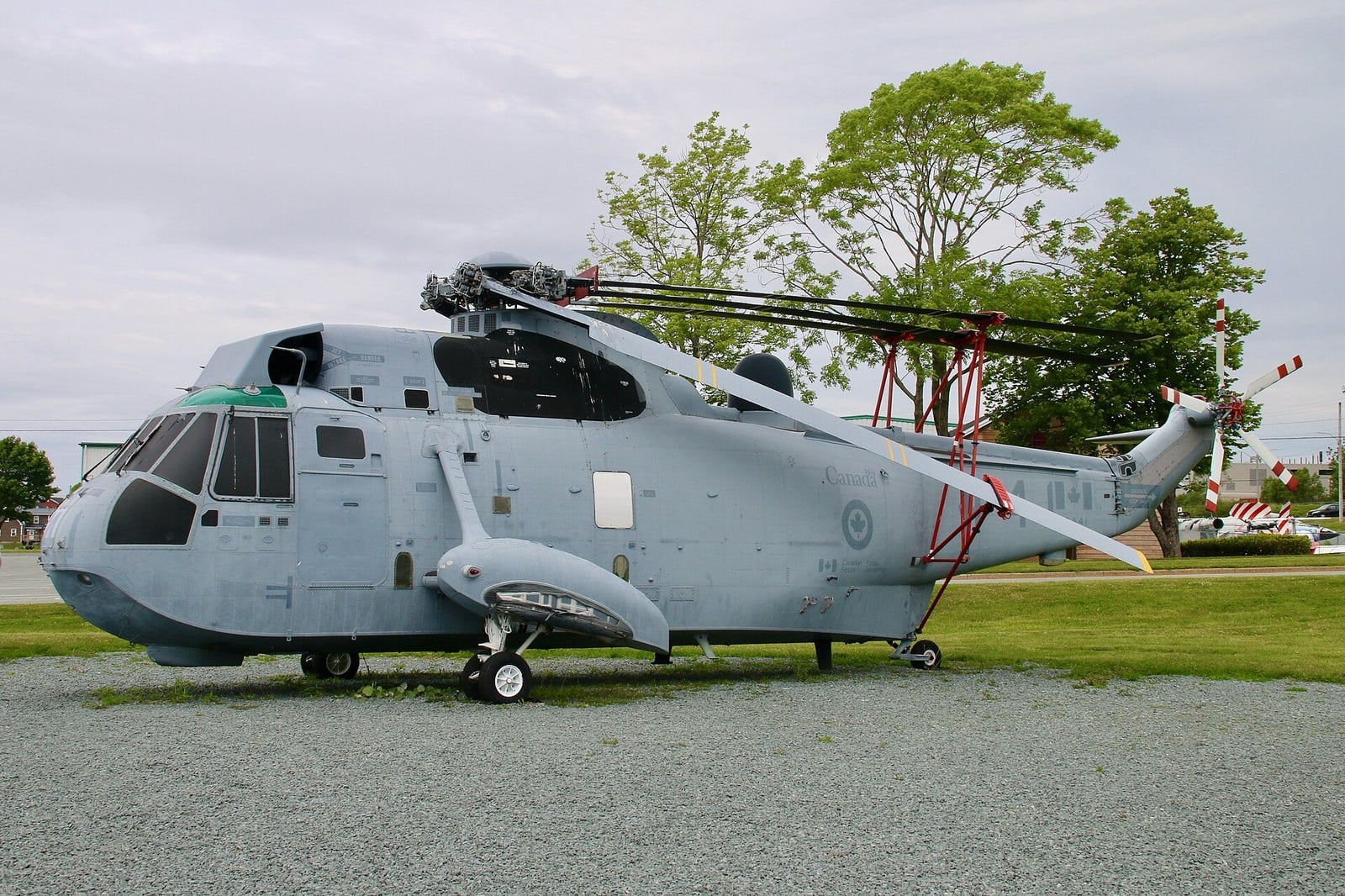
The Royal Canadian Air Force’s own film on the Sea King, the aircraft the Beartrap was built around.
The invention Canada gave away
The Beartrap did what good engineering does: it stopped being remarkable and became the way things are done.
The United States Navy adopted the principle as RAST — Recovery Assist, Secure and Traverse — built by Indal Technologies, and it is what puts an SH-60 Seahawk on the back of a destroyer today. Australia and Japan took it up. The Royal Navy adopted the hauldown approach. In Canada it went into every helicopter-carrying destroyer and, later, every Halifax-class frigate.
There is a lesson in the timing that Canadians tend to note with some feeling. The Beartrap was conceived, engineered and proven by a navy that, four years after Nipigon was declared operational, no longer existed as a separate service. Unification on 1 February 1968 folded the Royal Canadian Navy into the Canadian Armed Forces, and its Fleet Air Arm went with it. The Sea Kings passed to Maritime Command. The device stayed, and spread, and the ships that carry its descendants fly flags that are not Canadian.
The Sea King itself flew on in Canadian service until 2018 — fifty-five years, one of the longest careers of any military aircraft anywhere, and a procurement story that Canadians discuss through gritted teeth. But the machine was only ever half of it. The other half was a winch, a cable and a set of spring-loaded steel teeth, built in a shop in Dartmouth by people solving a problem nobody else had solved.
What it looks like when the sea is not cooperating: a CH-124 recovering to a deck in heavy weather.
Sources: Royal Canadian Air Force (Maple Leaf), Colonel (ret’d) Ernie Cable / Shearwater Aviation Museum, The Canadian Encyclopedia, The Crowsnest (Royal Canadian Navy, March–April 1965), Skies Magazine, Radio Research Paper archive.
0 Comments