
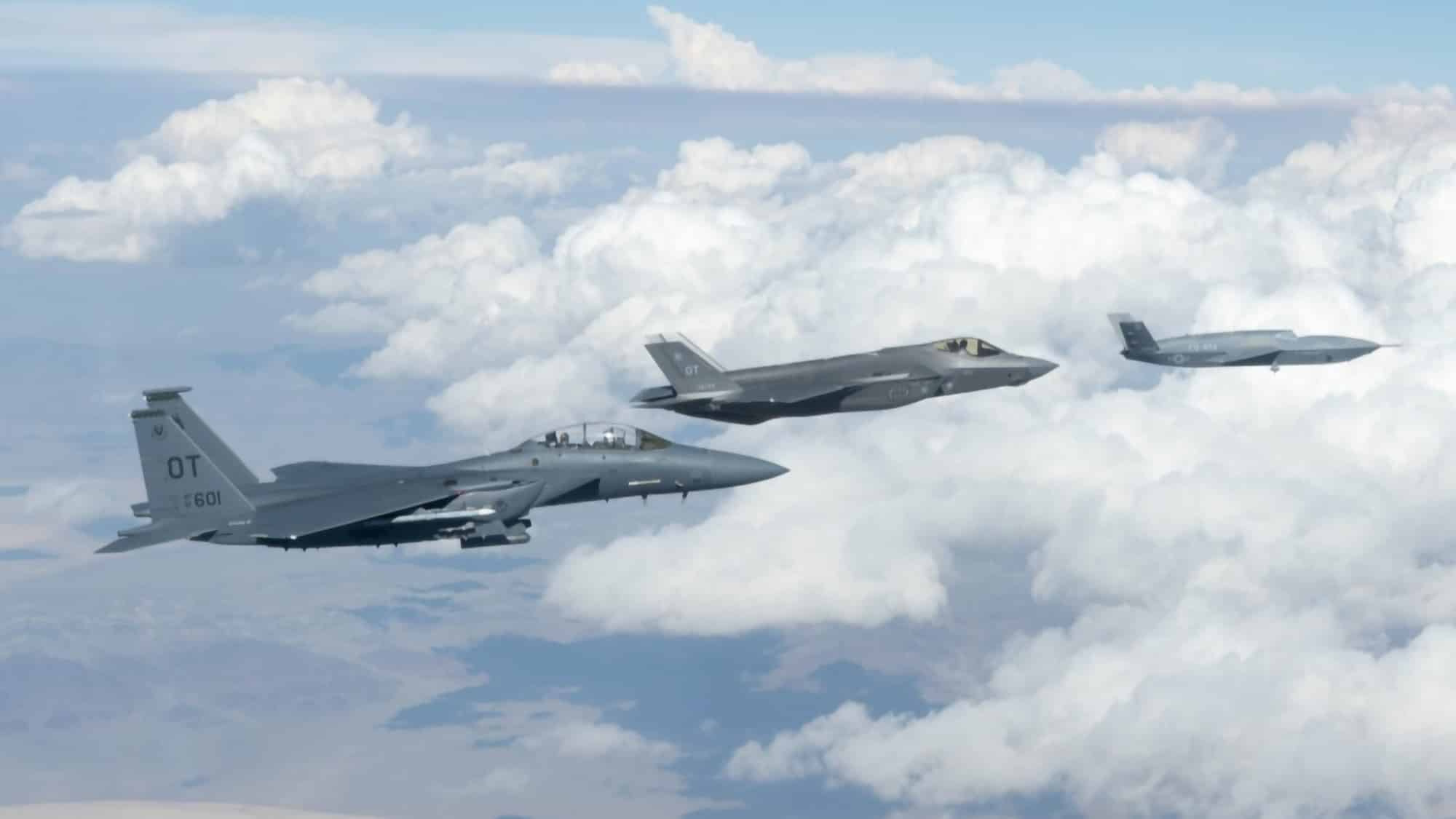
Three aircraft, one photograph. On the left, an F-15E Strike Eagle in Nellis test markings, tail code OT. In the middle, an F-35A. On the right, something with no cockpit, no canopy, no pilot: a General Atomics FQ-42 Vengeance, sitting in formation as though it belonged there.
GA-ASI released the image on Monday. It is the first time the company has shown its collaborative combat aircraft flying alongside crewed American fighters, and it is the sort of picture that does more work than a press release ever could. For thirty years the standard photograph of air power has been a formation of fighters. This is that photograph with one of the seats removed.
It also needs a careful caption, because what it shows and what people will assume it shows are two different things.
Quick Facts
| What was released | A GA-ASI photograph of an FQ-42 Vengeance flying in formation with an F-35A and an F-15E |
| When released | Monday 21 September 2026 |
| When flown | Not disclosed by GA-ASI; likely during summer 2026 |
| Where the aircraft live | Creech Air Force Base, Nevada, with the USAF Experimental Operations Unit |
| Manufacturer | General Atomics Aeronautical Systems (GA-ASI) |
| Sibling aircraft | FQ-44 Fury, built by Anduril |
| First flight | YFQ-42 prototype, 27 August 2025 |
| USAF target | 500 collaborative combat aircraft by 2032, 1,000 by the end of the decade |
Flying alongside is not the same as being commanded
This is the distinction that gets lost every time one of these photographs appears, and it matters more than any airframe detail.
The FQ-42 in that formation was not being tasked by the F-35. Both the Vengeance and Anduril's FQ-44 Fury are currently flying on their own mission autonomy systems, sharing the battlespace with crewed fighters, other CCAs and other traffic. What the photograph shows is coexistence: an uncrewed aircraft holding station safely in the same piece of sky as two manned fighters, which is itself far from trivial.
The collaborative part, where a pilot in an F-35 assigns a task and an uncrewed wingman executes it, is the next step. It requires hardware and software that are still being tested. Anduril has said the first live-flight demonstrations are expected within weeks or months. Until then, these are two aircraft flying near each other very competently.
The photograph came attached to a more prosaic announcement: a new FQ-42 had been delivered to Creech Air Force Base in Nevada on 18 September. Both types now live there, working with the Air Force's Experimental Operations Unit, and GA-ASI's vice president of advanced programs was in no mood to undersell the pace.

What the Vengeance actually is
The FQ-42A is built for semi-autonomous air-to-air work, and it descends from the XQ-67A Off-Board Sensing Station by way of an approach GA-ASI calls “genus-species”: a common chassis, different missions bolted on top. The company describes it as a fifth-generation uncrewed fighter with an internal weapons bay and features designed for low observability.
Put the XQ-67 and the YFQ-42 side by side and the changes are all about the radar return. The engine air inlet gained serrated edges, a treatment familiar from the B-2 Spirit. The shovel-shaped nose of the XQ-67 became something more conventional. The wings picked up more sweep, more taper and more area. The V-tails kept a similar angle but got shorter, more sharply tapered, and lost their clipped tips.
The other half of the aircraft is the autonomy core, which has been refined across more than five years of flying on the MQ-20 Avenger as a surrogate. That is the part that will eventually let an F-35 Lightning II pilot say “go look at that” and have it happen.
Four flying, one lost
The first YFQ-42 flew on 27 August 2025. A second followed on 31 October. GA-ASI has not published a fleet count, but at least four airframes are visible in recent photography, and one was lost in an incident in April 2026. For a programme moving this fast, on an aircraft deliberately designed to be affordable enough to risk, that is roughly the attrition you would expect.
The names settled recently too. The Air Force confirmed Anduril's internal name Fury for the FQ-44, but overruled GA-ASI on the FQ-42, discarding “Dark Merlin” in favour of Vengeance. Secretary of the Air Force Troy Meink, announcing them, also raised the numbers: 500 collaborative combat aircraft by 2032, out of 1,000 planned by the end of the decade. Earlier this summer the stated goal had been “over 150 combat capable CCA by the end of the decade”.
That is not a revised estimate. That is a tripling of ambition inside a single year.
Why this photograph, now
Anduril did the same thing a week earlier. During the Air, Space & Cyber Conference it released a picture of an FQ-44 Fury prototype flying alongside an F-35, and noted that the flight had taken place during an exercise in July. GA-ASI has not dated its own formation flight, though the same summer is the obvious guess.
Two competitors releasing near-identical images within a week of each other is not a coincidence, and it is not really aimed at aviation enthusiasts. It is aimed at the people who write budgets. A photograph of an uncrewed aircraft holding formation with an F-35 is the most economical possible argument that this programme is real, flying and worth another tranche.
It works, too. Whatever you think of the strategy, the picture is genuinely startling if you grew up on fighter formations. The Vengeance is smaller than the manned aircraft, cleaner, and entirely blank where a canopy should be.
The bit that still has to be proved
Everything shown so far is the easy half. Making an uncrewed aircraft fly safely near manned fighters is an engineering problem with a known shape. Making a pilot with a helmet full of information hand a task to an autonomous wingman, in a fight, under time pressure, and trust the result, is a different order of problem, and no photograph settles it.
The Air Force has been laying groundwork elsewhere. In August it evaluated Portable Command and Control Enclave ground stations for CCAs at Springfield Air National Guard Base, hosted by the Ohio Air National Guard's 178th Wing, with the aim of controlling these aircraft from austere locations rather than fixed facilities.
Production contracts for both types came months ahead of schedule this summer, and both designs dropped the “Y” prefix that marked them as prototypes. They are no longer experiments. They are aircraft the Air Force intends to buy by the hundred, and the next photograph anyone wants to see is the one where the F-35 is giving the orders.
TWZ interviews General Atomics about the FQ-42 Vengeance at the Air, Space & Cyber Conference, September 2026.
Sources: General Atomics Aeronautical Systems, The Aviationist, TWZ, Air Force Times, the US Air Force, Air Force Life Cycle Management Center.

0 Comments