
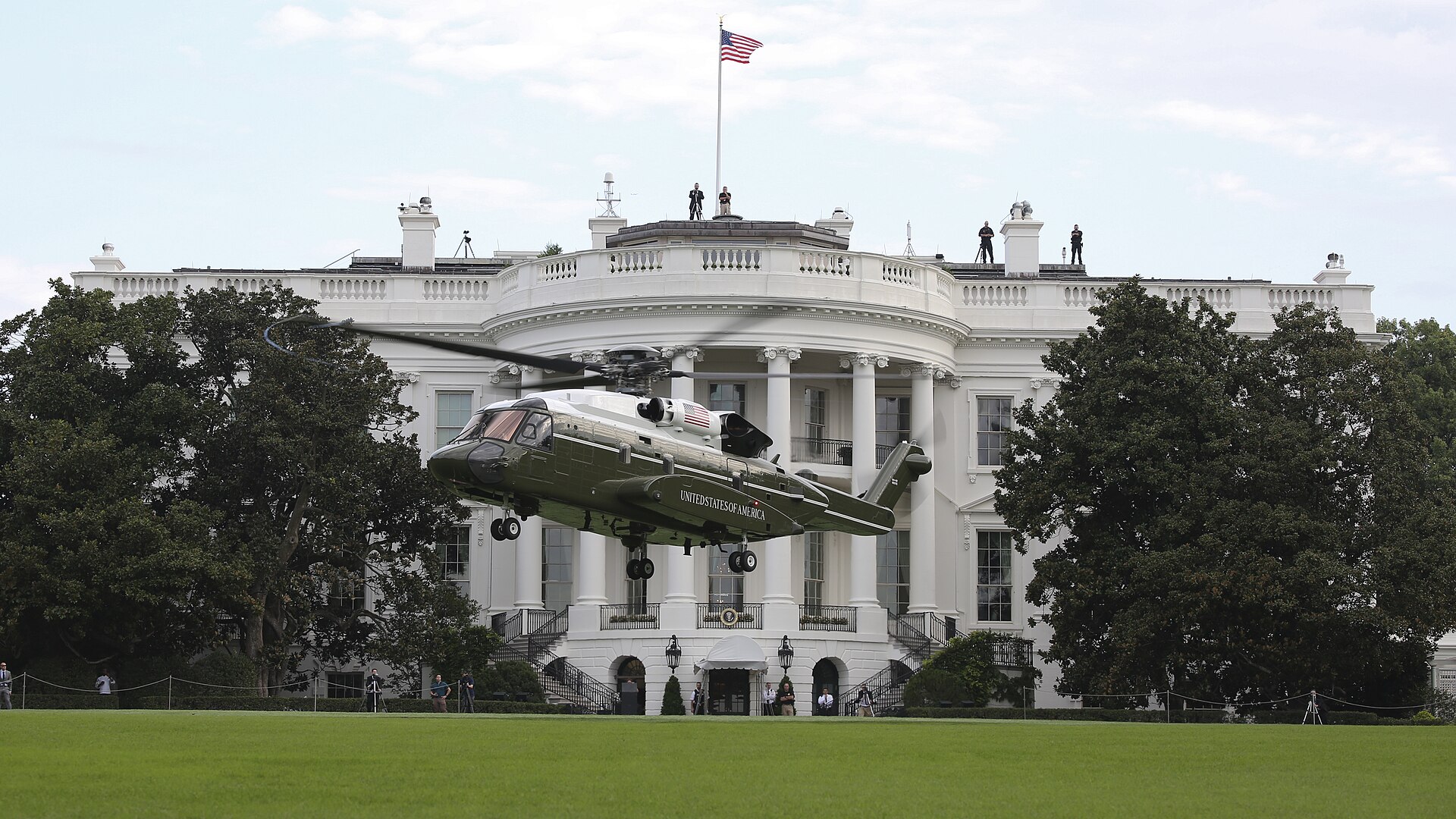
For most of sixty years, the most famous helipad in the world was a metal disc laid on grass.
Marine pilots bringing the president home to the White House aimed for it, set down on the South Lawn turf, and departed again. It worked because the helicopters doing the work were light enough for the lawn to survive them. On Monday that arrangement formally ended: President Donald Trump cut a ribbon in light drizzle, boarded a Sikorsky VH-92A Patriot, and lifted off from a new four-inch-thick granite pad built specifically because the newest Marine One was destroying the grass.
It was a double first. The first operational use of the helipad, and the first time a VH-92A had flown the president off the White House grounds at all, which is the core mission the aircraft was bought to do.
Quick Facts
| What happened | First operational use of the new White House granite helipad, by a VH-92A Patriot |
| When | Monday 21 September 2026 |
| The flight | White House to Joint Base Andrews, Maryland, en route to the UN General Assembly in New York |
| Why a pad was needed | VH-92A exhaust heat and rotor wash were tearing up the South Lawn turf |
| Surface | Four-inch-thick granite, quarried in California |
| Reported cost | Roughly $5 to $6 million, financed by Sikorsky |
| Previous arrangement | A metal landing disc placed directly on the grass |
| Aircraft programme | 23 VH-92A airframes, roughly $5 billion; in presidential service since August 2024 |
The engineering problem nobody photographed
The VH-92A entered presidential service under President Biden in August 2024, and then largely did not land at the White House. The Marine Corps kept using the older VH-3D Sea King and the VH-60N White Hawk for South Lawn work, for a reason that has nothing to do with politics and everything to do with physics.
Downwash is proportional to disc loading, and disc loading rises with weight. A heavier helicopter pushing the same rotor diameter drives more air, faster, into whatever is underneath it. Add engine exhaust directed downward onto the same patch of ground, and turf does not survive the encounter. Trump has said the VH-92A is roughly two and a half times more powerful than the aircraft it replaces, and he has described the result in blunt terms.
The old solution had worked for decades precisely because the loads were lower. Pilots aimed for a disc on the lawn, occasionally missed it, and chewed up some grass around the edges. That was tolerable. A helicopter that scorches the ground every single time is not.

A 20-degree lawn and an FAA guideline
Construction began in late June 2026 and immediately ran into something more fundamental than aesthetics: the South Lawn is not flat. Its natural grade has been reported at up to 20 degrees in places, which comfortably exceeds FAA heliport guidance that landing surfaces should be reasonably level.
That is not a decorative concern. A helicopter settling onto a sloped surface risks dynamic rollover, where one wheel or skid becomes a pivot and the rotor's own thrust rolls the aircraft over past its recovery angle. It is one of the classic ways to destroy a perfectly serviceable helicopter, and it is the sort of thing you engineer out of a permanent pad rather than manage around.
In early August the project stopped. Trump ordered contractors to tear out and redo weeks of work, including a 100-foot-wide carved granite presidential seal that was already taking shape, reportedly over dissatisfaction with the pad's appearance and the slope of the surrounding lawn.
While the work was redone, the president used the Ellipse, the park south of the White House, as a temporary landing zone. Monday's flight presumably ends that.
The manufacturer is paying for it
The unusual part of this story is not the granite. It is who bought it. Sikorsky, the Lockheed Martin subsidiary that builds the VH-92A, is financing the helipad. Trump has said this is intended, at least in part, as compensation for the company not fully disclosing how disruptive the helicopter's exhaust characteristics would be.
Read that plainly and it is a manufacturer paying to modify the customer's infrastructure so the product can do the job it was sold to do. Whatever the contractual mechanism, it is an unusually literal admission that the aircraft and the site were not compatible as delivered.
The granite itself was quarried in California and laid four inches thick. Trump has promoted it as effectively indestructible with a “million-year” lifespan, a claim that has not been independently substantiated.
The helipad was never the main problem
Turf damage is the visible issue. It is not the serious one.
The VH-92A programme covers 23 aircraft at roughly $5 billion, and it has been in trouble for most of its life. A 2021 Pentagon testing report found the helicopter failing to meet its reliability, availability and maintainability thresholds, judging it suitable for routine administrative flying but not for the emergency contingency missions that are the entire justification for a presidential helicopter fleet.
Central to that finding was the Mission Communication System, the secure link that keeps the president connected to the National Command Authority in a crisis. A Pentagon summary said it often delayed critical communications at the beginning of contingency missions. A helicopter that cannot reliably pass a launch order in the first minutes of a national emergency is not doing the job, however pristine the lawn underneath it.
The old helicopters are not finished yet
Monday's flight does not retire the fleet it was meant to replace. The Marine Corps intends to withdraw the VH-3D Sea Kings entirely this year, but plans to keep the VH-60N White Hawk flying through at least 2030, because the smaller aircraft performs better in hot and high conditions where the bigger helicopter struggles.
So the White Hawk will still turn up on the South Lawn from time to time, landing on granite that was poured for a different aircraft. And the real test of whether Monday was a new baseline or a one-off tied to the ribbon-cutting is simply which helicopter shows up over the coming weeks, with Xi Jinping's state visit the most visible occasion on the calendar.
Sixty years of landing on grass, ended by a helicopter with too much power for the lawn it was bought to serve. There are worse summaries of how procurement works.
The VH-92A lifting off the new White House helipad, 21 September 2026.
Sources: TWZ, The Washington Post, the Associated Press, the US Department of Defense Director of Operational Test and Evaluation, the US Marine Corps, Sikorsky.
0 Comments