
The Directorate of History and Heritage keeps Canada’s official squadron lineages, and its entry for 664 Squadron opens with five words that contain an entire institutional quarrel: “This Canadian Army squadron was authorized”. 664 carried an RCAF number. Its pilots were Royal Canadian Artillery officers. And for twenty years after the war, the question of whether the Army was allowed to own aircraft at all was fought out between the two services — until unification settled it, and then unsettled it again seven years later.
Quick Facts: the Army’s aeroplanes
- Subject: Canadian Army aviation, 1944 to 1968
- Wartime squadrons: 664, 665 and 666 (Air Observation Post) Squadrons
- Pilots: Royal Canadian Artillery officers, in RCAF-numbered squadrons
- Wartime aircraft: Auster AOP Mk IV and Mk V
- Post-war centre: Canadian Joint Air Training Centre, Rivers, Manitoba
- Post-war aircraft: Auster AOP.6, Cessna L-19 Bird Dog, Hiller CH-112 Nomad, CH-113A Voyageur
- Korea: Four Army pilots, one at a time, in the British 1903 Air OP Flight
- Army pilots by 1961: Some 140 qualified; 115 winged at Rivers
- The dispute: The air staff held that only the air force should operate aircraft
- 1968: Army aviation transferred to Mobile Command
- 1975: Transferred again, to Air Command, on 2 September
- Today: The Army owns no aircraft; the RCAF flies its helicopters from Army bases
Artillery officers in air force squadrons
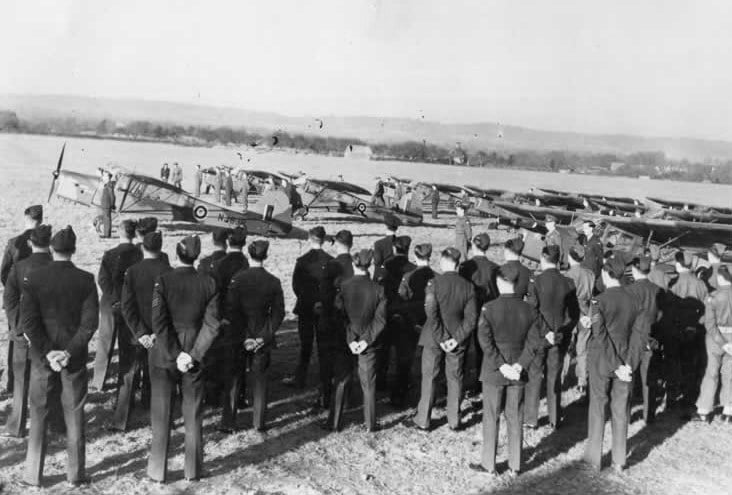
The Air Observation Post was a British idea that Canada adopted wholesale: a small, slow, unarmed aeroplane flown low over the battlefield by a gunner officer who could see where the shells were falling and correct them by radio. The pilot had to be an artilleryman, because the job was artillery, not flying.
Three squadrons carried Canadian AOP work, and all three wore RCAF numbers in the 600 block:
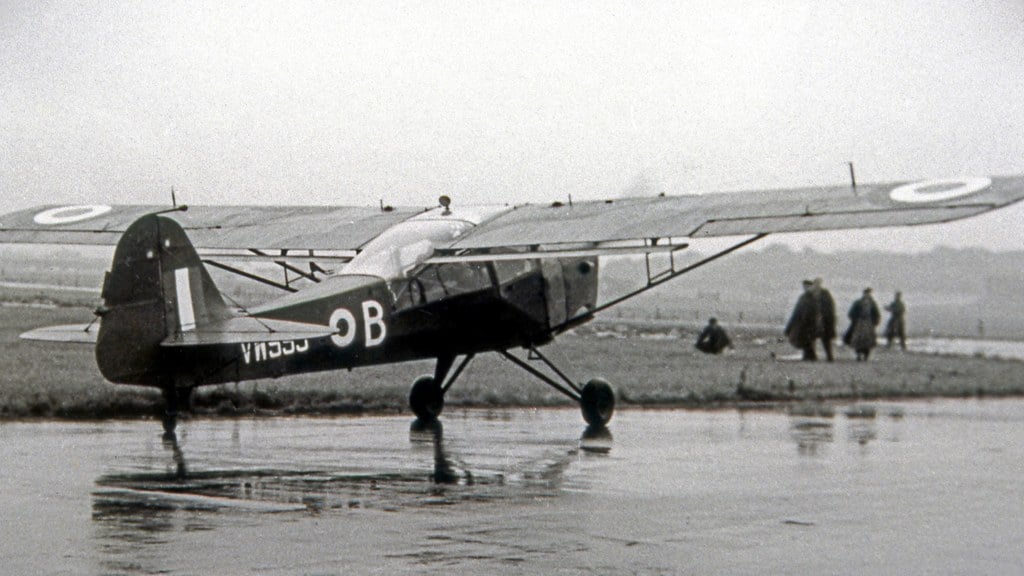
664 (Air Observation Post) Squadron, authorised 9 December 1944, disbanded 31 May 1946. It flew air observation operations in France, Belgium and the Netherlands under Fighter Command and First Canadian Army, and stayed on in Germany afterwards with British Air Forces of Occupation. Battle honour: France and Germany, 1945.
665 (Air Observation Post) Squadron, authorised 22 January 1945, disbanded 30 September 1945, in Great Britain and the Netherlands. Same battle honour.
666 (Air Observation Post) Squadron, authorised 5 March 1945, disbanded 30 September 1945, in Great Britain only. No battle honours — it was still working up when the war ended, and should not be described as a combat squadron.
The aircraft were Austers, Marks IV and V in north-west Europe. The first commanding officer of 664 was Major Dave R. Ely. The standard account has RCAF ground crew servicing artillery pilots, and it is almost certainly correct, because it exactly matches the British AOP model — but we could not find a source that states it, so we flag it rather than assert it.
Scotty flew Austers
One name on the 666 Squadron roll is startling. The Royal Canadian Artillery Museum places Captain James Doohan — later Montgomery Scott, chief engineer of the starship Enterprise — in 666 Squadron as an Air OP pilot, and quotes him on the experience: “You had to be some sort of a fool to volunteer.”
A caution, because the internet routinely mangles this. Doohan’s famous war story — wounded on D-Day at Juno Beach with the 13th Field Regiment, Royal Canadian Artillery — is a separate and earlier chapter. The Air OP flying came after. They are two different stories about the same man and they should not be run together.
The Auster in the air observation post role.
Korea: four pilots, borrowed
The shape of Canadian Army aviation in Korea tells you everything about its institutional position.
From 1952 the Canadian Army sent, in the RCAF’s own words, “a string of four pilots to Korea on one-year tours of duty to fly in Auster VI aircraft with the 1903 Air Observation Post Flight”. One at a time. Into a British flight. Canada had no Army aviation unit of its own in theatre.
The best known of them was Captain Peter Tees, who the RCAF describes as “an energetic combatant, completing 211 combat missions during his one-year tenure”. He was awarded the Commonwealth Distinguished Flying Cross; the Royal Canadian Artillery Association’s roll records that he had “flown Auster aircraft over the Commonwealth front since September 1952 for a period of 364 hours”. The official sources call him Captain; the artillery association lists him as Major Peter Joseph Angwin Tees, DFC, CD — almost certainly Captain at the time and Major later.
Alongside the four AOP pilots, sixteen Army officers served in Korea as forward air controllers.
Rivers, Manitoba

The institutional centre of Canadian Army aviation was a prairie airfield. No. 1 Airborne Research and Development Centre formed at Camp Shilo in October 1945; in April 1947 it became the Joint Air School and moved to Rivers; in March 1949 a reorganisation created the Joint Air Training Centre out of it, later the Canadian Joint Air Training Centre.
By about 1961 the CJATC ran an Airborne School that had qualified more than 13,000 paratroopers since 1947, an Air Supply School, a Light Aircraft School, a Helicopter School, a Tactical Fighter Flight with six T-33s and a Transport Support Flight with four C-119s. Its tri-service crest carried three interlinked coloured rings and the motto Serving Together.
And it produced pilots. A period account of the centre gives the number plainly: “There are at the moment some 140 Canadian Army officers qualified as pilots... 115 have received their wings at CJATC.”
There is a line in the same material that is almost too neat, published while the argument in the next section was very much alive: the colour of the uniform a man wears, it says, is really immaterial when it comes to getting the job done. Blue jobs and brown jobs, working together.
“Only the air force should operate aircraft”
That was not how it looked from the air staff.
The clearest scholarly statement comes from Bertram Frandsen’s doctoral study of the Cold War RCAF, which describes the air staff as engaged in “continuous and sometime acrimonious opposition to the development of aviation arms of the army and navy to meet those services’ specialized needs on the premise that only the air force should operate aircraft”.
That premise — only the air force should operate aircraft — is the whole dispute in nine words.
The Army’s side of it was argued in public, by very senior people, in a mass-circulation magazine. Lieutenant-General Guy Simonds, Chief of the General Staff from 1951 to 1955, published two pieces in Maclean’s in 1956: “Where We Have Gone Wrong on Defence” in June and “We’re Wasting Millions on an Obsolete Air Force” in August. Major-General W.H.S. Macklin, Adjutant General from 1949 to 1954, published in the same magazine in February 1956, attacking the resources being poured into North American air defence while the Army went short.
A former Chief of the General Staff and a former Adjutant General, going to the newsstands to complain about the air force budget. Whatever else it was, it was not a quiet disagreement.
Whose aircraft were they, actually?
Here the paper trail gets genuinely interesting, and genuinely unresolved.
Canada received Auster AOP.6s in 1948 for observer training at Rivers. The Canada Aviation and Space Museum says thirty-four aircraft, and says flatly that the RCAF operated them. The Canadian Warplane Heritage’s serials database counts forty-six Canadian Austers and records something rather different: “Operated by Canadian Army. Returned to RCAF on 24 January 1955.”
Both can be true at once, and if they are, the implication is considerable: the Army flew the aircraft and the air force owned them. An aircraft on RCAF charge can be recalled. That is a quieter and more effective form of control than any memo refusing a requisition — and we should be honest that we could not prove it. The documents that would settle it are in the Directorate of History and Heritage’s holdings in Ottawa and are not online.
What we can say is that the Army’s own post-war AOP squadron did not last. 444 (Air Observation Post) Squadron was authorised on 1 September 1947 and disbanded on 1 April 1949. Twenty months. The number came back in 1953 as a fighter squadron, then a strike/attack squadron, then — in 1972 — as a tactical helicopter squadron.
A preserved Auster AOP.6, the mark Canada received in 1948.
The aircraft the Army did fly

The Cessna L-19 Bird Dog replaced the Auster as the Army’s spotter and liaison aircraft. Vintage Wings of Canada says twenty-nine were acquired; the warplane heritage serials database says thirty-two, first taken on strength on 6 October 1954. We give both. They served with No. 1 AOP Flight at Camp Petawawa, No. 2 AOP Flight at Camp Shilo, the Army Aviation Tactical Training School at Rivers, and with regiments of the Royal Canadian Horse Artillery — including in Germany with 4 Canadian Mechanized Brigade Group in 1964.
The Hiller CH-112 Nomad was unambiguously an Army machine: twenty-seven in Canadian Army service from August 1961, flown by the Army Aviation Tactical Training School at Rivers and by the Royal Canadian Armoured Corps Helicopter Troop in Germany, withdrawn by July 1972.
And a distinction that is constantly got wrong: the CH-113 Labrador was an air force aircraft — six of them, for search and rescue, in service from 11 October 1963. The CH-113A Voyageur was an Army aircraft — twelve of them, for transport. Same airframe family, different services, different serial blocks. Labrador is blue; Voyageur is brown.
What it cost
A volunteer memorial roll maintained by the Canadian Army aviation community records three deaths from the Rivers era. We reproduce them because they are otherwise almost unrecorded, and with the caveat that this is a community memorial rather than an official register.
Lieutenant Ernest Arthur Annear, Royal Canadian Artillery, killed on 13 April 1954 in Auster VI 16680, about a mile from the training centre at Rivers. Major Thomas James O’Brennan and Lieutenant Wallace Richard Byrans Chaplin, Royal Canadian Army Service Corps, killed together on 9 June 1956 in Cessna L-19 Bird Dog 16708. Captain Douglas William Boettcher, Royal Canadian Artillery, of 3rd Regiment Royal Canadian Horse Artillery, killed in an L-19 accident at Arnsberg, Germany, on 2 May 1962.
Both serials fall inside the fleet ranges established from the official records, which is a point in the roll’s favour.
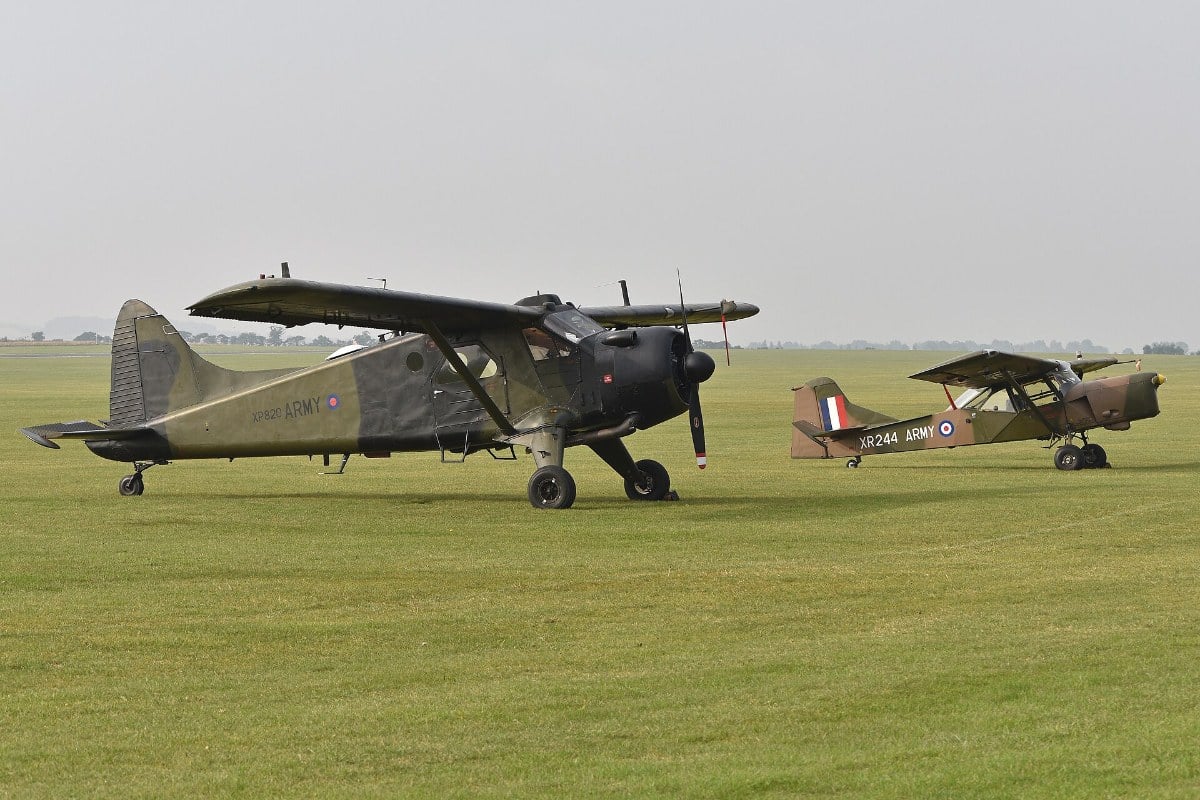
Auster, Beaver and Sioux flying together — the aircraft of post-war army aviation.
The whiplash
On 1 February 1968 the argument was settled in the Army’s favour by accident. Unification abolished the RCAF along with the other two services, and as the RCAF’s own history records, “The rest of the former RCAF, Fleet Air Arm and Army Air resources were divvied up between Mobile and Maritime Commands.” Army aviation went to Mobile Command — a land-forces command. The Army finally had its aircraft under its own operational authority, twenty-three years after 664 Squadron flew its first Auster.
It lasted seven years. Air Command was created on 2 September 1975, and the tactical helicopters went to it.
So: the air force lost its name in 1968 and won the argument in 1975.
Where it ended up
Today the Canadian Army operates no aircraft of its own. Every helicopter that supports it is flown by the Royal Canadian Air Force, in RCAF squadrons, under 1 Canadian Air Division. Tactical aviation sits in 1 Wing Kingston, with six squadrons: 400 at Borden, 403 at Oromocto, 408 at Edmonton, 430 at Courcelette, 438 at St-Hubert and 450 at Petawawa. (427 Special Operations Aviation Squadron is often listed with them and should not be — it belongs to Canadian Special Operations Forces Command.)
But look at where those squadrons live. 408 Tactical Helicopter Squadron flies CH-146 Griffons in support of the Canadian Army and is co-located with 1 Canadian Mechanized Brigade Group in Edmonton. 450 is at Petawawa. 430 is at Courcelette. The squadrons are air force; the addresses are army.
That is the settlement the twenty-year quarrel produced, and it is a more sensible one than either side was arguing for. The RCAF won the principle. The Army won the geography.
The thing we could not find out
One question defeated us, and it is the one we most wanted to answer.
Canadian Army officers were being formally winged at Rivers by 1961 — 115 of them, on the period record. But whose wings? We could not establish whether they received the standard RCAF pilot flying badge, a distinct Canadian Army flying badge, or an air force badge worn on army service dress; nor whether a separate Army pilot badge was ever authorised, and if so when and under what order; nor what the wartime artillery officers of 664, 665 and 666 wore on their tunics.
Three specialist insignia sources are silent on it. It is the sort of question a museum accession record with a photograph would settle in thirty seconds, and web searching cannot.
So we have left it open rather than guessed. If you know the answer — and somebody reading this will — we would very much like to hear it.
Sources: Directorate of History and Heritage official lineages for 664, 665, 666 and 444 Squadrons, canada.ca; Royal Canadian Air Force, “The Korean War” and “The genesis of Air Command”, canada.ca; Royal Canadian Artillery Museum; Royal Canadian Artillery Association; Canada Aviation and Space Museum (Ingenium); Canadian Warplane Heritage CASPIR serials database; Vintage Wings of Canada; Manitoba Historical Society; Bertram C. Frandsen, The Rise and Fall of Canada’s Cold War Air Force, 1948–1968 (Wilfrid Laurier University, 2015); 1 Wing and 408 Squadron pages, canada.ca; canadianarmyaviation.ca memorial roll. Conflicting figures and unverified points are flagged in the text.
0 Comments