
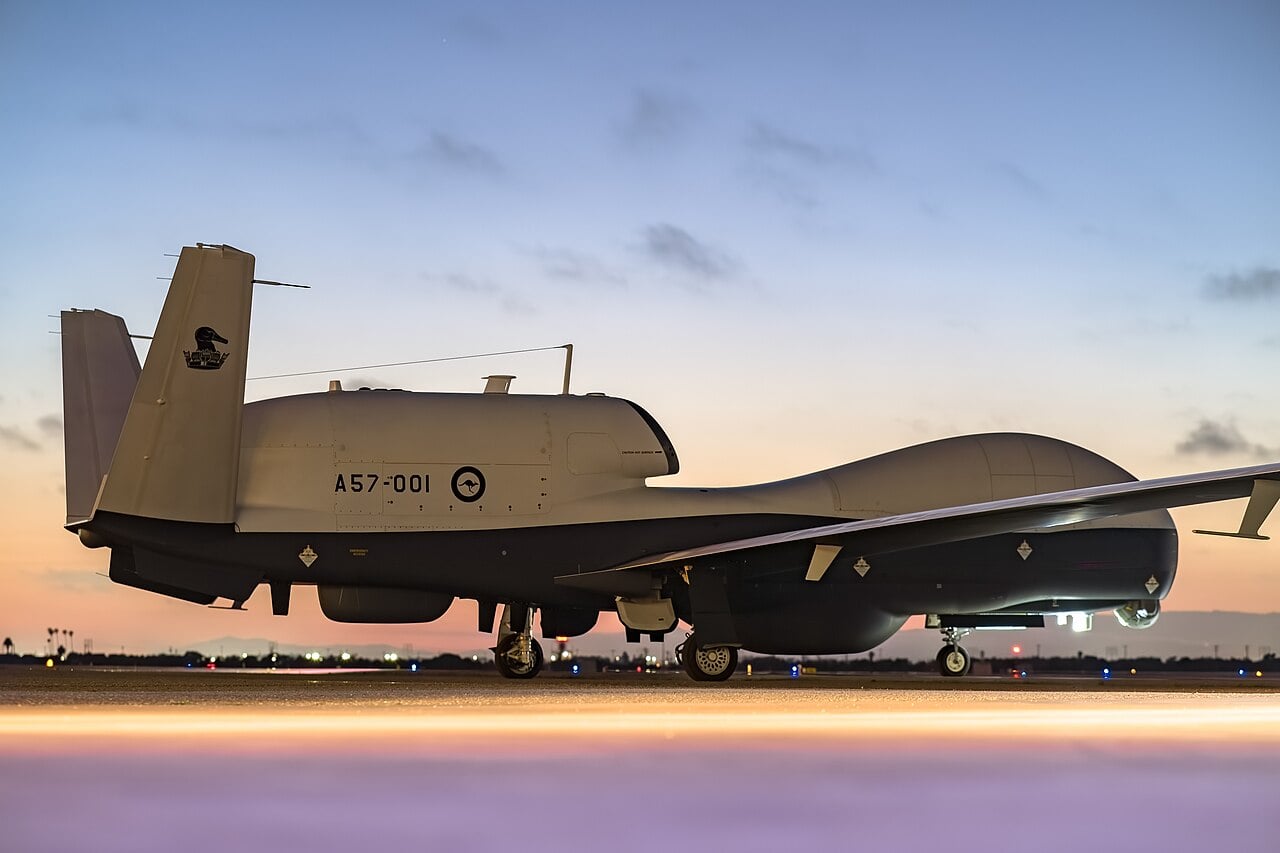
Australia has a surveillance problem that is essentially arithmetic. The area it is expected to watch is vast, the number of aircraft it can afford is not, and the distances mean an aircraft spends much of its life transiting rather than looking.
On Tuesday the Royal Australian Air Force declared two answers to that problem operational on the same day. The MQ-4C Triton, which can stay up for a day at a time, and the MC-55A Peregrine, which listens rather than looks, both reached Initial Operational Capability after extensive test and evaluation.
Two IOC declarations in one announcement is unusual. Doing it with an uncrewed aircraft and a classified electronic warfare jet is a fair statement of where the RAAF thinks the next decade is going.
Quick Facts
| Announced | 22 September 2026, Australian Department of Defence |
| MQ-4C Triton | Four on order, three delivered, the fourth due in 2028 |
| Triton unit | No. 9 Squadron, No. 92 Wing; aircraft based at RAAF Base Tindal |
| MC-55A Peregrine | Four on order, three delivered, the fourth due by the end of 2026 |
| Peregrine unit | No. 10 Squadron, RAAF Base Edinburgh, South Australia |
| Peregrine airframe | Gulfstream G550, converted for intelligence, surveillance, reconnaissance and electronic warfare |
| Triton endurance | Up to 24 hours, above 50,000 ft, 8,200 nautical mile range |
| P-8A fleet | All 14 delivered, the last in May 2026; Increment 3 Block 2 upgrades under way |
| Programme funding | Approximately A$5.5 billion over the decade |
The aircraft that does not land
The Triton is a maritime derivative of the Global Hawk lineage — it was once called BAMS, for Broad Area Maritime Surveillance, and is generally understood to be a hybrid of Block 20 and Block 30 Global Hawk thinking. What matters operationally is the AN/ZPY-3 radar and the endurance.
One aircraft can sweep more than 2.7 million square miles in a single sortie lasting up to 24 hours, above 50,000 feet, with a range of 8,200 nautical miles. For a country whose area of interest runs from the Southern Ocean to the South China Sea, that is not a marginal improvement over a crewed patrol aircraft. It is a different kind of coverage.
Three of Australia’s four Tritons have been delivered. The fourth arrives in 2028. All of them will fly from RAAF Base Tindal in the Northern Territory, operated by No. 9 Squadron, which sits under No. 92 Wing down at Edinburgh in South Australia — a split that says something about how the RAAF now thinks about basing aircraft close to the task and crews close to the analysis.
Australia is the only Triton operator outside the United States. NATO announced its own acquisition in July.
The quiet one
The Peregrine is the more interesting aircraft and the one nobody will tell you much about.
Underneath it is a Gulfstream G550, a business jet. Above and below that airframe sits an intelligence, surveillance, reconnaissance and electronic warfare fit that the Australian Department of Defence has never described in public. The aircraft is said to carry an array of signals intelligence capabilities alongside its ISR and electronic warfare functions.
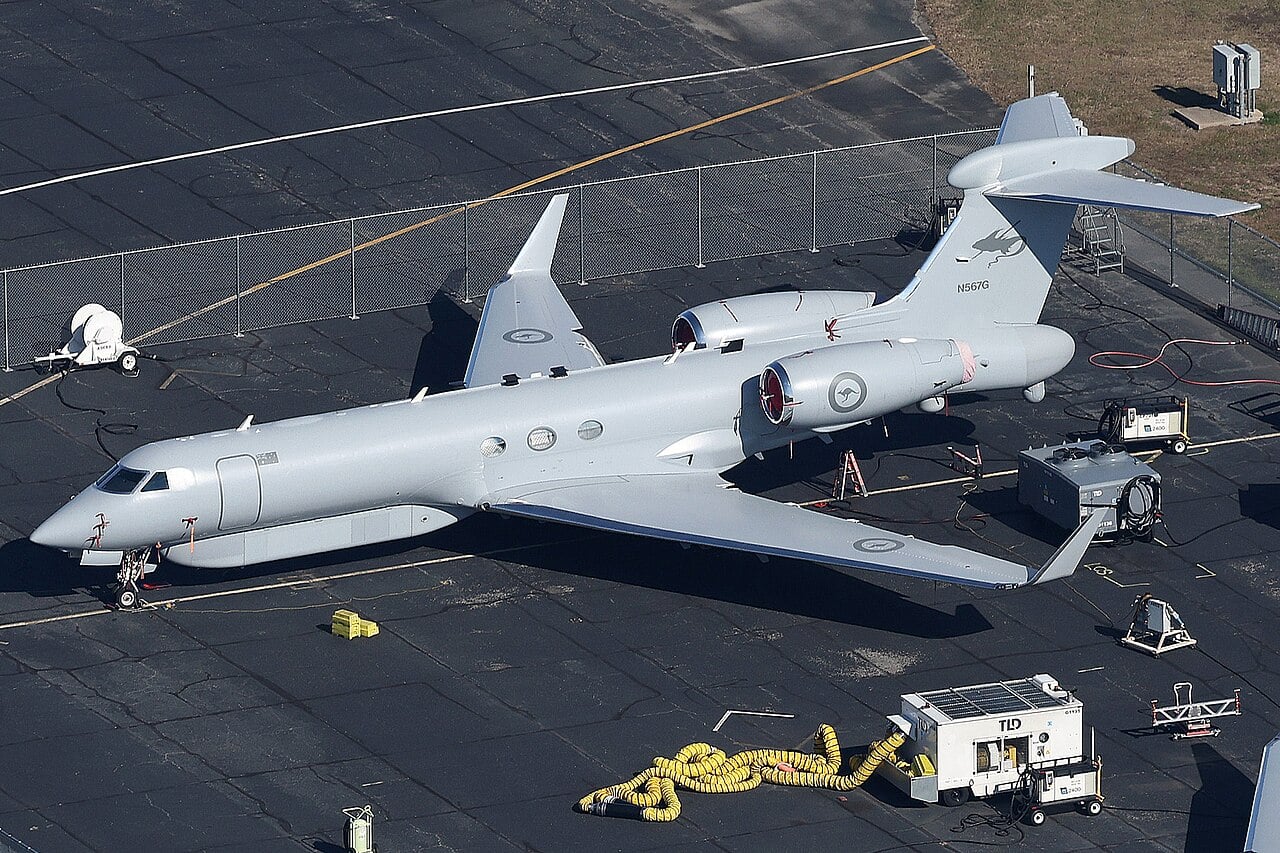
That fairing is the one part of the aircraft that talks. Leonardo disclosed in 2022 that its Osprey 50 AESA radar was involved, which is the closest thing to an official answer anyone has. Everything else about the fit remains classified, and will stay that way.
Three of the four Peregrines have arrived; the last is due by the end of the year. A51-003 flew the type’s first fully crewed mission with No. 10 Squadron at Edinburgh.
A family, not a fleet
The RAAF is deliberate about the phrase family of systems, and in this case it is more than branding. The Triton watches continuously and cheaply in crew terms. The P-8A Poseidon goes where something needs prosecuting. The Peregrine listens and, when required, interferes.
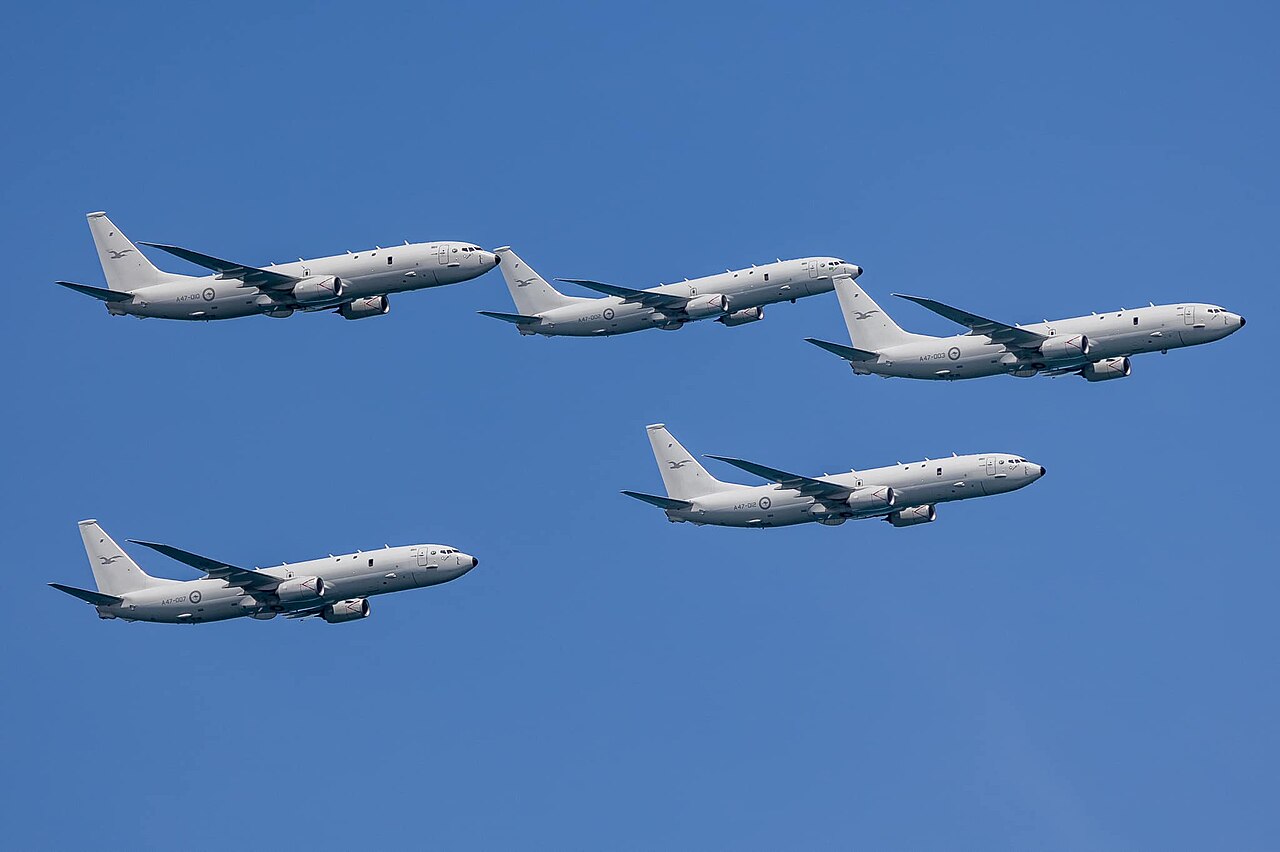
The same announcement confirmed that the P-8A fleet is complete at fourteen aircraft, the last delivered in May, and that Increment 3 Block 2 upgrades are under way. The first two were done in the United States. The rest will be done at Edinburgh, in a new deep maintenance and modification facility supported by Boeing Australia — which is its own quiet piece of news, because sovereign upgrade capability is what stops a fleet being hostage to somebody else’s queue.
Two aircraft types reaching IOC on the same morning is the sort of milestone that generates a press release and very little else. The substance is that Australia can now watch a large part of the Indo-Pacific continuously, and can hear a useful amount of what is being said across it. Whether four of each is enough is a separate question, and one the next decade will answer.
Sources: Australian Department of Defence; Minister for Defence media release; The Aviationist; Royal Australian Air Force; Northrop Grumman; Leonardo.
0 Comments