
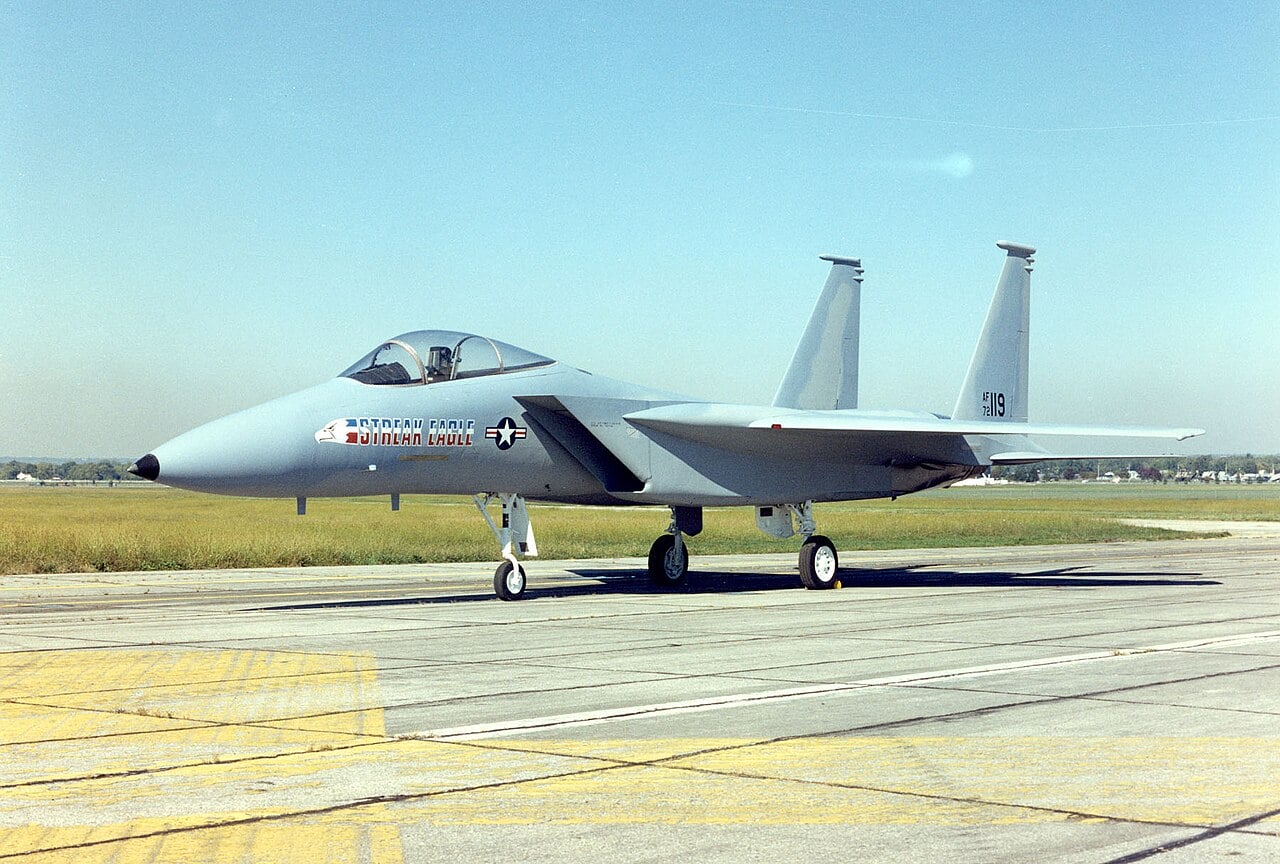
On 1 February 1975, a bare metal F-15A sat on the runway at Grand Forks Air Force Base in North Dakota, chained to a hold-back device, with both engines in full afterburner. When the hold-back let go, the aircraft was airborne in three seconds. Three minutes and 27.799 seconds after brake release, it passed through 30,000 metres — 98,425 feet — and kept coasting to nearly 103,000 feet before gravity took it back.
It was the eighth world record the same airframe had set in seventeen days.
Quick Facts
| Aircraft | McDonnell Douglas F-15A-6-MC, serial 72-0119, an early pre-production Eagle |
| Name | Streak Eagle, with AQUILA MAXIMA painted on the left fin |
| Base | Grand Forks AFB, North Dakota, field elevation 913 feet |
| Dates | 16 January to 1 February 1975 |
| Records | Eight FAI time-to-altitude world records, from 3,000 m to 30,000 m |
| Pilots | Maj. Roger J. Smith, Maj. Willard R. MacFarlane and Maj. David W. Peterson, F-15 Joint Test Force, Edwards AFB |
| Profiles designed by | Charles P. “Pete” Garrison, McDonnell Douglas chief developmental test pilot |
| Engines | Two Pratt & Whitney F100-PW-100 afterburning turbofans |
| Previous holders | The Soviet Ye-266 (MiG-25) for the three highest marks, set 4 June 1973 |
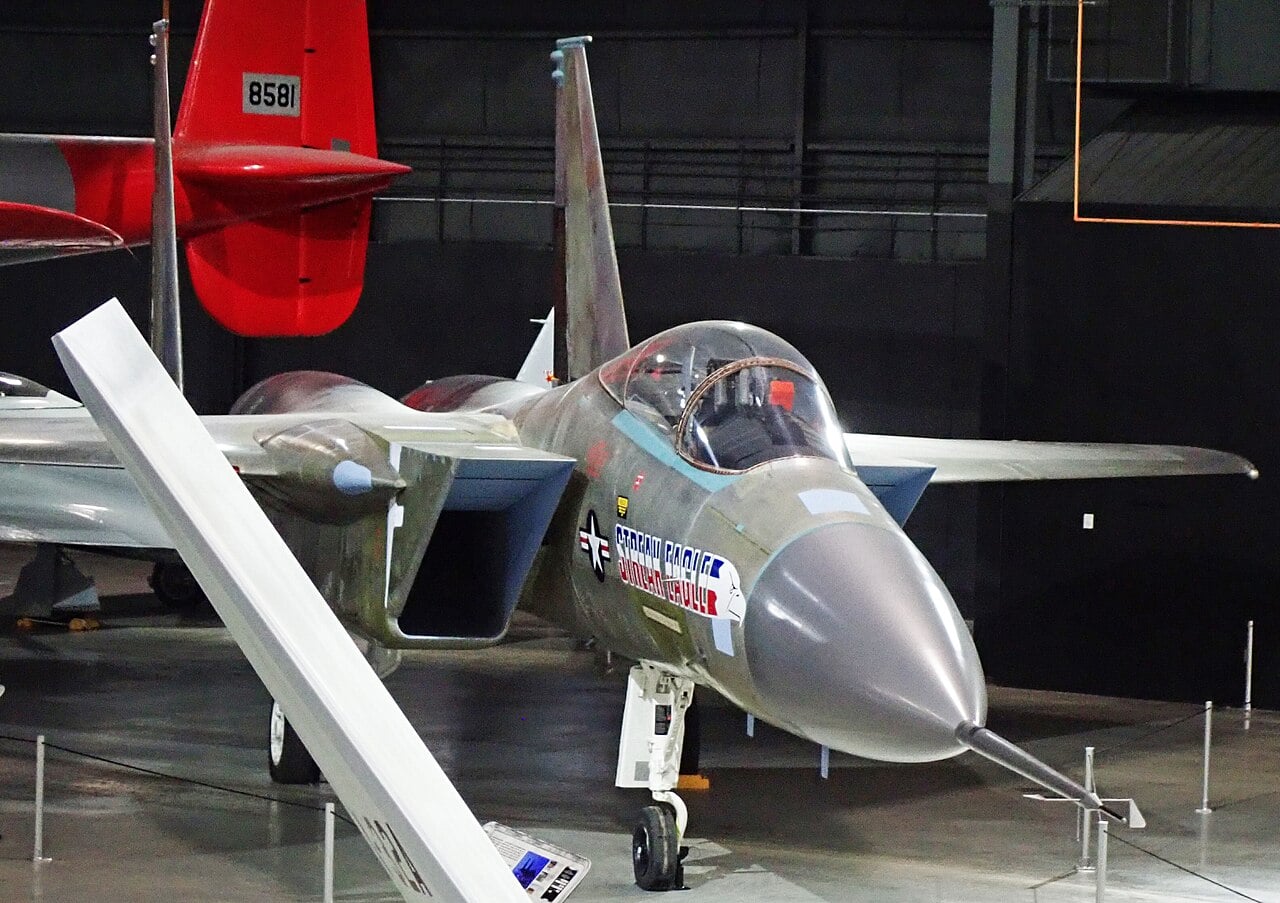
| Today | Preserved at the National Museum of the United States Air Force, Dayton, Ohio |
Everything That Could Come Off, Came Off
The Streak Eagle was an early pre-production F-15A, a machine whose internal structure and systems differed enough from the production standard that returning it to operational service was never going to be worth the money. That made it the ideal aircraft to ruin.
It flew unpainted. Bare metal saves weight, and at this level of margin, paint is weight. Most of the avionics went. So did anything else the record profiles did not strictly need. It carried only enough fuel for the specific flight it was about to make — not a tank, a calculation.
The Eagle was the first American fighter with more engine thrust than its own normal weight, which is the whole story in one sentence: it could accelerate while pointing straight up. The Streak Eagle existed to prove that in a form the Federation Aeronautique Internationale would ratify.
Five Records in a Single Day
The campaign opened on 16 January 1975 and three test pilots from the F-15 Joint Test Force at Edwards took five world records between them before the day was out.
The Eight Records, All From Brake Release
| Altitude | Time | Pilot | Date |
|---|---|---|---|
| 3,000 m | 27.571 s | Roger J. Smith | 16 Jan 1975 |
| 6,000 m | 39.335 s | Willard R. MacFarlane | 16 Jan 1975 |
| 9,000 m | 48.863 s | Willard R. MacFarlane | 16 Jan 1975 |
| 12,000 m | 59.383 s | Willard R. MacFarlane | 16 Jan 1975 |
| 15,000 m | 1 min 17.042 s | David W. Peterson | 16 Jan 1975 |
| 20,000 m | 2 min 02.94 s | Roger J. Smith | 19 Jan 1975 |
| 25,000 m | 2 min 41.025 s | David W. Peterson | 26 Jan 1975 |
| 30,000 m | 3 min 27.799 s | Roger J. Smith | 1 Feb 1975 |
FAI record files 9077, 8605, 8600, 8528, 8521, 9066, 9070 and 8520. All ratified, all since retired by changes to the sporting code.
Boeing’s own archive film of the Streak Eagle time-to-climb flights.
The Profile Pete Garrison Drew
The flight profiles were worked out by Charles P. “Pete” Garrison, McDonnell Douglas’s chief developmental test pilot, and the one for 30,000 metres is worth reading slowly.
Hold-back released at full afterburner. Airborne in three seconds. At 428 knots, pull straight into an Immelmann at 2.5 g, which brings the aircraft back over the airfield in level flight at about 32,000 feet — inverted. Roll upright. Keep accelerating through Mach 1.5 while climbing past 36,000 feet, then on to Mach 2.2. Pull up at 4 g into a 60-degree climb and hold it.
Then shut the engines down. Above a certain altitude the air is too thin to cool them and they will destroy themselves, so the last part of the climb is made on momentum alone. At the top, the Streak Eagle was doing about 55 knots — slower than a light aircraft on final approach, at 100,000 feet, with no engines running. The pilot pushed over into a 55-degree dive, waited until the aircraft was back below 55,000 feet where the air would support combustion again, relit, and flew home.
Whose Records Were They?
This was not an exhibition put on in a vacuum. The three highest marks the Streak Eagle went after all belonged to the Soviet Union, and specifically to the aircraft that had caused the F-15 to exist in the first place: the MiG-25, entered for record purposes under the designation Ye-266.
On 4 June 1973, Boris Orlov had taken a Ye-266 to 20,000 metres in 2 minutes 49.8 seconds, and Pyotr Ostapenko had reached 25,000 metres in 3 minutes 12.6 seconds and 30,000 metres in 4 minutes 3.86 seconds. Eighteen months later the Streak Eagle beat all three by margins that were not close: 2:02.94, 2:41.02 and 3:27.80.
The Soviets did not let it stand. On 17 May 1975, barely three months after Roger Smith’s 30,000-metre flight, a re-engined MiG-25 flying as the Ye-266M took the time-to-height records back, and in 1977 Alexander Fedotov used the same aircraft to reach 37,650 metres in a zoom climb — the absolute altitude record for a jet aircraft, and one that still stands.
There is a pleasing symmetry in how the two campaigns ended. Fedotov’s 1973 record climb also finished with the engines flamed out in air too thin to burn, the aircraft coasting up a ballistic arc with the speed bleeding down to about 75 km/h at the apex. Two rival air forces, two entirely different aeroplanes, and the same last few seconds: a fighter drifting almost stationary at the top of the atmosphere with nothing running.
Contemporary footage of the Grand Forks record flights.
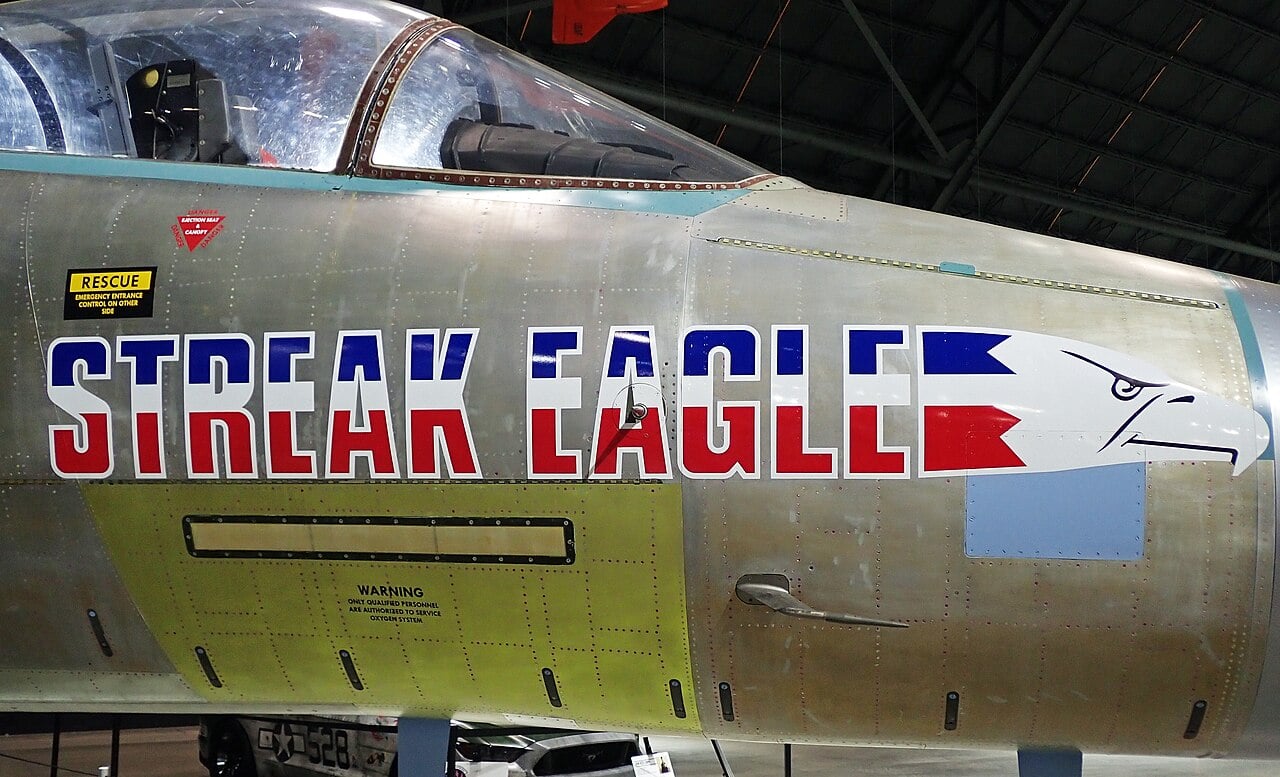
The Streak Eagle stopped flying when it ran out of usefulness as a test vehicle and was delivered to the National Museum of the United States Air Force in December 1980. The FAI has since retired all eight records through changes to its sporting code, so nobody can beat them in the form they were set. That is probably the right outcome for a campaign that was never really about the numbers. It was about a manufacturer, an air force and three test pilots proving in public, in a North Dakota winter, that the new fighter could do the thing the brochure claimed.
Sources: National Museum of the United States Air Force fact sheet on the McDonnell Douglas F-15 Streak Eagle; This Day in Aviation entries for 16 and 19 January, 26 January and 1 February 1975, citing FAI record files 8520, 8521, 8528, 8600, 8605, 9066, 9070 and 9077; Wikipedia entries for the McDonnell Douglas F-15 Eagle and the Mikoyan-Gurevich MiG-25, the latter citing Belyakov and Marmain.
0 Comments