
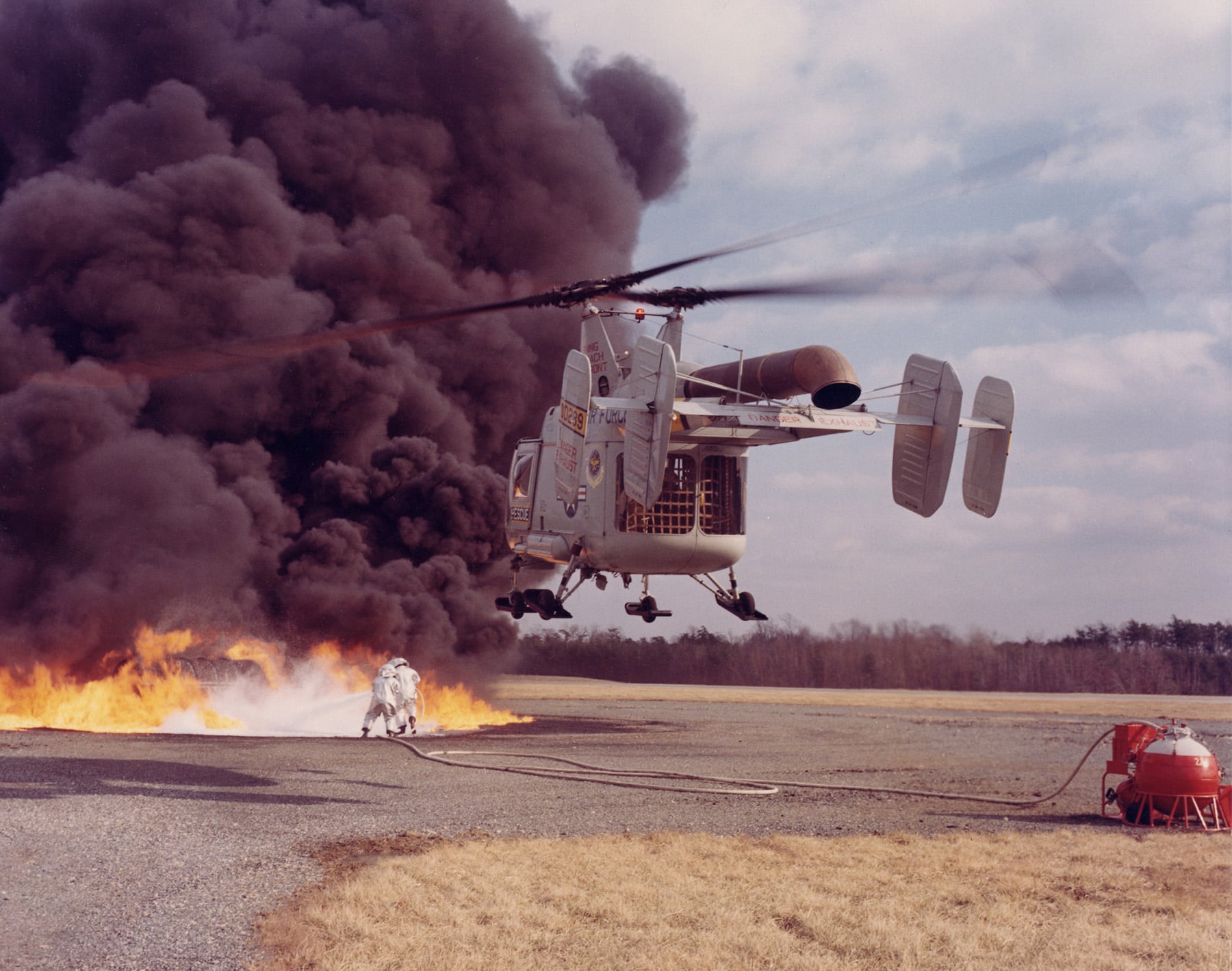
It was small, slow and oddly shaped, with two rotors that swung through each other like the blades of an eggbeater. Yet the Kaman HH-43 Huskie, better known by its radio callsign "Pedro", flew more rescue missions in Vietnam than all other helicopters combined.
It was never designed for war. The Huskie was built to sit next to a runway, rotors turning, ready to put out a burning jet and pull the crew out. How it ended up hovering over the jungle under fire is one of the best stories in rescue aviation.
Quick Facts
- Type: Local base rescue and firefighting helicopter
- Manufacturer: Kaman Aircraft
- First flight: 21 April 1953 (K-225 prototype)
- USAF service: November 1958 to the 1970s
- Built: 370, all versions
- Engine: Lycoming T53 turboshaft (HH-43B/F)
- Callsign: Pedro
- Vietnam record: 888 combat rescues, 1966 to 1970
A German Idea With an American Name
The Huskie's rotor layout came from Anton Flettner, the German engineer whose Fl 282 Kolibri was the first helicopter to go into series production. Brought to the United States after the war, Flettner became chief designer at Kaman, where his "synchropter" layout was developed further.
Two main rotors, mounted side by side and tilted outwards, turn in opposite directions and mesh like gears. Because they cancel each other's torque, there is no need for a tail rotor, and no engine power is lost driving one. That makes the helicopter compact and a strong lifter for its size. Kaman still uses the idea today on the K-MAX.
The first prototype, the K-225, flew on 21 April 1953. The Navy bought early versions as trainers and utility helicopters, and the Marines used them for observation. In 1954 one Navy HTK-1 was fitted with two Boeing turbines and became the world's first twin-turbine helicopter.
A Fire Truck That Flew
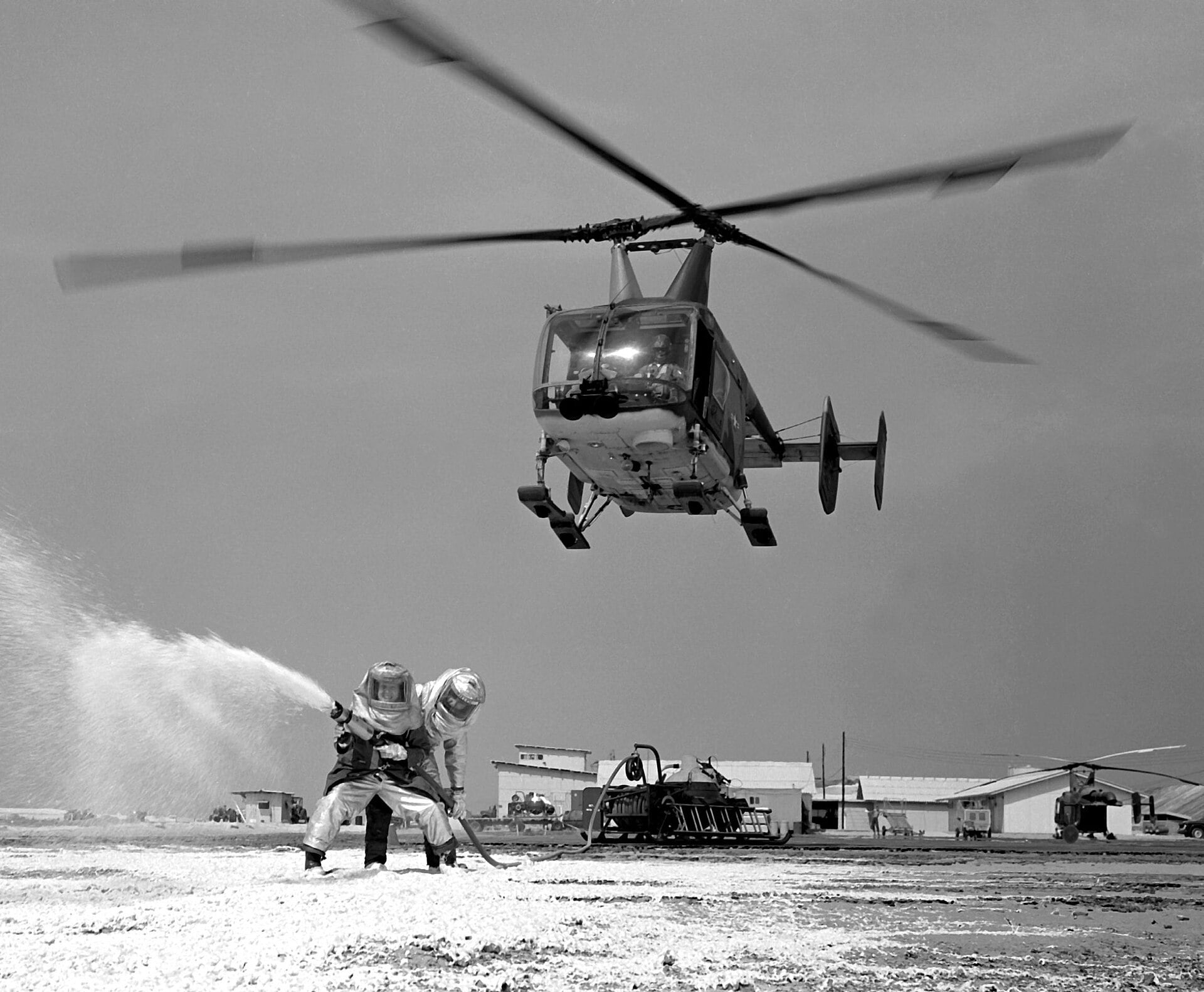
The Air Force wanted something different. It needed a helicopter that could reach a crashed aircraft on or near a base within minutes, faster than any fire truck. The first H-43As arrived in November 1958, and the turbine-powered H-43B followed in June 1959. With the 860 hp Lycoming T53, the B model was the version that mattered, and 200 were built.
The key piece of equipment hung underneath: an airborne fire suppression kit weighing about 1,000 pounds that could put out almost 700 gallons of foam. The Huskie flew to the crash with the kit and its firefighters. The powerful downwash from the rotors pushed flames and smoke away, opening a path to the cockpit.
The HH-43B also turned out to be a record-breaker. In the early 1960s it set several world records for helicopters in its class, including rate of climb, altitude and distance. The museum aircraft at Dayton, 60-0263, is credited with seven of them.
Pedro Goes to War
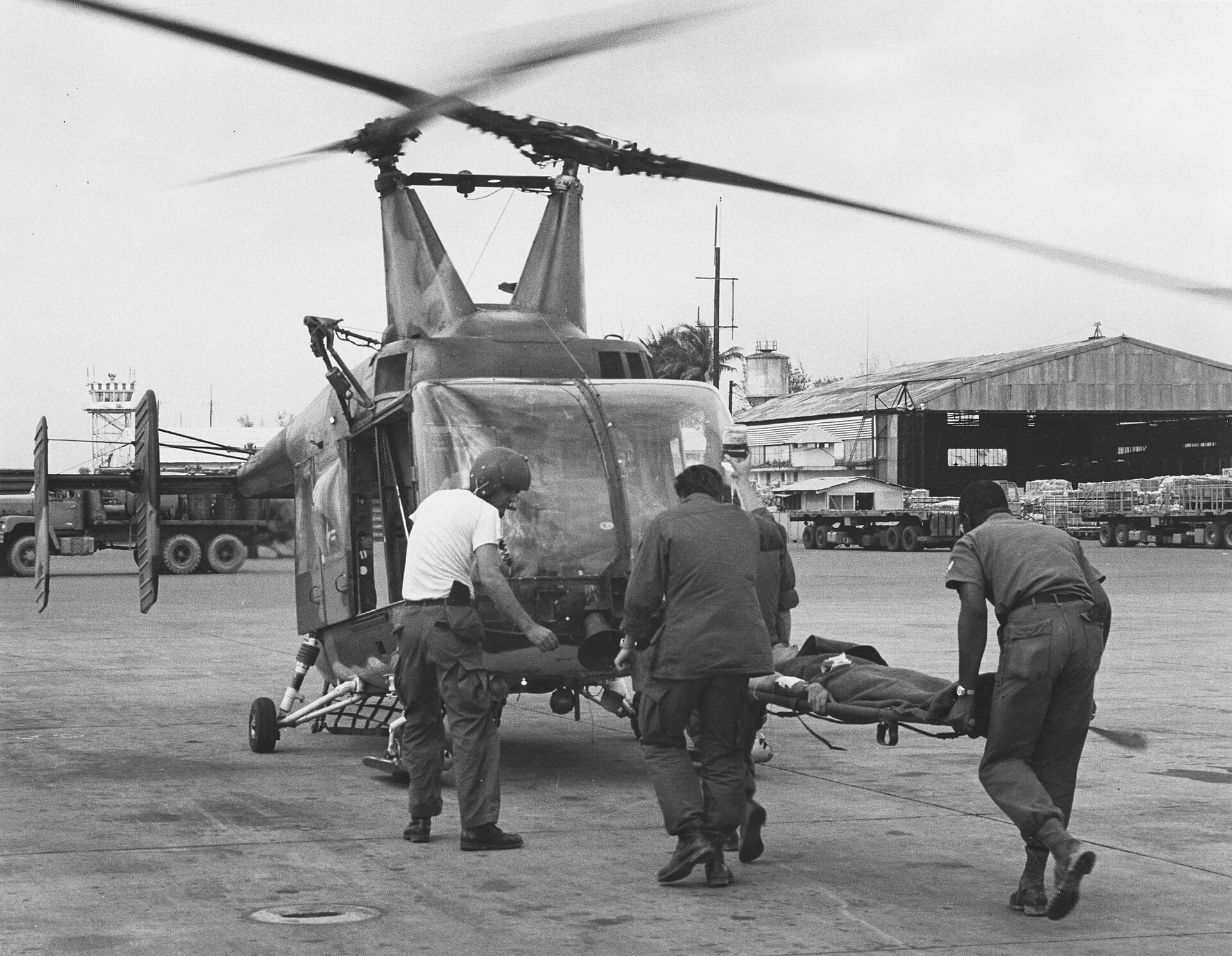
When the war in Vietnam grew, the Air Force had almost nothing else to send for rescue. The Huskies went because they were there. Their range was short and they were never meant to face gunfire, but they could hover over a jungle clearing and lower a hoist, and that was what counted.
The first combat medevac came in March 1965. Crews worked with what they had, adding extra fuel and armour where they could, and the helicopters flew from small detachments across Southeast Asia. By the time the last Huskies left, their record was hard to believe.
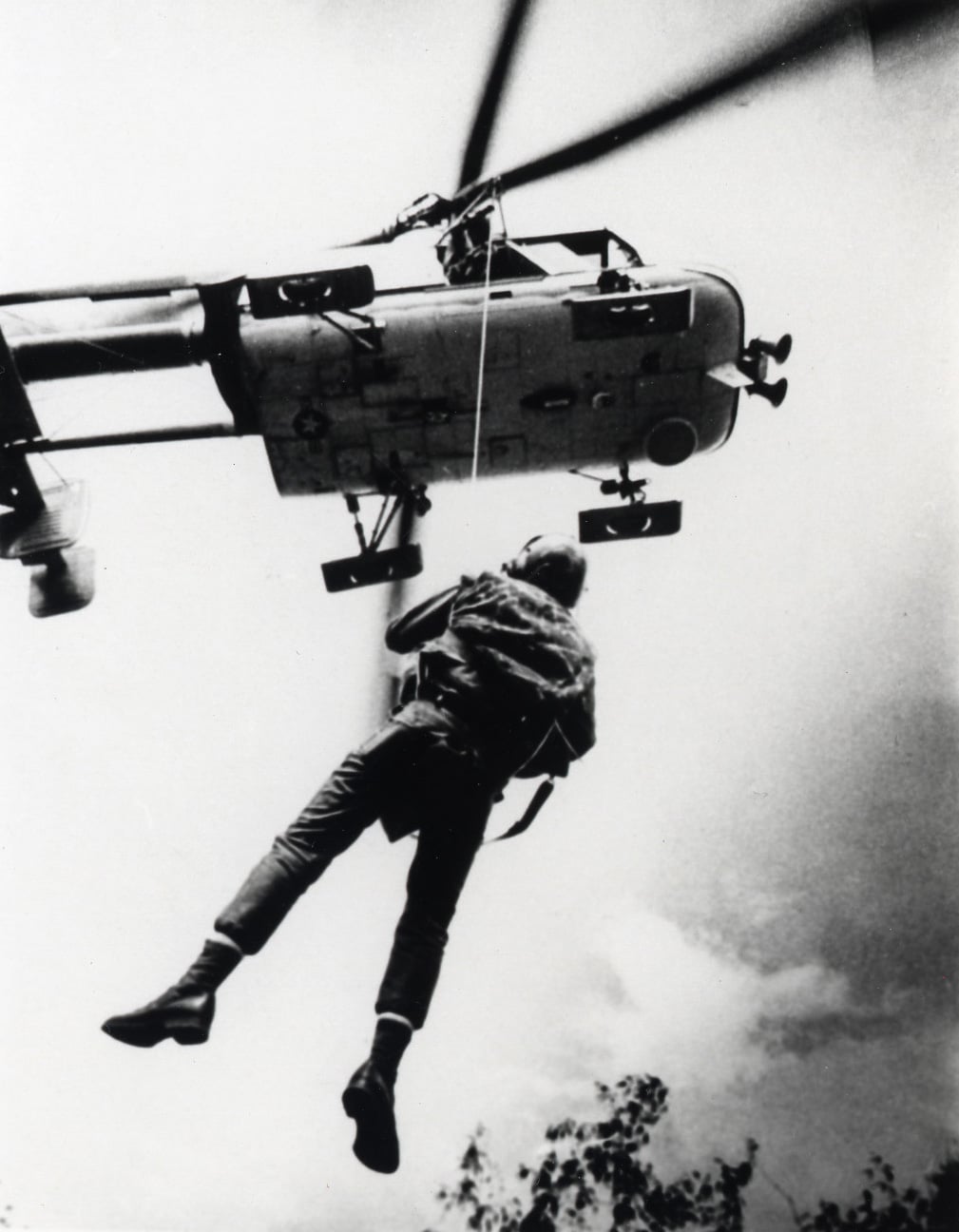
Between 1966 and 1970 the HH-43 made 888 combat rescues, 343 of them aircrew and 545 soldiers and others on the ground. The bigger HH-3E "Jolly Green" would take over the long-range missions, often escorted by A-1 Skyraider "Sandys", but for short-range rescue Pedro stayed busy until 1975.
The HH-43 Huskie, from Fight to Fly Studio.
Pitsenbarger at Cam My
The Huskie's most famous crewman did not fly it. A1C William H. Pitsenbarger was a pararescueman with Detachment 6, 38th Aerospace Rescue and Recovery Squadron, riding on HH-43Fs. His commander remembered him simply:
On 11 April 1966, HH-43s were sent to pick up wounded Army soldiers pinned down near Cam My, about 35 miles east of Saigon. Pitsenbarger rode the hoist down into the jungle to prepare the wounded for lift. Six casualties were flown out before one of the helicopters was hit by enemy fire.
Pitsenbarger could have gone up in the litter basket. Instead he stayed with the roughly 20 infantrymen still alive. For about an hour and a half he treated the wounded, made splints and stretchers, collected ammunition from the dead and passed it to the men still fighting, and then took up a rifle himself. He was killed by Viet Cong snipers that night. He was 21.
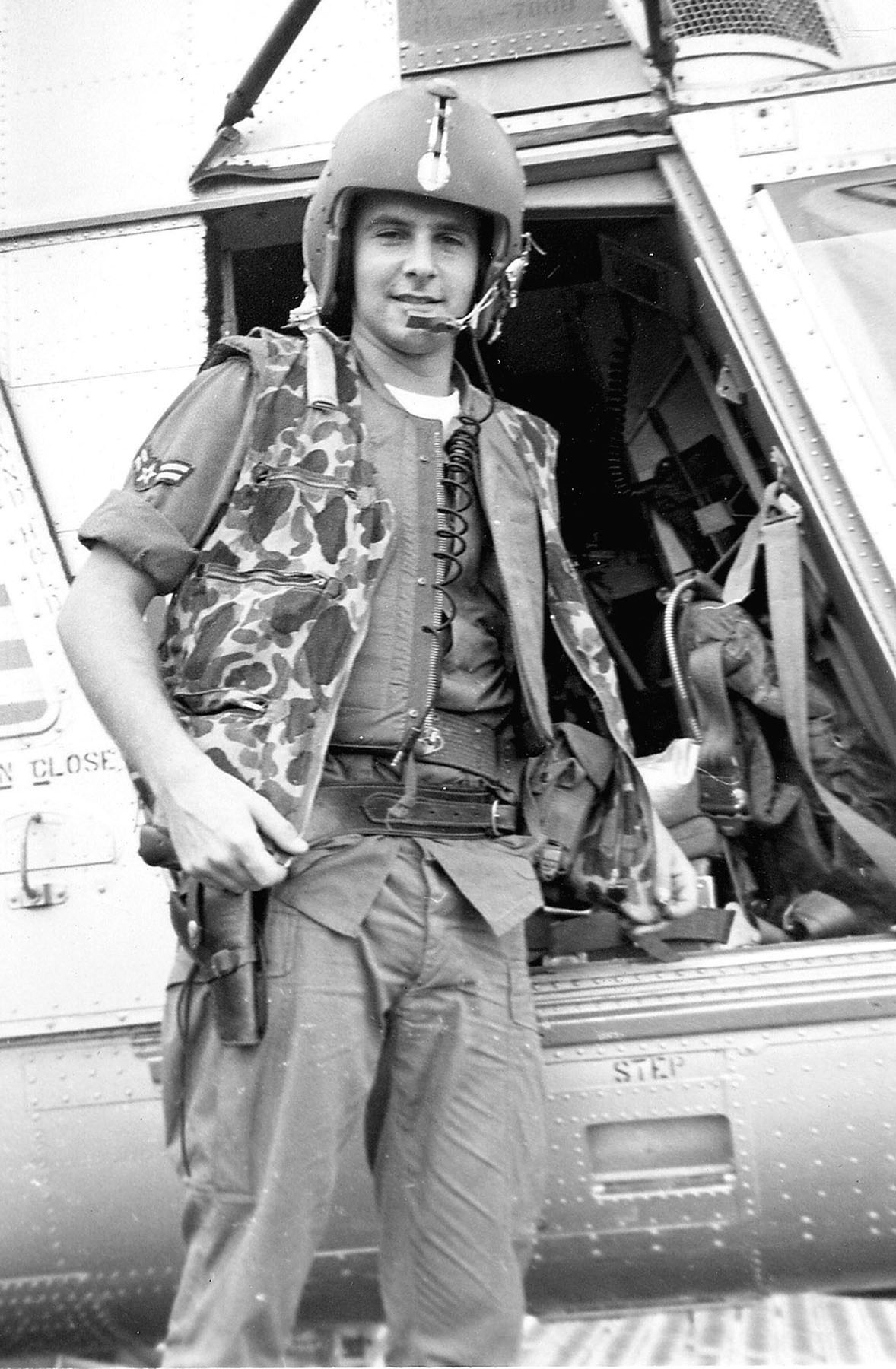
He received the Air Force Cross in 1966. On 8 December 2000 it was upgraded to the Medal of Honor. The citation says he
US Air Force: Portraits in Courage, William Pitsenbarger.
Where Are the Huskies Now?
The HH-43 was replaced in the early 1970s by larger helicopters such as the Sikorsky HH-3E, though some served in Southeast Asia until 1975. Of the 370 built, many survive in museums, but spare parts are very hard to find.
One is still flying. The Olympic Flight Museum in Olympia, Washington, keeps HH-43 serial 64-17558 airworthy, the only flying example known today.
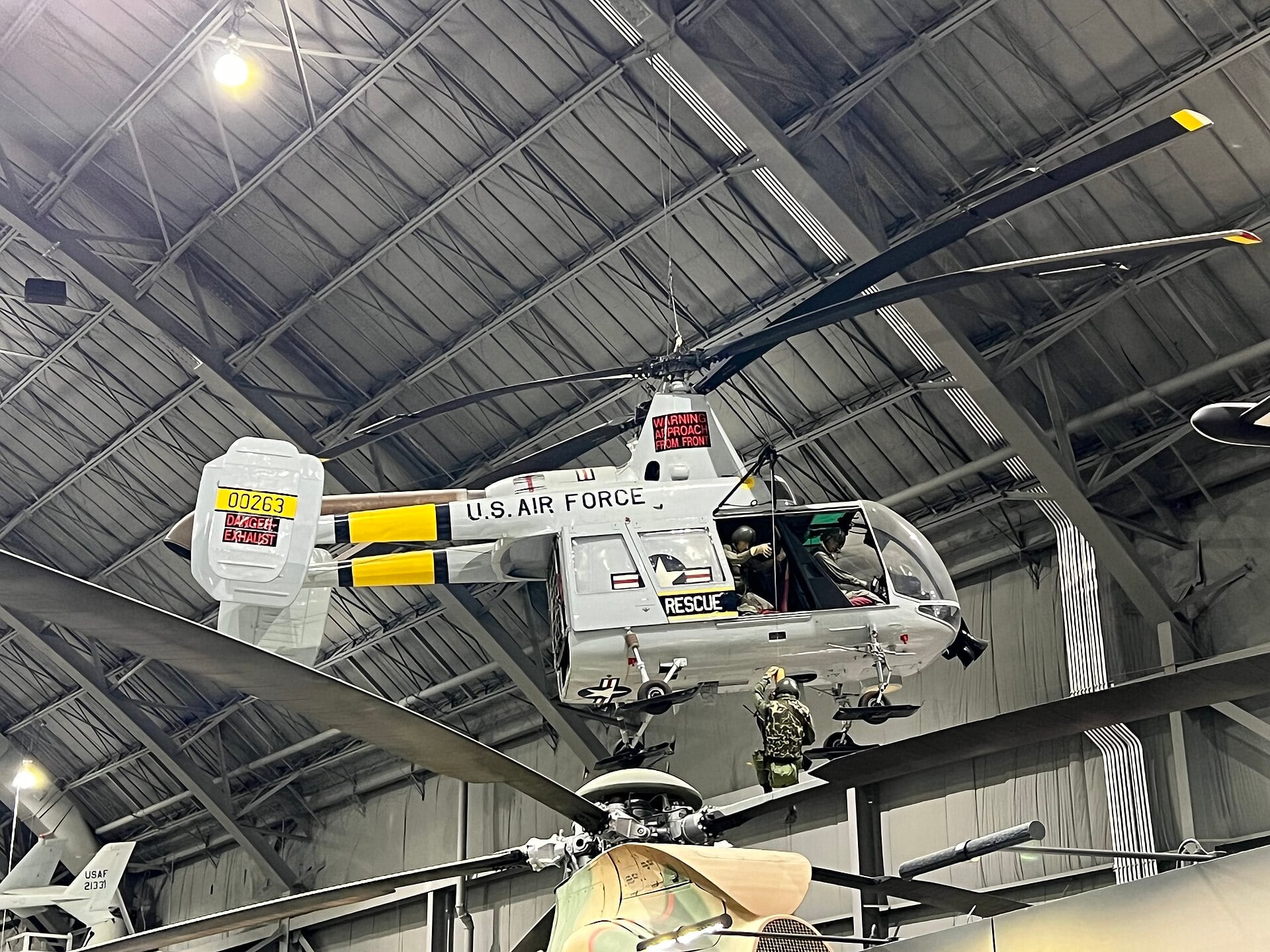
The last known flying HH-43 Huskie, from Ball Cap Casey.
The Huskie never looked like a warplane, and it was never meant to be one. But for thousands of soldiers and airmen in Vietnam, the sound of two eggbeater rotors was the sound of going home.
Sources: Wikipedia (Kaman HH-43 Huskie, William H. Pitsenbarger), National Museum of the US Air Force, Veterans Breakfast Club
0 Comments