
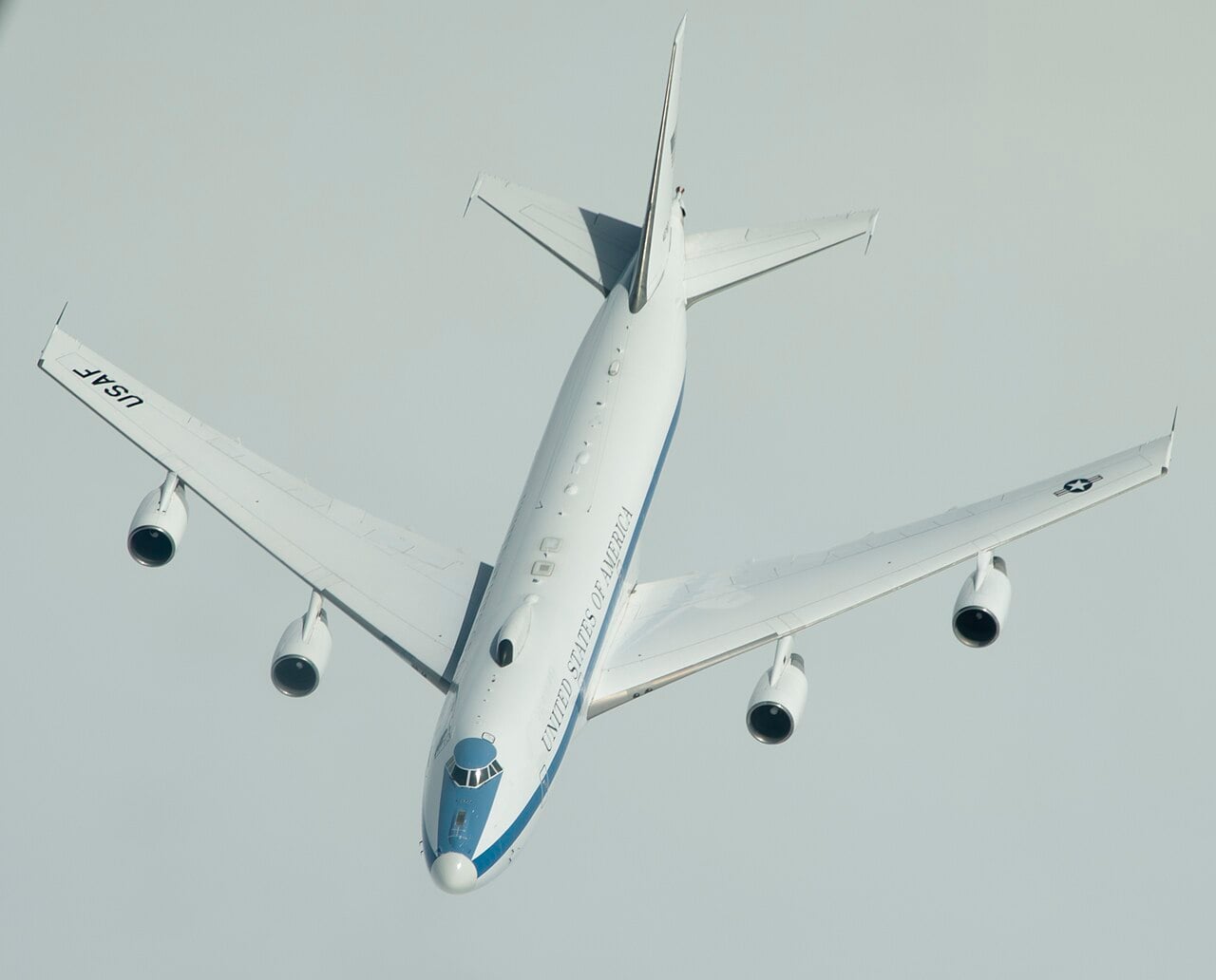
Every so often, a white Boeing 747 with a hump on its back turns up at a regional airport, flies a few approaches and leaves. Local TV stations ask what it was. Most recently, News On 6 asked that question in Tulsa at the end of September. The answer is always the same: the E-4B Nightwatch, better known as the Doomsday Plane.
It is the aircraft designed to keep the United States government running if the ground below it is on fire. And after more than four decades, it is finally getting a replacement.
Quick Facts
- Type: Boeing E-4B, modified from the Boeing 747-200B
- Role: National Airborne Operations Center (NAOC): survivable command post for the President, the Secretary of Defense and their successors
- Fleet: Four aircraft, 1st Airborne Command and Control Squadron, 595th Command and Control Group, Offutt AFB, Nebraska
- First E-4B delivered: 21 December 1979
- Crew: Up to 112 people, the largest crew of any USAF aircraft
- Endurance: 35.4 hours in a test flight; designed to stay aloft for a week with aerial refuelling
- Cost to fly: Nearly $160,000 per hour (2005 figure)
- Replacement: SNC E-4C Survivable Airborne Operations Center, based on the Boeing 747-8
A Flying Pentagon
The E-4 story began in 1973, when the Air Force ordered 747-200 airframes to replace the smaller EC-135J command posts. The first three were delivered as E-4As with interim equipment. A fourth, ordered in December 1973, was fitted with more advanced gear and became the first E-4B, delivered on 21 December 1979. The three E-4As were brought up to the same standard by January 1985.
Inside, the aircraft is laid out like an office building for the end of the world. There is an executive suite for the National Command Authority, a conference room, a briefing room, a battle staff area with 29 consoles, and a communications section that can talk to forces around the globe over UHF, SHF satellite and very low frequency radio. The galley can serve more than 100 hot meals on a long mission.
Business Insider's tour of the E-4B, one of the most-watched looks inside the aircraft. Video: Business Insider.
Built to Survive a Nuclear War
The E-4B's real trick is that it is hardened against the electromagnetic pulse (EMP) from a nuclear explosion. Its wiring and equipment are shielded, and it still flies with traditional analogue flight instruments, which are less vulnerable to an EMP than glass cockpit screens.

It can also stay up for a long time. In an endurance test, an E-4 remained airborne and fully operational for 35.4 hours, and the aircraft is designed to stay in the air for a week in an emergency with aerial refuelling. The limit is not fuel but engine oil. Filling it up takes two fully loaded KC-135 tankers.

Why It Shows Up in Places Like Tulsa
The E-4B flies regular training sorties, practising approaches at civil and military airfields around the country, and it often travels with the Secretary of Defense. Plane spotters and flight trackers follow it closely. When it appears somewhere unexpected, social media fills with theories. Usually, it is training.
It also follows the President abroad. In May 2026, flight trackers followed an E-4B across the Pacific to Okinawa during a presidential trip.
The Replacement: E-4C
The E-4Bs are old. The airframes were built in the 1970s and, according to Wikipedia, have a usable life that will be reached in 2039, with maintenance becoming harder long before that. In April 2024, the Air Force picked Sierra Nevada Corporation for a contract worth about $13 billion to build the replacement, now designated E-4C Survivable Airborne Operations Center. SNC bought five used Boeing 747-8s from Korean Air as the starting airframes, and flight testing began in 2025.
Until the E-4Cs arrive in the 2030s, four white 747s with humps on their backs will keep turning up at airports like Tulsa, flying a few approaches and leaving everyone wondering.
Sources: Wikipedia (Boeing E-4; SNC E-4C), DVIDS, U.S. Air Force, Defense News, Air & Space Forces Magazine, The Aviationist, News On 6, AirNav Radar and Wingbits on X. Featured image: Sgt. Nicole Leidholm / U.S. Air Force, public domain


0 Comments