

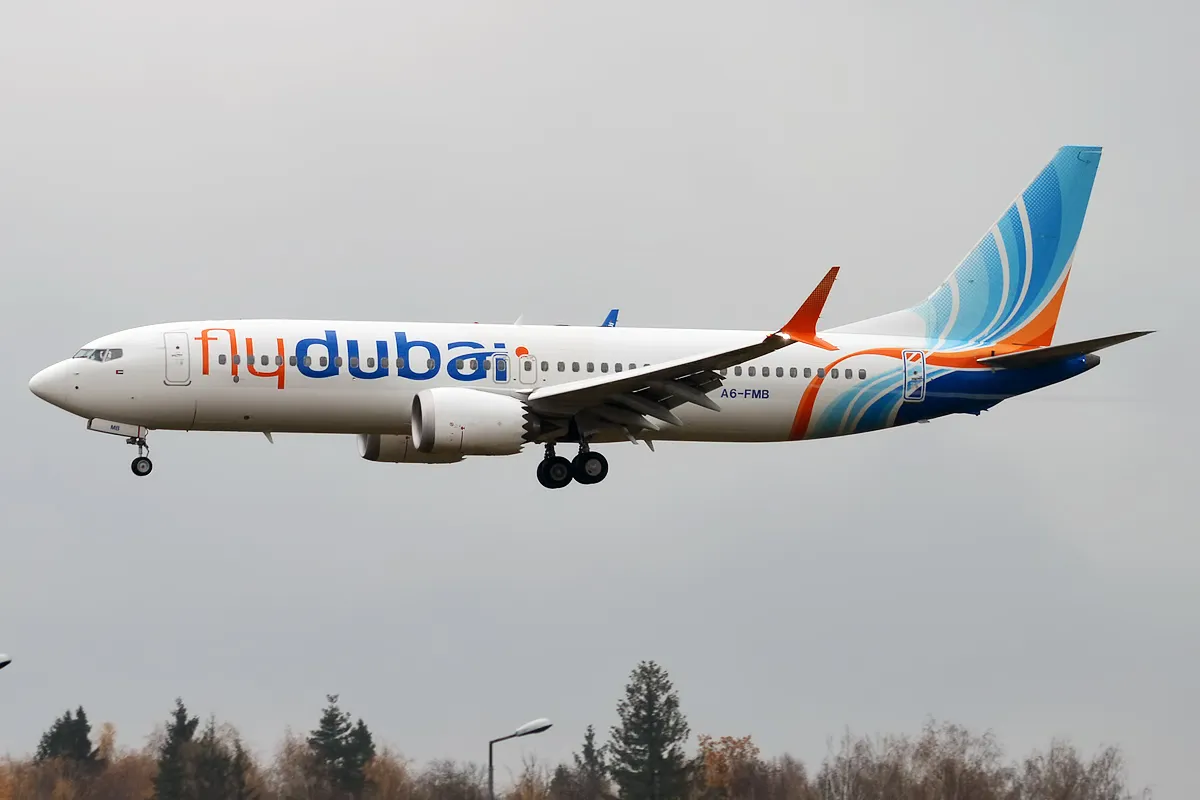
Within nine hours of flydubai FZ1073 landing at Tabuk, an Israeli cabinet minister had called it a jihadist terror attack, a finance minister had said the perpetrator should pay as though he had murdered, and the airline flying the aircraft had asked everybody to stop speculating.
All three statements were made about the same event, on the same day, and only one of them was accompanied by evidence. That gap is worth looking at directly, because the story of what happened in that cockpit is now moving considerably faster than the investigation into it.
Here is what is actually established about the co-pilot of FZ1073, what is being asserted without support, and the questions nobody has answered yet. We covered the flight itself and the squawk-code alarm that scrambled Israeli fighters in a separate report this morning.
Quick Facts
Established — one pilot stabbed the other in flight; the aircraft descended sharply; passengers and crew subdued the assailant; off-duty flydubai pilots stabilised and landed the jet at Tabuk.
Attributed to Israeli officials — the attacker was the co-pilot, and an Omani national. Sourced to unnamed Israeli officials speaking to CNN, not to a charging document.
Not established — his identity, the weapon, how it reached the cockpit, and the motive. None has been released by any authority.
Legal status — arrested and being questioned by Saudi authorities. Not charged. No court has ruled on anything.
The dive — flight tracking data shows the aircraft lost 17,400 feet in under two minutes.
The airline’s position — reasons and motives unknown, formal investigation launched, all parties urged to refrain from premature speculation.
What is actually established
The firmest account came from Netanyahu himself, in a video address. He was careful in one specific way that most of the coverage since has not been: he did not say which pilot attacked which.
Netanyahu went on to describe what he had been told by a passenger he spoke to personally: that the aircraft went into a spin and began to dive, and that the passenger managed to break into the cockpit with a crew member and together they neutralised the stabbing pilot while he was trying to sabotage the aircraft’s systems. Another air crew on board then entered the cockpit and stabilised the aircraft. He confirmed the pilot had been arrested and was being interrogated by Saudi authorities.
That the attacker was specifically the co-pilot, and specifically an Omani national, comes from a different and thinner place: Israeli officials briefing CNN, one of them anonymously. The US Ambassador to Israel, Mike Huckabee, also referred to Israelis on board having helped subdue the copilot. It is likely correct. It is not the same category of fact as a prime minister speaking on camera, and it is worth keeping the two apart.
Saudi Arabia’s leading aviation operator confirmed that both the captain and the co-pilot were injured and taken to hospital. Passengers filming inside the cabin described the stabbed pilot as severely wounded. One passenger, Ariel Oseran, recorded a message with blood smeared across his forehead: “Anyone who hears me we need help. We are landing in Tabuk in Saudi Arabia area, an unknown and unfamiliar area. Everyone on the plane is healthy and whole except for the pilot. We need help.”
What is being asserted without evidence
Israel’s Defence Minister Israel Katz described the incident as an attempted jihadist terror attack, thwarted only thanks to the heroism of a number of Israeli passengers. CNN, reporting his statement, noted plainly that he gave no evidence for the jihadist characterisation.
Finance Minister Bezalel Smotrich went further, saying Israel must relate to the intention and not to the results, and that the perpetrator must pay as if he murdered — along with any state or terrorist organisation that sent him. No authority has said anyone sent him. No authority has offered a motive at all.
President Isaac Herzog struck a different note, calling the outcome a great miracle and a moment of heroism, and saying Israel would act in every way to investigate the incident in depth together with its Emirati partners. Several other Israeli politicians across the spectrum, from Benny Gantz to Yair Golan to Itamar Ben-Gvir, praised the passengers.
Against all of that, the airline actually operating the aircraft said something notably more restrained.
There is no contradiction in reporting both. Politicians responded to an attack on their citizens within hours, which is what politicians do. But a characterisation offered without evidence, on the day, about a man who has been arrested and not charged, is a claim rather than a finding — and the distinction matters more, not less, when the stakes are this high.
The question aviation actually cares about: the knife
Strip away the politics and one question remains that every airline security department in the world is asking tonight. How did a bladed weapon get into the cockpit of an aircraft bound for Tel Aviv?
Neither the weapon nor its route on board has been disclosed. That is not evasion; it is genuinely early. But it is the crux, because flights to Israel operate under some of the tightest security protocols anywhere. Departing passengers face pre-screening and questioning, multiple passport checks, advanced baggage scanning and sometimes full-body screening. Foreign airlines must be approved by Israel’s Aviation Security Operation Center before they can serve the country at all.

There is history here too. In 2022 Israel and the United Arab Emirates resolved an aviation-security dispute that had threatened to halt Israeli carriers’ services to Dubai, after Israel’s Shin Bet raised concerns about security arrangements at Dubai International. The two sides reached a new agreement and undertook to work closely on airport security. That agreement is now going to be examined very carefully.
The uncomfortable part is that screening regimes are built primarily to stop threats coming from the cabin. The reinforced cockpit door, the defining security change of the post-2001 era, exists to keep passengers out. It offers nothing at all against a threat already sitting in a flight-deck seat. On FZ1073 that door appears to have worked exactly as designed, and passengers reportedly had to force their way through it to reach the cockpit.
Television coverage of the incident and the diversion to Tabuk.
What nobody has answered
CNN published its own list of open questions, which is a useful corrective to how settled the story sounds elsewhere. The identity of the attacker has not been released by any authority. The weapon has not been described, nor how it was brought aboard, nor exactly how the attack unfolded. No motive has been given by anyone official. Even the number of people on board has not been confirmed — flydubai has said all passengers are safe and accounted for, and Netanyahu said almost all of them were Israelis.
Reporting in the Swiss press and elsewhere has begun filling those gaps with details about the co-pilot: that he is Omani, that he had been with the airline around nine months, that the captain is Saudi. Some or all of that may well prove accurate. None of it has been confirmed by an authority, and a man’s biography assembled from unnamed sources on the day of his arrest is not a finding of fact.
For what it is worth, the pattern of this kind of event is that the early characterisation is often wrong. Determining whether a deliberate act by a crew member was ideological, personal, or the product of a medical or psychiatric crisis has historically taken investigators months, and in several well-known cases the competing explanations were still being argued over years later. Anyone confident about the answer nine hours in is not working from evidence.
Stranded in a country that does not recognise you
The aftermath produced its own small diplomatic problem. Roughly 174 people, most of them Israeli, were on the ground at a Saudi airport in a country that has no diplomatic relations with Israel. Until 2022, Israeli airlines and Israel-bound flights were not permitted to enter Saudi airspace at all.
Israel explored sending either a military or a civilian aircraft to collect them. Riyadh refused to allow Israeli aircraft in. The passengers went home instead on replacement flydubai jets sent to Tabuk, landing back at Ben Gurion in the early evening. Relatives waiting at the airport told CNN that three families had refused to board the substitute flight and were insisting on flying only with an Israeli carrier — which, in the circumstances, is not difficult to understand.
The investigation now sits across at least three jurisdictions: Saudi Arabia, which has the suspect in custody; the United Arab Emirates, whose airline and aircraft were involved and whose regulator will lead the formal safety investigation; and Israel, whose citizens were the intended victims and which has said it will investigate alongside its Emirati partners. Those three do not have a common legal framework, and two of them do not have formal relations. Getting to an agreed set of facts is going to be slow.
Which is the strongest argument for patience. The passengers and crew who forced that cockpit door open have earned a proper answer about what they walked into. They are unlikely to get it this week, and nothing said on television today counts as one.
Sources: CNN live coverage, 30 September 2026, including Prime Minister Benjamin Netanyahu’s video address, the flydubai spokesperson’s statement, and reporting by Tal Shalev, Billy Stockwell, Catherine Nicholls, Ivana Kottasová, Dana Karni, Andrew Carey, Kim Kelaita, Sophie Tanno, Eyad Kourdi and Abbas Al Lawati; US Ambassador Mike Huckabee via X; statements from President Isaac Herzog, Defence Minister Israel Katz and Finance Minister Bezalel Smotrich; Saudi aviation operator Cluster2; The Jerusalem Post; Newsweek; 20 Minuten. The co-pilot has been arrested and is being questioned. He has not been charged, and the allegations against him have not been tested in any court.


0 Comments