

The shipping ticket said "Oxy Cannisters — 'Empty'." The spelling was wrong and so was the word in quotation marks. There were five cardboard boxes, each weighing 45 to 50 pounds, and they were loaded into the forward hold of a DC-9 at Miami on 11 May 1996 alongside three tyres and wheels. Nobody aboard knew what was in them, because the man who packed them did not know either.
Thirteen minutes later ValuJet flight 592 was in the Everglades and all 110 people on it were dead.
Almost every rule governing what you may and may not carry onto an aeroplane has a story like that behind it. They are not arbitrary, they are not security theatre, and they are not the same thing as the rules the screener enforces at the checkpoint. They are the dangerous-goods regulations, and the modern version of the same argument is sitting in your pocket.
Quick Facts
ValuJet 592 — Douglas DC-9-32, N904VJ, 11 May 1996, 1413:42 EDT, Miami to Atlanta. 110 dead: both pilots, three flight attendants, 105 passengers.
The cargo — unexpended chemical oxygen generators, carried without safety caps, labelled "aircraft parts" and described on the ticket as empty. In an FAA test the temperature above a single box reached about 2,000 °F ten minutes after ignition.
The rule that followed — 49 CFR 173.168(f)(1): "A chemical oxygen generator is forbidden for transportation on board a passenger-carrying aircraft."
Class D abolished — Federal Register, 17 February 1998, Docket 28937, Amendments 25-93 and 121-269. 14 CFR 25.857(d) has read "[Reserved]" ever since.
Lithium limits — 49 CFR 175.10(a)(18): up to 100 Wh freely; 101–160 Wh with the operator's approval, maximum two spares; above 160 Wh there is no exception. Spare batteries and power banks are carry-on only.
FAA incident count — 38 verified lithium battery incidents between 1 January and 30 June 2025, and a record 89 in calendar 2024, in the FAA's own words.
Five boxes marked "empty"
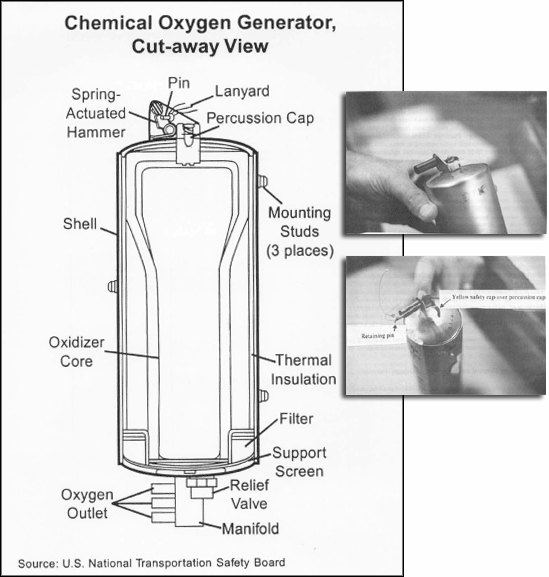
The generators had been removed from two other ValuJet aircraft by a maintenance contractor, SabreTech. A chemical oxygen generator is the device behind the drop-down mask: pull the lanyard, a percussion cap fires, and a sodium chlorate core begins an exothermic reaction that liberates oxygen for roughly a quarter of an hour. The reaction cannot be stopped once started, and it runs hot.
The maintenance manual required a safety cap over the primer of any generator that had not been expended. SabreTech did not have safety caps in inventory. The mechanics tagged the units green, meaning "repairable". A stock clerk, seeing the green tags and having spoken to nobody about what the devices were, concluded they were empty canisters, packed them end to end along the length of each box with two or three inches of bubble wrap on top, and labelled the boxes as company material.
The NTSB's probable cause names three failures, and it is worth reading in full rather than in summary. The fire in the Class D cargo compartment "was initiated by the actuation of one or more oxygen generators being improperly carried as cargo", and the causes were the failure of SabreTech to prepare, package and identify them; the failure of ValuJet to oversee its contract maintenance programme; and "the failure of the Federal Aviation Administration (FAA) to require smoke detection and fire suppression systems in class D cargo compartments."
The design that was supposed to smother the fire
A Class D compartment had no fire detection and no fire suppression. That was not an oversight; it was the design philosophy. Seal the hold tightly enough and limit the airflow, and any fire inside it will consume the available oxygen and go out. The regulation as it then stood required that "a fire occurring in it will be completely confined without endangering the safety of the airplane or the occupants", and specified an acceptable airflow of 1,500 cubic feet per hour for compartments of 500 cubic feet or less.
The philosophy works, right up until the cargo is itself an oxidiser. The Safety Board put it plainly: "Although class D cargo compartments are designed to suppress fire through oxygen starvation, this accident and events before this accident illustrate that some cargo, specifically oxidizers, can generate sufficient oxygen to support combustion in the reduced ventilation environment of a class D cargo compartment."
And the Board had asked for detection and suppression before. After an in-flight fire aboard American Airlines flight 132, a DC-9-83, at Nashville in February 1988, it issued Safety Recommendations A-88-122 and -123. In August 1993 the FAA replied that such systems "were not cost beneficial" and terminated the rulemaking.
The ValuJet 592 investigation in full. The sequence inside the forward hold is the part worth watching: a Class D compartment was designed to starve a fire of oxygen, and the cargo it was carrying made its own.
The two words that rewrote the rulebook
On 17 February 1998 the FAA published "Revised Standards for Cargo or Baggage Compartments in Transport Category Airplanes" — Docket 28937, Amendments 25-93 and 121-269, effective 19 March 1998. It eliminated Class D as an option for future type certification and gave existing passenger aircraft until 19 March 2001 to bring every Class D compartment up to Class C standard, meaning a separate approved smoke or fire detector reporting to the flight deck and a built-in suppression system controllable from the cockpit.
Read 14 CFR 25.857 today and the whole history is in two words. Paragraph (a) is Class A, (b) is Class B, (c) is Class C, (e) is Class E, (f) is Class F, added in 2016. Paragraph (d) reads, in its entirety: "[Reserved]". The category has been an empty slot in the certification basis since Amendment 25-93.
The matching prohibition on the cargo itself is just as blunt. 49 CFR 173.168(f)(1): "A chemical oxygen generator is forbidden for transportation on board a passenger-carrying aircraft." Not restricted, not requiring approval. Forbidden.

The rule that follows you into the cabin
Which brings us to the thing in your bag. The governing text for passengers is 49 CFR 175.10(a)(18), and it sets three thresholds that almost everybody gets slightly wrong.
Up to 100 watt-hours, a lithium-ion battery travels without anyone's permission. Between 101 and 160 Wh it travels "with the approval of the operator", and no more than two such spares per person, in carry-on baggage. Above 160 Wh there is no exception in the section at all — the only higher figure anywhere in the passenger rules is the 300 Wh allowance for a wheelchair or mobility-aid battery under paragraph (a)(17). Spare batteries, the regulation says, "must be carried in carry-on baggage only", and each one must be "individually protected so as to prevent short circuits".
The sentence that catches people out is paragraph (a)(18)(iv): articles containing lithium cells "the primary purpose of which is to provide power to another device must be carried as spare batteries in accordance with the provisions of this paragraph." That is the legal definition of a power bank. It is not a device. It is a spare battery, and it may never go in the hold.
A power bank going into thermal runaway in a cabin. This is the scenario behind every airline rule that now tells you to keep the thing where a crew member can reach it.
What the airlines added, and what the regulations still have not
Here is the part most coverage gets wrong. The two-power-bank limit you keep reading about, and the ban on using or charging one in flight, are not in 49 CFR. IATA's 2026 passenger guidance says so itself: these are "further proposed restrictions" and "it will take some time for these proposals to be accepted into regulation", with airlines "moving early to adopt these measures". The same document records a genuine terminology change — power banks "are no longer referred to as 'spare batteries'" in IATA's own material, even though US regulation still treats them as exactly that.
The carriers moved first and individually. Emirates announced on 30 September 2025 that from the following day customers could carry one power bank under 100 Wh, that power banks "may not be used to charge any personal devices onboard", that charging a power bank from the aircraft supply "is not permitted", and that they may not go in the overhead bin. Qantas and Jetstar introduced their own rules from 15 December 2025: up to two power banks, cabin baggage only, each not exceeding 160 Wh, with use and charging on board prohibited. Southwest requires a power bank in use to be visible rather than stowed in a bag. South Korea went further and did it by government order, the Ministry of Land, Infrastructure and Transport requiring from 1 September 2025 that power banks be insulated and kept in a seat pocket or inside clothing, never in an overhead bin and not used in flight.
Separately, and much less widely understood, lithium-ion batteries shipped as cargo have been barred from passenger aircraft since 1 April 2016, and when carried on a freighter must be offered "at a state of charge not exceeding 30 per cent of their rated capacity". That applies to the pallet in the hold, not to the phone in your hand.
The freighters that proved the point — carefully
Two cargo accidents are always cited here, and both deserve more precision than they usually get.
UPS flight 6, a Boeing 747-44AF, crashed near Dubai on 3 September 2010, killing both pilots. The GCAA found that "a large fire developed in palletized cargo on the main deck… consisting of consignments of mixed cargo including a significant number of lithium type batteries and other combustible materials", and that it "escalated rapidly into a catastrophic uncontained fire". Less than three minutes after the first warning the fire had severely damaged the flight control systems; the captain's oxygen supply failed five and a half minutes after it. But the report stops short of proving ignition: it concludes "with reasonable certainty" that the fire was in cargo containing lithium batteries, and says only that it is "possible" a battery went into thermal runaway. Headlines that say lithium batteries caused UPS 6 are stating more than the investigation did.
Asiana flight 991, also a 747-400F, went into the sea west of Jeju on 28 July 2011, again with two crew killed. The Korean ARAIB found that "a fire developed on or near the pallets containing dangerous goods but no physical evidence of the cause of the fire was found". Its finding on the batteries is a model of careful language: the board "failed to acquire the data that could prove the self-ignition possibility of lithium-ion batteries in normal conditions of transport, but when they are heated externally, they can go into thermal runaway."
Both reports converge on the same structural complaint, and it is the Class D argument again in a different compartment: there is no regulatory requirement for active fire suppression in a Class E cargo hold.
UPS 6 out of Dubai in September 2010. A fire took hold in palletised cargo on the main deck and the crew lost the cockpit to smoke within minutes. Both pilots were killed, and the accident is a large part of why bulk lithium shipments on passenger aircraft are now forbidden outright.
What is actually forbidden — and what is not
The genuinely forbidden list, in both cabin and hold, is shorter and stranger than most people assume. All fireworks, the FAA says, "no matter how small", including sparklers and party poppers. Strike-anywhere matches. Torch and jet-flame lighters. Flammable aerosols that are not medicinal or toiletry articles, which catches spray paint, WD-40 and cooking spray. Passenger-supplied oxygen in any form, including canned "recreational" oxygen. And the one that started this article.
The limits on what is allowed are oddly specific. One packet of safety matches or one lighter — the regulation says "or", even though the FAA's own consumer chart lists them as two separate allowances. Dry ice: 2.5 kg, 5.5 pounds, per person, with the operator's approval and in a package that lets the gas escape. Self-defence spray: one container, not exceeding 118 ml, checked baggage only. Alcohol over 24 per cent and up to 70 per cent: five litres per person in unopened retail packaging, and nothing above 70 per cent at all.
And then the myths. Hoverboards are not banned by the FAA — "these devices may be carried like other portable electronic devices in checked or carry-on baggage", with operator approval above 100 Wh and a genuine prohibition only above 160 Wh. The blanket ban you have read about is airline policy, not federal rule. A small medical mercury thermometer is legal in checked baggage in a protective case. Chemical hand warmers "are not regulated as hazardous materials for transportation". Instant ice packs are allowed for medical purposes. Electric curling irons are unrestricted; it is the butane ones that are limited to one per person. And medically necessary liquids are not subject to the 100 ml rule at all — the TSA "allows larger amounts of medically necessary liquids, gels, and aerosols in reasonable quantities for your trip", provided you declare them.
That last distinction is the one worth carrying away. The FAA's own chart says it: "the TSA security rules are separate from the Federal Aviation Administration (FAA) dangerous goods safety rules." One set exists to stop somebody doing harm deliberately. The other exists because of five cardboard boxes that nobody thought were dangerous.

Sources: NTSB Aircraft Accident Report AAR-97/06 (ValuJet 592); NTSB Safety Recommendation letter A-96-25 through -28, 31 May 1996; testimony of NTSB Chairman Jim Hall to the House Subcommittee on Aviation, 15 May 1997; Federal Register, 17 February 1998, Docket 28937, Amendments 25-93 and 121-269; 14 CFR 25.857 and 121.314, and 49 CFR 173.168, 173.185, 175.10 and 172.102 Special Provision A100 (eCFR); FAA PackSafe; FAA SAFO 16004; FAA blog, 12 August 2025; IATA Lithium Battery Guidance Document and Passengers Travelling with Lithium Batteries, 2026 editions; IATA press release, 15 October 2025; UAE GCAA Final Report 13/2010 (UPS 6); Republic of Korea ARAIB report AAR1105 (Asiana 991); Emirates media centre, 30 September 2025; Qantas Agency Connect, November 2025; korea.net (MOLIT), 2025; TSA.


0 Comments