
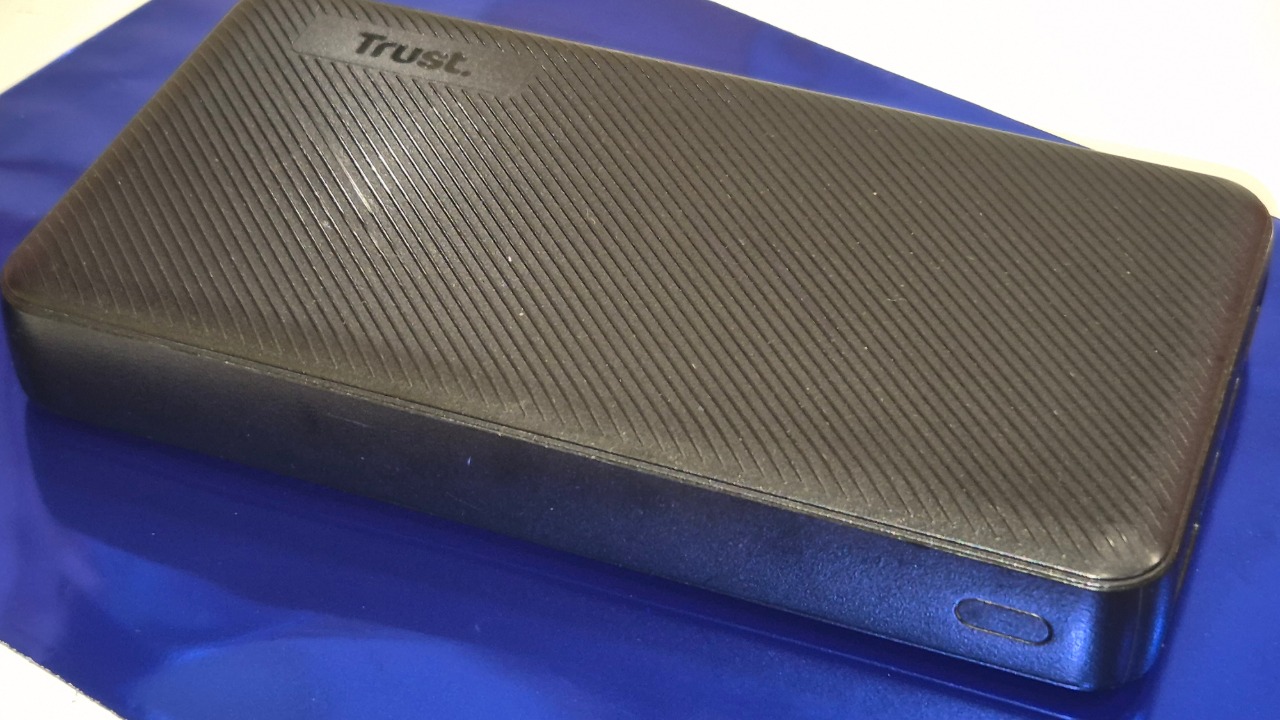
The gate agent turns the power bank over in her hand, looking for a number. The passenger already knows the one printed on the case in the largest type: 20,000 mAh. It is the number the shop advertised, the number on the box, the number in the Amazon listing. It is also not the number she needs.
What she is looking for is a watt-hour rating, because that is the unit every aviation rulebook on earth is written in. On a good power bank it is etched somewhere on the underside in six-point grey. On a cheap one it is not there at all, and then the rule is that the device does not fly.
This gap between the number on the box and the number in the regulation is the reason power banks have become the most-asked question in airport security, and on 27 March 2026 it got sharper, because that is the day the global rules changed.
Quick Facts
Rule in force: ICAO Technical Instructions (Doc 9284), Addendum No. 1, applicable 27 March 2026
Limit per passenger: two power banks
Energy limit: 100 Wh without operator approval
Roughly equivalent capacity: about 27,000 mAh at 3.7 V nominal
Above 160 Wh: not carriable in passenger baggage at all
Stowage: carry-on only, forbidden in checked baggage
Recharging on board: prohibited
Airline variation: wide. Emirates allows one bank and bans use outright
What changed on 27 March 2026
The International Civil Aviation Organization amended its Technical Instructions mid-edition. Addendum No. 1 to Doc 9284, 2025 to 2026 Edition, carries an applicability date of 27 March 2026 and rewrites the passenger battery table so that power banks are no longer treated as ordinary spare batteries. The addendum text sets out five requirements for them:
- must be carried as carry-on baggage;
- must not be recharged while onboard the aircraft;
- should not be used to recharge a portable electronic device while onboard the aircraft;
- no more than two power banks may be carried per person; and
- must be individually protected so as to prevent short circuits when not in use.
Two of those are genuinely new. The two-bank cap did not exist before, and neither did the prohibition on recharging a power bank from the aircraft supply. The third, on using a bank to charge a phone in flight, is phrased as should not rather than must not, which is why some airlines ban it outright and others do not.
ICAO explained the split in its own announcement: the devices "will now be limited to two per passenger, and passengers will be prohibited from recharging them during flights", with crew exempted where the aircraft’s operational requirements demand it. IATA, reproducing the addendum for operators, was blunter about the reasoning. Power banks, it wrote, "are presenting an increasing concern with the threat of thermal runaway and fire risk in aircraft", with "low barriers to manufacturing and a general lack of confidence in global regulatory oversight of non-conforming manufacturers".
CBS Evening News on a power bank that burst into flames in flight, and the damage it left behind.
The number on the box is the wrong number
Every authority that writes these rules gives the same formula, and not one of them finishes the job. IATA states it as "Wh = Ah x V". The FAA goes a step further and spells out the milliamp-hour conversion in its own passenger FAQ: "For milliamp hours (mAh), divide mAh by 1000 (to get to Ah) and then multiply by the V." Qantas publishes a worked example. The underlying UN definition is the most precise of all: the watt-hour rating is "calculated by multiplying nominal voltage by rated capacity expressed in ampere-hours".
So: divide by a thousand, multiply by the voltage. Which voltage? None of them says. That single omission is the whole problem, because the number a passenger is most likely to reach for is the 5 V printed beside the USB socket, and 5 V is the wrong figure by a wide margin.
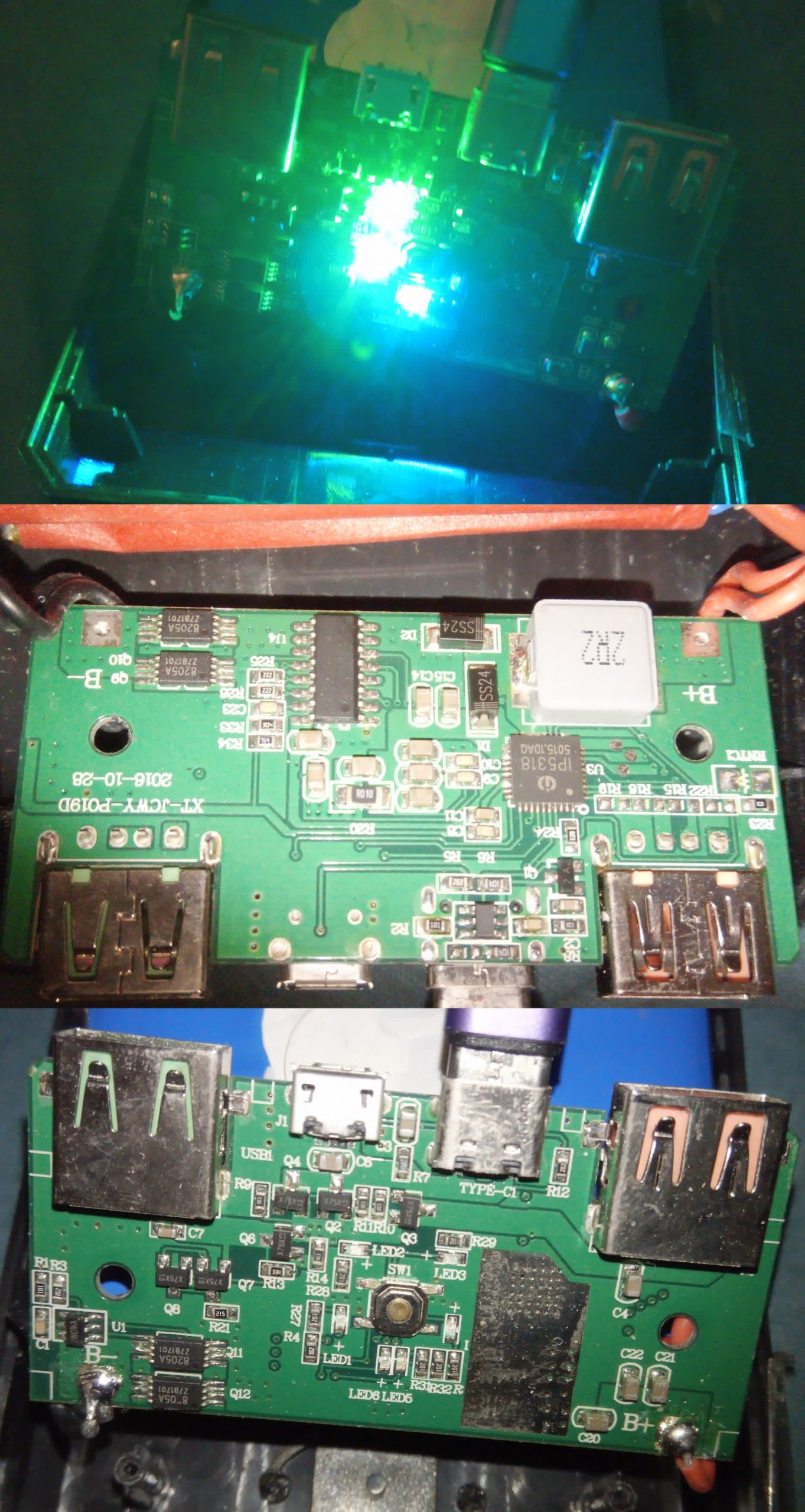
The 5 V at the socket is an output, manufactured by a boost converter on exactly the kind of board above. The rating in the regulation is a property of the cells: their manufacturer-declared nominal energy, derived from rated capacity and nominal voltage. For the lithium-ion cells inside consumer power banks that nominal figure is conventionally 3.6 or 3.7 volts, and 3.7 V is the value the FAA’s own fire-safety laboratory uses when it describes its test articles.
It is worth being precise about the limits of that claim, because this is where published explanations tend to overreach. No standard that we could read fixes lithium-ion nominal voltage at 3.7 V; IEC 61960-3, the standard the UN Manual points to, is paywalled. What can be said is that the regulation uses nominal voltage, that nominal voltage for these cells is conventionally 3.6 to 3.7 V, and that it is certainly not 5 V. Use 5 V and a perfectly ordinary 20,000 mAh bank lands at exactly 100 watt-hours, right on the threshold. That is why the error matters.
Where the lines actually fall
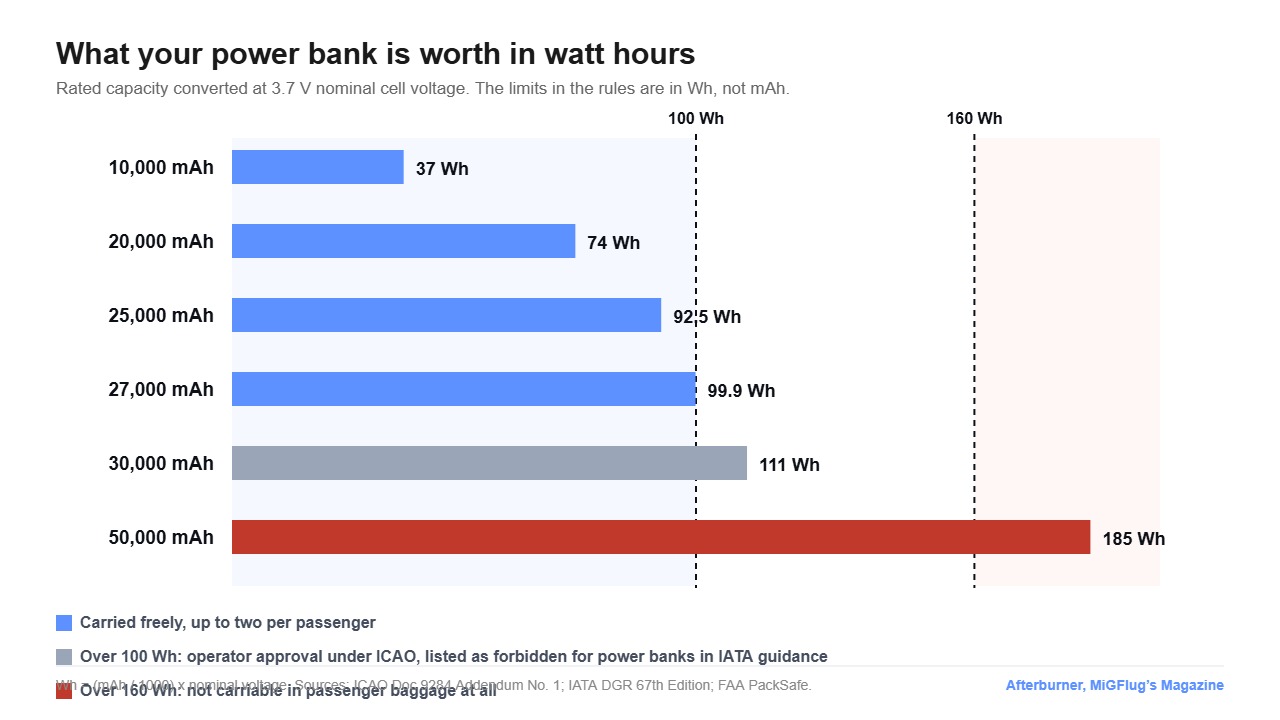
Do the arithmetic at 3.7 V and the picture is clear. A 10,000 mAh bank is 37 Wh. The ubiquitous 20,000 mAh brick is 74 Wh, comfortably inside the limit. A 25,000 mAh unit is 92.5 Wh. At 27,000 mAh you are at 99.9 Wh, which is one tenth of a watt-hour under the line, and that is not a coincidence: 100 Wh divided by 3.7 V is 27,027 mAh, which is precisely why 26,800 and 27,000 mAh are the largest capacities routinely marketed as travel-friendly.
Above that it gets unforgiving quickly. A 30,000 mAh bank is 111 Wh and over the line at either assumed voltage. A 50,000 mAh unit is 185 Wh, past 160 Wh, and simply cannot be carried in passenger baggage in any configuration. The Civil Aviation Authority of Singapore is one of the few regulators to publish a mAh equivalent at all, bracketing the threshold as roughly 27,000 mAh, which is consistent with a 3.7 V assumption although CAAS does not state the voltage it used.
IATA’s own survey work explains why the industry bothered. Forty-four per cent of travellers now carry a power bank. Forty-five per cent wrongly believe it is acceptable to pack one in checked luggage, where it is forbidden outright. And a third believe there is no power limit on power banks or spare batteries at all.
ICAO says one thing, IATA says another
Here is the wrinkle that makes a mockery of the idea of a single global rule. The ICAO addendum permits a power bank between 100 and 160 Wh with the operator’s approval, exactly as it does for other spare batteries. IATA has decided not to carry that across. Its operator guidance states that the provision "will not be carried into the 68th edition of the DGRs", citing the same concerns about manufacturing oversight, and its passenger-facing table simply marks the 100 to 160 Wh power bank row Forbidden.
So a 120 Wh power bank is lawful under the ICAO Technical Instructions with your airline’s approval, and forbidden in the guidance the airlines are being handed. Qantas, meanwhile, publishes its own allowance of "up to two power banks per person, each not exceeding 160Wh", which is more generous than IATA’s table and squarely within ICAO’s. Three documents, three answers, same device.
The Australian Transport Safety Bureau’s own footage of the aftermath of the Hobart fire, which is the incident that drove much of the 2025 and 2026 tightening.
Why the rules got stricter: a backpack over row 7
On 21 July 2025 a Virgin Australia Boeing 737, VH-YFY, was descending towards Hobart with six crew and 149 passengers aboard when cabin crew heard what the ATSB report describes as a popping and hissing sound. White smoke and then flames came from the overhead locker above row 7. A passenger’s backpack was alight. The crew emptied an extinguisher into it, then water, then discharged a second extinguisher into the locker to stop it reigniting. The flight crew broadcast a PAN PAN and landed safely.
Inside the backpack was a power bank in thermal runaway. Two findings from investigation AO-2025-043, released on 18 December 2025, did more to change airline policy than any amount of rulemaking. The cabin crew could not complete the operator’s lithium battery fire procedures, because the fire began ten minutes before landing while they were also securing the cabin. And two crew members who reached for the protective breathing equipment "did not find it effective due to fitment and communication/visibility issues", which left them with no protection from the smoke.
Virgin Australia now requires power banks and spare batteries to be stowed in the seat pocket, under the seat in front, or on the passenger. Not in the overhead lockers. Qantas and Jetstar revised their own policies in mid-December. The FAA had already made the same argument in safety alert SAFO 25002 in August 2025: batteries in overhead bins "may be obscured, difficult to access, or not readily monitored", so detection and firefighting "may be delayed in flight, increasing the risk to safety".
Every airline then writes its own version
IATA’s dangerous goods table ends with a sentence that is doing an enormous amount of work: the provisions "may be limited by State or operator variations. Passengers should check with their airline for the current provisions." They vary more than most passengers imagine.
Emirates is the strictest of the majors. Since 1 October 2025 using any kind of power bank on board is prohibited, passengers may carry one rather than two, charging a bank from the aircraft supply is not permitted, and banks may not go in the overhead bin at all. Lufthansa Group followed on 15 January 2026 with a group-wide rule: neither used nor charged on board, maximum two, no overhead stowage. Singapore Airlines and Scoot got there first, on 1 April 2025, followed by Thai Airways on 15 March 2025, EVA Air on 1 March 2025 and AirAsia on 1 April 2025.
Asiana published one of the tightest numerical limits of any carrier when its 20 April 2026 notice capped spare batteries at five per passenger, against IATA’s baseline of twenty. Cathay Pacific warns that any power bank beyond the second will be confiscated by security screening at Hong Kong International. And two carriers go the other way: Ryanair and Air New Zealand both explicitly permit using a power bank to charge a device in the cruise, banning it only during taxi, take-off and landing, which is exactly what ICAO’s recommendation, as opposed to its requirement, allows.
States have started legislating directly too. Hong Kong’s Civil Aviation Department issued advisory circular DGAC 2/2026 on 28 March 2026 with immediate effect, capping passengers at two banks in carry-on and prohibiting recharging in flight. Singapore’s CAAS published safety information bulletin 2026-02 on 6 April 2026 to the same effect. Malta’s notice cites the ICAO addendum directly. The direction of travel is one way.
NBC News on the rise in lithium battery incidents aboard US flights.
What to do before you fly
Find the watt-hour marking. IATA states that "all lithium-ion batteries are required to have the Watt-hour rating marked on the outside of the battery case", and the consequence of its absence is spelled out plainly: if staff "are unable to verify the Watt-hour rating by checking either the battery, or the user documentation, the operator may not permit the carriage of the lithium battery". An unmarked bank is a bank that may not travel, regardless of its actual capacity.
If there is no marking, do the conversion yourself and know the answer before you reach the checkpoint. Keep the bank in the seat pocket or under the seat rather than the overhead bin, which is now a rule rather than a courtesy on a growing list of airlines. Protect the terminals, which in practice means the original packaging, a pouch, or tape. And do not pack one in the hold under any circumstances: that is the one rule every authority agrees on, and the reason is simply that a fire in the cabin gets fought and a fire in the hold does not get reached.
The underlying awkwardness is not going away. The industry regulates energy; the market sells capacity; and the two are related by a voltage that nobody prints on the box. Until that changes, the honest answer to "is my 20,000 mAh power bank allowed" is yes, almost certainly, at about 74 watt-hours, and the only way to be sure is to do the sum.
Sources: ICAO Doc 9284 Technical Instructions Addendum No. 1; ICAO news release on power bank restrictions; IATA Guidance to Operators on Power Banks and IATA Guidance Document for Passengers Travelling with Lithium Batteries 2026; IATA Dangerous Goods Regulations 67th Edition Table 2.3.A; FAA PackSafe and FAA SAFO 25002; ATSB investigation AO-2025-043; UK CAA; Hong Kong Civil Aviation Department DGAC 2/2026; CAAS Singapore SIB 2026-02; airline published conditions of carriage.



0 Comments