
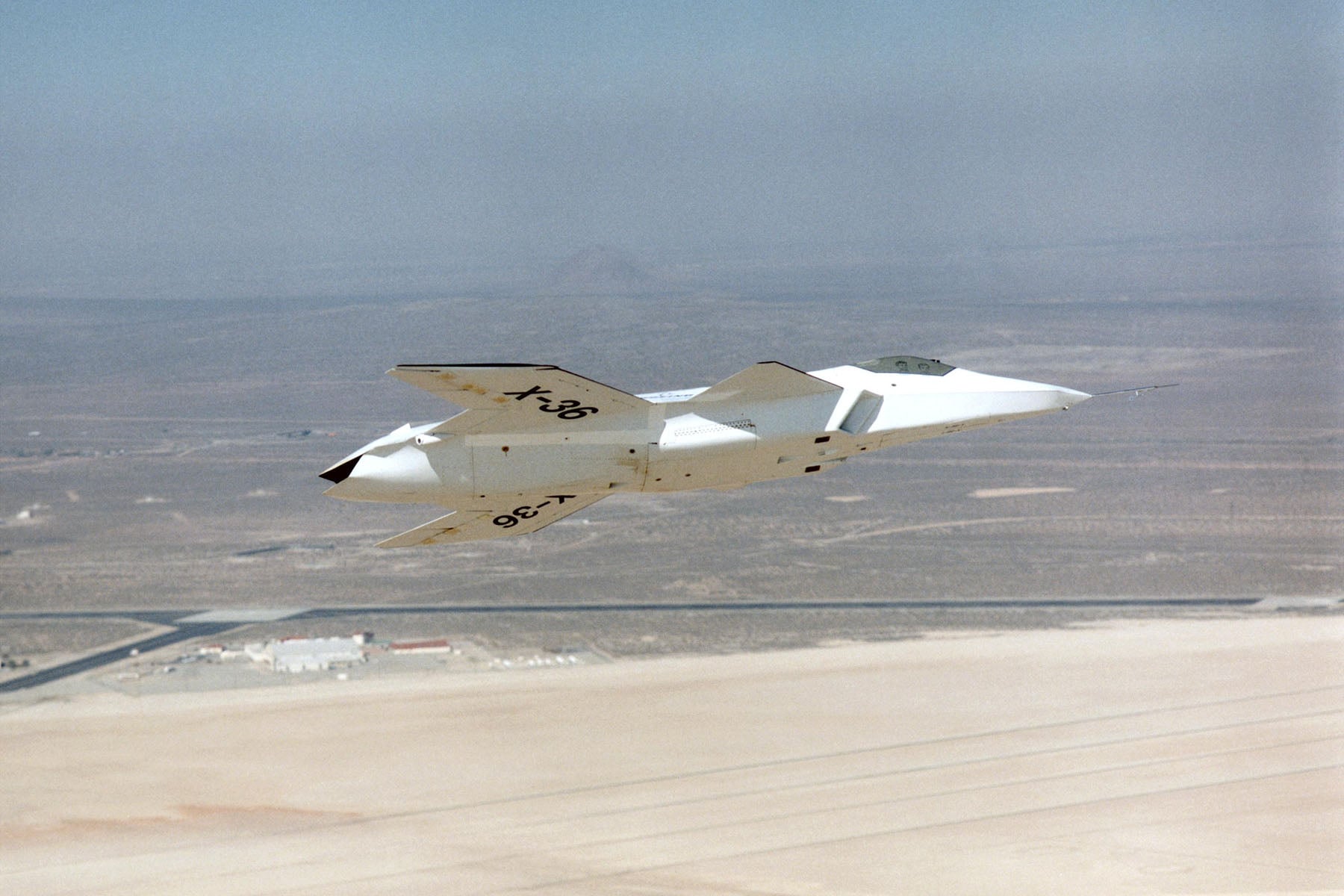
Every fighter you have ever seen has a tail. Fins keep it pointing forward, rudders turn it, and for a stealth aircraft those same fins are big flat radar reflectors. In 1997, NASA and McDonnell Douglas flew a small, sinister-looking jet over the Mojave Desert to find out what happens when you simply leave the tail off.
The X-36 Tailless Fighter Agility Research Aircraft had no vertical fin at all, no pilot on board and a price tag of around $21 million for two airframes. It flew 31 times, outmanoeuvred expectations and, nearly thirty years later, looks remarkably like the sixth-generation fighters now emerging in China and the United States.
Quick Facts
- Aircraft: NASA / McDonnell Douglas X-36, two built
- Scale: 28 percent of a notional future fighter
- Size: About 19 ft long, just over 10 ft span, about 1,250 lb fully fuelled
- Engine: Williams International F112 turbofan, about 700 lbf thrust
- Flights: 31, from 17 May to 12 November 1997, total 15 hours 38 minutes
- Pilot: Flown remotely from a ground cockpit with a nose-camera view
- Cost: About $21 million for both aircraft, according to NASA
How Do You Steer a Fighter With No Tail?
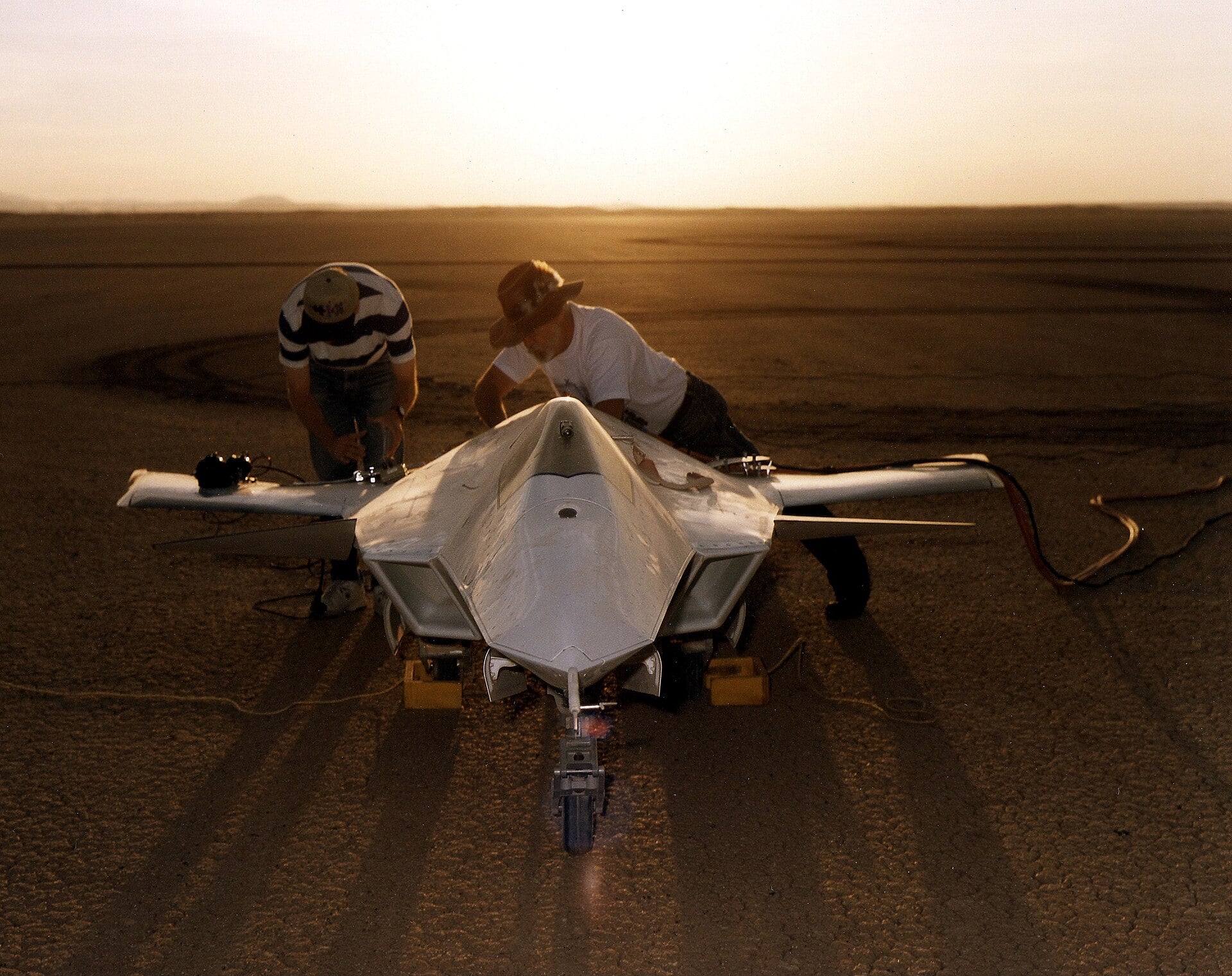
Take away the fin and rudder and an aircraft loses its natural directional stability. It wants to swing sideways, and the pilot loses the usual tool for yaw control. The X-36 replaced those functions with a combination of technologies: a canard foreplane ahead of the wing, split ailerons that could open like a clamshell on one side to create drag and yaw the aircraft, and a thrust-vectoring nozzle that pointed the engine’s exhaust.
Holding it all together was a digital fly-by-wire system. The X-36 was unstable by design, so a computer had to make constant corrections faster than any human could. That instability was the point: an unstable aircraft can change direction far more quickly than a stable one.
A Fighter Flown From the Ground
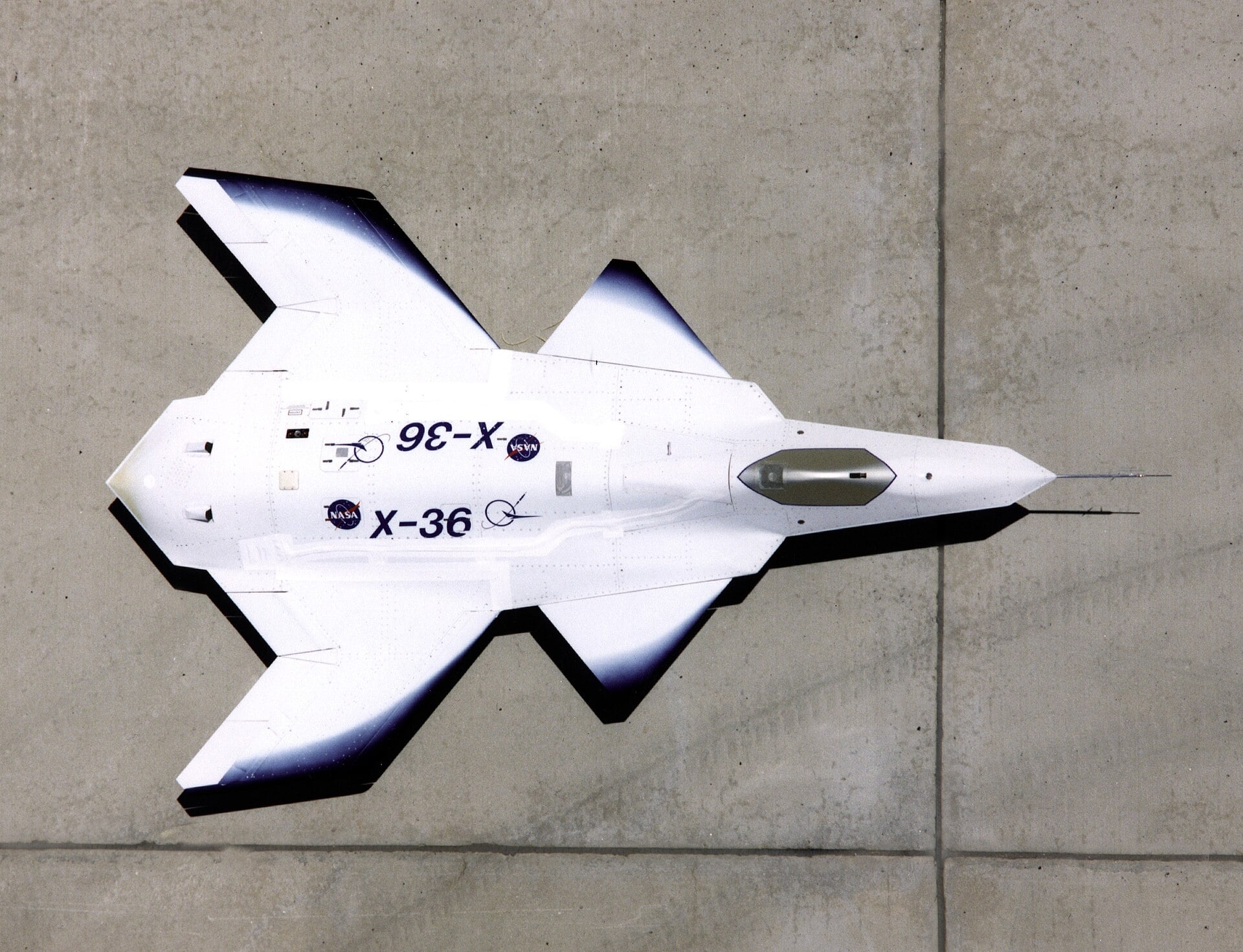
At 28 percent scale, the X-36 was far too small for a cockpit. Instead, the pilot sat in a ground-based virtual cockpit with a live video feed from a camera in the nose, flying it much like a full-size aircraft. NASA’s Ames Research Center led the project in partnership with McDonnell Douglas, which became part of Boeing during the programme.
Over 25 weeks in 1997, the two-aircraft fleet flew 31 times from NASA Dryden at Edwards Air Force Base. It reached 40 degrees angle of attack, a top speed of 206 knots and 20,200 feet, and it proved that a tailless design could be controlled through demanding manoeuvres. In 1998 it flew twice more for Boeing’s RESTORE project, testing adaptive neural-network software that automatically compensated for simulated control-surface failures.
Why It Matters Now
The X-36 never led directly to a production fighter. But its lessons fed into a generation of tailless designs, from unmanned combat aircraft demonstrators to the stealthy shapes now flying in China, where tailless fighters such as the J-36 have been photographed in flight.
The two X-36s survive. One is displayed at the National Museum of the US Air Force in Dayton, Ohio; the other at the Air Force Flight Test Museum at Edwards Air Force Base.
Dark Skies tells the story of the X-36:
Period footage of the X-36 in flight:
Sources: NASA, Boeing (September 1997 release), Wikipedia

0 Comments