
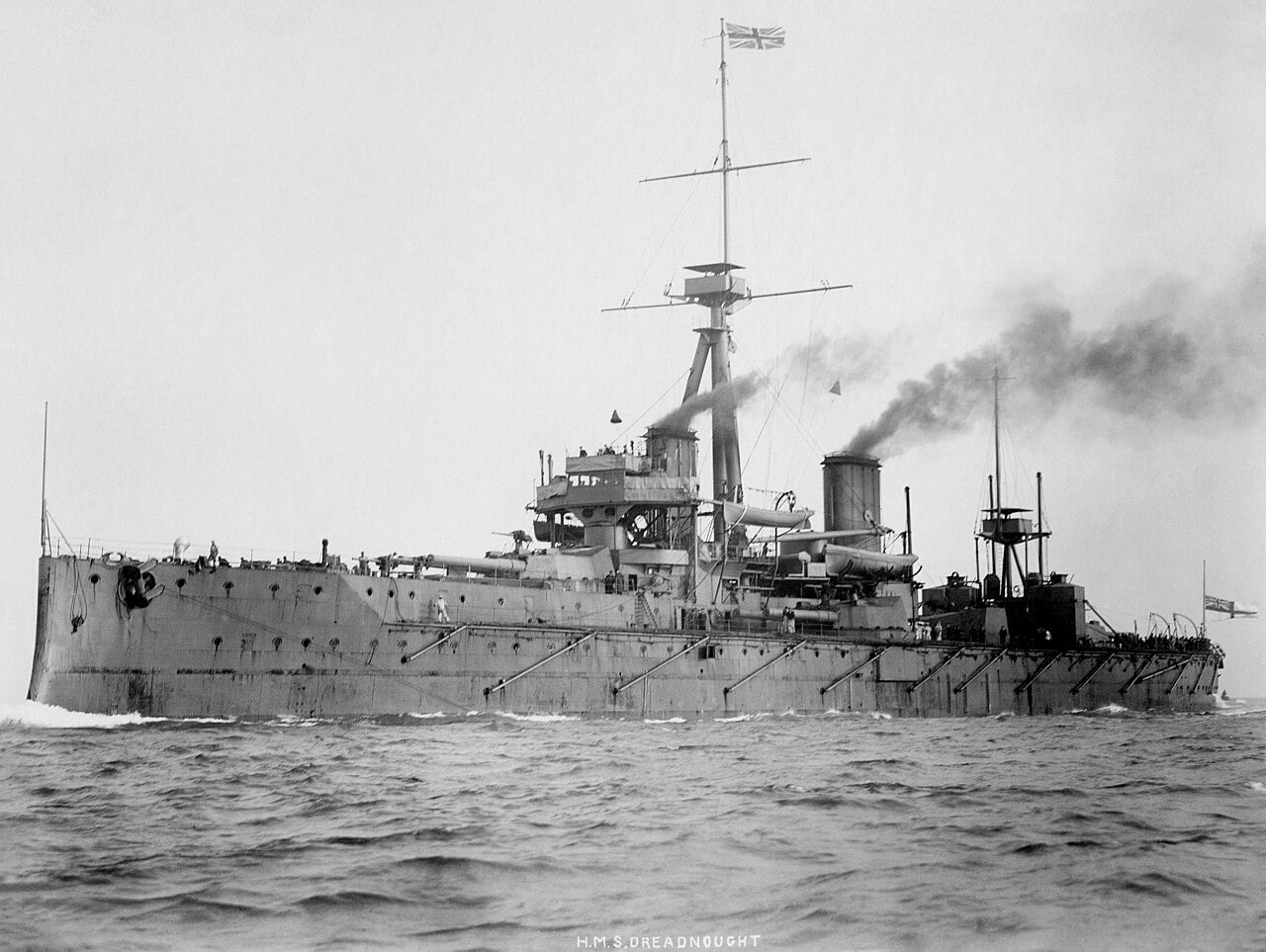
On 10 February 1906, King Edward VII smashed a bottle against the bow of a new battleship at Portsmouth. A year after work on her began, HMS Dreadnought went to sea for trials, and every other battleship in the world, including all of Britain’s own, was suddenly second-rate. Navies even coined a word for them: pre-dreadnoughts.
Dreadnought started an arms race that ran straight into the First World War and shaped naval power for decades. But her story has an ending that belongs in an aviation magazine. Within forty years, the kind of warship she created had been beaten not by bigger guns, but by aircraft.
Quick Facts
- Ship: HMS Dreadnought, Royal Navy battleship
- Laid down: 2 October 1905, HM Dockyard Portsmouth
- Launched: 10 February 1906 by King Edward VII
- Commissioned: 2 December 1906; joined the fleet 11 December
- Armament: Ten 12-inch guns in five twin turrets
- Machinery: Parsons steam turbines, the first in a battleship; 21 knots
- Cost: About £1.7 to £1.8 million
- Fate: Sold for scrap 1921; broken up from 1923
All Big Guns, and Turbines
Dreadnought was the brainchild of Admiral Sir John “Jacky” Fisher, the First Sea Lord, who set up a Committee on Designs in January 1905 and steered it towards two radical ideas. The first was armament. Earlier battleships carried a mix of heavy and medium guns. Dreadnought carried ten 12-inch guns of a single calibre in five twin turrets, eight of which could fire on either beam. The second was propulsion. She was the first battleship driven by Parsons steam turbines, which gave her 21 knots, faster than any battleship afloat.
Just as striking was the speed of construction. Dreadnought was laid down on 2 October 1905 and went to sea for trials on 3 October 1906, a year and a day later. Her guns and turrets were simply given top priority. Germany answered with its own all-big-gun battleships, the first of them the Nassau class, laid down in 1907, and the race was on. By 1914 the size of a nation’s dreadnought fleet had become the measure of its power.
The Only Battleship to Sink a Submarine
Dreadnought’s own war was quieter than her reputation. Her one moment of glory came on 18 March 1915, off northern Scotland, when she rammed and sank the German submarine U-29. Its commander, Otto Weddigen, had become a hero in Germany after his earlier boat, U-9, sank three British cruisers in 95 minutes in 1914. He and his whole crew were lost. Dreadnought remains the only battleship confirmed to have sunk a submarine. She missed the Battle of Jutland in 1916 because she was in refit, was sold for scrap in 1921 and was broken up from 1923.
Even before then, aviation had begun to close in. In 1917 the Royal Navy fitted a flying-off deck to HMS Furious, a big-gun ship of Fisher’s own design, and in July 1918 seven Sopwith Camels from Furious attacked the Zeppelin base at Tondern, destroying two airships, in what is regarded as the first attack in history by aircraft from an aircraft carrier.
Bombs Against Armour
In July 1921, off the Virginia coast, US Army aviator Billy Mitchell set out to prove that aircraft could sink a battleship. His target was the former German dreadnought Ostfriesland, a Jutland veteran handed to the United States after the war. On 21 July his Martin MB-2 bombers dropped 2,000-pound bombs around her, and she sank 22 minutes after the first one fell.
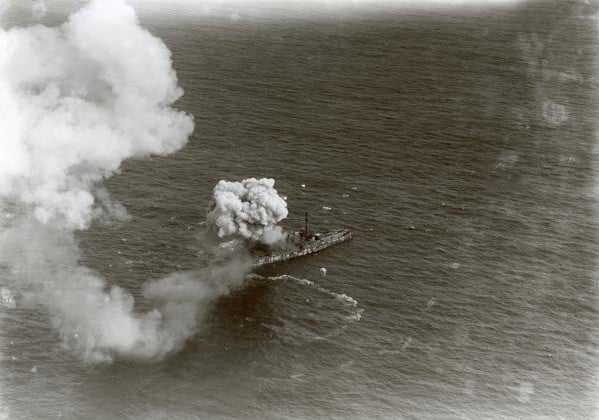
The test was hotly disputed. The ship was anchored, unmanned and had no damage control, and Mitchell broke the agreed test rules. The Navy concluded that the battleship was still the backbone of the fleet. Mitchell disagreed, loudly, and was eventually court-martialled for it, as we tell in our story of Billy Mitchell.
The Proof, 1940 to 1945
The Second World War settled the argument. On the night of 11 to 12 November 1940, 21 Swordfish biplanes from HMS Illustrious attacked the Italian fleet in harbour at Taranto, putting three battleships out of action for the loss of two aircraft. Japanese planners studied the raid. In May 1941 a single Swordfish torpedo jammed the rudder of the German battleship Bismarck and doomed her. On 7 December 1941, Japanese carrier aircraft sank or damaged all eight US battleships at Pearl Harbor.
Three days later came the moment many historians see as the true end of the battleship era. Off Kuantan in Malaya, 88 land-based Japanese bombers sank HMS Prince of Wales and HMS Repulse, the first capital ships actively defending themselves to be sunk solely by air power while steaming in the open sea. 840 men died.
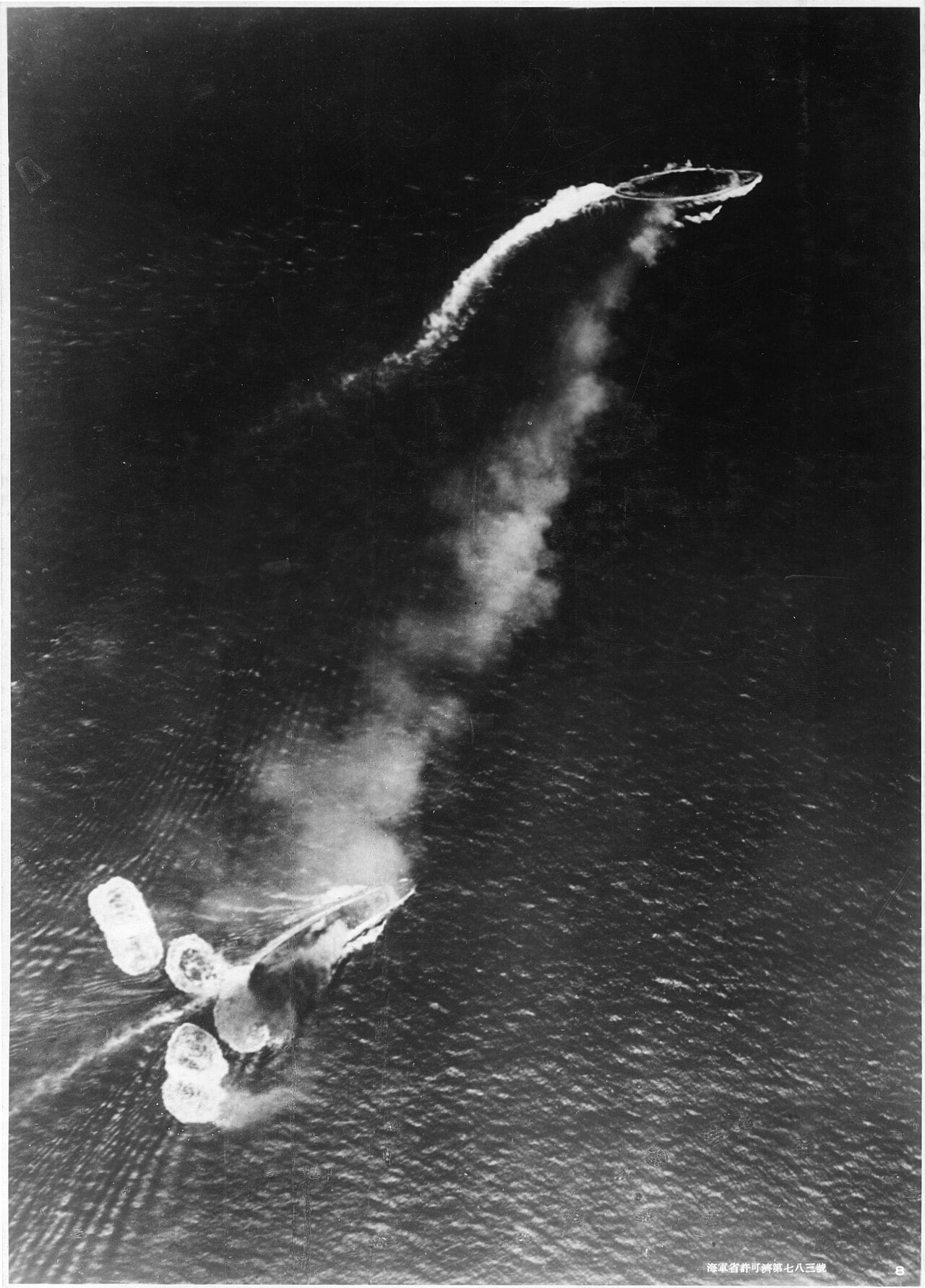
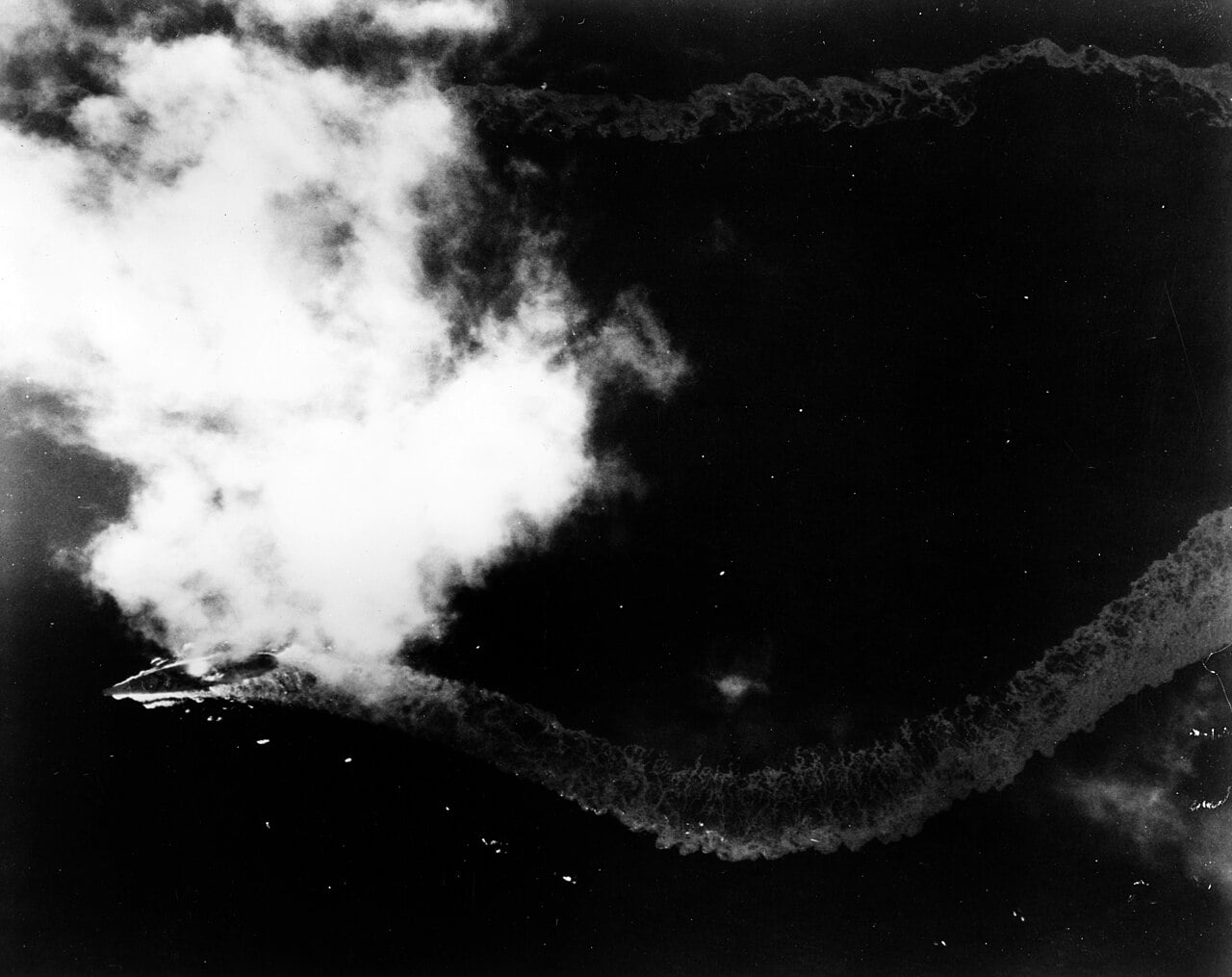
The largest battleships ever built went the same way. Japan’s Musashi was sunk by US carrier aircraft in the Sibuyan Sea on 24 October 1944. RAF Lancasters with 12,000-pound Tallboy bombs capsized the German battleship Tirpitz near Tromsø on 12 November 1944. And on 7 April 1945, around 280 US carrier aircraft sank Yamato, the biggest battleship in history, north of Okinawa.
After the Dreadnought
A handful of battleships served on for decades as floating gun batteries. The last of them, USS Iowa and USS Wisconsin, were finally struck from the US Navy register in 2006. By then the capital ship of every major navy had long been the aircraft carrier, the ship Fisher’s Furious had pointed towards in 1917. Dreadnought had made every battleship obsolete in a single year. Aircraft took a little longer to do the same to her descendants, but they did it just as completely.
Sources: Wikipedia, HMS Dreadnought (1906), Nassau-class battleship, HMS Furious, Tondern raid, SMS Ostfriesland, Battle of Taranto, Sinking of Prince of Wales and Repulse, Japanese battleships Musashi and Yamato, Operation Catechism, USS Wisconsin; uboat.net (U-29); US Naval History and Heritage Command (Pearl Harbor fact sheet; Capt. A. W. Johnson, account of the 1921 bombing experiments); Air & Space Forces Magazine; Wikiquote (John Fisher, citing Churchill, The World Crisis); Royal Museums Greenwich

0 Comments