

On 15 March 1975, a hang glider pilot stood on the frozen surface of a Wisconsin lake with a biplane glider on his shoulders and a small two-stroke engine buzzing behind him. There was no hill and no sea breeze to lift him. He opened the throttle, ran, and kept climbing.
John Moody was in the air for about 30 minutes, then shut the engine off and soared back down. Veteran light-aviation journalist Dan Johnson credits him as “the first person to foot-launch and climb from flat terrain without benefit of wind or a slope.” EAA calls him the father of modern ultralight aviation.
Fifty years after he showed that machine to the crowds at Oshkosh, his original Icarus II has been restored by volunteers and now hangs in the EAA Aviation Museum. Here is how a weekend fix for a flat state turned into a whole branch of aviation.
Quick Facts
- Pilot: John K. Moody, Wisconsin hang glider pilot
- Aircraft: Powered Icarus II, a rigid biplane hang glider designed by Taras Kiceniuk Jr.
- First powered flight: 15 March 1975, from a frozen lake in Wisconsin
- Engine: Small two-stroke of about 10 to 12.5 hp (sources differ)
- Oshkosh debut: EAA fly-in, summer 1976
- Company: Ultralight Flying Machines of Wisconsin
- Regulation that followed: FAA Part 103, 1982
- Today: Restored by the Michigan Ultralight Association; on display at the EAA Aviation Museum since October 2026
A Hang Glider Pilot With No Hills
By the mid-1970s hang gliding was booming on the coasts, where pilots could run off dunes and cliffs into steady wind. Wisconsin offered neither. As EAA's Rick Hayes put it in his history of the aircraft, the flat terrain and lack of steady wind made the sport difficult for Moody.
Moody had taught himself to fly in an Icarus II he built in the mid-1970s. The design came from Taras Kiceniuk Jr., a Southern California teenager who began building hang gliders in 1971 while still in high school. The Icarus II was a rigid biplane flying wing with steeply swept wings and hand-controlled tip rudders, and many copies were built from plans Kiceniuk sold.
Rising costs had already pushed ordinary flying out of reach for many people, the Smithsonian's Air & Space magazine noted. A glider that could take off from a field without a towplane or a mountain was the obvious next step.
15 March 1975: Power on the Ice
Moody's fix was simple: bolt a small engine and a pusher propeller onto the glider. Accounts of the exact engine differ. EAA describes a two-cycle, 12.5-hp McCulloch; Dan Johnson, writing in Kitplanes in 2006, says it was a 10-hp West Bend. Wikipedia's history of powered hang gliders says West Bend for the first flight and a McCulloch 101 for Oshkosh.
The location varies slightly too. EAA names Long Lake in Wisconsin; Johnson places the frozen lake southwest of Milwaukee. What every source agrees on is the date, 15 March 1975, and the result: Moody climbed under power for about 30 minutes.
The whole aircraft weighed about 90 pounds. He launched by lifting it, running until it flew, then climbing as high as about 1,000 feet and cruising at roughly 26 mph, according to EAA.
EAA archive footage of John Moody demonstrating his powered Icarus II hang glider at the Oshkosh convention.
Oshkosh 1976: The Demonstration That Started It All
Moody described the design in the February 1976 issue of EAA Sport Aviation and flew it at the EAA convention in Oshkosh that summer. For a crowd used to aircraft that needed runways, watching a man take off on foot was a shock.
Lee also told the magazine the flights “just set the world on fire.” Moody turned his hobby into a business, founding Ultralight Flying Machines of Wisconsin. According to Dan Johnson, the company sold components for powered hang gliders, including the Stewart Maximizer reduction drive, a tail-mounted elevator system and crosswind landing gear.
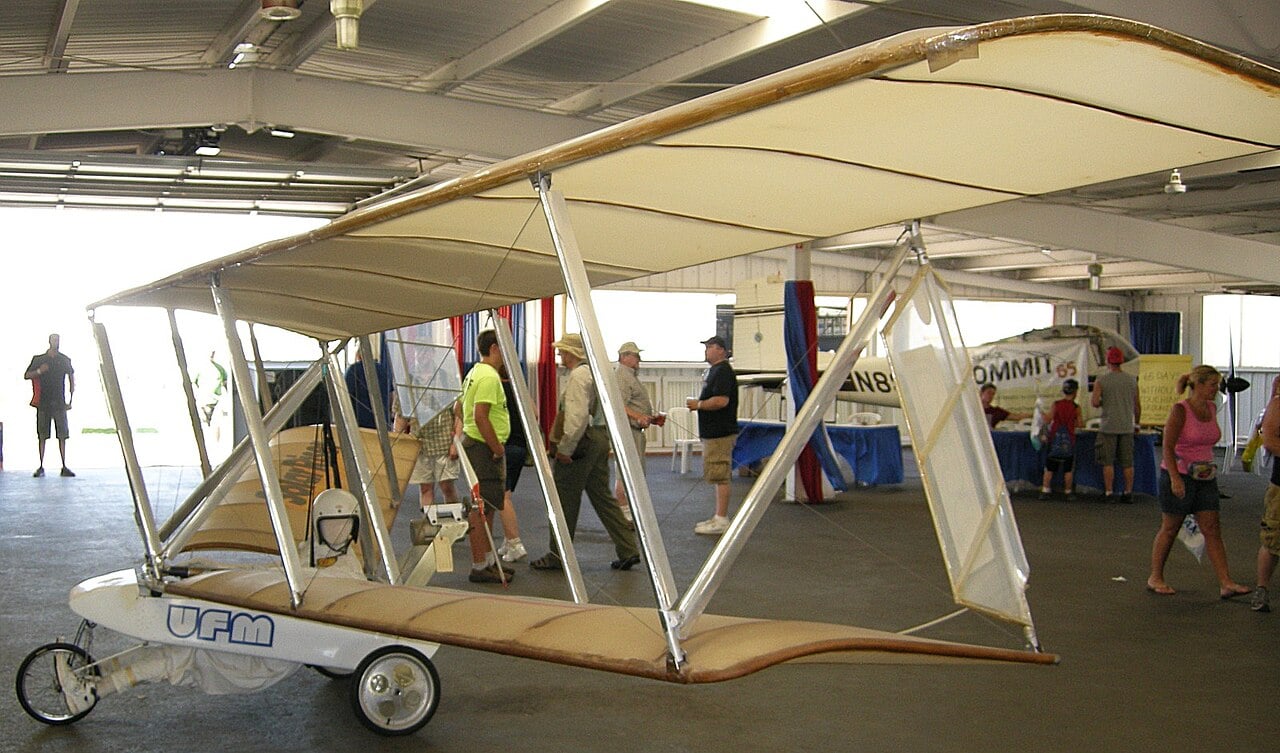
The Icarus II also led directly to the UFM Easy Riser. Larry Mauro developed that swept-wing biplane from Kiceniuk's design, and Wikipedia's article on the type calls it the first modern ultralight aircraft once it was powered in 1975. Wheels were soon added because many pilots could not run fast enough to take off.

The Ultralight Boom
Others followed fast. Wikipedia's history of the powered hang glider records that by the end of 1979 there were almost 100 companies selling powered ultralights, though very few of the designs could still be foot-launched. Air & Space reported nearly 15,000 Weedhoppers sold alone.
The appeal was price and freedom. A two-stroke engine, aluminium tube and fabric could put a person in the air for a fraction of the cost of a certified light aircraft, and pilots in flat regions like the Midwest no longer needed a hill.
Mauro even went solar. In 1979 he installed solar cells and an electric motor on a stock Easy Riser, and the resulting Solar Riser became the first solar-powered aircraft to carry a person aloft.
Part 103: The Rule That Made It Legal
Thousands of unregistered, unlicensed flying machines forced a regulatory answer. In 1982 the FAA created Part 103, which exempted ultralight vehicles from registration and pilot certification. EAA, which helped develop and support the rule, says it remains the basis of US ultralight regulations today.
The limits are tight: one seat, recreational use only, under 254 pounds empty, no more than five US gallons of fuel, a top speed of 55 knots and a power-off stall speed of no more than 24 knots. We cover the details in FAR Part 103: The Aircraft You Can Fly With No License.
Moody's demonstrations helped lead to that rule, EAA says. In 1991 he became the first recipient of the US Ultralight Association's top honour, which bears his name, and in 1999 EAA inducted him into its Ultralight Hall of Fame.
John Moody flies an Easy Riser and talks about the early days of ultralight flying.
Fifty Years Later: The Icarus II Comes Home
Moody kept flying long after he left the business, performing a comedy airshow act in an Easy Riser. In 2025 he donated the original Icarus II, the first powered hang glider to fly at Oshkosh, to EAA. Michigan Ultralight Association members Bill Darnell and Don Niles collected it from his home in Florida during SUN 'n FUN 2025.
MULA volunteers spent months cleaning, repairing and re-covering the glider to Moody's original specifications. It was displayed in the ultralight area at EAA AirVenture Oshkosh 2026, marking 50 years since the 1976 demonstration, with Moody in attendance.
After the convention, EAA said the Icarus II would move to the EAA Aviation Museum for permanent display, and on 15 October 2026 EAA announced it among six aircraft newly added to the museum’s displays.
At AirVenture Oshkosh 2026, John Moody and the restored Icarus II, the aircraft that helped start the ultralight boom 50 years earlier.
Every powered paraglider, ultralight trike and Part 103 single-seater flying today traces part of its lineage to a frozen lake in Wisconsin and one pilot who refused to wait for a hill.
Sources: EAA (Hangar Flying: Rick Hayes, Emme Hornung, Malcolm Brubaker; EAA News), Plane & Pilot / Kitplanes (Dan Johnson), Air & Space / Smithsonian (Tim Wright), Wikipedia (Powered hang glider; UFM Easy Riser; Taras Kiceniuk Jr.; Ultralight aircraft in the United States)
0 Comments