
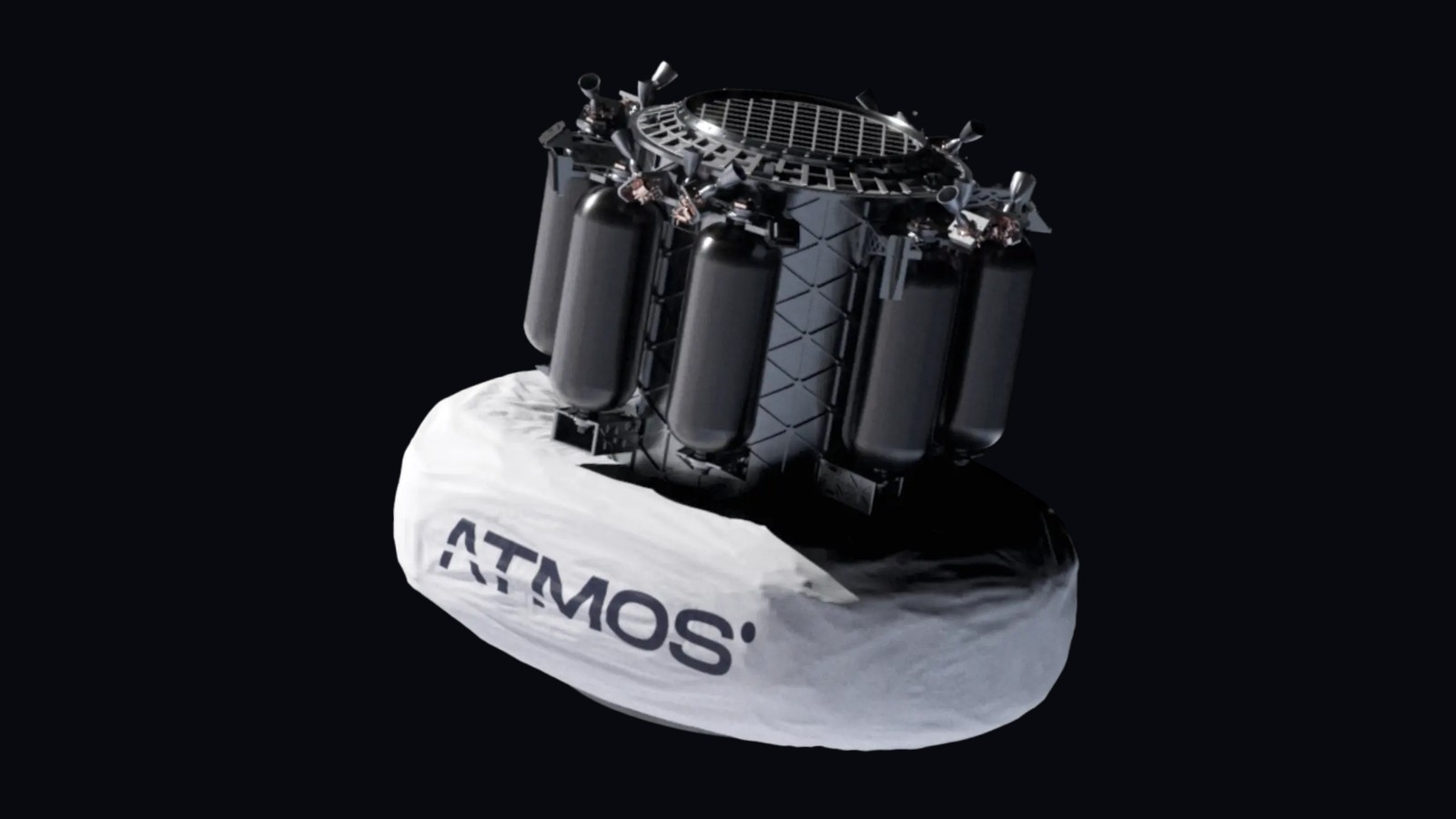
A German company that has flown exactly one capsule, and did not get it back, has signed a cooperation agreement with Europe’s largest missile manufacturer to study a weapon dropped from orbit.
ATMOS Space Cargo and MBDA Deutschland announced the deal on 18 November. The subject is something the two of them call Precision Orbital Deep Strike, or PODS: a conventional munition parked in low Earth orbit and brought down, on command, onto a target on the ground. No hardware exists. No money has been disclosed. What exists is a signature and a scope of work.
That is worth stating at the top, because the figures already circulating around this story — a strike anywhere on Earth inside an hour, centimetre accuracy, dozens of capsules waiting in orbit — appear nowhere in anything either company has actually published.
Quick Facts
- What: cooperation agreement to study a Precision Orbital Deep Strike (PODS) capability
- Who: ATMOS Space Cargo GmbH and MBDA Deutschland
- Announced: 18 November 2026
- Scope: systems architecture, technical feasibility, payload integration studies, possible technology demonstrations
- Budget disclosed: none
- Timetable disclosed: none
- Hardware built: none
- ATMOS flight heritage: one sub-orbital re-entry attempt, PHOENIX 1, April 2025
What the two companies actually signed
The agreement covers, in the companies’ own words, “systems architecture, technical feasibility, payload integration studies and potential technology demonstrations.” That is a feasibility study with an option to build a demonstrator, not a weapons programme. The release is equally careful about what PODS is for: it “is being explored and developed as a future conventional defence capability.”
ATMOS also draws a hard line between this work and its day job. “PODS is a dedicated defence system,” the release says. “ATMOS’s civilian PHOENIX vehicles remain a separate product dedicated to orbital logistics and return for research and industry.” Any future deployment, it adds, would be subject to applicable law and to decisions by governments and military authorities.
MBDA brings the other half. The company is Europe’s largest missile house, a joint venture of Airbus, BAE Systems and Leonardo, and MBDA Deutschland is its German arm. It knows how to build a guided weapon, qualify it and sell it to a defence ministry. What it has never done is operate one from orbit.
Who ATMOS Space Cargo is
ATMOS was founded around 2021 and now lists more than 150 employees across three European sites: Lichtenau in Germany, Strasbourg in France and Kraków in Poland. In April 2026 it closed a €25.7 million Series A, co-led by Balnord and Expansion, with Keen Defence and Security and the European Innovation Council alongside. The defence work sits in a separate unit, ATMOS WORKS, aimed at European government customers.
Its product is PHOENIX, a reusable orbital transfer and return vehicle. The company quotes a total payload capacity of 100 kg and mission durations from three hours to twelve months. The interesting part is how it comes home: instead of an ablative heat shield, PHOENIX carries an inflatable atmospheric decelerator, a non-ablative structure that works as both heat shield and air brake. ATMOS claims up to ten times better landing accuracy than parachute-based re-entry systems.
The flight record is one mission, and it was a partial success. PHOENIX 1 launched on a Falcon 9 on SpaceX’s Bandwagon-3 rideshare on 21 April 2025. The capsule inflated its heat shield under real re-entry conditions and sent back flight data from itself and its customer payloads. It did not send back everything: by ATMOS’s own account, data from the final stage of descent could not be retrieved. The capsule was never recovered, and recovery had not been planned after a late trajectory change moved the splashdown some 2,000 km off the Brazilian coast.
That is a real, hard-won result — the first re-entry mission flown by a European company — and it is also a long way from a weapon that has to put a munition on a specific point on the ground.

The figures nobody has confirmed
Within a day of the announcement, the story had acquired a specification. It did not come from the announcement.
The 60-minute figure traces back to an article Klaus published on LinkedIn in March 2026, months before this agreement, arguing the case for a conventional capability able to reach a legitimate military target anywhere on Earth within the hour. Defense News reports it as exactly that: his earlier advocacy, not a PODS requirement. The Argentine outlet Aviacionline was explicit that the two companies did not confirm 60 minutes as a specification.
The phrase “unlimited range” comes from a report in The Times at the start of November, before the agreement, which first revealed that ATMOS was working on the concept and hunting for a defence partner. The claim that dozens of capsules would be needed traces to Handelsblatt, and is attributed to German press reporting rather than to either company.
Set those aside and what the two firms have said about performance is: nothing. No range. No time to target. No accuracy. No mass. No cost. No date. For a story about a weapon that would be among the most consequential things Europe has ever put in orbit, that absence is the most honest thing in it.
Veritasium on Project Thor, the orbital kinetic weapon the United States studied and never built. The physics in it is the reason PODS is a harder engineering problem than the headlines suggest.
Rods from God, and why nobody built them
The idea is old. Project Thor is credited to Jerry Pournelle, who worked in operations research at Boeing in the 1950s before he became a science-fiction novelist: telephone-pole-sized tungsten rods, dropped from orbit, destroying hardened targets with nothing but kinetic energy.
It reached official paper in the US Air Force’s Transformation Flight Plan of November 2003, which described Hypervelocity Rod Bundles — roughly 20-foot, one-foot-diameter tungsten rods controlled from a satellite. A rod that size masses over eight tonnes. It arrives at something like Mach 10 and delivers on the order of eleven tonnes of TNT equivalent.
Which is precisely the problem. Eight tonnes to orbit, per shot, to deliver the effect of a large conventional bomb that an aircraft could carry for a fraction of the cost. The document itself noted that a conventional warhead of similar weight might be more practical. Nobody ever built it.
PODS is not that. A munition inside a re-entry vehicle is a different proposition from a bare tungsten rod: lighter, guided, and brought through the atmosphere by a decelerator rather than surviving on mass alone. Whether that changes the economics is exactly what the two companies have agreed to find out.
What the Outer Space Treaty actually says
Every story about an orbital weapon runs into the 1967 Outer Space Treaty. It is worth reading the operative sentence rather than the summary of it. Article IV:
States Parties to the Treaty undertake not to place in orbit around the Earth any objects carrying nuclear weapons or any other kinds of weapons of mass destruction, install such weapons on celestial bodies, or station such weapons in outer space in any other manner.
Nuclear weapons, and other weapons of mass destruction. That is the whole prohibition. Conventional weapons are not mentioned. The treaty’s stronger language — use “exclusively for peaceful purposes”, no military bases, no weapons testing of any kind — appears in the second paragraph of the same article, and it applies to the Moon and other celestial bodies, not to Earth orbit.
So a conventional munition in low Earth orbit is not caught by Article IV. The law of armed conflict and the UN Charter rules on the use of force would still apply to anything it did. It is also fair to note what is missing from the coverage of this announcement: not one lawyer, academic or government official has gone on the record about the treaty question. The companies themselves say only that their activities remain subject to screening for compliance with applicable legal and regulatory requirements, and that they will obtain any authorisations required. Neither release names the treaty.
British Pathé newsreel of the Outer Space Treaty being signed in Washington in 1967. The text the diplomats agreed that day is the text that governs this story.
It has been done once, and it was nuclear
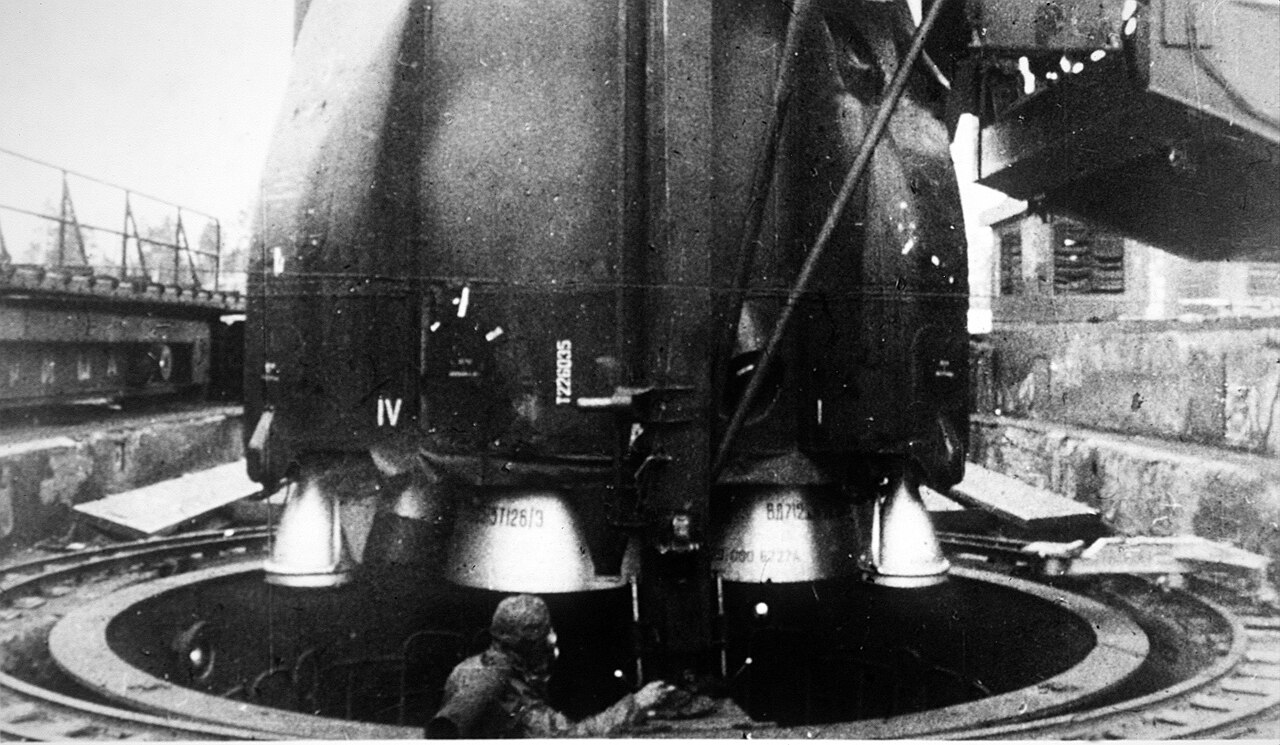
One state has deployed an orbital bombardment system. The Soviet R-36O, the orbital variant of the missile in the photograph above, began deployment in November 1968 and by 1971 all eighteen silos were in service in Kazakhstan. It put its warhead into a partial orbit so the approach could come over the South Pole, away from American early-warning radars, then braked it back down before a full revolution.
It was a nuclear system, and it did not last. SALT II in 1979 expressly prohibited developing, testing or deploying fractional orbital bombardment systems. The treaty was never ratified by the US Senate, but the Soviet Union complied anyway. The R-36O was out of service by February 1983.
The concept resurfaced in 2021, when the Financial Times reported that China had tested a fractional orbital bombardment system carrying a hypersonic glide vehicle. The test is generally placed around August 2021, lofted by a Long March 2C. The FT reported the vehicle missed its target by a couple of dozen miles; the IISS put it at roughly twenty-four. Beijing said the launch had been a reusable spaceplane, not a missile test. The Pentagon’s 2022 China Military Power Report described a vehicle that travelled about 40,000 km over more than 100 minutes before impacting inside China.
The pattern across sixty years is consistent: orbital strike is technically achievable, strategically awkward, and expensive enough that nobody has stuck with it.
What happens next
Realistically: a study. The agreement commits two companies to assess whether the thing can be built, with no public money attached and no schedule. ATMOS has flown one capsule and brought back most, not all, of the data. MBDA has never operated anything in orbit. Specific development activities, the release says, remain subject to further evaluation and separate agreements.
What has changed is that the conversation is now on the record. A European missile prime has put its name to the proposition that conventional strike from orbit is worth examining, at a moment when European governments are spending on deterrence at a rate not seen in decades. Whether PODS ever flies matters less, for now, than the fact that a serious company is willing to say the words out loud.
Sources: ATMOS Space Cargo and MBDA Deutschland joint announcement (18 November 2026); ATMOS Space Cargo company pages; Defense News; TWZ; Aviacionline; Defence24; United Nations Office for Outer Space Affairs, Treaty on Principles Governing the Activities of States in the Exploration and Use of Outer Space; US Air Force Transformation Flight Plan (2003); Financial Times; International Institute for Strategic Studies; US Department of Defense China Military Power Report 2022.



0 Comments