
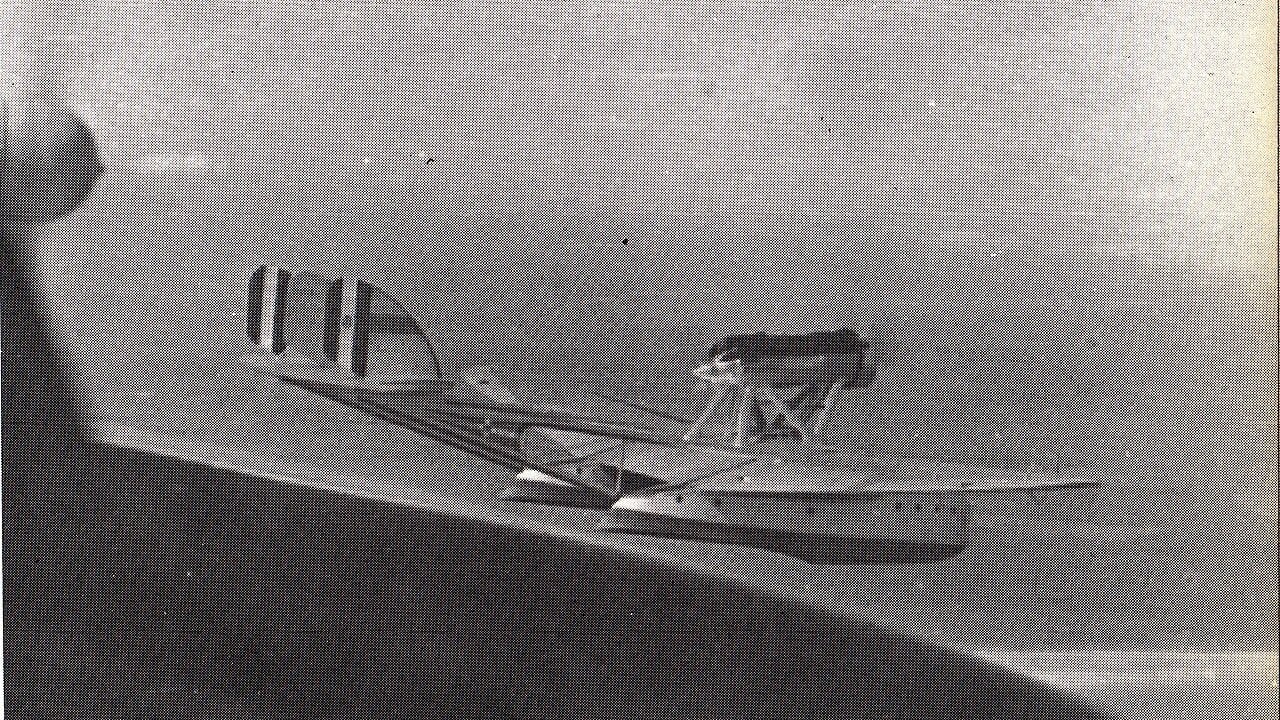
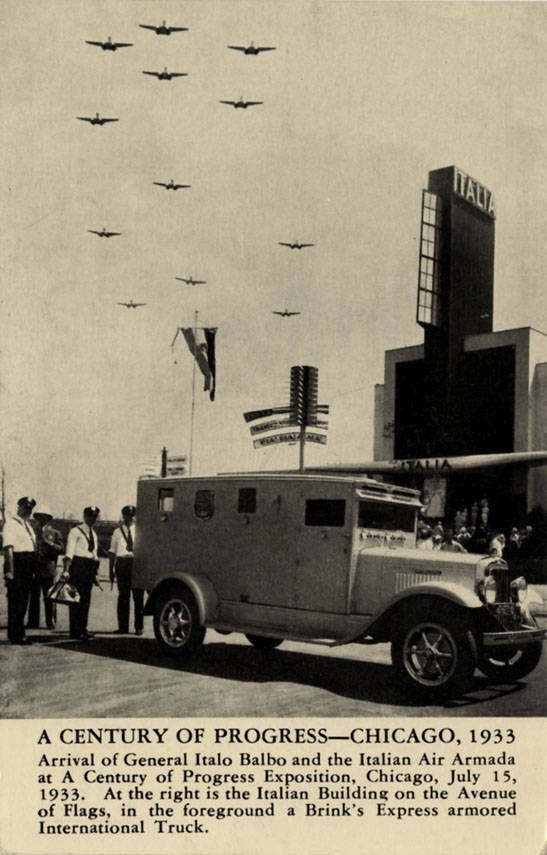
Early on the evening of 15 July 1933, a crowd lining Chicago’s lakefront stared south into the industrial haze. Then they appeared: two dozen big twin-hulled flying boats in tight formation, gliding down one after another onto Lake Michigan. Overhead, US Army aircraft spelled out “Italia”.
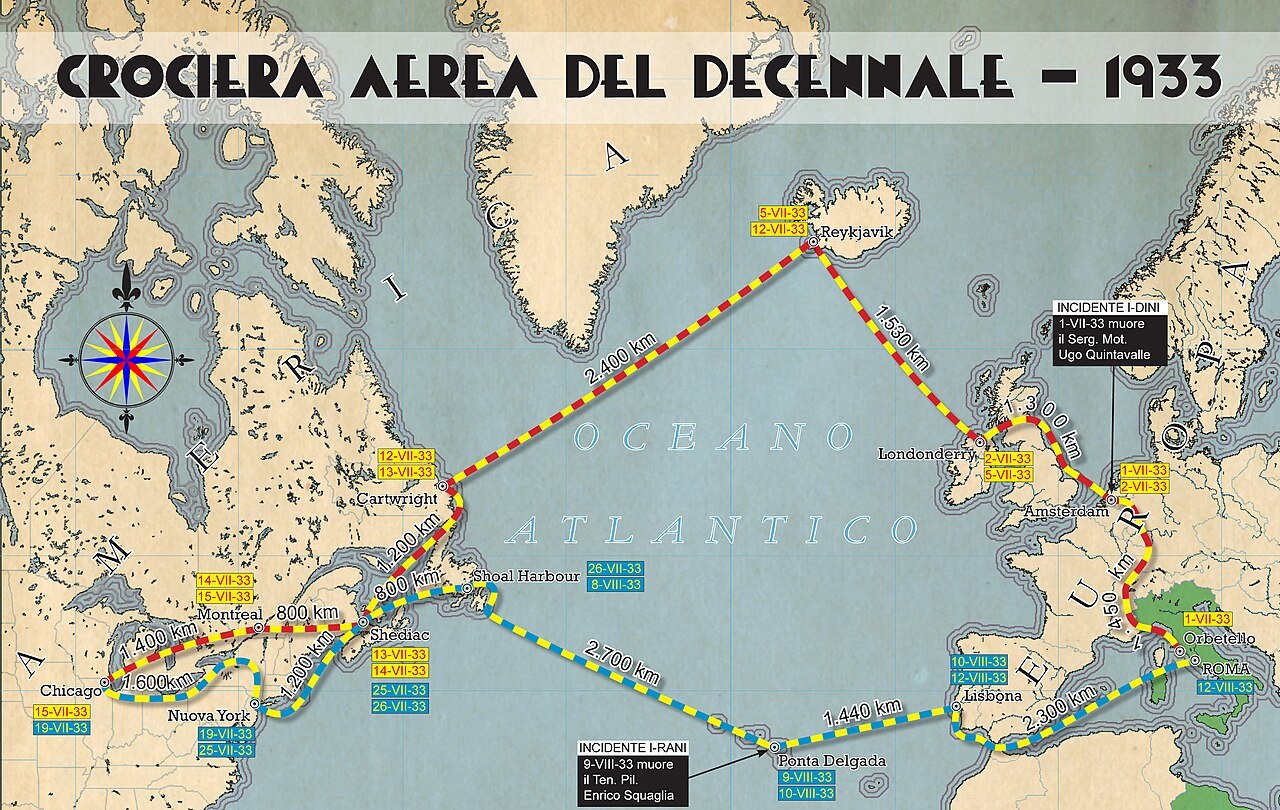
They had flown from Orbetello on the Tuscan coast, by way of Amsterdam, Northern Ireland, Iceland, Labrador and Canada. Leading them was Air Minister Italo Balbo, and the flight was the Decennial Air Cruise, the Crociera aerea del Decennale: the largest mass formation crossing of the Atlantic that had ever been attempted.
It was a genuine feat of navigation and organisation. It was also, unmistakably, a piece of Fascist theatre, timed and staged to show the world what Mussolini’s Italy could do. Ninety-three years on, both halves of that story are still visible on the streets of Chicago.
Quick Facts
- Flight: Decennial Air Cruise (Crociera aerea del Decennale), led by Air Minister Italo Balbo
- Dates: 1 July to 12 August 1933
- Aircraft: Savoia-Marchetti S.55X twin-hull flying boats; 24 arrived in Chicago per the Chicago Tribune (Wikipedia counts 25 in the expedition)
- Outbound route: Orbetello, Amsterdam, Londonderry, Reykjavík, Cartwright, Shediac, Montreal, Chicago (15 July), New York (19 July)
- Return route: Shediac, Shoal Harbour, Azores, Lisbon, Rome
- Losses: Two men killed: Ugo Quintavalle at Amsterdam and Enrico Squaglia in the Azores
- Legacy: Balbo Monument and Balbo Drive in Chicago; “Balbo” as a word for a big formation
A decade worth celebrating, by Rome’s measure
The name tells you the politics. The flight was conceived for the tenth anniversary of the March on Rome in 1922, and when the preparations ran into 1933 the title was kept to mark another anniversary: ten years of the Regia Aeronautica, the Royal Italian Air Force, founded in 1923.
Balbo had already run three mass flights: across the western Mediterranean in 1928, the eastern Mediterranean in 1929, and from Orbetello to Rio de Janeiro with a dozen flying boats in 1930 and 1931. According to Wikipedia’s account, he disliked the cult of the lone celebrity aviator and wanted his pilots to feel part of an air force. This time he planned to double the size of the Brazil expedition, to 24 aircraft and about 100 men.
An early plan to fly around the world via Asia, the Aleutians and Alaska was dropped because of cost and the Japanese invasion of Manchuria. Instead, Balbo picked Chicago’s Century of Progress International Exposition, whose motto he thought suited the occasion perfectly.
Two years of school for a single flight
The crews trained at a school set up for the expedition, the Scuola di navigazione aerea d’alto mare. Most of the officers were young, mentored by about a dozen veterans of the Brazil flight. They studied mathematics, physics, aerodynamics, navigation and English, learned the aircraft at the factories that built them and how to handle a flying boat on the water, and even spent the winter of 1932 to 1933 mountaineering at Misurina in the Dolomites in case they came down in the far north. Half the original applicants failed.
Their aircraft was the Savoia-Marchetti S.55, a twin-hull monoplane flying boat whose pilots sat in the thick centre section of the wing between the two hulls, with two engines mounted back to back in a push-pull pair above them. The North Atlantic version, the S.55X, had more powerful Isotta Fraschini engines; 25 were built.
The Italian Air Force’s own short film marking 1 July 1933, the day the Decennial Air Cruise left Orbetello (in Italian).
By May 1933 everything was ready except the weather. Storms over the Alps and northern Europe held the armada at Orbetello for weeks, a delay the newspapers followed day by day.
Orbetello to Lake Michigan
On the night of 30 June to 1 July 1933 the weather finally cleared. Balbo set reveille for 4:15 a.m., and the formation crossed the Alps to Amsterdam in about seven hours. There the cruise suffered its first loss: the aircraft I-DINI flipped over while landing, and Sergeant Mechanic Ugo Quintavalle was trapped and killed in the wreckage.
The next legs went to Londonderry, then through fog to Reykjavík, where bad weather held the crews for six days. On 12 July they made the hardest crossing of all, about 12 hours from Iceland to Cartwright in Labrador. From there the route ran to Shediac in New Brunswick, where some 30,000 people turned out in a town of about 10,000, and on 14 July to Montreal.
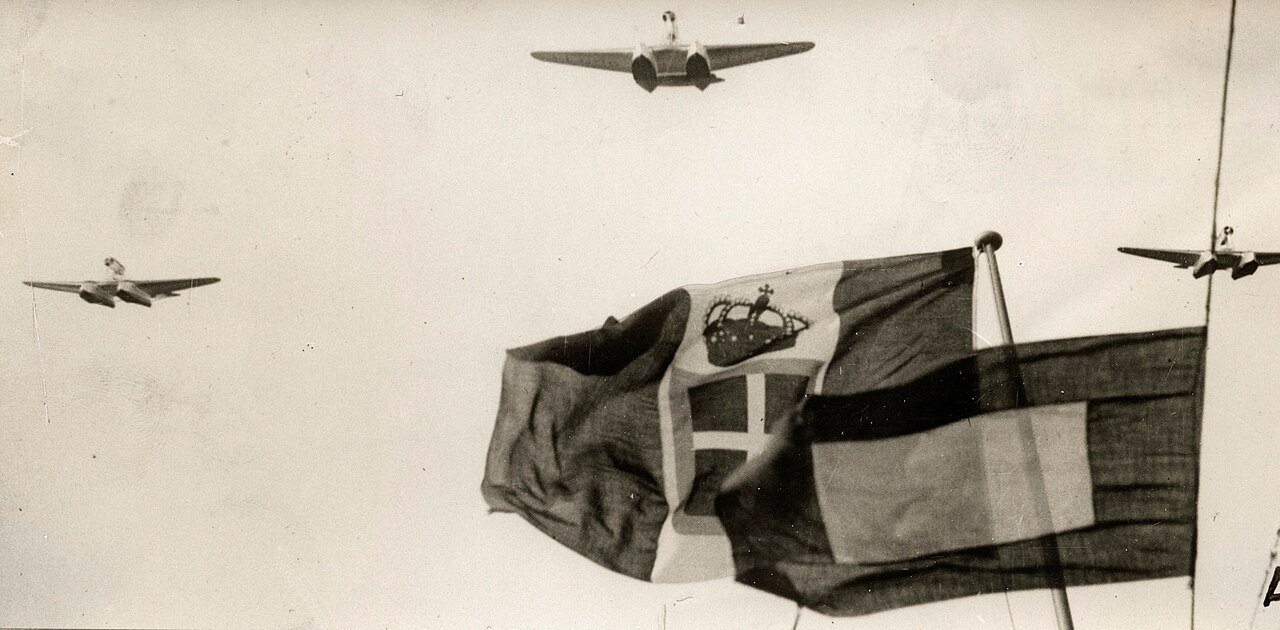
The last leg brought trouble of a different kind. A storm forced a detour on the way to Chicago, and Balbo’s fleet arrived late, escorted by US Army aircraft from Selfridge Field. The Chicago Tribune described the journey from Rome as 6,100 miles long.
“Chicago, grande metropoli”
The welcome was enormous. Balbo stepped onto his aircraft’s wing with a cigarette while the rest of the formation landed, then came ashore at Navy Pier. The Tribune reported that 60,000 people had waited all afternoon at Soldier Field, where Mayor Edward Kelly announced a new name for the street that led to the fairgrounds.
Seventh Street became Balbo Avenue. The Sioux performers at the fair’s Indian Village adopted Balbo as “Chief Flying Eagle”, and on 19 July the armada flew on to New York, landing in Jamaica Bay. President Franklin D. Roosevelt invited Balbo to lunch at the White House on 20 July and presented him with the Distinguished Flying Cross.
British Pathé newsreel footage of the Italian Air Armada in 1933.
Balbo’s own speech at Soldier Field made the purpose plain. Delivered in Italian and translated by the Italian ambassador, it framed the flight as a mission “to bring a message of friendship from the new Italy to the United States.” At home, the Tribune’s Rome correspondent noted, the regime’s press turned the acclaim into praise for Mussolini instead.
The long way home
The return began on 25 July. The plan was a direct 3,000-kilometre hop from Newfoundland to Ireland, but storms and fog kept the armada at Shoal Harbour for two weeks. On 8 August the crews flew instead some 2,700 kilometres to the Azores, splitting between Ponta Delgada and Horta.
The next morning, during the take-off from Ponta Delgada, the aircraft I-RANI overturned and Lieutenant Enrico Squaglia was killed. The ceremonies planned in Lisbon were cancelled. On 12 August 1933 the armada reached Rome, six weeks after it had left.
A column, a street and a word
The flight left marks on two continents. In 1934, Mussolini gave Chicago an ancient Roman column from Ostia to commemorate the arrival. According to the Chicago Park District, it is the city’s most ancient outdoor artifact and still stands in Burnham Park, a monument some now consider controversial because of its ties to Mussolini and Balbo.
Balbo Drive survived too. A 2017 campaign to rename it in honour of the journalist and civil rights pioneer Ida B. Wells met opposition, and the city chose to rename Congress Parkway instead. In Newfoundland, a road at Clarenville overlooking Shoal Harbour still carries the name Balbo Drive.
Istituto Luce newsreel of the formation over Chicago at the end of the outbound crossing (Archivio Luce Cinecittà, in Italian).
Balbo himself did not enjoy the glory for long. In November 1933 he was sent to govern Libya, a move widely seen as Mussolini keeping a popular rival at a distance. He was killed in 1940 when Italian anti-aircraft guns shot down his aircraft over Tobruk. His English-speaking legacy is one word: a “Balbo” came to mean any large formation of aircraft.
Strip away the propaganda and one fact remains. Before July 1933, only 28 attempts to fly the North Atlantic had succeeded, all of them single aircraft. Balbo’s armada crossed it as a squadron, and brought the idea of routine ocean flying a little closer.
Sources: Wikipedia (Decennial Air Cruise; Italo Balbo; Savoia-Marchetti S.55), Chicago Tribune, Chicago Park District, Italian Air Force, British Pathé, Archivio Luce
0 Comments