
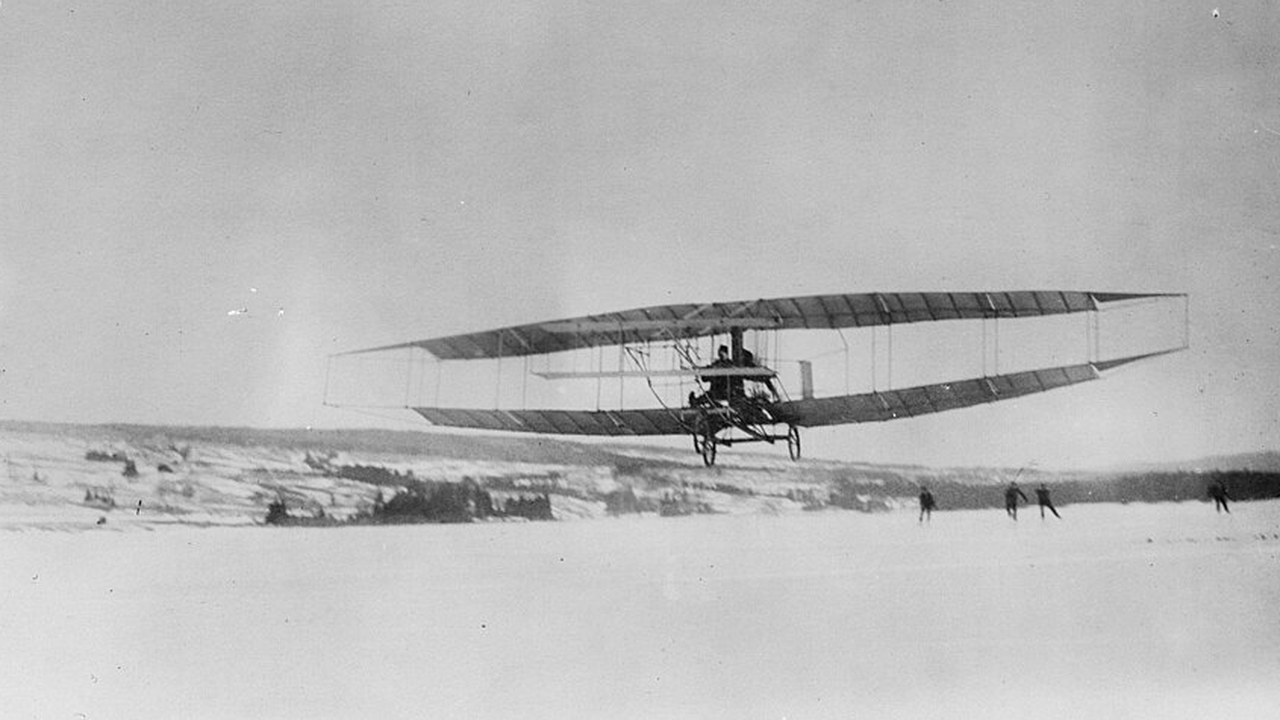
On the morning of 23 February 1909, a horse-drawn sleigh dragged a strange machine out onto the frozen surface of Baddeck Bay in Cape Breton, Nova Scotia. It was all bamboo, steel tube, wire and balloon cloth, with long, pale wings and a little three-wheeled undercarriage. More than 100 of Alexander Graham Bell’s neighbours had come out onto the ice to watch.
At the controls sat a 22-year-old local engineer named John Alexander Douglas McCurdy. On its second attempt, after a run of about 30 metres, the machine lifted off. It flew at between three and nine metres above the ice, at roughly 65 km/h, before settling back down. Canada had seen its first powered, heavier-than-air flight.
Quick Facts
- Aircraft: AEA Silver Dart (Aerodrome No. 4)
- Built by: Aerial Experiment Association, founded October 1907 by Alexander Graham Bell and Mabel Hubbard Bell
- First flight in Canada: 23 February 1909, from the ice of Baddeck Bay, Nova Scotia
- Pilot: J.A.D. McCurdy, 22, the aircraft’s principal designer
- Flight: About 3 to 9 m above the ice at roughly 65 km/h; distance reported as about 800 m
- Engine: Water-cooled engine developed by Glenn Curtiss
- Fate: Damaged beyond repair landing in sand at Petawawa, Ontario, August 1909
- Replicas: RCAF replica (1958), Canada Aviation and Space Museum; centenary replica (2009), Bell museum, Baddeck
Bell’s young men
The aircraft was the Silver Dart, and it was the work of the Aerial Experiment Association, the AEA. Bell, already world-famous for the telephone, had been fascinated by flight since boyhood and had spent years experimenting with giant man-carrying kites at Beinn Bhreagh, his summer estate above Baddeck.
In October 1907 he and his wife, Mabel Hubbard Bell, formed the AEA, with Mabel providing the money. The members were young: McCurdy, the son of a Bell family friend, and his University of Toronto classmate Frederick “Casey” Baldwin; US Army Lieutenant Thomas Selfridge; and Glenn Curtiss, a motorcycle engine builder from Hammondsport, New York.
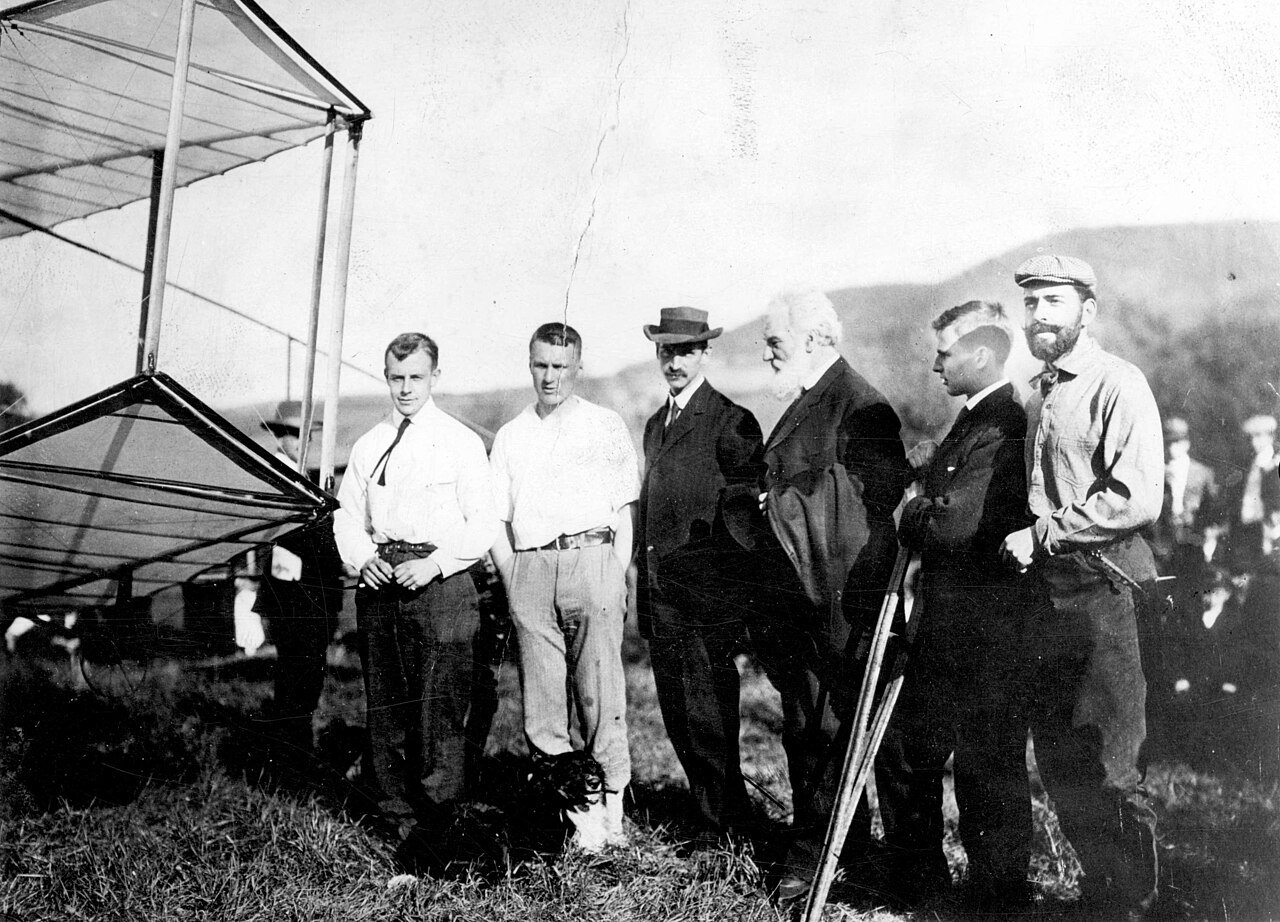
Bell’s interest went back a long way. According to the organisers of the 2009 Silver Dart centennial, he had watched Samuel Langley’s model aircraft fly in Washington in the 1890s and drawn his own conclusion.
The AEA built a run of “aerodromes”, Bell’s preferred word for aeroplanes: the Red Wing, the White Wing and the June Bug, with which Curtiss won the Scientific American Trophy on 4 July 1908, a story Afterburner has already told. The fourth, Aerodrome No. 4, was the Silver Dart, with McCurdy as its principal designer.
The silver-winged machine
The Silver Dart was a canard, with its elevator out in front of the wings. The frame was steel tube, bamboo, wire and wood, held together in places with friction tape, and the wings were covered in rubberised silk balloon cloth. Curtiss developed its water-cooled engine, a step on from the AEA’s earlier machines. It had no brakes and, like most aircraft of its time, it was not easy to control.
After a series of successful flights at Hammondsport, the aircraft was dismantled, crated and shipped to Baddeck, the Bells’ Canadian home. That set up the flight of 23 February: a Canadian pilot, in his home village, flying a machine he had largely designed.
The RCAF Foundation tells the story of the Silver Dart and the birth of aviation in Canada.
Accounts of exactly how far McCurdy flew that morning differ. The Canadian Encyclopedia gives about 800 metres; other accounts describe a wide turn and a flight of close to a kilometre or more. What they agree on is that the flight was controlled, that McCurdy brought the machine back down safely, and that it was the first of its kind in Canada.
It was also, as The Canadian Encyclopedia puts it, the first controlled flight by a British subject in the British Empire. For years the Wright brothers and the French pioneers had led the way. Now an aircraft had flown from the ice of a Nova Scotia lake, flown by a Nova Scotian.

Two hundred flights and a sandy end
The Silver Dart kept flying. The Canadian Encyclopedia credits it with more than 200 flights. The AEA itself had run its course: Selfridge had been killed in September 1908 as Orville Wright’s passenger at Fort Myer, Curtiss was going into business for himself, and the association was dissolved at the end of March 1909.
An attempt was also made to sell the aircraft to the Canadian Army, according to the Canada Aviation and Space Museum. That summer the Silver Dart was taken to the military camp at Petawawa, Ontario, for trials. On 2 August 1909 it carried the first passenger in Canada. But the soft sand made a poor airfield, and during those trials in early August the Silver Dart was damaged beyond repair on landing. The army did not buy.
A short history of the Silver Dart in the CanadianCoFlt series on aircraft significant to Canada.
McCurdy went on to a long aviation career. He is credited with the first flight from Florida to Cuba, served as assistant director of aircraft production for the Canadian government in the Second World War, and was Lieutenant Governor of Nova Scotia from 1947 to 1952. In 1959, on the 50th anniversary of the Silver Dart, he received the McKee Trophy He died in Montreal in 1961.
Flying it again
The flight was designated a national historic event in 1934. For the 50th anniversary, volunteers from the Royal Canadian Air Force built an airworthy replica at No. 6 Repair Depot in Trenton, Ontario. Wing Commander Paul Hartman flew it at Baddeck on the anniversary in 1959, but high, gusty winds caused it to crash. He was unhurt, and the repaired replica is now in the collection of the Canada Aviation and Space Museum in Ottawa.

For the centenary, a volunteer group called the Aerial Experiment Association 2005 built a new flying replica. On Sunday 22 February 2009, the day before the anniversary, former Canadian astronaut Bjarni Tryggvason flew it five times from the ice of Baddeck Bay, watched by hundreds of people. After a collapsed nose wheel on his first run, he told The Globe and Mail what the day meant.
The centennial replica of the Silver Dart flying at Baddeck in 2009.
In 2013 that replica moved into its permanent home at the Alexander Graham Bell National Historic Site in Baddeck, suspended inside the museum within sight of the bay. The site’s superintendent, David Ebert, told CBC News that Bell’s aviation legacy deserved to be remembered alongside the telephone.
Canada’s aviation story runs from the Silver Dart through bush planes, water bombers and CF-18s. It started with a 22-year-old, a sleigh, and a frozen bay in Cape Breton.
Sources: The Canadian Encyclopedia (Norman Hillmer; James H. Marsh), Canada Aviation and Space Museum, Flight of the Silver Dart Centennial Celebration, The Globe and Mail, CBC News, Library of Congress


0 Comments