
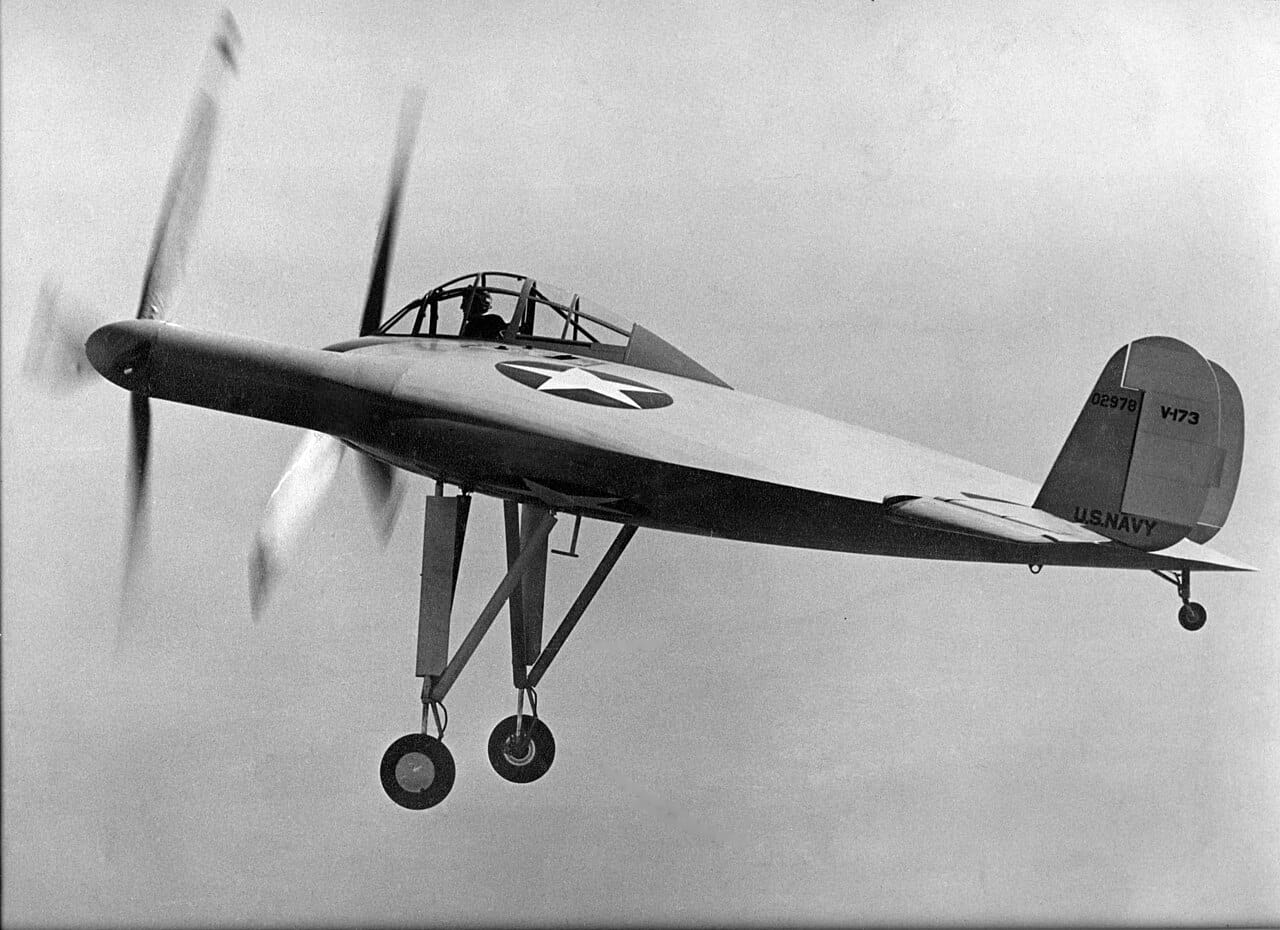
It sat on the ground at twenty-two degrees nose-up, which meant the pilot could not see forward at all. To take off and land he looked down through windows cut into the floor at his feet.
The Vought V-173 was a flat disc with two enormous propellers on the front and almost nothing a 1942 aviator would recognise as a wing. Test pilots called it the Flying Pancake. It flew 190 times and never once crashed.
Its successor, built to turn the idea into a carrier fighter, never left the ground at all.
Quick Facts
| Aircraft | Vought V-173 “Flying Pancake” — one built |
| First flight | 23 November 1942, from Bridgeport, Connecticut, with Vought chief test pilot Boone Guyton at the controls |
| Designer | Charles H. Zimmerman, an aerodynamicist who came to Vought from NACA |
| Shape | A circular wing 23.3 ft across using a symmetrical NACA 0015 section — almost no conventional wing at all |
| Engines | Two Continental A-80 four-cylinder engines, 80 horsepower each |
| Propellers | Three-bladed and wooden, 16.5 ft in diameter — enormous relative to the aircraft |
| Performance | Max speed 138 mph, gross weight 2,258 lb, climb to 5,000 ft in about seven minutes |
| Flights | 190, with no crashes. Charles Lindbergh flew it and found it easy to handle |
| The successor | The all-metal XF5U-1, roughly five times heavier with two Pratt & Whitney R-2000 radials. It never flew |
Why a disc?
Zimmerman was chasing one thing: the ability to fly extremely slowly without stalling.
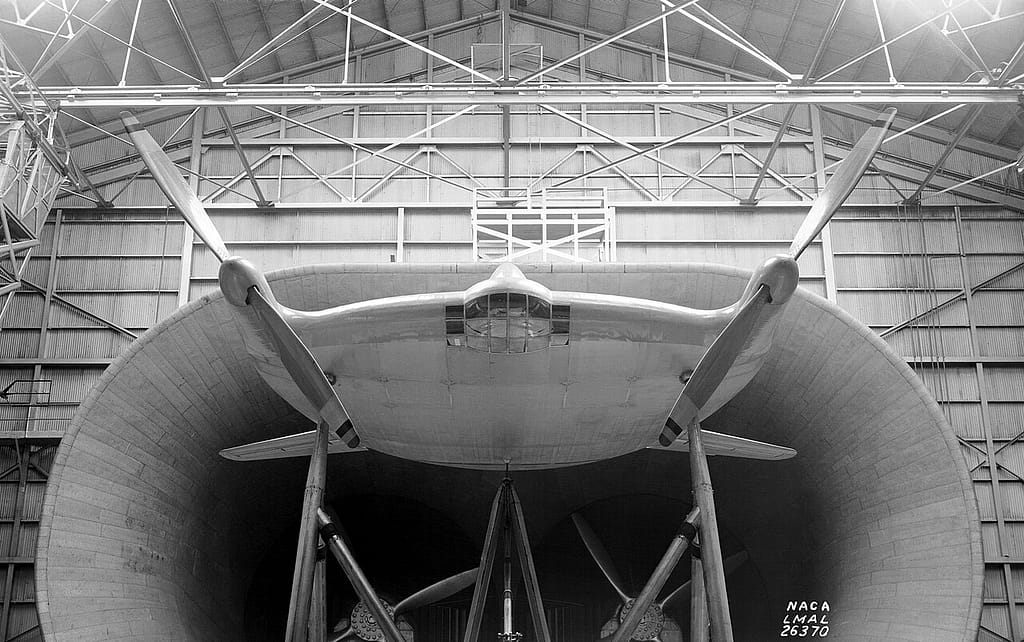
A conventional wing sheds vortices at its tips that spill lift and create drag, and the shorter and stubbier the wing, the worse the penalty. The usual answer is a long, thin wing. Zimmerman went the opposite way — make the wing so short it is essentially circular, then put a huge propeller at each tip turning against the vortex, cancelling it out.
The propellers were not there merely to provide thrust. They were part of the wing's aerodynamics. That is why they are so absurdly large and mounted exactly where they are.
It worked. The V-173 could fly at speeds where a conventional fighter would have fallen out of the sky, and in a 25-knot headwind it could take off with essentially no ground roll at all. For an aircraft intended to operate from a pitching carrier deck, that was the entire point.
Flying it was reportedly bizarre
Those huge propellers, spinning fast, gave the aircraft handling closer to a rotorcraft than a fighter.
The airframe itself was pure 1942 improvisation: wood and tube covered in doped fabric. When the Vought Aircraft Heritage Foundation restored the surviving aircraft decades later, volunteers reproduced that covering by hand.
The fighter that never flew
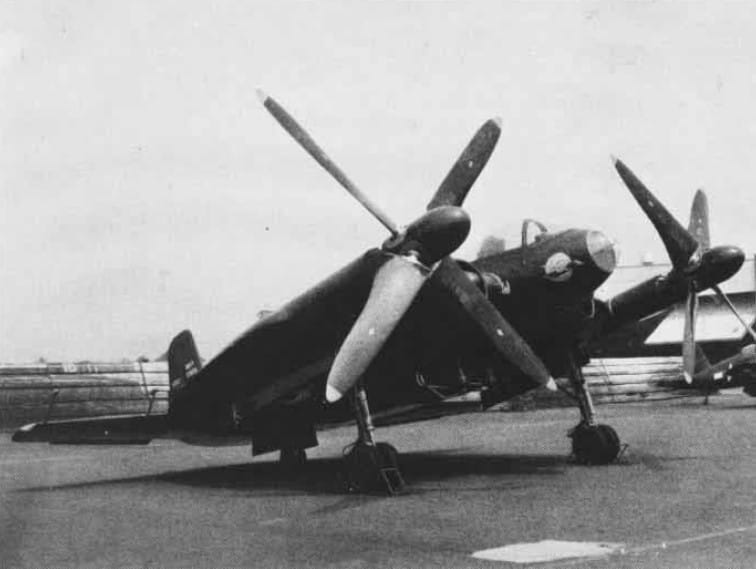
The Navy liked what it saw enough to order a combat version: the XF5U-1, sometimes called the Flying Flapjack. It was a completely different animal — all metal, 32 ft 6 in span, two Pratt & Whitney R-2000 radials in place of the V-173's pair of 80-horsepower engines. Empty weight went from just over a ton to more than six.
It was completed. It ran. It taxied and made short hops. But it never made a genuine flight, and by the time it was ready the war was over and the Navy had committed to jets. Both airframes were scrapped. The V-173 survived and is now in the Smithsonian's collection.
One caution for anyone browsing this subject online: because the two aircraft look superficially similar, footage of “the pancake flying” is constantly captioned as the XF5U. It is not. Every image of a pancake in the air is the V-173, without exception. The XF5U never got there.
What it was actually for
It is tempting to file the Flying Pancake under aviation curiosities and move on. That undersells it.
Zimmerman was solving a real and enduring problem: how do you build an aircraft fast enough to fight and slow enough to land on a boat? Every carrier aircraft since has been a compromise on exactly that axis, and the industry's eventual answers — swing wings, blown flaps, vectored thrust, ski jumps, and now tiltrotors — all attack the same question from different directions.
The V-173 was the strangest answer anyone came up with, and in its own terms one of the few that actually worked. One hundred and ninety flights, no accidents, and a test pilot roster that included Charles Lindbergh.
It just arrived at the exact moment the propeller stopped being the future.
Period test footage of the V-173 actually flying.
A fuller account of the design and why the shape made sense.
Sources: Smithsonian National Air and Space Museum; Smithsonian Air & Space magazine; NASA; Wikipedia.
0 Comments