

Ask anyone which airliner first broke the sound barrier and they will say Concorde. They will be wrong by seven years — and by one very ordinary-looking Douglas jetliner that most people have completely forgotten.
On 21 August 1961, a standard Douglas DC-8 — the same four-engine airliner that carried holidaymakers across the Atlantic — was deliberately pushed past Mach 1 in a screaming dive over the California desert. It remains the only conventional airliner ever to go supersonic on purpose, other than Concorde and the Soviet Tu-144.
QUICK FACTS
| Date | 21 August 1961 |
| Aircraft | Douglas DC-8-43, registration N9604Z ("Empress of Montreal") |
| Top speed | Mach 1.012 (~660 mph) at ~41,000 ft, in a dive |
| Time supersonic | ~16 seconds |
| Pilot | William M. Magruder (Douglas chief test pilot) |
| Operator | Delivered to Canadian Pacific Air Lines, November 1961 |
A test, not a stunt
The flight had a serious purpose. Douglas wanted flight-test data on a new wing leading-edge design, and pushing the DC-8 to its limits was the way to get it. But there was showmanship in it too: Magruder wanted to prove his airliner could survive Mach 1 — and grab some publicity from arch-rival Boeing’s 707.
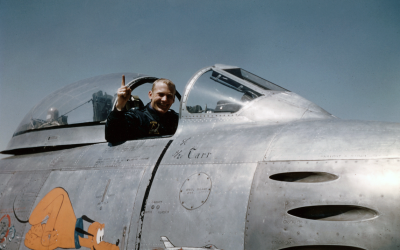
The plan was audacious. Take a brand-new airliner up to around 52,000 feet — itself a record altitude for a commercial transport — then roll it over into a dive and let gravity do the rest. Chase planes came along to film it, including an F-104 Starfighter reportedly flown by Magruder’s old friend Chuck Yeager.

Sixteen seconds — and a scare
As the DC-8 plunged, the Mach needle crept past 1.0 and held there for about 16 seconds. Flight-test engineer Richard Edwards, aboard the aircraft, remembered the moment vividly decades later.
Scary is the right word. In the dive the elevators lost their bite and the stabilizer motor stalled against the enormous aerodynamic load — for a few seconds the airliner did not want to pull out. Magruder’s solution was pure test-pilot nerve: he pushed further into the dive to unload the tailplane, which restored control and let him haul the DC-8 level. Throughout, his manner was famously unflappable.

Three months later, N9604Z was delivered to Canadian Pacific Air Lines, renamed Empress of Montreal, and spent the next two decades doing exactly what every other DC-8 did: carrying passengers. Its supersonic record stood until the Tu-144 flew in 1969.
No airline ever built a business on supersonic DC-8s, of course. But the next time someone tells you Concorde was the first airliner through the sound barrier, you can gently correct them — and tell them about the day an ordinary jetliner went looking for Mach 1, and found it.
Frequently Asked Questions
Which airliner first broke the sound barrier?
How fast did the DC-8 go?
Why would anyone dive an airliner past Mach 1?
How did they do it?
Did anything go wrong?
What happened to the aircraft afterwards?
Sources: Smithsonian Air & Space Magazine; HistoryNet; This Day in Aviation; Wikipedia.

0 Comments