

Two Queensland companies signed an agreement at Parliament House in Canberra on Monday that, on paper, is unremarkable: a rocket firm and a scramjet firm agreeing to work together.
What they are actually proposing is a business almost nobody offers. Not a hypersonic weapon. A hypersonic taxi service: a way for defence and commercial customers to get their own hardware above Mach 5 and see what happens to it, repeatedly, without waiting years for a slot on somebody else’s programme.
Quick Facts
| Who | Gilmour Space Technologies and Hypersonix, both Queensland-based |
| What | Agreement to develop hypersonic flight-test options for defence and commercial programmes |
| Announced | 8 September 2026, at an NRF Connect event at Parliament House, Canberra |
| Gilmour brings | Rocket propulsion, launch, mission integration and flight test |
| Hypersonix brings | Scramjet propulsion and hypersonic vehicle technology |
| Hypersonic defined | Mach 5 and above, five times the speed of sound |
| Framework mentioned | AUKUS Pillar II |
| Common backer | Both are portfolio companies of the National Reconstruction Fund Corporation |
The bottleneck is not ideas. It is flights.
Hypersonic research has a supply problem. Wind tunnels can only take you so far, and every serious question about high-speed flight, whether a sensor survives, whether a datalink holds, whether a guidance system works when the air outside is a plasma, eventually has to be answered by flying something.
Test flights are scarce, expensive and booked out. That scarcity is what the two companies are aiming at.

Two halves of one problem
The split of labour is neat, because a scramjet has an awkward requirement: it does not work standing still.
A supersonic combustion ramjet has no compressor, no turbine and essentially no moving parts. It works by using the vehicle’s own forward speed and a shock train in the inlet to compress incoming air, then burning fuel in a flow that is still supersonic. Elegant, but it means the engine has to be delivered to its operating speed by something else before it can do anything at all.
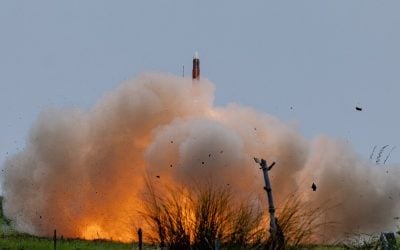
That something else is a rocket, which is Gilmour’s side of the partnership. Hypersonix supplies the vehicle and the scramjet; Gilmour supplies the booster, the launch, the mission integration and the flight-test apparatus around it.
Sovereign capability, and what that phrase is doing
Both companies leaned on the word sovereign, and in this case it is not filler. The stated aim is to keep the intellectual property, the skills, the infrastructure and the advanced manufacturing inside Australia rather than exporting the interesting parts and importing the finished article.
The AUKUS Pillar II reference points the same way. Pillar II is the advanced-capabilities strand of the pact, covering hypersonics among other technologies, and a country that can offer allied programmes a place to test is a more useful partner than one that can only host them.
That both firms sit in the National Reconstruction Fund Corporation’s portfolio, and that the announcement was made at Parliament House rather than at a trade stand, tells you how this is being positioned in Canberra.
How Hypersonix’s hydrogen-fuelled SPARTAN scramjet works, and why an engine with no moving parts still needs a rocket to get going.
An agreement is not a flight. Neither company has said when the first joint test will happen, what it will carry, or who will pay for it. But the logic is sound and the gap in the market is real, and for once the interesting hypersonic news is not coming from Washington, Moscow or Beijing.
Frequently Asked Questions
What did Gilmour Space and Hypersonix agree to do?
What speed counts as hypersonic?
How does a scramjet engine work?
Why does a scramjet need a rocket?
What is AUKUS Pillar II?
Who funds Gilmour Space and Hypersonix?
Sources: Asia Pacific Defence Reporter; Gilmour Space Technologies; Hypersonix Launch Systems; National Reconstruction Fund Corporation; Startup Daily.


0 Comments