

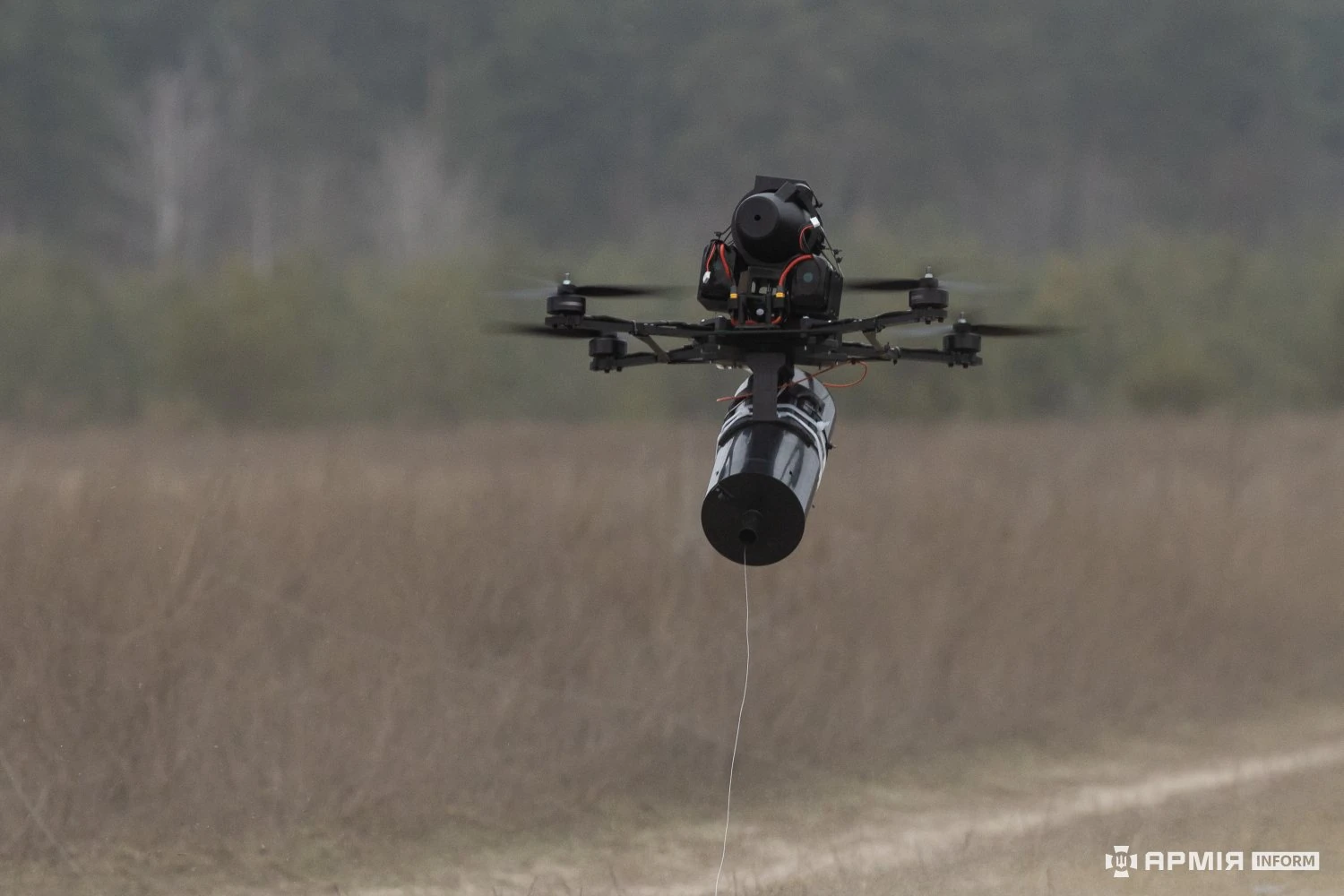
In February 2025, Ukraine became the first nation in history to establish a dedicated military branch for unmanned systems. The Unmanned Systems Forces — or USF — are not an experiment. They are now the largest consumer of drones on the planet, fielding an estimated four million units in 2025 alone and targeting six to seven million in 2026, with production capacity already approaching ten million per year.
That is not a typo. Ukraine is producing drones on an industrial scale that dwarfs anything seen in conventional warfare, and the numbers keep climbing.
From Improvisation to Institution
When Russia invaded in February 2022, Ukraine's drone capability was rudimentary. Volunteer units taped grenades to commercial quadcopters. Turkish-made Bayraktar TB2s scored early propaganda victories but proved vulnerable to Russian air defences as the war ground into attritional combat.
What followed was the fastest military-industrial adaptation since the Second World War. By 2023, thousands of small workshops across Ukraine were producing first-person-view attack drones — cheap, expendable, and devastatingly accurate. By 2024, the government formalised the effort, creating a procurement pipeline that bypassed traditional defence contracting. And in February 2025, President Zelensky signed the USF into existence as a full branch of the armed forces, equal in status to the army, navy, and air force.
Colonel-General Vadym Sukharevskyi, the USF's first commander, oversees an organisation that now includes dedicated drone infantry units, electronic warfare specialists, long-range strike teams, and an entire logistics chain for maintaining millions of expendable airframes in the field.
The FPV Revolution
The backbone of Ukraine's drone force is the first-person-view attack drone. Costing as little as $400 to $500 apiece, these small quadcopters carry shaped-charge warheads and are guided by an operator wearing video goggles. They fly at speeds up to 150 kilometres per hour and can strike a tank's turret ring or a bunker's firing slit with precision that would make a guided missile jealous.
Early FPV drones had a range of five to ten kilometres and relied on radio links that Russian electronic warfare could jam. Ukraine's engineers solved both problems. By mid-2025, fiber-optic guided FPV drones — trailing a hair-thin glass filament behind them — became standard issue on many frontline sectors. These drones are completely immune to electronic jamming, since the control signal travels through the wire rather than through the air. Their range has expanded to twenty kilometres and beyond, with some experimental models reaching fifty.
Meanwhile, conventional radio-linked FPV drones have pushed their operational range past 100 kilometres using relay drones — unmanned aircraft that hover at altitude and retransmit the control signal deeper behind enemy lines. This "middle strike" doctrine allows Ukrainian operators sitting in shipping containers far from the front to hit targets that were previously reachable only by expensive cruise missiles or long-range artillery.
Dismantling Russia's Air Defences
Perhaps the most strategically significant achievement of the USF in 2025 and 2026 has been the systematic destruction of Russian air defence assets. According to Ukrainian military officials, drone strikes have hit 194 elements of Russia's integrated air defence network in the first half of 2026 alone — radars, command vehicles, missile launchers, and communication nodes.
This matters far beyond the drone war itself. Every S-300 or S-400 battery destroyed by a $500 FPV drone is a multi-million-dollar asset that Russia cannot easily replace. More importantly, every gap torn in the air defence network makes Russian airspace more vulnerable to Ukrainian deep strikes using longer-range weapons — and potentially to manned aircraft operations that would have been suicidal a year earlier.
Ukraine has also begun targeting Russian drone production facilities directly. Strikes on factories in Yelabuga, Alabuga, and other locations have disrupted Moscow's own drone manufacturing programmes, particularly the Shahed-type one-way attack drones that Iran helped Russia set up for mass production.
The Industrial Base
What makes Ukraine's drone force unique is not any single technology but the production model behind it. Ukraine has built a distributed manufacturing ecosystem with hundreds of small producers, many of them operating from civilian workshops, garages, and university labs. Government contracts flow through a digital procurement platform that allows rapid iteration — a new drone design can go from prototype to mass production in weeks rather than the years typical of traditional defence procurement.
Production reached four million units in 2025. The government's stated target for 2026 is six to seven million, though officials have indicated that installed capacity could produce up to ten million if funding and component supplies allow. To put that in perspective, the entire global commercial drone market ships roughly four million units per year. Ukraine alone is now producing more military drones than the rest of the world's commercial drone industry combined.
Components remain a bottleneck. Motors, flight controllers, and camera sensors are overwhelmingly sourced from China, creating a supply chain vulnerability that Ukraine and its Western allies are working to address through domestic production and alternative sourcing.
What the World Is Learning
Every major military on earth is watching Ukraine's drone war with intense interest. The lessons are stark. First, mass matters more than sophistication — a thousand $500 drones will saturate defences that a single $2 million missile cannot. Second, electronic warfare is now as important as air defence. Third, the ability to iterate and produce at speed is a decisive advantage that traditional defence procurement models cannot deliver.
The United States has launched its own Replicator programme to field thousands of autonomous drones. Turkey, already a drone superpower thanks to Baykar, is accelerating AI-enabled swarm development. China is investing heavily in counter-drone systems. And NATO members from Poland to the United Kingdom are rewriting doctrine to account for a battlefield where the sky is never empty.
But Ukraine remains the only country that has built and operated a drone force at this scale under actual combat conditions. The Unmanned Systems Forces are not a concept or a white paper. They are a functioning military branch that destroys hundreds of targets every single day. And they are writing the textbook that every air force in the world will study for the next fifty years.


0 Comments