
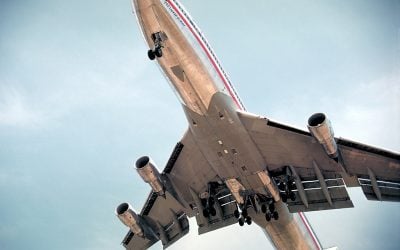
Look at the belly of the aircraft below. There is a cockpit on it. No glass, no pilot, no hole in the airframe. It is paint.

The man who put it there was told, as a young man, that he would never be allowed to fly a military aircraft. He spent the next seventy years in them anyway, with a sketchbook, and along the way he worked out something about air combat that the engineers had missed.
Quick Facts
| Who | Keith Ferris, American aviation artist, born 14 May 1929 in Honolulu |
| Why not a pilot | An egg allergy. It blocked the vaccinations required for the Air Force flight cadet programme |
| What he did instead | Aviation art, and more than fifty years in the USAF Art Program |
| Time in the air | Around 300 hours of jet fighter time, in B-52s, an F-4E over Thailand, with the Thunderbirds, and on missions over Bosnia |
| Paintings | 62 major works in the US Air Force art collection |
| Smithsonian | Two murals, each 75 feet wide and 25 feet high, in the National Air and Space Museum |
| Patents | Five US patents and four foreign patents for camouflage and paint schemes. The first issued 16 May 1978 |
| The false canopy | A cockpit painted on the underside, adopted on A-10s and Canadian CF-18s |
| Age | 97 |
An egg allergy
Ferris was born into it. His father Carlisle was an Army Air Corps lieutenant stationed at Luke Field on Ford Island, and the family moved from base to base: Kelly Field in Texas, where his father instructed for six years, then March Field in California. Ferris took his first flight on his tenth birthday, in a Douglas B-18A.
He went to Texas A&M in 1946 to read aeronautical engineering and joined the Air Force ROTC intending to fly. Then the medical came back. He was allergic to eggs, which meant he could not take the vaccinations the flight cadet programme required, and that was the end of it.
So he changed the plan rather than the goal. He transferred to George Washington University and studied anatomy and figure drawing at the Corcoran alongside it. He drew aircraft for Air Force training publications and nuclear weapons manuals in St Louis for five years, then went freelance for the aerospace industry.
The Air Force, having refused to let him fly, then spent four decades putting him in the back of its aeroplanes. Through the Society of Illustrators’ Air Force Art Program he flew in most of the bombers, fighters and trainers in the inventory. In December 1963 he flew a cross-country with the Thunderbirds in an F-100 Super Sabre, in the slot, during a practice display. He accumulated roughly 300 hours of jet fighter time and gave the Air Force 62 major paintings.
What a painter noticed that engineers had not
An artist spends his working life on a single problem: how the eye reads a shape. Which edges it finds, which it invents, how quickly it decides what it is looking at. Ferris spent 300 hours in fighter cockpits thinking about that problem while the aircraft around him manoeuvred.
A dogfight is decided in glances. Two aircraft converge at a closing speed measured in hundreds of knots, both pilots loaded up under g, and each has a fraction of a second to work out where the other one is pointed and which way it is about to go. Everything after that follows from that first read.
Ferris’s idea was to poison the read. Make the underside look like the topside. For one beat, the other pilot cannot tell whether he is looking at the belly of an aircraft turning away or the top of one turning into him. One beat is not much. In a merge it is the whole thing.
“If you’re going to camouflage a plane in the first place, it makes sense to avoid conspicuous insignia.”
Keith Ferris, on the design principles behind his schemes, in Air & Space Forces Magazine
The paint systems that carry his name were not only the false canopy. The Ferris and Heater-Ferris schemes used asymmetric, splintered patterns in three greys, Matt Dark Gray, Dark Gull Gray and Light Gull Gray, chosen to break up the outline so the eye cannot fix the shape, the size or the heading. No black, no bright colours, matt finishes, insignia toned down. They flew on F-14s of VF-111 around 1978 to 1980, on F-4s, and influenced later F-15 and F-16 schemes.

Nature got there first
Biologists have a word for this. It is automimicry: an animal imitating another part of itself rather than its surroundings.
Butterflies carry eyespots near the trailing edge of the hindwing. Several fish carry a dark false eye near the tail. The predator strikes what it reads as the head, the prey moves the other way, and the bite lands on a fin instead of a skull. It does not have to work often to be worth having.
The false canopy is the same bet. It does not need to deceive an opponent for long. It needs to cost him one glance at the moment when glances are expensive.
Does it actually work
Here the honest answer is: partly, and pilots have argued about it for forty years.
The standard objection turns up in the comments under every post about it, and it is not stupid: if the enemy is close enough to see your paint, he is close enough to see that the canopy is flat, that there is no head in it, and that the aircraft is the wrong way up. Against a pilot who has time to look, the trick fails.
What testing did show is more modest and more useful. Experiments with the Ferris and Heater-Ferris schemes found they reduced the range at which an aircraft could be picked up visually, and made its direction of travel harder to judge. That is the disruptive pattern doing the work as much as the canopy. The false cockpit is the part people photograph; the splintered grey is the part that shortens detection range.
And the wider point survives the argument. Most air combat since the 1980s has been decided beyond visual range, which is precisely why visual-range tricks look quaint. But aircraft still merge, and when they do, the eye is still the sensor, and the eye can still be lied to.

The murals
The camouflage is a footnote to the career, not the career. Ferris joined the Society of Illustrators in 1960, founded the American Society of Aviation Artists and served as its president, and was inducted into the National Aviation Hall of Fame in 2012 as the dean of American aviation art.
Two of his paintings are architecture. Fortresses Under Fire covers a wall of the National Air and Space Museum’s World War II gallery, 75 feet wide and 25 feet high, showing the B-17G Thunderbird under attack by German fighters on its 70th mission, 15 August 1944. It took roughly 135 days of planning and 75 days to paint. Its companion, The Evolution of Jet Aviation, carries 27 significant jets from eight countries and twenty manufacturers.
“I place my dad in the same position as everybody else that I’ve flown with.”
Keith Ferris, on the aircrew in his paintings, in Air & Space Forces Magazine
His father flew. He did not. So he painted the men who did, from the seat behind them, and then he worked out how to make their aircraft harder to kill.
Keith Ferris was born on 14 May 1929, which makes him 97.
The post that brought this up
This came round on Instagram from the account theaviationcircle. The account has the substance right, including the egg-allergy detail, the 300 hours and the five patents. Worth knowing that his first camouflage patent issued on 16 May 1978, two days after his forty-ninth birthday, and that the false canopy is one element of a system rather than the whole of it.
Frequently Asked Questions
Why do some fighter jets have a fake cockpit painted on the bottom?
Who invented the false canopy?
Does a false canopy actually work?
What is automimicry?
What is the Ferris camouflage scheme?
Which aircraft carry a false canopy?
Why did Keith Ferris never become a pilot?
Where can you see Keith Ferris’s paintings?
Sources: Air & Space Forces Magazine; National Aviation Hall of Fame; Keith Ferris Art (Ferris Paint Systems); Wikipedia entries for Keith Ferris and the McDonnell Douglas CF-18 Hornet; US Patent 4,089,491 and related filings; theaviationcircle on Instagram; Afterburner reporting


0 Comments