
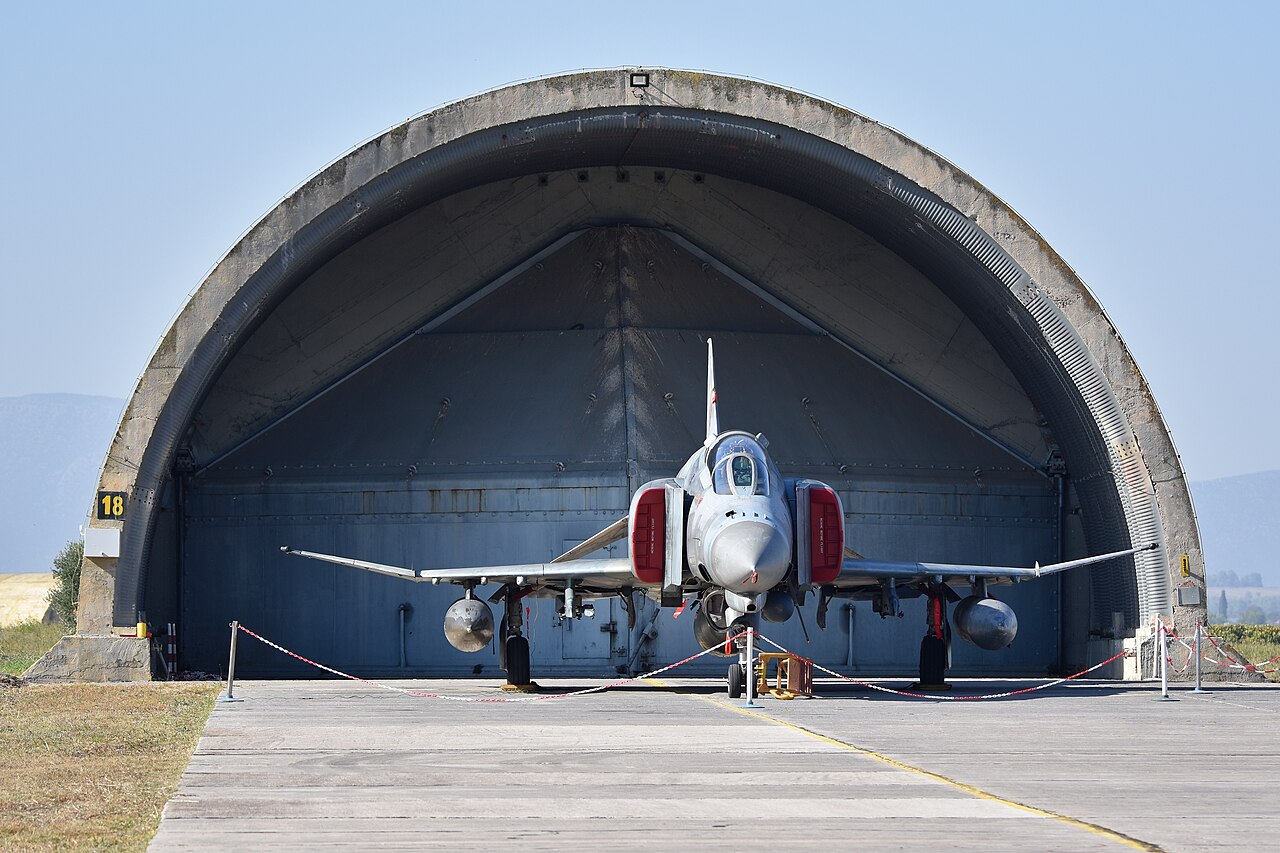
The display had been running for barely two minutes. Thousands of people were standing along the fence line at Tanagra Air Base, north of Athens, cameras up, waiting for the noise that only a Phantom makes. Then the jet came out of a turn, low, and did not climb.
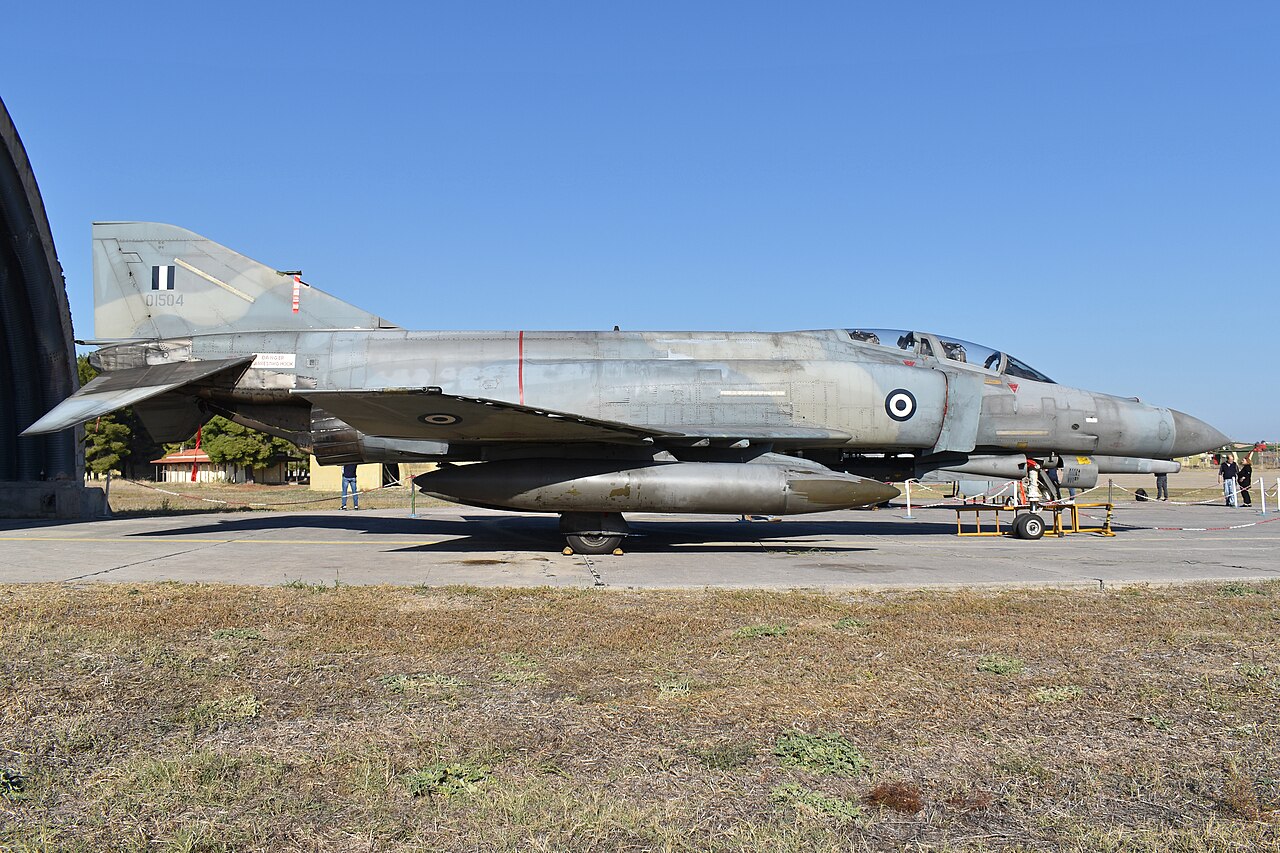
At 14:55 on Saturday 5 September 2026, a Hellenic Air Force F-4E AUP Phantom II hit the ground roughly three nautical miles southeast of the airfield, broke apart and burned. Both crew members were killed. Neither ejection seat fired.
The aircraft was 01504, a 338 Squadron jet from 117 Combat Wing at Andravida — one of the last operational Phantoms left anywhere in the world.
Informations clés
Quoi: Hellenic Air Force F-4E AUP Phantom II crashed during a flying display
Quand: 14:55 local, Saturday 5 September 2026
Où: Tanagra Air Base (114 Combat Wing), about 60 km north of Athens
Aéronef: F-4E AUP, serial 01504, built as USAF 72-1504, c/n 4455
Unité: 338 Squadron “Aris”, 117 Combat Wing, Andravida Air Base
Équipage: Squadron Leader Ioannis Blesias, 40, and Flight Lieutenant Dimitrios Petrou, 37 — both killed
Spectators: No fatalities; two people reported injured by debris and taken to Chalkida Hospital
Statut: Cause under investigation by a Hellenic Air Force board; three days of armed forces mourning declared
Two minutes into the display
Athens Flying Week bills itself as the largest airshow in southeastern Europe, and the 2026 edition was scheduled to run across both Saturday and Sunday at Tanagra. The German Air Force had sent a Eurofighter, a Tornado and an A400M. The Phantom had flown a rehearsal at the media day the previous afternoon, 4 September, without incident.
Video shot by spectators shows the jet running in fast and low, rolling into a turn back towards the runway, then descending in a way that never resolves into a climb. It struck the ground beyond the airfield boundary, near an industrial estate that was closed for the weekend, and exploded. A column of oily black smoke went up over the base within seconds.
Some witnesses told Greek media that the aircraft appeared to be trailing smoke before it went down. That account has not been confirmed by the Hellenic Air Force, and at this stage nothing about the cause should be treated as settled.
Eighty-five firefighters, eleven water-dropping aircraft and helicopters were committed to the fires, which broke out at more than one point. Debris was later found scattered well away from the main impact site, including near factory buildings. Two people were reported injured by fragments and taken to hospital in Chalkida. The remainder of the show was cancelled and the crowd was sent home.
The two men in the cockpit
The Hellenic Air Force named the crew on Saturday evening. Squadron Leader Ioannis Blesias, 40, came from Pyrgos in the western Peloponnese and leaves a five-year-old son. Flight Lieutenant Dimitrios Petrou, 37, lived in Patras, with family roots in Epirus. His five-month-old daughter was due to be christened on 12 September.
Defence Minister Nikos Dendias declared three days of mourning across the Greek armed forces, running from Saturday to Monday.
In Pramanta, the mountain village in Epirus that Petrou’s family comes from, the mayor of Voreia Tzoumerka, Nikos Vaitsis, described a habit that says more about the man than any service record.
Why Greece still flies Phantoms
The Phantom first flew in 1958, and Greece is one of only three countries still operating it, alongside Turkey and Iran. That is not sentimentality. It is the result of a rebuild.
The Hellenic Air Force took its first F-4Es in 1974 under the Peace Icarus programme. In the late 1990s a substantial part of the fleet went through the Peace Icarus 2000 upgrade, emerging as the F-4E AUP with a new pulse-Doppler radar, a modernised cockpit and the ability to carry current air-to-air and precision air-to-ground weapons. Sources differ on the exact number rebuilt, generally quoting somewhere between 36 and 39 airframes.
The result is a 1970s airframe running 1990s avionics, flown into the late 2020s by a single squadron. Before Saturday, The Aviationist counted 17 airframes on Greek strength as of December 2025. That figure is now 16.
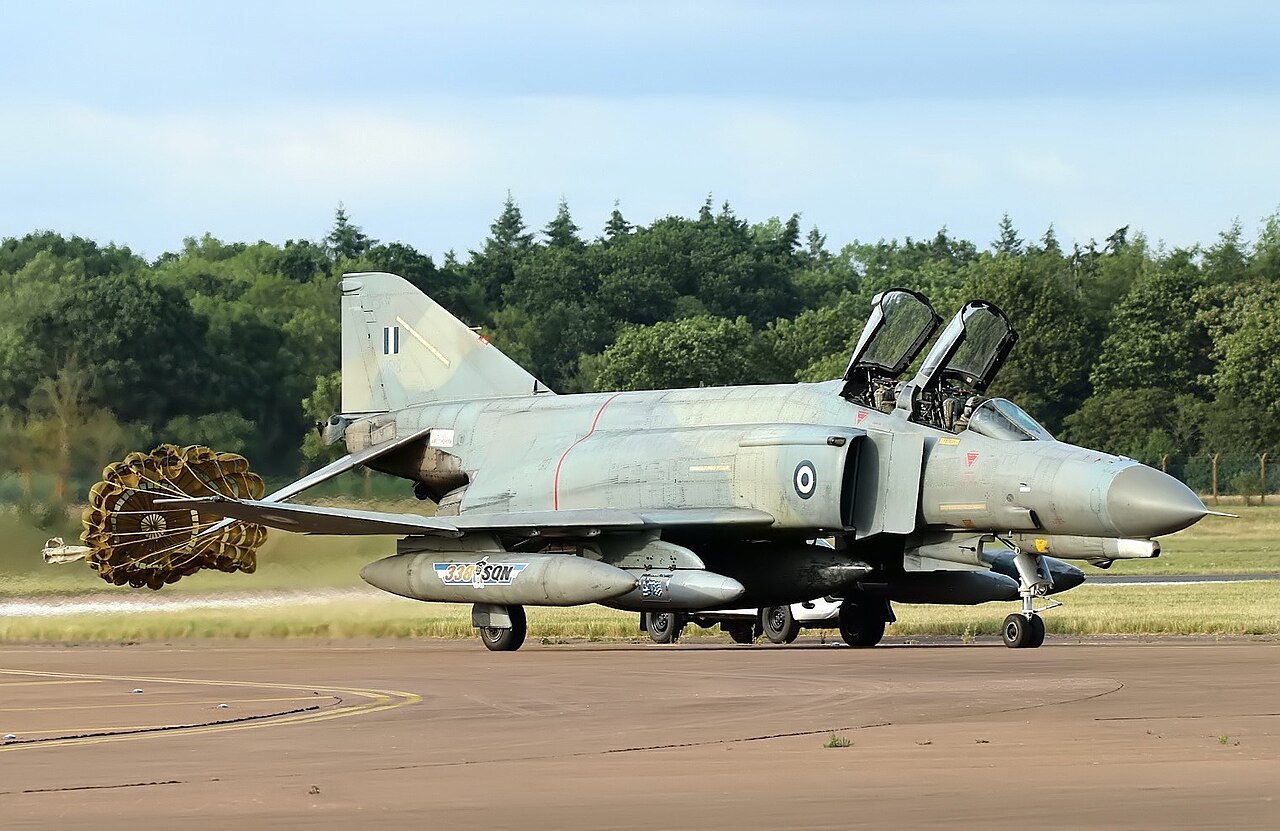
Andravida has become a pilgrimage site for enthusiasts because of it. The base hosts PhanCon, the European Phantom Conference, which draws photographers from across the world to see and hear an aircraft that has essentially vanished everywhere else. That community felt Saturday personally.
What happens now
A Hellenic Air Force board of inquiry has been appointed. Personnel at the site are recovering wreckage so the technical investigation has the physical evidence it needs, and the material is being moved to a secure location for analysis. Greek authorities have said there is no indication the ejection system was activated.
An investigation like this takes months, not days, and any conclusion drawn before then is guesswork. The one thing that can be said with certainty is that display flying in a heavy, fast, fifty-year-old fighter leaves very little room, and that the people who do it know exactly how little.
News coverage from Tanagra on 5 September, including spectator footage of the aftermath.
Foire aux questions
What happened at the Athens Flying Week 2026 airshow?
Who were the pilots killed in the Tanagra Phantom crash?
Did the crew eject from the F-4 Phantom at Tanagra?
Were any spectators hurt at the Athens Flying Week crash?
Why does Greece still fly the F-4 Phantom in 2026?
How many F-4 Phantoms does the Hellenic Air Force have left?
Sources: Hellenic Air Force General Staff and Greek Ministry of National Defence statements; ProtoThema; GreekReporter; The Aviationist; Reuters; aeroTELEGRAPH.

0 Comments