
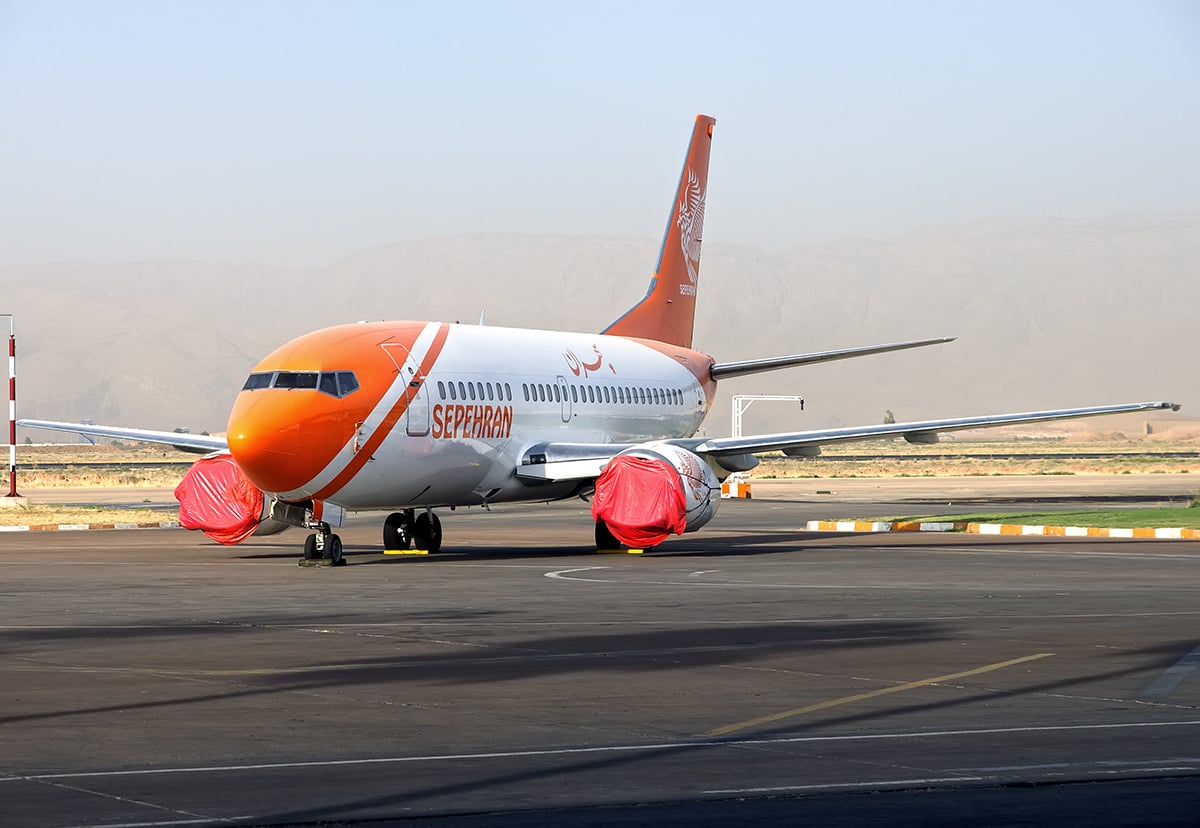
The video is short and very loud. A Boeing 737 is shaking itself half to pieces somewhere over northeastern Iran, and above the heads of the passengers the ceiling is coming apart — long panels of interior lining folding down out of the roofline and dropping into the seats while people scream and pray into their phone cameras.
Nobody was hurt. That is the first and most important fact about the Sepehran Airlines flight that left Mashhad for Kermanshah and came straight back. A tyre let go on takeoff, the crew turned round, and the vibration on the way back was violent enough to shake the cabin lining out of its clips. The aircraft stopped, the doors opened, and everyone walked off.
What makes it worth more than a viral clip is the timing. Eight days before that ceiling came down, the US Treasury had put Sepehran Airlines on a sanctions list by name — one of 27 Iranian carriers designated in a single afternoon — and tightened the rules that govern how Western-built aircraft in Iran get their parts. The jet in the video is a Boeing 737 Classic from a fleet whose average age is past thirty. Those two facts sit uncomfortably close together.
Informations clés
Compagnie aérienne: Sepehran Airlines (flysepehran), IATA IS, ICAO SHI, callsign SHIRAZI
Itinéraire: Mashhad (MHD) to Kermanshah (KSH), domestic
Aéronef: Boeing 737 Classic; several outlets report the registration as EP-FSU, a 737-300 first flown in 1996
Ce qui s'est passé: Tyre failure on takeoff and a reported engine problem, emergency return, cabin ceiling lining shaken loose
Blessures : Aucun signalement
Date: Reported inconsistently. Iranian outlets carried it on Monday 14 September 2026; aeroTELEGRAPH says Sunday 13 September; Simple Flying says 15 September
Flotte: 12 aircraft, all Boeing 737-300 and 737-500, average age over 30 years; 21 destinations; hubs Mashhad, Tehran Imam Khomeini and Tehran Mehrabad
Sanctions status: Designated by OFAC on 8 September 2026 under Executive Order 13902
A tyre, a vibration, and a ceiling that let go
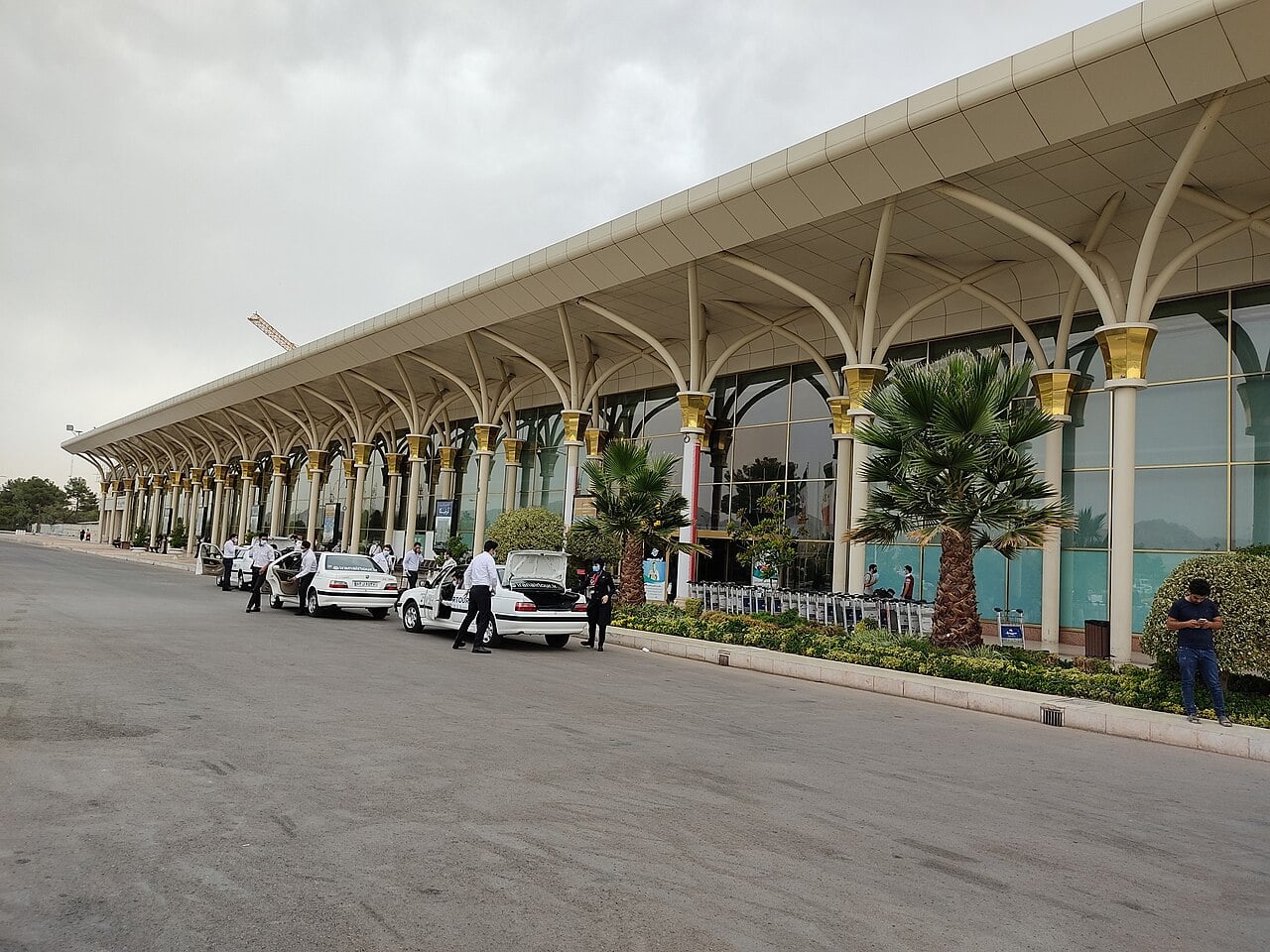
The sequence is simple enough. The 737 was climbing away from Mashhad Shahid Hasheminejad International Airport, Iran’s second-busiest, bound for Kermanshah near the Iraqi border. A tyre failed on the takeoff roll. The crew declared an emergency and brought the aircraft back.
The tyre was not the whole of it. Iranian accounts disagree on the primary fault: the provincial airports authority for Khorasan Razavi, quoted by Iranian media, described a technical failure of an engine, while other Iranian outlets lead on the burst tyre. Both elements appear in nearly every account, and the Civil Aviation Organization of Iran, which has opened an investigation, has not adjudicated between them.
Either way the effect in the cabin is the same. A failed tyre destroys the balance of the wheel assembly, and that imbalance feeds a hard, high-frequency shudder straight up through the gear legs into the airframe; a damaged engine adds its own. Interior lining panels are held in place by clips and fasteners designed for decades of ordinary flexing, not for that. On this aircraft, they let go.
Iranian reporting relayed by aeroTELEGRAPH, citing the outlet Rokna News, adds that the same service had been cancelled twice the previous day for a technical defect, and that the airline swapped aircraft before the third attempt. That detail comes from a single chain of sourcing and has not been confirmed officially.
One claim that spread with the video is worth knocking down: it was reported in places that the aircraft lost cabin pressure. There is nothing to support that — the claim appears in a headline whose own body text never mentions pressurisation, and in no other account. The 737 never reached cruising altitude, and what fell was cosmetic lining. The passengers were frightened, not decompressed.
The date nobody has settled
There is an unresolved discrepancy in the record, and it is better stated than smoothed over. Iranian outlets — Mehr News, Fararu, Tabnak among them — carried the story on the evening of Monday 14 September, which makes that the best-supported date. aeroTELEGRAPH, working from Rokna News, placed the flight a day earlier, on Sunday 13 September. Simple Flying dated it to 15 September, and much of the English-language coverage that followed took the same date, which looks like the publication date rather than the event’s. Iran’s Civil Aviation Organization has issued no timeline of its own.
Treat the registration with the same distance. Several outlets give EP-FSU, a Boeing 737 Classic whose first flight is listed as July 1996, which would make it thirty years old. That is consistent with the fleet, but it is press reporting rather than an official identification, and at least one of those outlets hedges it itself.
Three weeks earlier, at the same airport
This is not the first time Mashhad has closed a runway for a Sepehran 737 this summer. On 25 August 2026, flight IS4310 arrived from Tehran Mehrabad with 127 people aboard and ran off the runway after what the Civil Aviation Organization described as a normal landing, with no technical problem reported beforehand. The aircraft left the paved surface still travelling fast and came to rest with its nose gear no longer holding it up. Nobody was injured. Runway 13R and Taxiway Q were closed while the aircraft was recovered.
That jet was EP-FSF, a Boeing 737-529 built in May 1992 — and its logbook is a tour of the last three decades of aviation economics. It started life with the Belgian flag carrier Sabena as OO-SYJ, went east to AeroSvit and Ukraine International, then further east to Riau Airlines and Kalstar in Indonesia, and joined Sepehran in 2016. Aircraft reach Iranian fleets by that kind of route because the direct ones are closed.
Operation Economic Outcast
On 8 September 2026, the US Treasury’s Office of Foreign Assets Control sanctioned 36 targets over Iran’s aviation sector. Twenty-seven of them were Iranian airlines, designated under Executive Order 13902 for operating in the aviation sector of the Iranian economy. Sepehran Airlines is on that list by name, alongside Qeshm Air, Taban, Zagros, Iran Aseman, Saha and most of the rest of the country’s commercial fleet.

The announcement did more than add names to a list. OFAC suspended three Iran-related aviation authorisations, including one that had allowed non-US airlines to fly US-origin or US-controlled commercial aircraft into Iran, and another covering overflights. Treasury’s Financial Crimes Enforcement Network issued a parallel alert asking banks to watch for the front companies and third-country intermediaries Iranian carriers use to buy aircraft and parts.
Treasury’s stated target is the regime’s use of civil aviation to move weapons, personnel and illicit cargo, and Mahan Air — designated back in 2011 for supporting the IRGC-Qods Force — is the centre of gravity. The airlines designated on 8 September were swept up by a sector-wide determination made on 24 August.
The bind, not the verdict
It would be easy, and wrong, to draw a straight line from a Treasury press release to a ceiling panel landing in someone’s lap eight days later. Sanctions do not burst tyres, and the maintenance state of one 737 on one morning in Mashhad is not something anyone outside the investigation knows yet.
What can be said is structural. Iranian operators have kept Western airframes flying for decades on accumulated spares, locally repaired components, cannibalised aircraft and parts bought through intermediaries — because the ordinary supply chain has been closed to them since long before this year. The 8 September action narrows the legal routes further. OFAC was explicit that it will consider aviation safety-related requests case by case, which is a door left ajar rather than one closed; but a case-by-case licence is a slower and less certain thing than a parts order.
That is the bind. A country flying thirty-year-old jets on a shrinking parts supply, a regulator investigating its second Mashhad runway incident in three weeks, and a sanctions regime aimed at the regime that happens to run through the same hangar. The passengers on the Kermanshah flight walked away. The wider problem did not.
Sources: US Department of the Treasury press release sb0623 and the accompanying FinCEN alert, 8 September 2026; AeroTime, Stephen Pope, 26 August 2026; aeroTELEGRAPH, citing Rokna News; Simple Flying and Gulf News, 15 September 2026; Mehr News, Fararu and Tabnak, 14 September 2026; Civil Aviation Organization of Iran statements via ISNA; Airfleets; Wikipedia.
0 Comments