
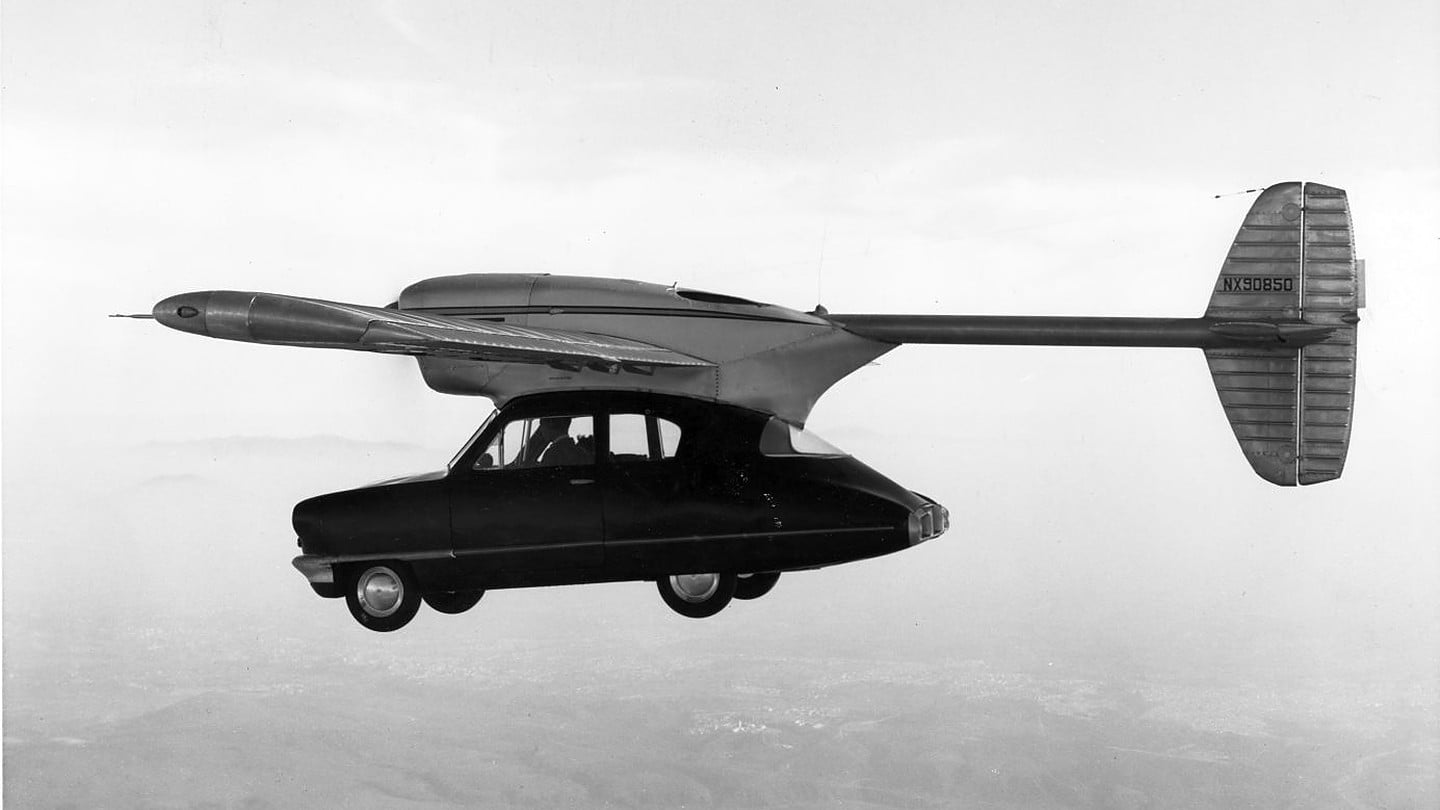
On 18 November 1947 a test pilot took off from San Diego in a car with an aeroplane bolted to the roof, and discovered somewhere over the mud flats that he had almost no aviation fuel on board. He had checked the fuel gauge before departure. It was the wrong one.
He had read the gauge for the twenty-five horsepower Crosley engine that drove the car’s wheels, not the one for the hundred-and-ninety horsepower Lycoming that turned the propeller. Three days after its first flight, the ConvAirCar was in the mud.
Informations clés
| Aéronef | Convair Model 118 ConvAirCar, also called the Hall Flying Automobile |
| Designer | Theodore P. “Ted” Hall |
| Inscription | NX90850 |
| Car engine | 25 hp Crosley, rear-mounted, driving a plastic-bodied four-seat car |
| Flight engine | 190 hp Lycoming O-435C, in the detachable wing unit |
| Envergure | 34 ft 5 in (10.49 m) |
| vitesse de croisière | 125 mph (201 km/h) |
| Production plan | 160,000 units at a projected $1,500 each |
| Construit | Two, the second rebuilt around the first one’s wing |
| Destin | Programme cancelled in 1948 |
Not a stunt — a business plan
It is tempting to file the ConvAirCar under eccentric post-war whimsy. The numbers say otherwise. Consolidated Vultee, shortly to become Convair, was a serious manufacturer chasing the post-war aviation boom, and it planned to build 160,000 of these at around $1,500 apiece.
The business model was cleverer than the aeroplane. You would own the car. The wing, tail and flight engine would live at the airport and be rented, bolted on when you wanted to fly and left behind when you did not. A four-seat family car during the week, an aircraft at the weekend, without paying to own the expensive half.
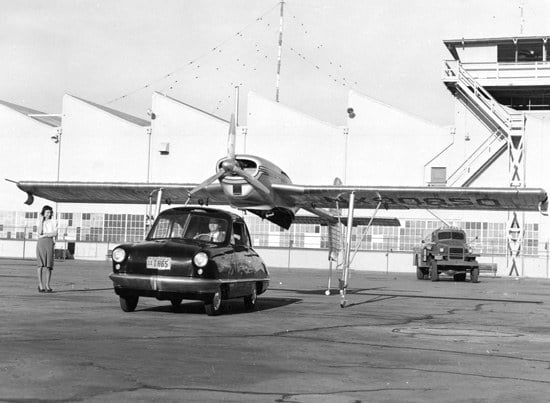
Ted Hall had been working on the idea since before the war, when Consolidated unsuccessfully pitched a flying car for commando raids. His first postwar attempt, the two-seat Model 116, flew on 12 July 1946 and completed 66 test flights. The Model 118 was the grown-up version: bigger, four seats, a plastic car body, and far more power upstairs.
Two fuel gauges, one cockpit
Here is the design flaw that no amount of engineering talent had caught. The machine had two completely separate engines with two completely separate fuel systems, and therefore two fuel gauges, sitting in front of a pilot who was also a driver.
Test pilot Reuben Snodgrass first flew NX90850 in November 1947. On the 18th, on a one-hour demonstration flight, the Lycoming ran dry. He put it down near San Diego, destroying the car body and damaging the wing, and walked away with minor injuries. He had reportedly departed with little or no aviation fuel aboard, having checked a gauge that showed full — the car’s.
Read that headline the way 1947 read it. Not “prototype suffers fuel-system incident during flight test”. Flying auto crashes. The public had been sold a car that flies, and the car that flies had fallen out of the sky on its third day.
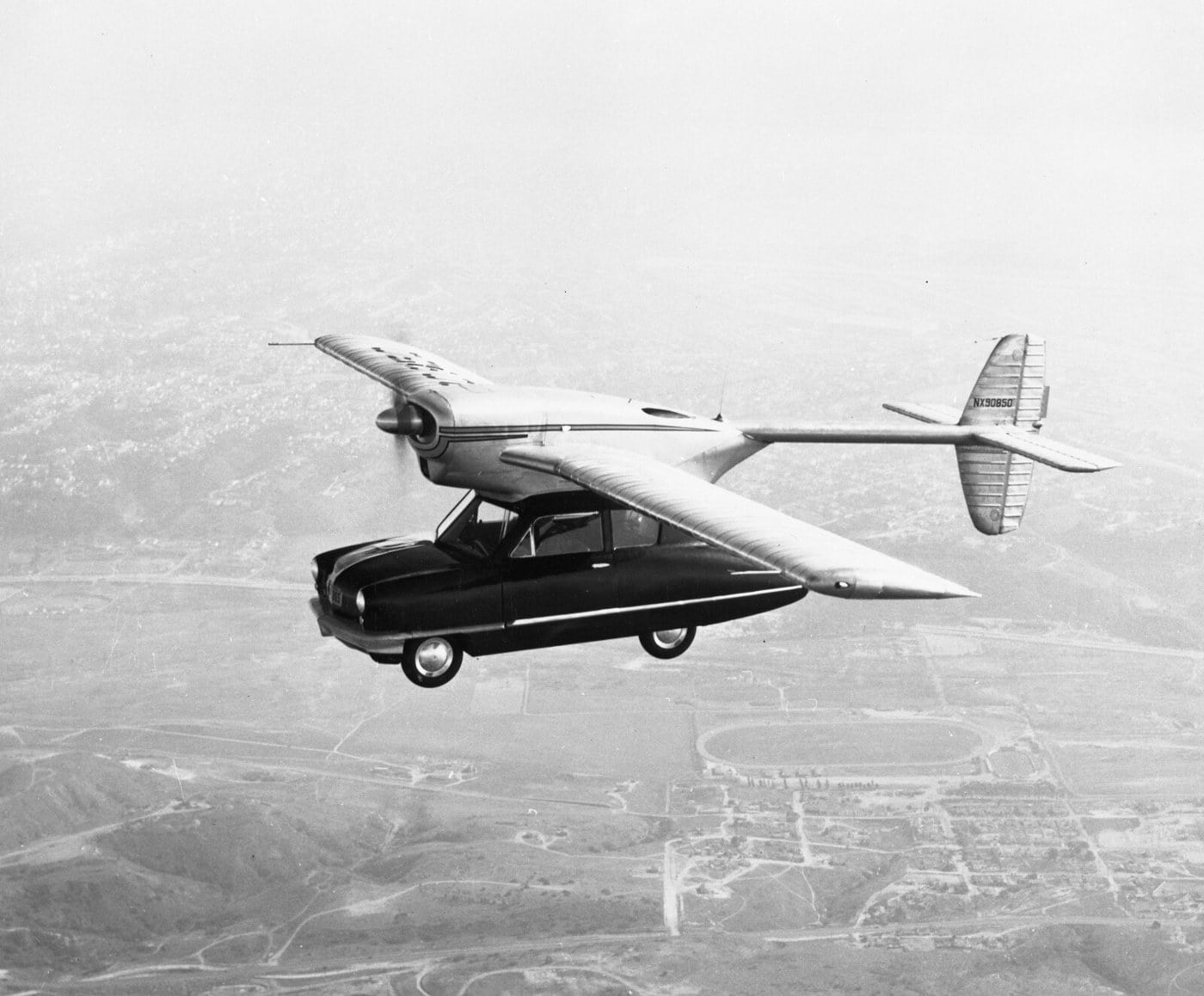
It flew again, and it was already over
Convair salvaged what it could. The same wing was fitted to another car body and the rebuilt machine flew again on 29 January 1948, piloted by W. G. Griswold. Technically the programme was alive. Commercially it was finished: the enthusiasm had gone out of it, and Convair cancelled.
Rights reverted to Hall, who set up his own company to carry on. Nothing reached production. Of the 160,000 ConvAirCars planned, the world got two, and one of those was mostly the other one.
The failure was not aerodynamic
What sinks the ConvAirCar is not that it was a bad aircraft. It cruised at 125 mph and flew acceptably. It is that nobody had thought hard enough about the human being sitting in it.
Aviation has spent the eighty years since learning this lesson repeatedly and expensively: two similar controls that do different things, two similar gauges that mean different things, and a procedure that relies on the operator remembering which is which. The industry now has a name for it — design-induced error — and a whole discipline devoted to designing it out.
Every flying-car startup currently promising a machine that drives and flies inherits the same problem. Two modes, two sets of systems, one person. The ConvAirCar got there first, and found the sharp edge in three days.
Sources: John Wegg, General Dynamics Aircraft and their Predecessors (Putnam, 1990); Bill Yenne, The World’s Worst Aircraft (1993); The New York Times, 19 November 1947; San Diego Air and Space Museum Archives.
0 Comments