
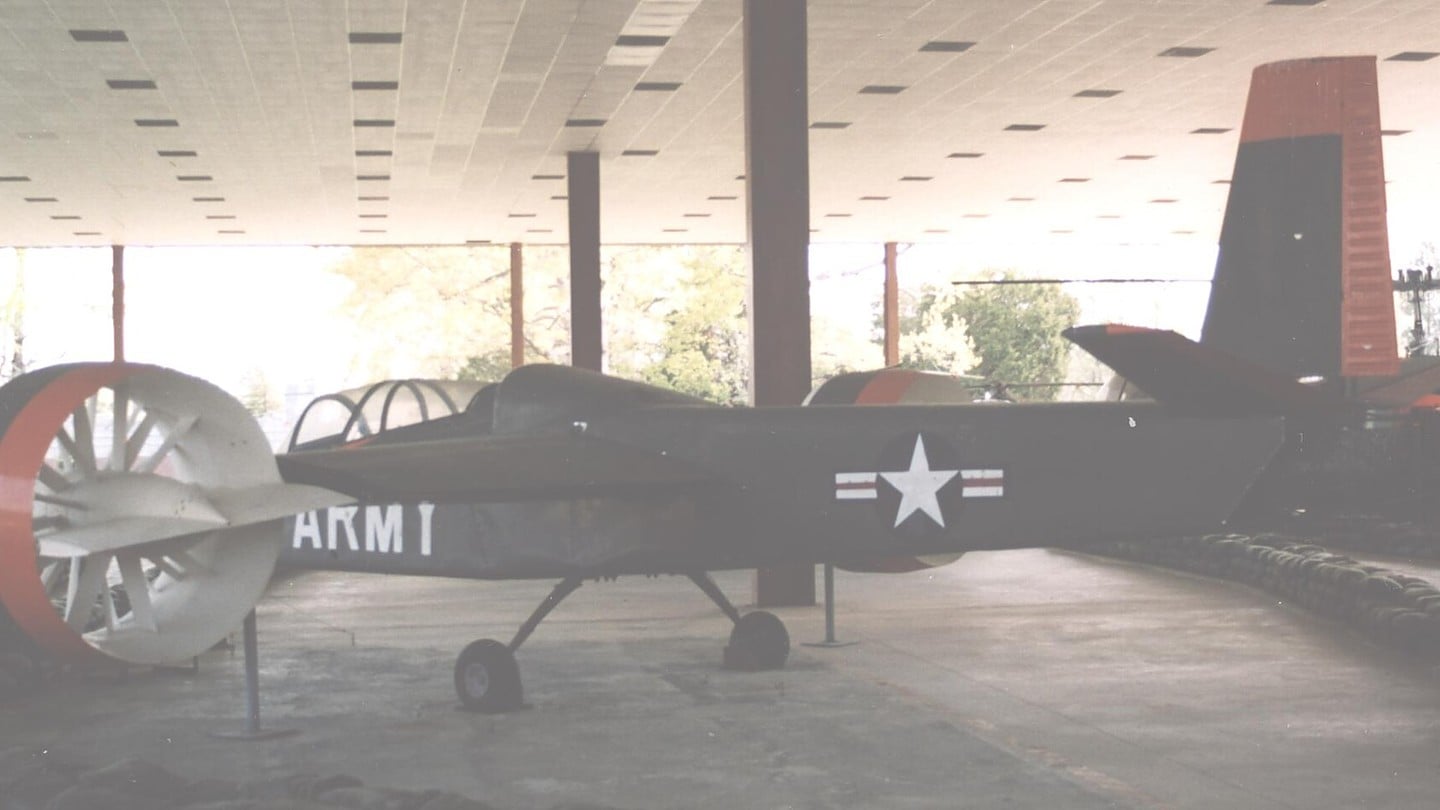
The landing gear came off a Cessna 182. The seats came out of a P-51 Mustang. The actuators that swivelled the ducts were taken from a T-33. In February 1958 this assembly of other people’s parts hovered, then flew forwards, and in doing so became the first aircraft to make the tilting-ducted-fan idea actually work.
One was built. The US Army watched it for five years, decided helicopters would do, and walked away.
Informations clés
| Aéronef | Doak VZ-4 (company designation Doak Model 16), serial 56-9642 |
| Designer | Edmund R. Doak Jr., a self-taught engineer and former Douglas vice president |
| Contracter | 10 April 1956, for a single research prototype |
| Moteur | Lycoming YT53 of 840 shp, later a 1,000 shp T53-L-1 |
| Propulsion | Two wingtip tilting ducted fans, 48 in propellers inside 60 in ducts |
| First hover | 25 February 1958 |
| First full transition | 5 May 1958 |
| Équipage | Two, in tandem, flying on a conventional stick and rudder |
| Construit | One. Army trials ended 1963; NASA flew it until 1972 |
| Survivant | Preserved at the US Army Aviation Museum since August 2024 |
Why the Army wanted it
Doak pitched the concept to the Army’s Transportation Research and Engineering Command at Fort Eustis in 1950, and the argument was pure Cold War. If the Soviets attacked NATO airbases, runways would be cratered and conventional aircraft would be stuck on the ground.
What Doak offered was an aircraft that could take off and land almost anywhere, hover and loiter over a target, and fly backwards like a helicopter — but then rotate its ducts and cruise like a fixed-wing aeroplane, fast, with wing-mounted weapons. The Army signed a contract for one prototype on 10 April 1956.
Built from the parts bin, deliberately
Edmund Doak was a self-taught engineer who had risen to vice president at Douglas before founding his own company in Torrance in 1940. During the war it employed 4,000 people building moulded plywood fuselages for AT-6 and BT-13 trainers, plus doors, hatches and gun turrets for most of the American industry.
The Model 16 reflected that make-do heritage. To save weight it was originally built as uncovered welded steel tubing — a flying frame — until it turned out the open structure ruined the forward-speed testing, at which point a moulded fibreglass nose and thin aluminium aft skin were added. The gear, seats and duct actuators were all lifted from other aircraft.
The trick was the transition
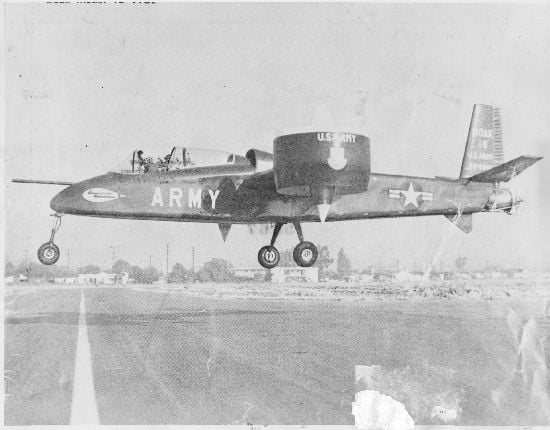
A single turbine in the fuselage drove both wingtip fans through a T-box and a four-inch aluminium shaft. The fans sat vertically for take-off and landing and rotated to horizontal for cruise. Plenty of people had drawn that. Doak was the first to demonstrate it working.
It hovered on 25 February 1958 and made its first full transition from vertical to horizontal flight and back on 5 May. The pilot did it all with a conventional stick and rudder, which was part of the point: no new flying skill required.
Period footage of the VZ-4 hovering and transitioning.
It was not flawless. Short take-off and landing performance came in below expectations, and the aircraft had an unhelpful tendency to pitch nose-up during the transition — the exact regime where a VTOL aircraft is least forgiving.
Thirty-two hours on a stand, eighteen on a rope
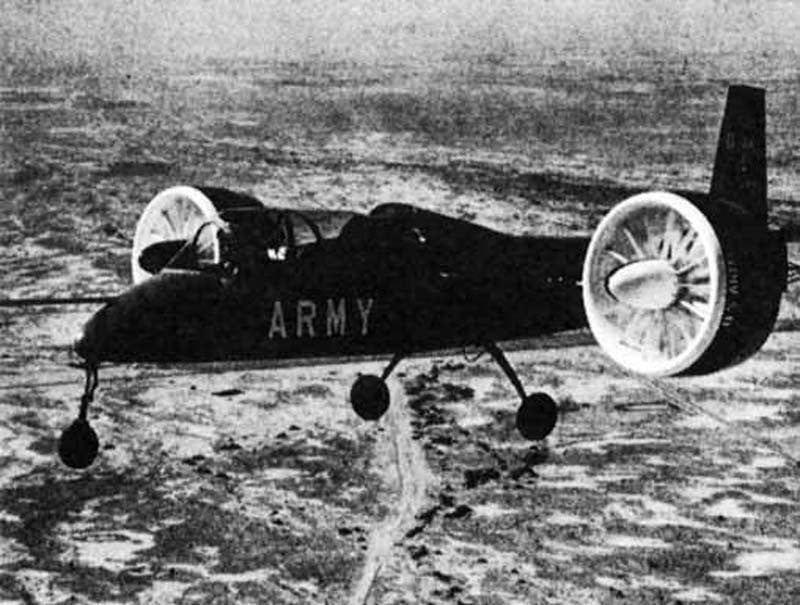
The test programme reads like an honest piece of engineering. Taxi trials, then 32 hours of running in a test stand, then 18 hours of tethered hovering before it was allowed to fly free. In October 1958 it went to Edwards for another 50 hours, where it showed roughly 230 mph maximum, 175 mph cruise and about an hour of endurance.
The Army formally accepted it in September 1959 as the VZ-4DA and passed it to NASA Langley. Then the aircraft industry hit a recession, Doak laid off ninety percent of his workforce in late 1960, and Douglas bought the patents and engineering files and hired four of his engineers to carry on.
Further 1958 test footage from the Doak programme.
Killed by the helicopter
In 1963 the Army made its decision, and it was not about the VZ-4 being bad. It concluded that the helicopter would meet its VTOL requirements, moved the money from exotic VTOL research into buying helicopters, and ended the trials. This was the era in which the Huey was about to define what Army aviation meant.
NASA kept flying the aircraft until 1972. In January 1973 it went to the US Army Transportation Museum at Fort Eustis and stood in the outdoor pavilion for half a century. In August 2024 it was moved permanently to the US Army Aviation Museum, where it is now indoors.
Everything that flies over you now has its ducts
Here is the part that makes the VZ-4 worth your attention. Look at almost any electric air taxi being built today — the eVTOLs promising to carry you across a city — and count the ducted fans that rotate from vertical to horizontal.
That is Doak’s layout. He proved it in 1958 with a turbine, a shaft and parts from three other aeroplanes. What he did not have was the thing that makes it practical: electric motors small enough to put at each duct, and flight-control computers fast enough to manage the transition without asking the pilot to be a hero.
One aircraft, one of everything, and a concept that had to wait sixty years for its electronics to be invented.
Sources: Roy Stevenson, “Doak’s One-Off”, Histoire de l'aviation, July 2014; Stephen Harding, U.S. Army Aircraft Since 1947 (Airlife, 1990); Jane’s All the World’s Aircraft 1958–59; US Army Aviation Museum. Note: published performance figures vary; range is given as both 230 and 250 miles and service ceiling as both 6,000 and 12,000 ft.
0 Comments