
On Thursday 7 September 1944, Duncan Sandys, the British minister in charge of countering Germany’s secret weapons, told the press that the flying-bomb threat to London was essentially finished.
“Except possibly for a few last shots, the Battle of London is over.”
Duncan Sandys, press conference, London, 7 September 1944
The next evening, at about half past six, two rockets rose out of the pine-lined avenues of Wassenaar, a wealthy suburb just north of The Hague. Roughly five minutes later the first of them came down on Staveley Road in Chiswick, West London. Nobody heard it coming. The age of the ballistic missile had arrived, and it had been launched from a Dutch residential street.
A reel from the Dutch history account @the_dutch_archeologist0 has been telling that story to a large audience this month. It gets the core right. A few of its numbers and one of its headline claims need tightening, and the part of the story it only touches on, what the rockets did to the Netherlands itself, deserves far more space.
The reel that prompted this article.
Informations clés
- First V2 on London: launched from Wassenaar, 8 September 1944, early evening; hit Staveley Road, Chiswick
- First V2 of the war: launched hours earlier the same day at Paris, from the Belgian Ardennes
- Launched from The Hague area: about 1,054 V2s (Nationaal Comité 4 en 5 mei)
- Fired at London: 1,358; about 2,754 Londoners killed and 6,523 injured
- Failed launches around The Hague: 87, of which 11 came down in built-up areas, killing at least 65 Dutch civilians
- Bezuidenhout, 3 March 1945: an RAF raid on the Haagse Bos launch area hit a residential district instead; 511 to 532 killed
- Last V2 on London: 27 March 1945, Hughes Mansions, Stepney, 134 killed
Two Rockets From a Suburban Crossroads
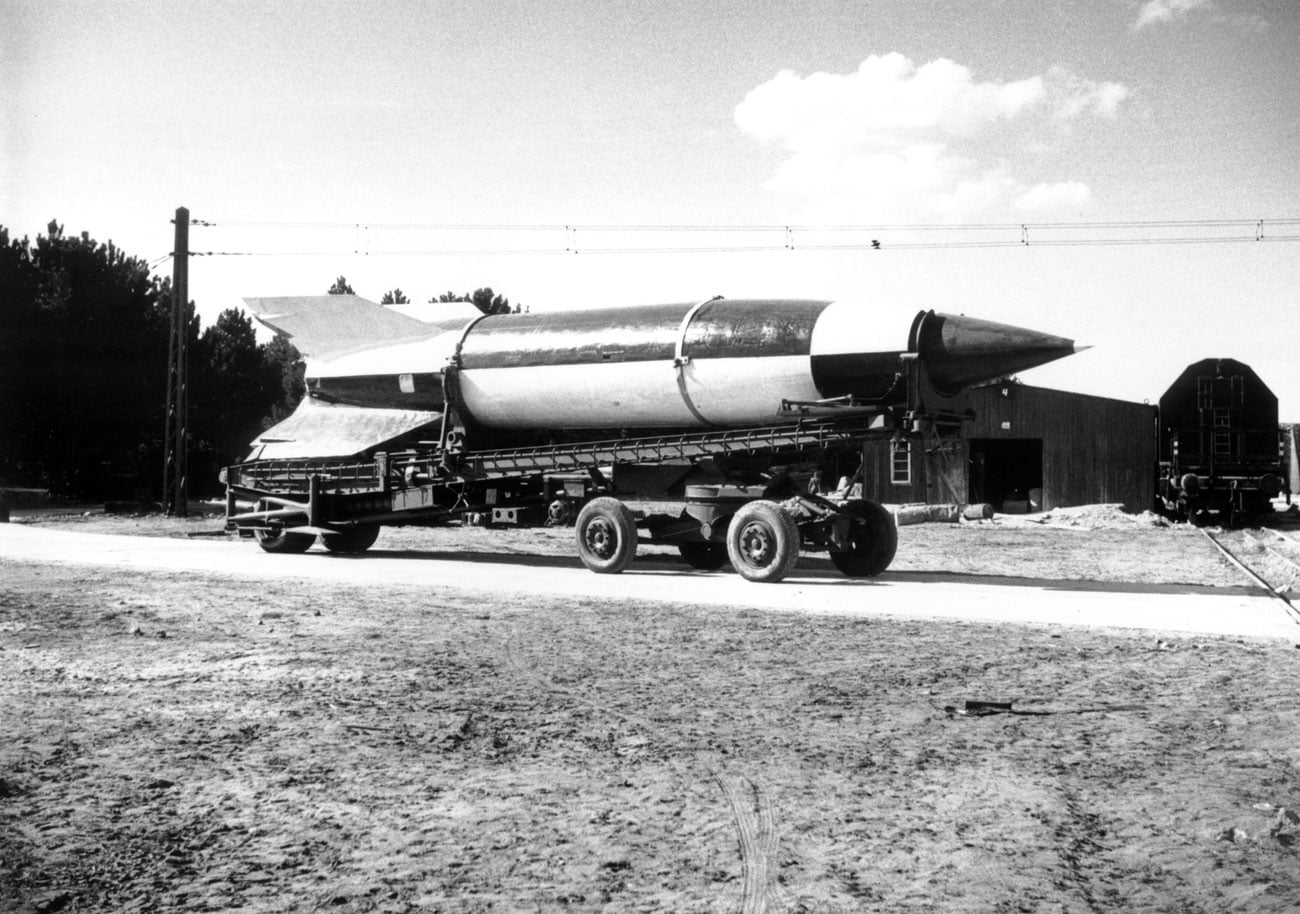
The launches were carried out by Artillerie-Abteilung 485, a mobile army unit that had moved into the Wassenaar area only days earlier. There was no bunker and no fixed ramp. A V2 arrived on a Meillerwagen trailer, was raised upright onto a small steel launch table on a paved road, fuelled with alcohol and liquid oxygen, and fired. The crews picked quiet, tree-covered junctions because they hid the vehicles from Allied reconnaissance aircraft.
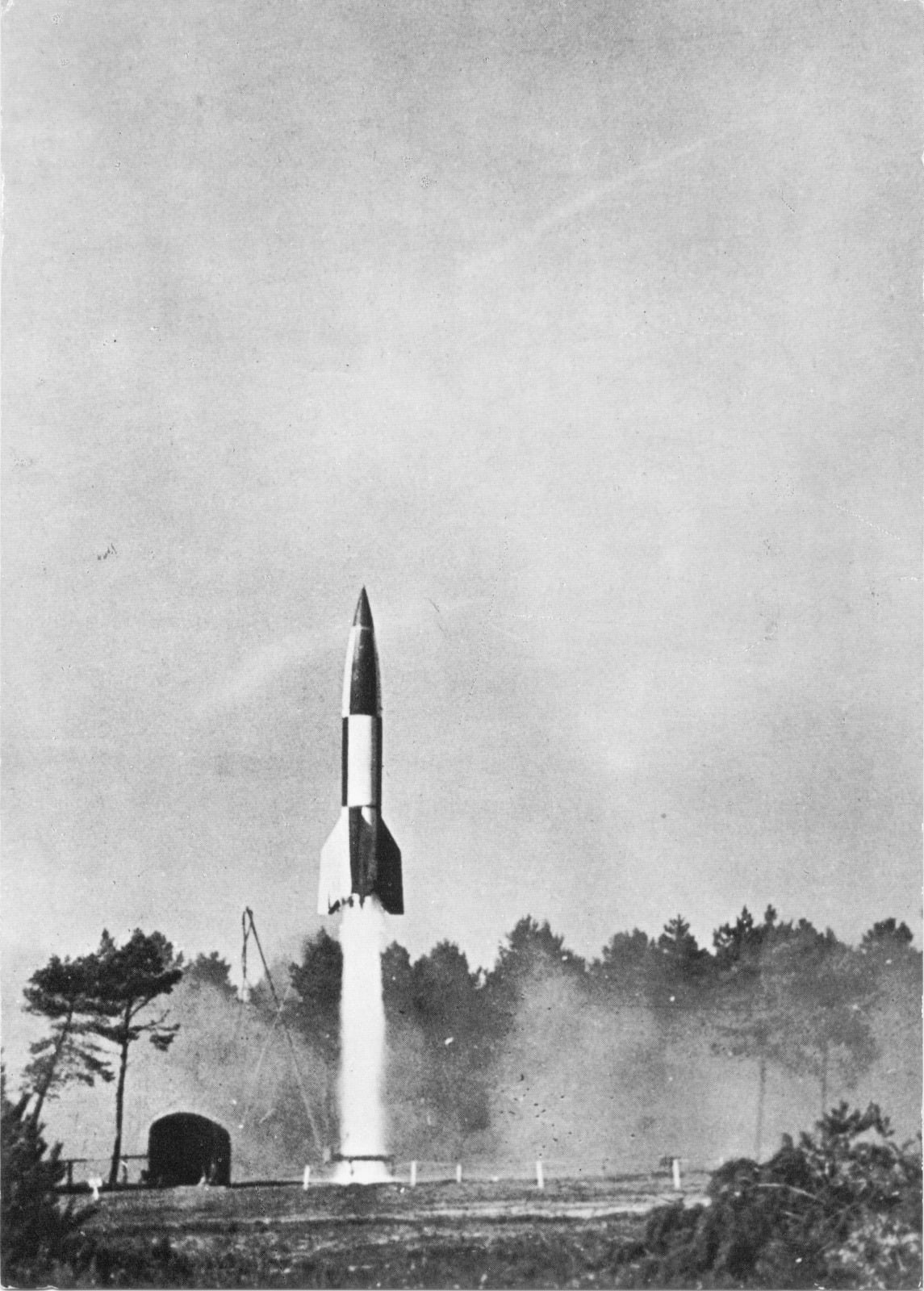
The first rocket was fired from the junction of Lijsterlaan, Konijnenlaan and Koekoekslaan; the second from the junction of Lijsterlaan and Schouwweg. Local sources give the launch time as between 18:30 and 18:36. The rockets climbed to the edge of space and came down at several times the speed of sound, so the explosion arrived before the sound of the approach.
In Chiswick the rocket killed three people: three-year-old Rosemary Clarke, her neighbour Ada Harrison, and Sapper Bernard Browning. Around twenty more were injured, and according to the Brentford & Chiswick Local History Society eleven houses were demolished and hundreds more damaged. The second rocket landed in Parndon Wood near Epping and hurt no one. The next day the Germans cleared the residents out of the southern part of Wassenaar to keep the launch area secret.
The British government said nothing. The explosions were put down to gas mains, and Londoners quickly started joking about “flying gas pipes”. Winston Churchill only confirmed to Parliament on 10 November 1944 that Britain was under rocket attack. Today a pair of matching memorial pillars marks the launch site in Wassenaar and the impact site on Staveley Road.
Correction: Paris Was First, by a Few Hours
The reel is headlined “The First V2 Attack Was Launched From the Netherlands”. That is true of the first V2 on London, but not of the first V2 fired in anger. On the morning of the same day, 8 September 1944, a battery in the Belgian Ardennes near Gouvy fired a rocket at newly liberated Paris. It hit Maisons-Alfort on the south-eastern edge of the city, killing six people and injuring 36. London came that evening.
The Hague Becomes a Launch Pad
After Wassenaar, the batteries spread through the western Netherlands: the Haagse Bos woodland in the heart of The Hague, the Duindigt estate, Ockenburgh and Loosduinen, the Rijswijk woods near the Peace Monument, Hoek van Holland and the Scheveningen area. The Hague offered what the rocket troops needed: the right distance to London, road access, tree cover and, uncomfortably for its residents, the protection of a city the Allies would hesitate to bomb.
According to the Nationaal Comité 4 en 5 mei, which keeps the Dutch register of war memorials, about 1,054 V2s were launched from The Hague area. London was hit by 1,358 rockets in total, and the V2 campaign against the city killed an estimated 2,754 people and injured 6,523. The single worst strike, at the Woolworth’s store in New Cross on 25 November 1944, killed 160 people outright; later counts put the toll higher. The last rocket to reach London fell on Hughes Mansions in Stepney on 27 March 1945, killing 134. Launches from The Hague ended as the German units withdrew at the end of that month.
The Dutch resistance watched all of it. Groups in The Hague and Wassenaar reported launch positions and firing times to London, the Wassenaar municipality notes, with the telegraphist Rob de Brauw of the Peggy group coordinating the radio traffic.
How Many Rockets Left Dutch Soil?
The reel says more than 1,700 V2s and thousands of V1s were launched from Dutch territory. The first figure is plausible but we could not confirm it from a primary count. The Hague area alone accounts for roughly 1,054 launches; Batterie 444 fired more than 75 from the woods at Rijs in Gaasterland, Friesland, between 25 September and 20 October 1944, first at England and then at Antwerp, and an SS battery later fired from Hellendoorn in Overijssel. Totals published for the whole country vary between sources, so we would treat any single number with caution.
The V1 claim needs more care. The flying bombs that hit London in 1944 came overwhelmingly from ramps in northern France, and air-launched from Heinkel He 111 bombers over the North Sea. From Dutch soil, Operation Zeppelin fired several hundred long-range V1s at Britain from Dutch launch sites between 2 and 28 March 1945, using extended-range versions of the flying bomb. Antwerp, hit by 2,448 V1s, was bombarded from ground sites in the eastern Netherlands and western Germany. “Thousands” from the Netherlands is possible if the Antwerp campaign is included, but it is not a clean, documented figure.
The Rockets That Fell on The Hague
The V2 was rushed into service, and it showed. Of the launches from The Hague area, 87 failed, according to the Nationaal Comité 4 en 5 mei. Eleven of those rockets came down in built-up areas, and at least 65 Dutch civilians were killed by German rockets that never left the Netherlands.
On the afternoon of 27 October 1944, a rocket launched from the Rijswijk woods crashed less than 100 metres from a boys’ boarding school run by the Brothers of Saint John (the Kruisvaarders). At least 13 people died, possibly 14: seven boys, the youngest nine years old, five brothers, and a gardener who died of his injuries the following March. About 50 more were wounded.
“Because of the urgency of deploying it in the war, not enough time had been spent on testing.”
Gemeente Rijswijk, on the accident of 27 October 1944 (translated from Dutch)
On New Year’s Day 1945 a V2 fell back into the Indigostraat in The Hague and killed 24 civilians, the worst single rocket accident in the city. On 25 January another crashed onto the Riouwstraat, killing ten; a ten-year-old boy, Robbert Schouten, survived asleep in his bed and was photographed the next day. Three stone plaques on the corner of Indigostraat and Kamperfoeliestraat now carry the names and ages of the Indigostraat dead, several of them small children.
Bezuidenhout: The Raid That Missed
The Allies could not ignore the launch sites, but attacking them meant bombing inside a Dutch city. RAF fighter-bombers attacked launch areas and supply points around The Hague repeatedly through the winter. The worst outcome came on the morning of Saturday 3 March 1945.
Between 51 and 56 North American B-25 Mitchell and Douglas Boston medium bombers were sent to hit the Haagse Bos, the woodland where German rocket troops were operating. The raid missed by more than a kilometre and fell on the Bezuidenhout, a densely populated residential district next to the forest. Investigations pointed to a combination of errors: navigation coordinates entered wrongly, low cloud and poor visibility, and a much stronger wind than forecast, which carried the bombs away from the target.
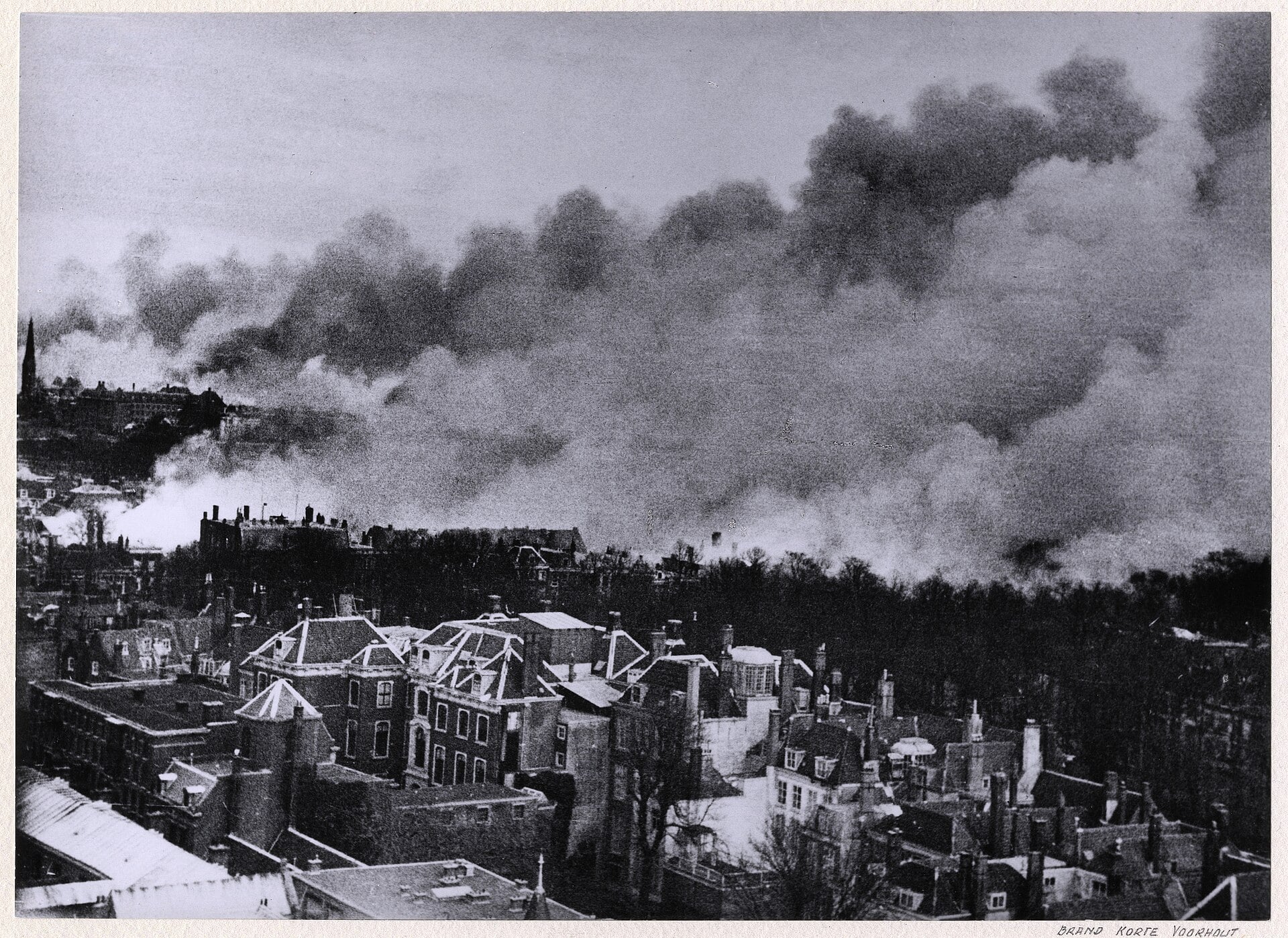
Fires spread through the district. Between 511 and 532 people were killed, depending on the source, and about 30,000 were left homeless. British aircraft afterwards dropped leaflets expressing condolences. The raid is commemorated every year in The Hague, and the monument in the district is called the “Monument of human error”.
The Haags Historisch Museum video above asks the question its title poses, in Dutch: was the bombing of the Bezuidenhout really a mistake?
From Wassenaar to the Space Age
The reel ends on the V2’s legacy, and here it is right. Militarily the rocket changed nothing: it arrived too late, carried a modest warhead and could not be aimed at anything smaller than a city. But it was the first long-range ballistic missile and the first human-made object to reach space, and after the war its engineers and hardware seeded the missile and space programmes of the United States and the Soviet Union. The British fired captured rockets from Cuxhaven in October 1945 under Operation Backfire, which produced the photographs on this page.
It is worth remembering the cost that sits behind that legacy: about 12,000 forced labourers and concentration-camp prisoners died building the weapon, thousands of civilians died where it landed in London and Antwerp, and in The Hague people died because it was fired from their streets.
Foire aux questions
Where was the first V2 on London launched from?
Was the first V2 attack launched from the Netherlands?
How many V2 rockets were launched from The Hague?
How many people did V2 rockets kill in London?
Did V2 rockets kill people in the Netherlands?
What was the Bezuidenhout bombing?
Why did the British government blame V2 explosions on gas mains?
Sources: Nationaal Comité 4 en 5 mei (V2 memorial, Indigostraat, The Hague); Gemeente Wassenaar (V2 launch site); Gemeente Rijswijk (V2 accident of 27 October 1944); Atlantikwall Den Haag; V2ROCKET.COM; Brentford & Chiswick Local History Society; A London Inheritance; British Modern Military History Society; TracesOfWar (Gouvy launch site); Friesland.nl (Rijs launch site); London Remembers (Hughes Mansions); Wikipedia (V-2 rocket, V-1 flying bomb, Bombing of the Bezuidenhout, Staveley Road); Haags Historisch Museum; British Pathé; Wikimedia Commons.

0 Comments