
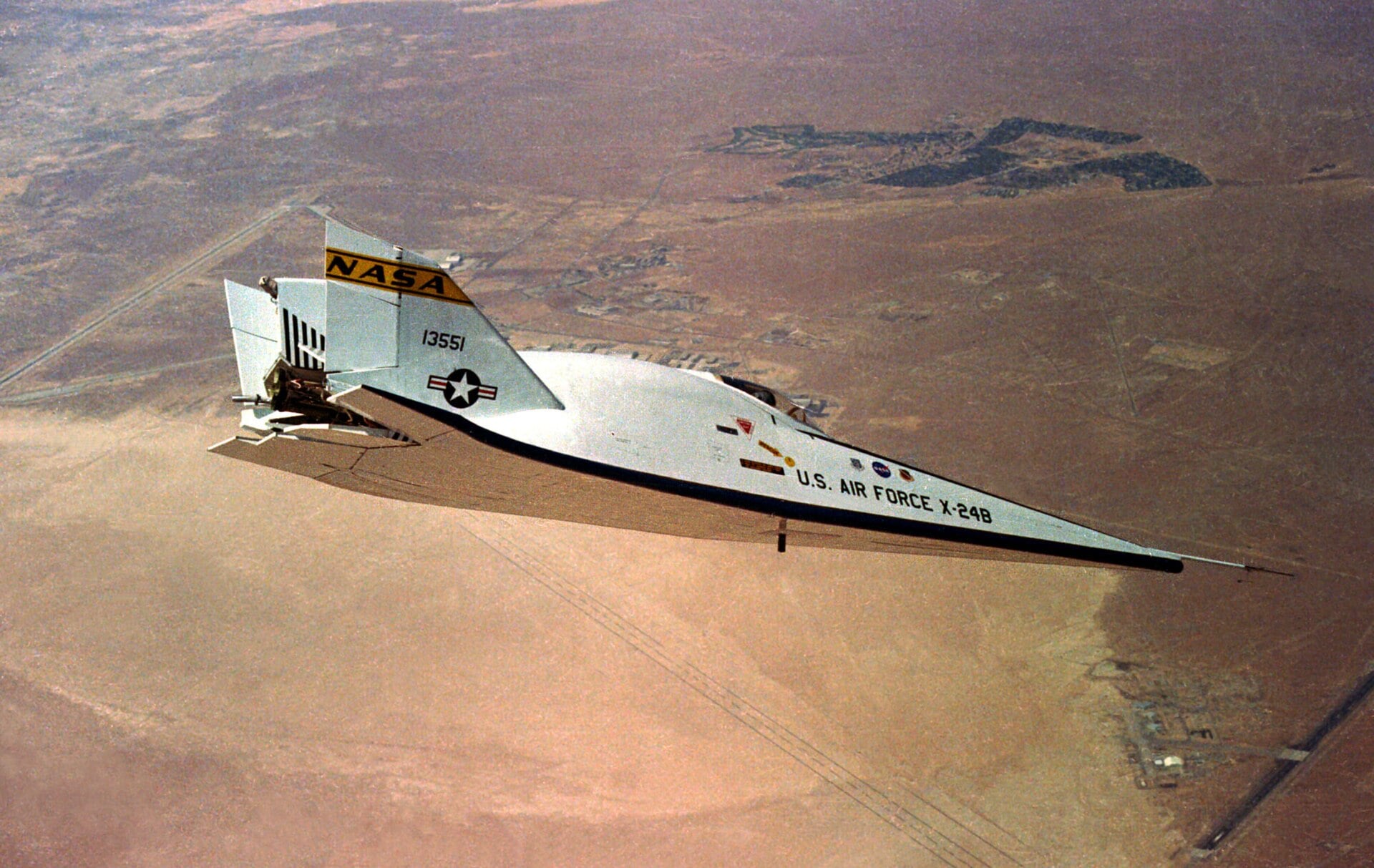
It had no wings worth the name, no engine running at touchdown and only one chance to get it right. On 5 August 1975, NASA test pilot John Manke brought the X-24B lifting body down from 60,000 feet without power and landed it on the concrete main runway at Edwards Air Force Base, right where he intended.
It sounds like a stunt. It was one of the most important landings in the history of spaceflight. That single approach convinced NASA that a heavy, wingless re-entry vehicle could be flown to a precision landing without engines, and the Space Shuttle was built on that conclusion.
Informations clés
- Aéronef: Martin Marietta X-24B, rebuilt from the X-24A
- Surnom: The “flying flatiron”
- Premier vol : 1 August 1973 (glide), pilot John Manke
- Vols : 36 in total, 12 glide and 24 powered, 1973 to 1975
- Vitesse maximale : 1,164 mph (Mach 1.76); maximum altitude about 74,100 ft
- Moteur: Reaction Motors XLR11 rocket, 9,800 lbf thrust
- Aujourd'hui: On display at the National Museum of the US Air Force, Dayton, Ohio
What Is a Lifting Body?
A lifting body generates lift from the shape of its fuselage rather than from wings. For a vehicle coming back from space, that is attractive: wings are heavy, they get hot during re-entry, and they are hard to protect. A lifting body can survive re-entry like a capsule, yet still fly and land like an aircraft.
The catch is that lifting bodies glide like bricks. Their lift-to-drag ratio is low, so they come down steeply and fast, and there is no going around for a second try. From the 1960s, NASA and the US Air Force flew a whole family of them at Edwards, including the M2-F2, HL-10 and X-24A, to find out whether pilots could handle them.
From Teardrop to Flying Flatiron
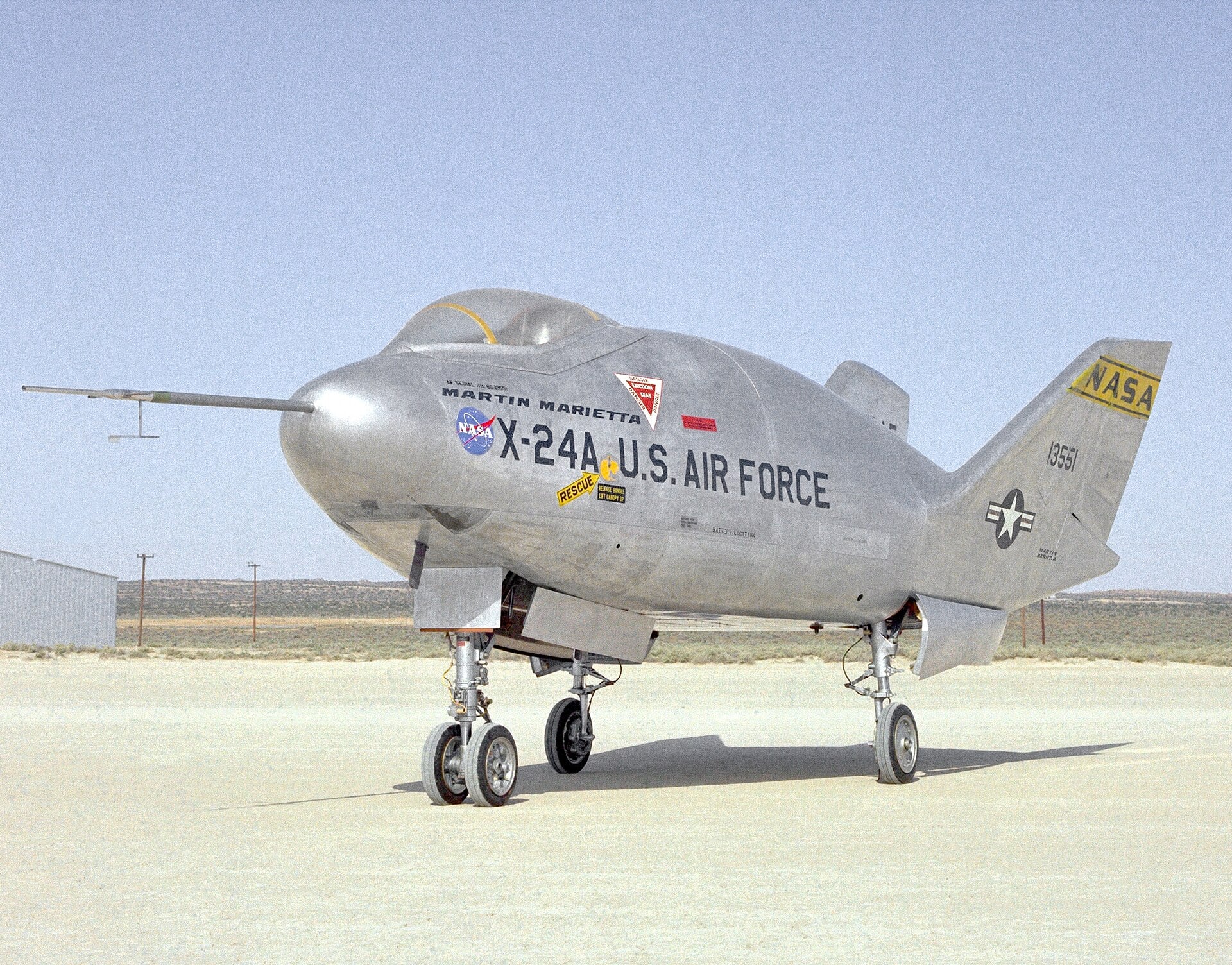
The X-24A first glided in April 1969 and made 28 flights. Then the Air Force, NASA and Martin Marietta rebuilt it almost completely. The bulbous teardrop became a long, flat-bottomed shape with a double-delta planform and a pointed nose, which pilots nicknamed the flying flatiron. The new shape had a much better glide ratio and could reach higher speeds.
Manke flew it for the first time on 1 August 1973 and made its first powered flight that November. Over the next two years, the X-24B flew 36 times, reaching 1,164 mph, or Mach 1.76, and around 74,100 feet. Like the X-15 before it, it was carried aloft under the wing of NASA’s B-52 and dropped before lighting its XLR11 rocket.
The Landing That Shaped the Shuttle
Most lifting-body flights ended on the vast dry lakebeds around Edwards, where a pilot could land almost anywhere. A runway is different: a narrow strip, a fixed touchdown point and no margin. Manke’s landing on the main runway on 5 August 1975 showed that it could be done consistently, and Air Force Maj. Mike Love followed with a second runway landing.
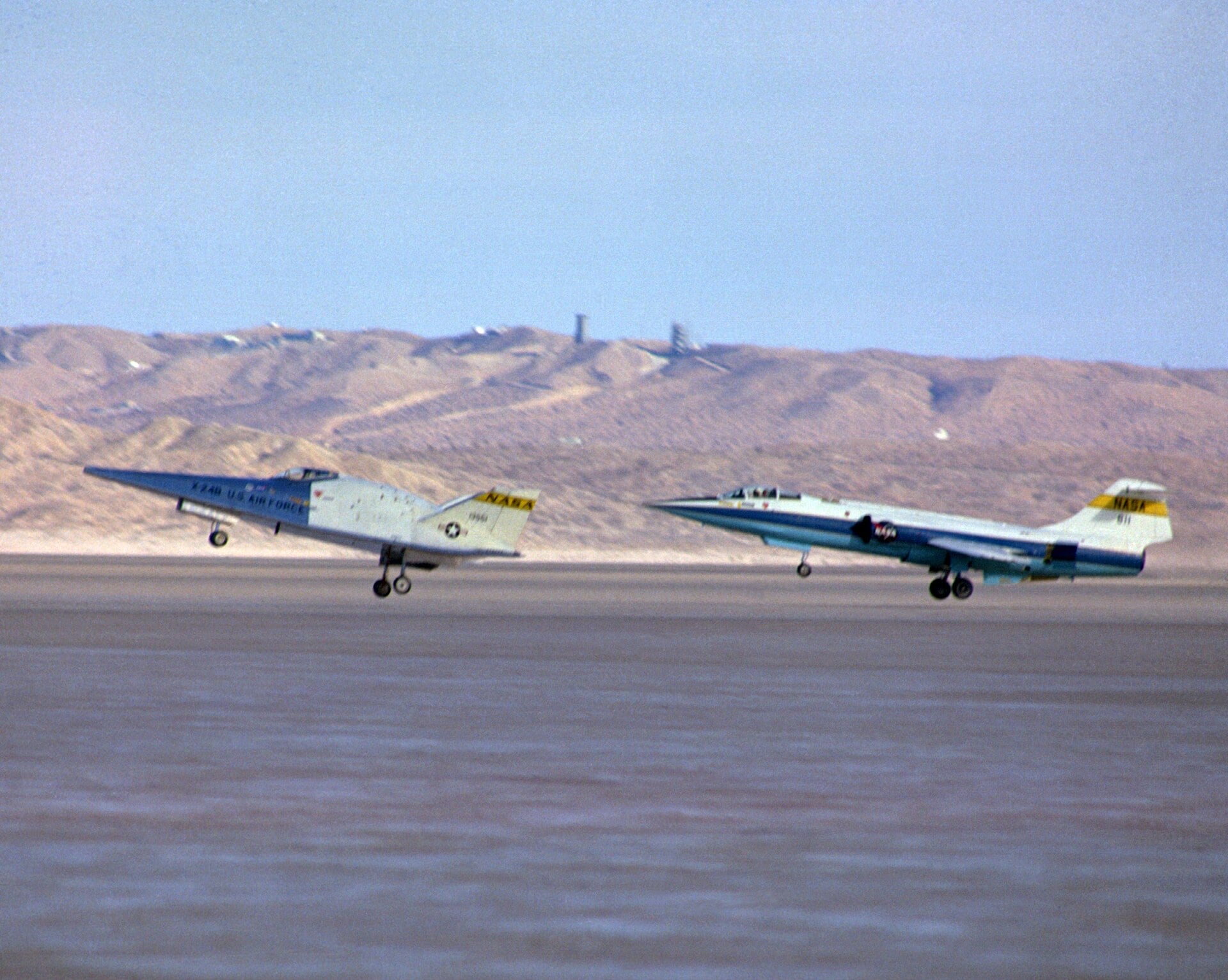
The consequences were concrete. NASA had considered fitting the Space Shuttle with auxiliary jet engines to help it on approach. After the X-24B landings, engineers decided the Shuttle could glide in unpowered, and the extra engines, with all their weight and complexity, were dropped. Every Shuttle landing from 1981 to 2011 was an unpowered glide.
NASA Armstrong’s film of the X-24B landing on runway 04 at Edwards:
The End of the Lifting Bodies
The X-24B’s final flight later in 1975, flown by NASA’s Bill Dana, closed the era of piloted lifting-body research at Edwards. Manke finished with 42 lifting-body flights, more than any other pilot. A planned hypersonic successor, the X-24C, was studied in the late 1970s but never built. The X-24B itself now sits in the National Museum of the US Air Force in Dayton, Ohio.
And the idea never went away. Sierra Space’s Dream Chaser spaceplane is a lifting body too, part of the same family tree as the shapes that once dropped from a B-52 over the Mojave.
The launch of the X-24B from NASA’s B-52 mothership:
Sources: NASA, National Museum of the US Air Force, US Air Force Test Center, Wikipedia


0 Comments