
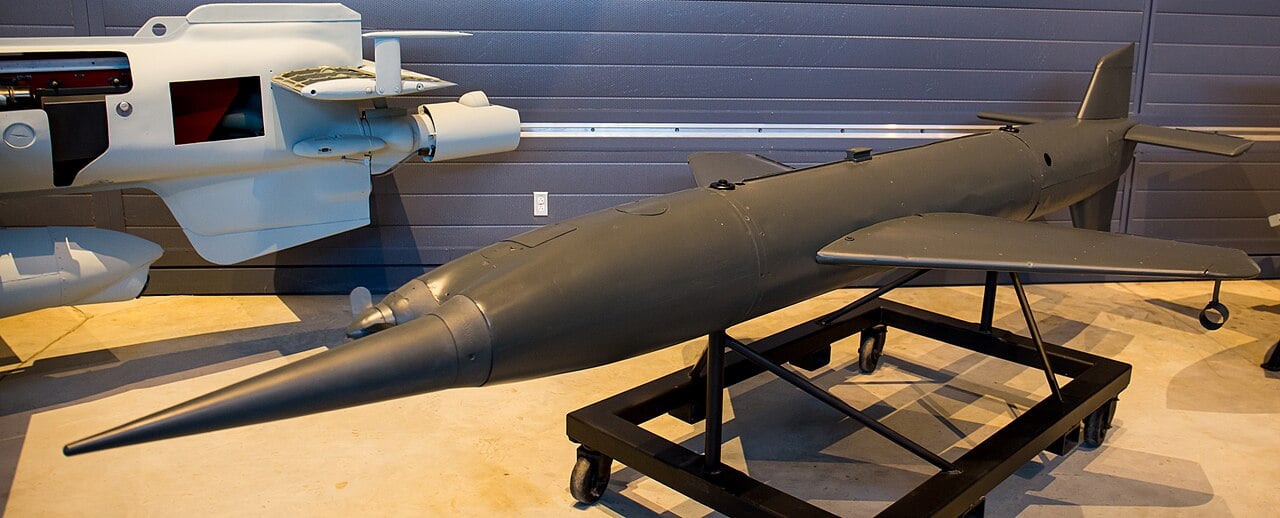
By 1943 Allied bomber streams were pounding German cities by day and night, and the Luftwaffe’s fighters and flak could not stop them. One answer was a weapon that did not yet exist anywhere: a guided missile fired from the ground at aircraft. Germany worked on several. The Henschel Hs 117 Schmetterling, or “Butterfly”, was one of them.
A post circulating on Instagram calls it “the world’s first surface to air missile”. Most of what it says about the Schmetterling is right. That opening claim is not.
Informations clés
- Designer: Herbert A. Wagner, Henschel
- Origins: Proposed 1941, rejected, revived 1943
- First test launches: May 1944, Karlshagen near Peenemünde
- Test launches: 59, more than half of them failures
- Propulsion: BMW 109-558 liquid rocket plus two Schmidding 109-553 solid boosters
- Conseils: Manual command to line of sight: operator, telescope and joystick
- Ogive: About 25 kg
- Destin: Cancelled in early 1945 before entering service
A Missile Steered by Joystick
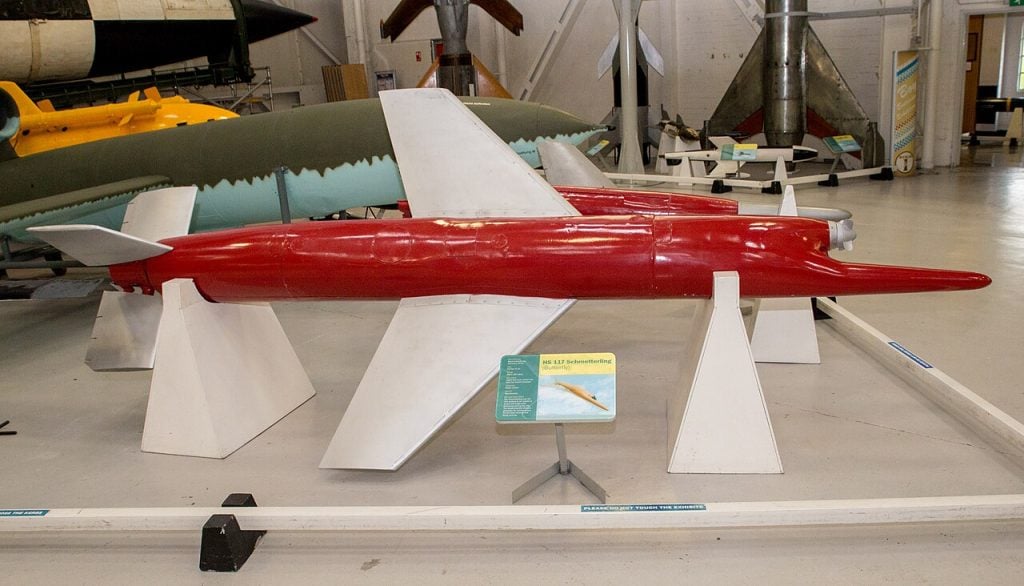
Herbert Wagner, who had already designed the Hs 293 anti-ship glide bomb, proposed the Schmetterling in 1941. The Air Ministry turned it down; nobody saw the need. Two years later, with Allied bombing intensifying, it was revived. The missile looked like a small aircraft, with short swept wings, a cross-shaped tail and two solid-fuel boosters strapped above and below the body to get it off the launch ramp. A BMW liquid-fuel rocket then sustained the flight.
Guidance was manual. An operator watched the missile through a telescopic sight, helped by a flare in its tail by day or a light at night, and steered it onto the bomber with a joystick. The commands went out by radio over the Kehl–Straßburg link already used for the Hs 293. Proximity fuzes were planned but never materialised, so in tests the warhead was normally detonated by radio command.
Not the World’s First
The Schmetterling was not the first surface-to-air missile, even in Germany. The Rheinmetall-Borsig Rheintochter began test firings in August 1943, and the Wasserfall, a scaled-down relative of the V-2, made its first test launch on 29 February 1944. Schmetterling launches only started in May 1944. Neither Wikipedia nor the Smithsonian’s National Air and Space Museum, which holds one, calls it the first.
What the Smithsonian does say is more interesting: of the German anti-aircraft missiles, the Hs 117 came closest to being deployed. Mass production was ordered in December 1944, with plans for operational use from March 1945 and a planned output that would have reached thousands a month by late 1945. The museum itself calls that timetable unrealistic.
Cancelled Before Combat
The caption is right that the programme was cancelled in early 1945 before the missile saw combat. Sources differ on the exact date: English sources usually give 6 February 1945, German ones January 1945, both ordered by SS general Hans Kammler, who by then controlled Germany’s missile programmes. An air-launched version, the Hs 117H, had flown 21 tests from a Dornier Do 217; its development ended in February 1945 too.
After the war the Soviet Union built copies of both the Schmetterling and the Wasserfall at its NII-88 institute, testing them from 1948. The Schmetterling copy, the R-105, was rejected because its layout made it unsuitable against jet bombers.
Where to See One
Surviving Hs 117s are on display at the Smithsonian’s Steven F. Udvar-Hazy Center near Washington, at the RAF Museum Cosford in England, and, on loan from the RAF Museum, at the Deutsches Technikmuseum in Berlin.
Voir cette publication sur Instagram
Sources: Smithsonian National Air and Space Museum (object A19890595000 and Rheintochter record); Wikipedia (English and German), Henschel Hs 117, Wasserfall, Rheintochter, Brakemine; HistoryofWar.org; Axis aircraft and missile archive (classicwings); Steven Zaloga and others via the Soviet air-defence history archive at nymas.org

0 Comments