
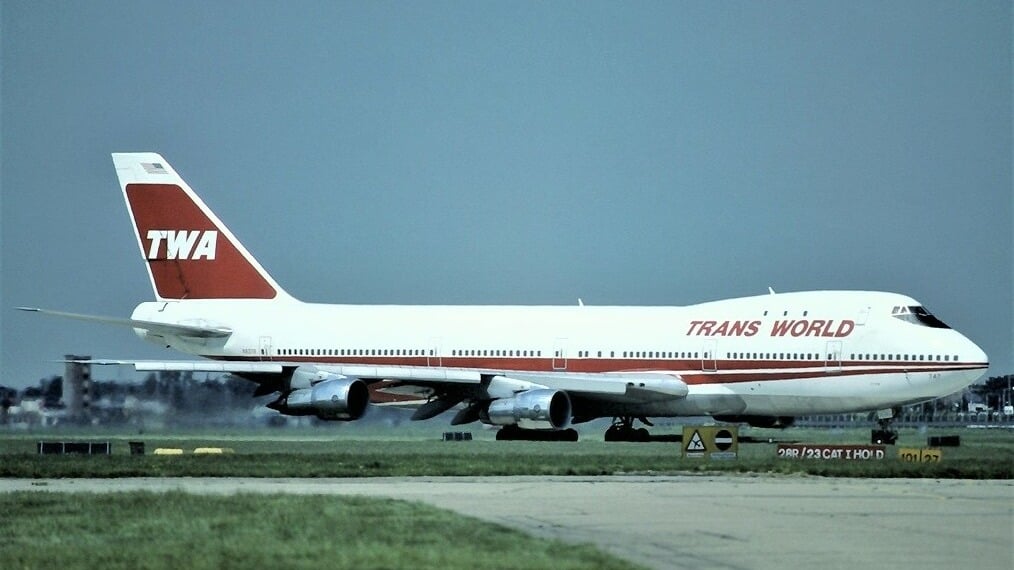
A Boeing 747-8 leaves the gate with up to 63,034 US gallons of kerosene on board. That is 238,609 litres, or 191,603 kilograms. Boeing puts the same aeroplane’s operating empty weight at 220,128 kilograms, so the fuel alone weighs almost as much as the entire finished aircraft. None of it is in the fuselage. Almost all of it is inside the wings, in the structure itself, sloshing about in a box made of spars and ribs with no separate tank inside at all.
Ask most passengers where airliner fuel tanks are and you get a shrug, or a guess at something underfloor. Ask an engineer and the answer is not about plumbing at all. Fuel lives in the wings because putting it there makes the wing lighter — not lighter in mass, obviously, but lighter in the only sense that governs how much metal the wing needs.
Then there is the second answer, which almost nobody knows: on an A380, nineteen tonnes of fuel can be sitting in the tail.
Informations clés
Where the fuel is: Almost entirely inside the wing structure itself — sealed integral, or wet-wing, tanks between the spars and skins
Why there: Bending relief: fuel weight outboard cancels lift before it reaches the wing root, so the root structure can be lighter
Boeing 747-8, passenger: 63,034 US gallons usable, 238,609 litres, 191,603 kg. Boeing notes the figure includes tail fuel tank volume
Boeing 747-8F, freighter: 59,734 US gallons. Boeing notes the freighter is not designed with tail fuel tanks
747-8 tank by tank: Main 2 and 3: 14,430 US gal each. Main 1 and 4: 5,320 each. Reserve 1 and 4: 1,534 each. Centre wing: 17,000
Airbus A380 trim tank: 23,698 litres of usable fuel, 18,958 kg, in the horizontal stabilizer (EASA type certificate data sheet A.110, issue 17)
A380 total usable: 324,339 litres across ten wing tanks, the trim tank and system volume
Maximum fuelling rate: 500 US gallons a minute per nozzle, at up to 50 psi (Boeing 747-8 airport planning document)
The rule that changed everything: 14 CFR 25.981, created 7 May 2001 and amended in 2008 and 2018, after the loss of TWA flight 800
The Wing Is the Tank
A transport wing is not a tube with fuel pumped into it. The structure between the front and rear spars, bounded above and below by the wing skins and divided by ribs, is sealed and filled directly. Engineers call it an integral or wet-wing tank. There is no bladder, no separate vessel: the thing holding the kerosene is the same thing holding the aeroplane up.
The reason that arrangement wins has nothing to do with saving space. In flight the wing is being bent upwards by lift along its whole span, and everything that bending has to be reacted at the wing root, where the wing meets the fuselage. The root is where the structure is heaviest and the stresses are highest, and the amount of material that has to go in there is set by the largest bending moment the wing will ever see.
Now put the fuel outboard. Its weight pulls down exactly where the lift is pushing up, and the further out along the span it sits, the more of the lift it cancels before that load ever reaches the root. The term of art is bending relief, and it is worth real structural weight. It is also why the limiting case for wing strength is often not the heaviest take-off but a lightly fuelled one: an aeroplane with full tanks and a modest payload is, from the wing root’s point of view, a gentler flight than the same aeroplane nearly dry.
Burn order follows from the same logic. Outboard fuel is generally held as long as the fuel system allows, so the relief stays in place for as much of the flight as it can.
What a 747 Actually Holds, Tank by Tank
Boeing publishes the breakdown in the 747-8 airport planning document, and it is more interesting than the headline number. Each wing carries a main tank inboard, a main tank outboard and a reserve tank at the tip. Inboard main tanks 2 and 3 take 14,430 US gallons each. Outboard main tanks 1 and 4 take 5,320 gallons each. The reserve tanks, right out at the wingtips, hold 1,534 gallons each. Then there is a centre wing tank of 17,000 gallons, sitting in the wing box under the floor between the main landing gear.
Those tanks are the whole of the freighter’s supply, and Boeing lists the 747-8F total usable fuel as 59,734 gallons. The passenger 747-8 is listed at 63,034. The difference is 3,300 gallons, and Boeing explains it in two footnotes that are as close to a plot twist as an airport planning manual gets. Against the passenger aeroplane: value includes tail fuel tank volume. Against the freighter: 747-8F is not designed with tail fuel tanks.
The 747 has been quietly carrying fuel in its tailplane since long before anyone thought to ask about it.
The Tank in the Tail, and Why It Is There
It is not storage. Or rather, storage is a side effect of what it is really for.
An aeroplane in cruise with its centre of gravity well forward is paying for the privilege. The wing lifts, gravity pulls at the centre of gravity ahead of it, and the tailplane has to generate a download to hold the nose where the crew want it. That download is negative lift, and the wing has to make extra lift to carry it, and extra lift means extra induced drag, all the way across the ocean.
Move the centre of gravity aft and the tail download shrinks. Move it close enough to the aerodynamic centre and the trim drag nearly disappears. You cannot do that by loading passengers differently, because the balance has to stay safe on the ground and through the whole flight. But you can do it with fuel, because fuel is the one payload the aeroplane can move while airborne.
So some long-haul aircraft carry a trim tank in the horizontal stabilizer and pump fuel aft in cruise. The A380 is one. The passenger 747-8 is another. The numbers are not small. The European Union Aviation Safety Agency type certificate data sheet for the A380, issue 17 of 5 August 2026, lists the trim tank at 23,698 litres of usable fuel, which is 18,958 kilograms — almost nineteen tonnes. Its servicing points, according to the Airbus airport planning document, sit nearly 64 metres aft of the nose, in a surface most people assume is hollow. The same document lists ten wing tanks per aeroplane, from 10,340 litres in each outer tank to 46,142 litres in each inner, and puts the total usable fuel, wings, trim tank and system volume together, at 324,339 litres.
The Centre Tank, and What It Cost the Industry
The one tank that is not in a wing is the one with a history. The centre wing tank sits in the wing box inside the fuselage, under the cabin floor, and on the 747-8 it holds 17,000 gallons on its own. It is also the tank that sits closest to the aeroplane’s heat sources, and that turned out to matter more than anyone had designed for.
On 17 July 1996 a TWA 747-100 climbing out of New York broke up off Long Island, killing everyone on board. The Safety Board’s finding is not only about what happened that evening. It is about an assumption the entire certification system had been built on.
Read that second paragraph again. The contributing factors were not a faulty part. They were the design and certification concept — the belief that you could make a fuel tank safe purely by making sure nothing inside it could ever spark. The vapour above the fuel was simply assumed to be there, flammable, forever, and the whole safety case rested on perfect exclusion of ignition sources across decades of service, maintenance and wiring ageing.
The rulemaking that followed rewrote that. Section 25.981 of the airworthiness standards, created in its modern form on 7 May 2001 and amended in July 2008 and again in September 2018, still requires that no ignition source be present. But it no longer stops there. It now caps how flammable a tank is allowed to be: the fleet average flammability exposure of a fuel tank may not exceed three per cent of the flammability exposure evaluation time, or the exposure of a tank inside the wing of that same aeroplane model, whichever is greater, calculated by a method the rule names explicitly. The alternative, under paragraph (c), is to provide a means of mitigating an ignition so that it cannot prevent continued safe flight and landing.
In practice that second route is the one the industry largely took, and it is why modern transports carry a nitrogen generating system. Air is bled from the engines, driven through hollow-fibre membranes that strip out most of the oxygen, and the resulting nitrogen-enriched air is pushed into the tank ullage. You cannot burn what has no oxygen. The rule also added critical design configuration control limitations, a mechanism that forces the protective design features to be identified, documented and protected through every future repair and modification — because the original failure was not a design error so much as an assumption that quietly decayed.
What that looks like in hardware is worth seeing, because it is the least glamorous and most consequential box on a modern airliner.
So How Long Does It Take to Fill a 747?
This is the question Google gets asked next, and the planning manual answers it sideways. Boeing lists the maximum fuelling rate as 500 US gallons a minute per nozzle, at a total maximum fuel pressure of 50 psi, through underwing pressure connectors on both wings.
Do the division on a single nozzle and a full 747-8 would take over two hours. Nobody does that, which is exactly why the aeroplane has several connectors rather than one: the ramp runs more than one nozzle at a time and the fill comes down accordingly. The practical limit is rarely the aeroplane anyway. It is how fast the hydrant system or the bowser fleet at that particular stand can deliver, and whether the turn-round has anything else waiting on it.
The other thing worth knowing is that a long-haul aeroplane is almost never filled. Carrying fuel costs fuel, every tonne of it burns a fraction of itself just being lifted, and dispatch loads what the sector and the reserves require rather than what the tanks will take. Full tanks on a 747-8 are an edge case, not a routine.
Three Tanks, Three Different Jobs
Put it together and the layout stops looking like plumbing and starts looking like three separate engineering arguments made in metal.
The wing tanks are a structures decision: fuel goes outboard because its weight cancels lift before the lift reaches the root, and that buys wing weight back. The centre tank is a volume decision, and it is the one that carries a scar, because the industry learned the hard way that a tank near heat with flammable vapour above the fuel could not be made safe by excluding sparks alone. And the trim tank is an aerodynamics decision, moving the balance point aft in cruise to stop the tailplane pushing down and the wing paying for it.
None of which the passenger will ever notice, beyond a faint smell of kerosene on the airbridge. Which is rather the point.
Sources: Boeing 747-8 Airplane Characteristics for Airport Planning, document D6-58326-3 revision E, January 2026; Airbus A380 Aircraft Characteristics, Airport and Maintenance Planning, December 2023; EASA Type Certificate Data Sheet No. EASA.A.110, Airbus A380, issue 17, 5 August 2026; 14 CFR 25.981; NTSB Aircraft Accident Report AAR-00/03, Trans World Airlines Flight 800.
0 Comments