
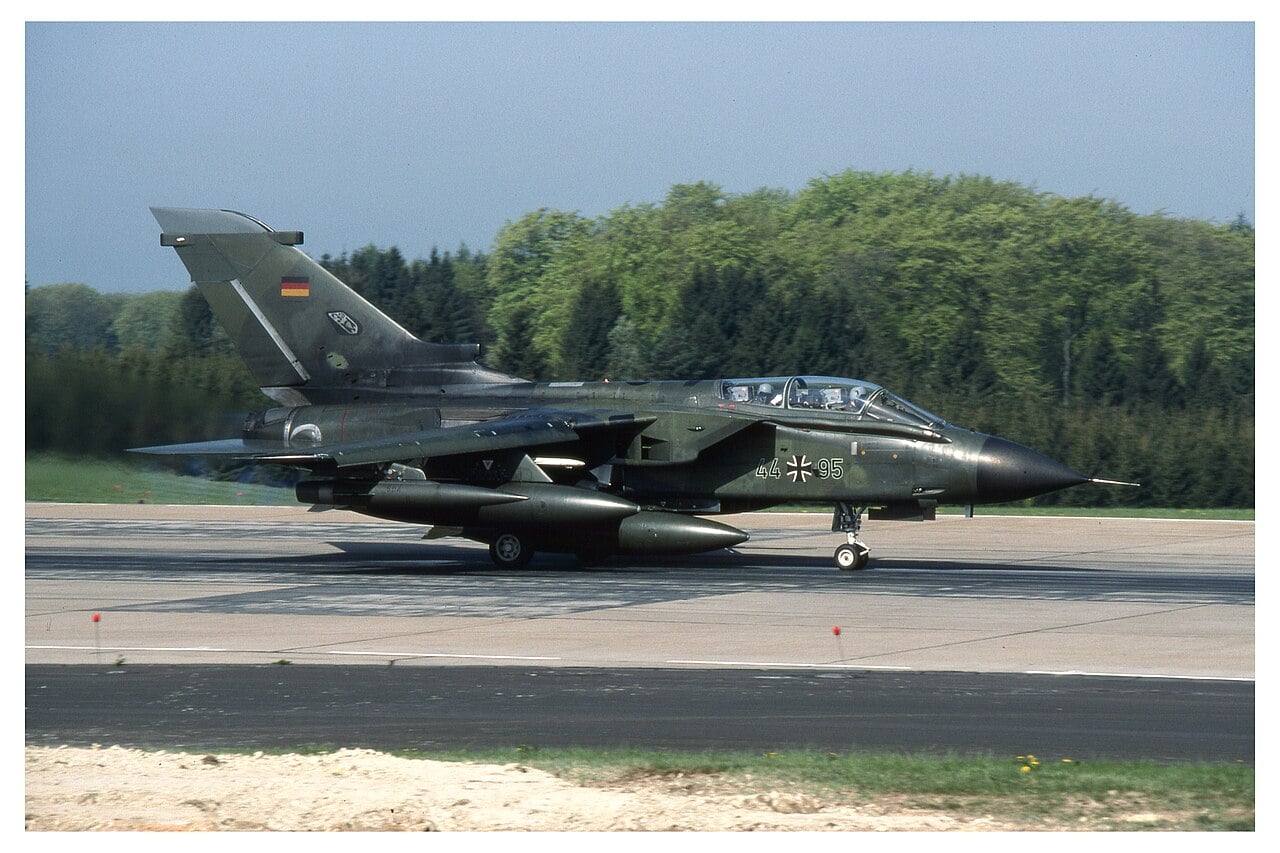
If the Cold War had turned hot in Central Europe, one of West Germany’s main answers to waves of Warsaw Pact tanks would have been a box under the belly of a Tornado. The MW-1, short for Mehrzweckwaffe 1, or multi-purpose weapon 1, was a huge submunition dispenser that fired thousands of bomblets and mines out of its sides as the aircraft flew over the target at very low level. Footage of it in action, from Cold War-era test films, still circulates widely.
Informations clés
- Nom: MW-1 (Mehrzweckwaffe 1), multi-purpose weapon 1
- Promoteur: Raketen Technik GmbH, a joint company of MBB and Diehl
- Carrier: Panavia Tornado IDS (Germany and Italy)
- En service : From 1984
- Taille: About 5.3 m long, 1.3 m wide
- Poids: About 4.7 tonnes loaded
- Tubes: 112, in four sections of 28, firing to both sides
- Footprint: About 300 to 500 m wide and up to 2.5 km long
- Combat use: None confirmed
- Destin: Destroyed under the Convention on Cluster Munitions; Germany finished on 25 November 2015
A Weapon for the Fulda Gap
Development began in the early 1970s alongside the Tornado itself. The task was brutally simple: in a war in Central Europe, NATO’s strike aircraft would have to attack armoured columns and the airfields behind them, flying as low as possible to survive dense air defences. Rather than drop individual bombs, the Tornado would fly a straight line over the target and empty the MW-1 in about 0.6 seconds, covering a strip several hundred metres wide.
According to Jane’s Air-Launched Weapons, the dispenser could be emptied as low as about 60 metres above the ground at around 1,000 km/h. Its 112 tubes, each 132 mm in diameter, were arranged in four sections and fired their loads out to both sides, which is why the film footage shows the ground erupting in a wide band on either side of the aircraft’s track.
More Than Three Bomblets
The MW-1 was a modular system, and a single dispenser carried one type of load or a planned mix. The main submunitions were:
- KB44: a small shaped-charge bomblet against armour, up to 4,536 per dispenser
- MIFF: an anti-tank mine with a magnetic influence fuze, up to 896
- MUSA and MUSPA: multi-purpose mines with delayed and sensor fuzes, intended to deny an area such as an airfield, several hundred per dispenser
- STABO: an anti-runway bomblet designed to penetrate concrete, 200 per dispenser
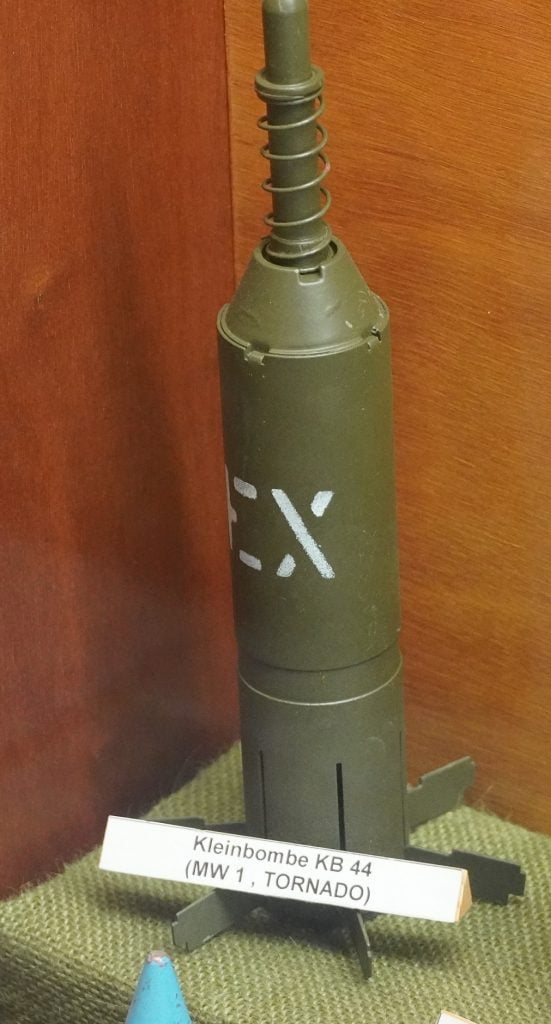
The Landmine and Cluster Munition Monitor, which documented Germany’s stockpile before its destruction, lists five MW-1 load variants, from a dispenser with 200 STABO bomblets to one with 4,536 KB44s. In total, the German MW-1 stock alone held well over a million submunitions.
Germany’s JP233?
The British equivalent was the Hunting JP233, carried by RAF Tornados. Both dispensed runway-cratering bomblets and area-denial mines from beneath the aircraft at low level. The difference was emphasis: the JP233 was optimised for attacking airfields, while the MW-1 was designed from the start for a wider range of targets, including tank formations. The JP233 was used by RAF Tornados against Iraqi airfields in 1991. There is no confirmed combat use of the MW-1 by either Germany or Italy, the only other country to buy it.
The End of the Dispenser
By the 1990s, the idea of overflying a defended target at 60 metres had become far more dangerous, and stand-off weapons such as the German-Swedish Taurus took over the job. The weapons themselves also became illegal for most of Europe. The Convention on Cluster Munitions entered into force on 1 August 2010, and Germany, which had held more than sixty million submunitions in the Cold War, destroyed its last cluster munitions on 25 November 2015, almost three years ahead of the treaty deadline. The MW-1 went with them. The Tornado itself is now leaving German service too; we look at its long career in The Eierlegende Wollmilchsau.
What the Popular Description Gets Right
The usual description is broadly correct: the MW-1 was a Luftwaffe Tornado submunition dispenser with anti-runway, anti-armour and magnetic anti-tank mine loads, and it is fairly compared with the British JP233. Two refinements. There were more than three types of submunition: alongside the KB44 anti-armour bomblet, the MIFF magnetic mine and the STABO runway penetrator, there were the MUSA and MUSPA area-denial mines. And unlike the JP233, the MW-1 never went to war.
Sources: Jane’s Air-Launched Weapons, Issue 35 (2000), as summarised by ArmedConflicts.com; Landmine and Cluster Munition Monitor, Germany country profile (2018); German Federal Foreign Office and Federal Ministry of Defence, joint press release (25 November 2015); Royal Air Force, Air Power in the Gulf War; Imperial War Museums, JP233 collection record.


0 Comments