
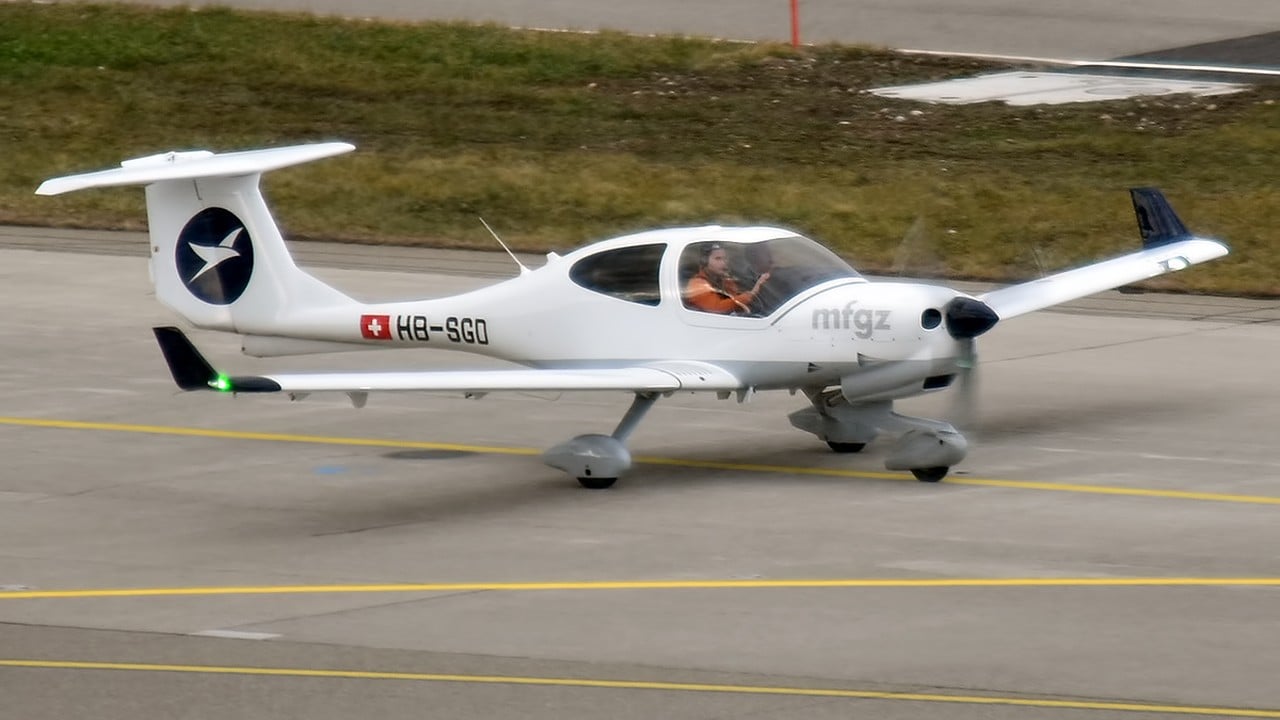
Walk onto the ramp at a modern flight school and there is a good chance the aircraft waiting for you is white, slender, made of plastic and runs on the same fuel as an airliner. It has a T-tail, a bubble canopy and long, thin wings that look as if they were borrowed from a glider. It is the Diamond DA40, and it has quietly become one of the standard machines on which the world learns to fly.
For decades that job belonged to aluminium high-wingers with a design lineage going back to the 1950s. The DA40 took a different route: composite construction, a glass cockpit as standard and, in its current main version, a diesel engine. Its most striking selling point, though, is a statistic. When Aviation Consumer magazine compared popular light aircraft in 2011, the DA40 had the lowest fatal accident rate of the types it studied.
Informations clés
- Taper: Four-seat, single-engine light aircraft and trainer with composite airframe
- Fabricant: Diamond Aircraft (Austria); built in Wiener Neustadt and London, Ontario
- Moteurs : Austro Engine AE 300 diesel, 168 hp, jet fuel (DA40 NG); Lycoming IO-360, 180 hp, AVGAS (DA40 XLT)
- Croisière: Up to 154 kts TAS at 16,000 ft (DA40 NG)
- Consommation de carburant : 5.1 US gal/h at 60% power (DA40 NG)
- Gamme: 934 nm at FL160, 50% power, no reserves (DA40 NG)
- Cockpit : Garmin G1000 NXi with central standby instruments
- Safety: Fatal accident rate 0.35 per 100,000 hours, lowest in Aviation Consumer’s 2011 study
From two seats to four
The DA40 Diamond Star is the four-seat development of Diamond’s earlier two-seat DA20, and first flew in the late 1990s. Diamond Aircraft, founded in 1981 and headquartered in Austria, builds it at Wiener Neustadt in Austria and at London, Ontario, in Canada. The company says more than 5,500 Diamond aircraft of all types are now flown by private pilots and flight-training organisations worldwide; more than 2,000 of them are DA40s.
The layout is simple and clean: a low-wing cantilever monoplane with a fixed tricycle undercarriage, a T-tail and an airframe built from composite materials. Diamond describes the structure as an all-composite airframe that combines advanced aerodynamics with passive safety technology for occupant protection.
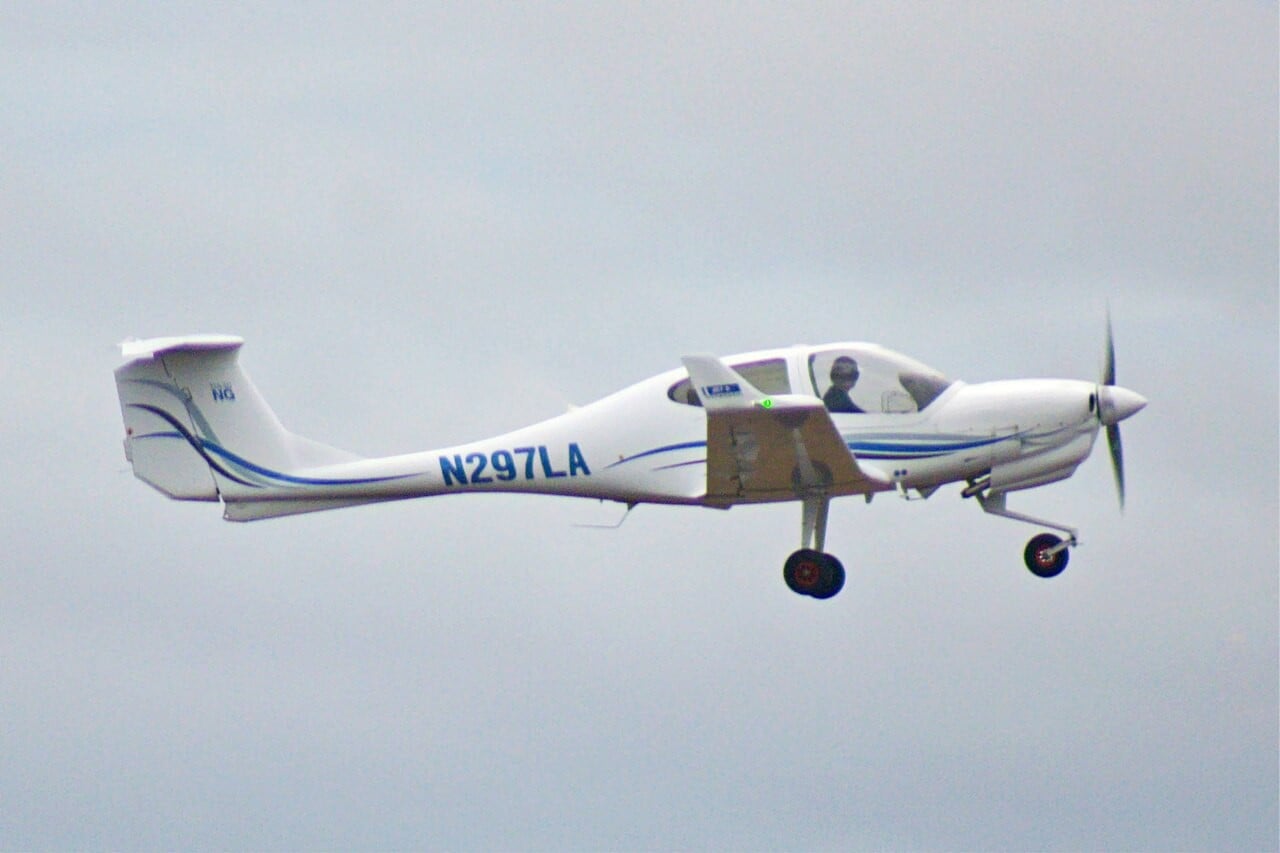
That long, high-aspect-ratio wing is no styling accident. Long, slender wings with low wing loading tend to give gentle, predictable handling at low speed, exactly what you want under a nervous student. Diamond’s own figures for the jet-fuel DA40 NG give a stall speed of 58 knots in landing configuration.
Jet fuel in a four-seater
The DA40 has been built with several engines. The petrol versions use a Lycoming IO-360 of 180 hp; today’s DA40 XLT carries the Lycoming IO-360 M1-A and burns AVGAS. A diesel version, the DA40 TDI, used a Thielert Centurion engine. The current headline model, the DA40 NG, uses an Austro Engine AE 300: a 168 hp turbocharged, common-rail 2.0-litre diesel with single-lever electronic engine control, built by a company in the Diamond group.
The point of the diesel is fuel. The AE 300 runs on Jet A-1, Jet A and JP-8 among others, which is available at airports where AVGAS is scarce or expensive. Diamond quotes a consumption of 5.1 US gallons (19.3 litres) per hour at 60 percent power, a maximum cruise of 154 knots true airspeed at 16,000 feet and a maximum range of 934 nautical miles at FL160 on 50 percent power, with no reserves.
There is a trade-off. Diamond’s own tables show the NG climbing at 651 feet per minute at sea level against 780 for the AVGAS XLT, and the NG needs a longer take-off roll. Flight schools that buy the NG are betting that cheaper, more widely available fuel matters more over thousands of training hours than a few hundred feet per minute.
AVweb’s flight trial of the jet-fuel Diamond DA40 NG.
The safety record
Here is the statistic that made the DA40’s name. In a study for its January edition, reported by AVweb in December 2011, Aviation Consumer studied the accident records of 11 popular light aircraft. The DA40 had the lowest fatal accident rate, 0.35 per 100,000 flight hours, ahead of the Cessna 172 at 0.45 and against a general aviation average of 1.2.
Its overall accident rate, 1.19 per 100,000 hours, was a little more than a sixth of the GA average of 6.3. The combined fatal rate for the Cirrus SR20 and SR22, aircraft with a full airframe parachute, was 1.6 in the same study. In 2020 the magazine went looking for DA40 accidents again and found only 51 NTSB reports for a type with more than 2,000 built. Several were so minor, such as a slow roll into a hangar after a parking-brake mistake, that they barely counted as accidents.
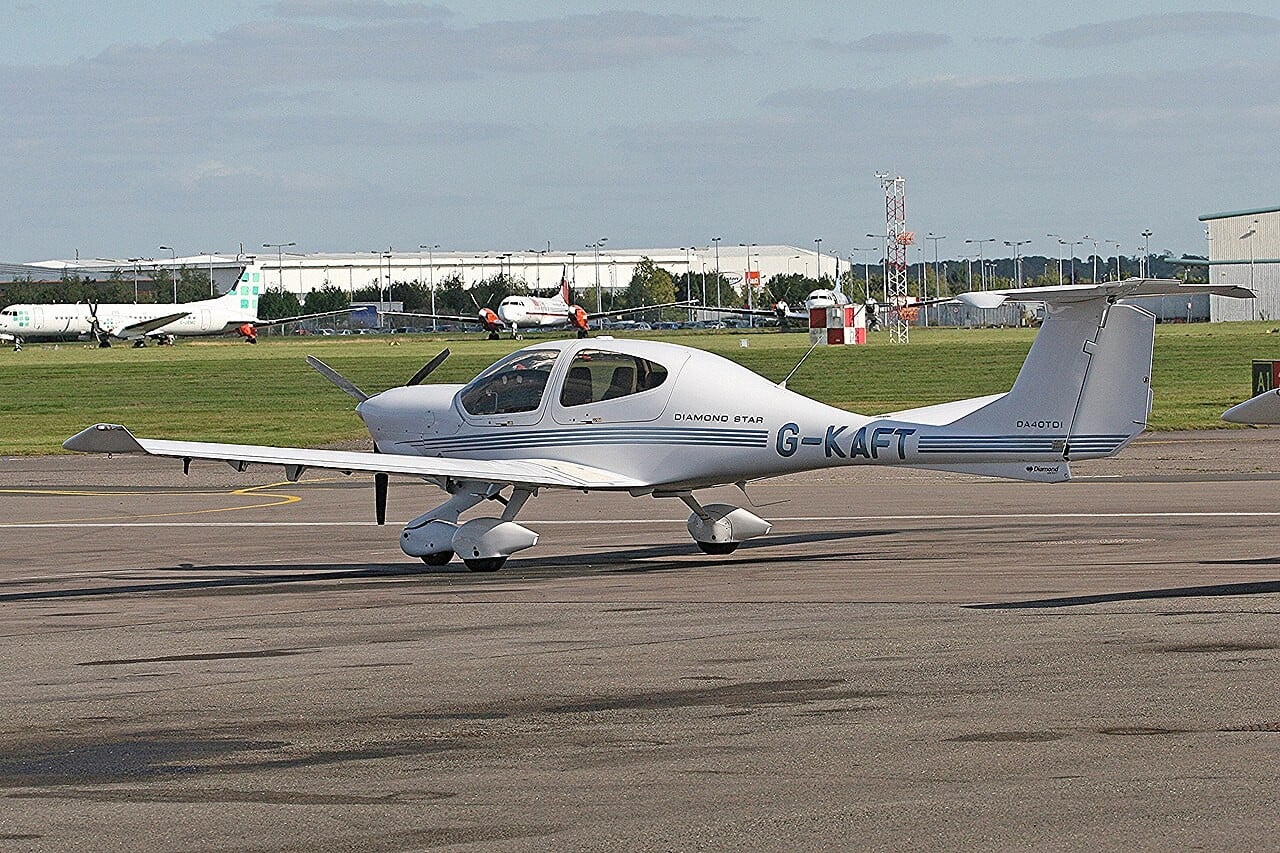
Statistics like these depend on who flies the aircraft and how, and a fleet dominated by supervised training flights may look different from one flown by private owners. Diamond itself credits its active and passive safety approach: handling and stability to avoid accidents in the first place, and crashworthiness to protect occupants if the unexpected happens.
A glass cockpit from the first lesson
Current DA40s are built with the Garmin G1000 NXi flight deck, with an optional GFC700 autopilot, synthetic vision and traffic advisories. Students who start on the DA40 learn on two large screens from their first lesson, much as they will later in an airliner.
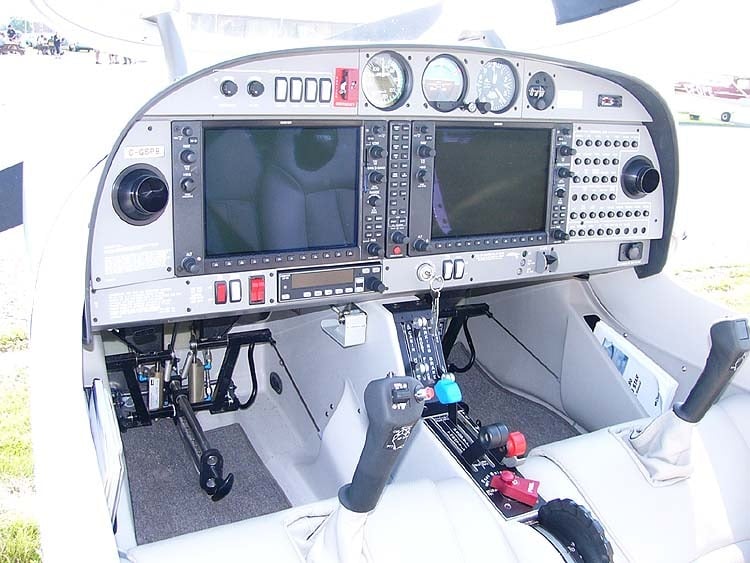
Diamond has kept something old-fashioned in the middle of the panel. Conventional, full-size standby instruments sit centrally where both student and instructor can see them, which, the company notes, also allows partial-panel training: practising what to do when the screens go dark.
Diamond Aircraft’s own film of the DA40.
The flight-school workhorse
The DA40 is the centre of what Diamond calls its flight-school solution: the single-engine DA40 NG and DA40 XLT for basic training, the twin-engine DA42-VI for multi-engine training, simulators and its own engines from one supplier. At EAA AirVenture Oshkosh in July 2026, Diamond delivered a DA40 XLT to Middle Tennessee State University, while the DA40 NG on display was part of SkyWarrior Flight Training’s previously announced 18-aircraft order.
The next chapter may be electric. Diamond says it is developing the eDA40, an all-electric training version of the aircraft. Whether batteries can match a diesel that burns five gallons an hour is the open question, but the airframe that started it all is clearly expected to keep teaching for years to come.
If you are working out where and how to earn your licence, Afterburner has looked at the costs in Cheapest Country for a PPL: Real Costs and the Licence Catches, and at what comes after in Hour Building to the ATP: What 1,250 Flight Hours Cost. There is a fair chance some of those hours will be logged in a white composite Diamond.
Diamond Aircraft presents the DA40 NG.
Sources: Diamond Aircraft (DA40 overview and technical specifications; Why Diamond; Oshkosh 2026 release), AVweb, Aviation Consumer, Wikipedia (Diamond DA40 Diamond Star)
0 Comments