
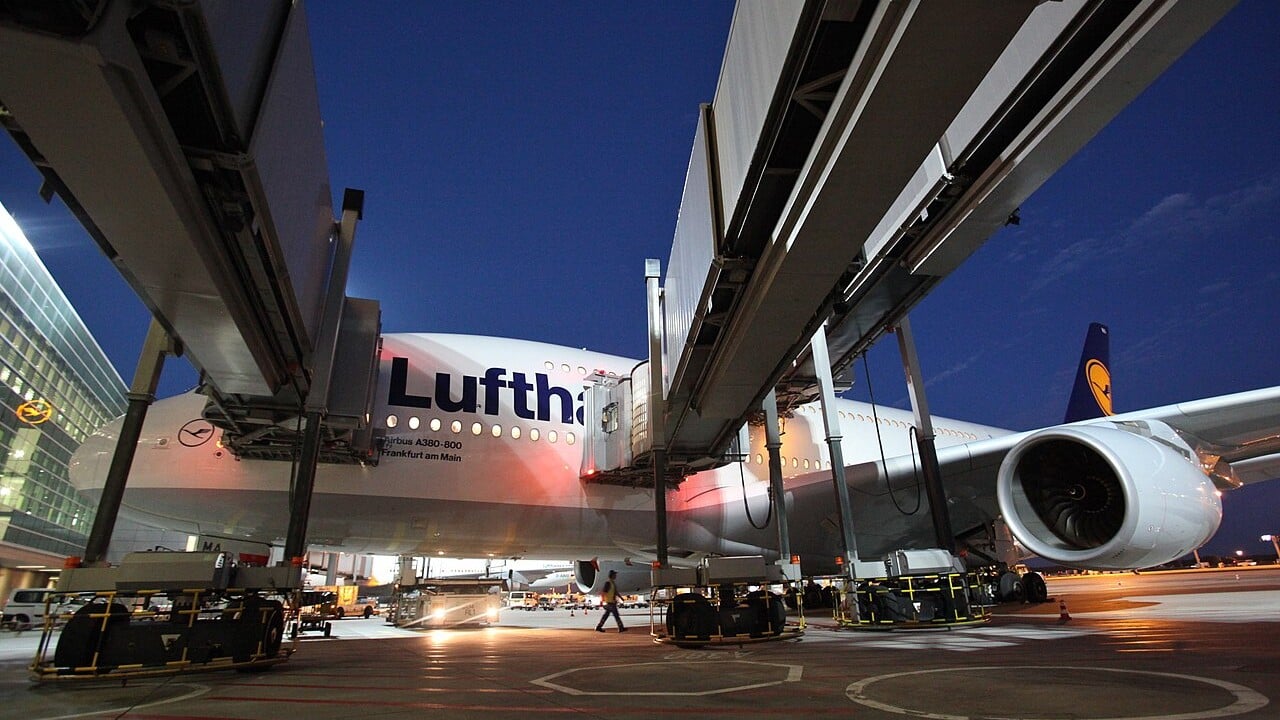
You walk through it twice on almost every big-airport trip and barely notice it. A sloping corridor, a slight bounce underfoot, a gust of cold or hot air at the join, and then the aircraft door. The jet bridge is the last piece of the airport you touch before departure and the first one you meet after landing.
It is also a surprisingly clever machine. A modern passenger boarding bridge pivots, telescopes, climbs, drives across the apron on its own wheels and, with the latest docking systems, can find the aircraft door by itself. Here is how the tunnel to your plane actually works, who built the first one, and why some airlines would rather you used the stairs.
Informations clés
- Nom officiel : Passenger boarding bridge (PBB); also aerobridge, airbridge, jetway
- Main parts: Rotunda, 2 or 3 telescopic tunnels, elevation columns, drive bogie, cab
- Rotunda swing: Up to ±90 degrees on ADELTE bridges
- A380 bridges: Reach up to 8 m to dock with the upper deck (ADELTE)
- Early milestones: United Air Dock test 1954; Aero-Gangplank at O’Hare 1958; SFO and Atlanta 1959
- Inventor credited: Frank Der Yuen, MIT-trained engineer from Honolulu
- First outside the US: Amsterdam Schiphol, 1961, according to ADELTE
- Trademark: “Jetway” is a brand of Oshkosh AeroTech
What a jet bridge actually is
A jet bridge is an enclosed, movable connector between a terminal gate and an aircraft door. It lets passengers board and disembark without walking across the apron in the rain, the snow or the jet blast. The industry term is passenger boarding bridge, or PBB, and the same thing is called an aerobridge, airbridge, or passenger loading bridge.
Most people call it a “Jetway”. That is a trademark. Jetway passenger boarding bridges are built today by Oshkosh AeroTech, which Oshkosh Corporation bought from JBT in August 2023, and the brand name has become generic in the same way Kleenex has for tissues.
Because the bridge connects at floor level, passengers with reduced mobility can reach the aircraft without climbing stairs or using a special lift. That alone made it an obvious choice for big airports once air travel became a mass business.
Anatomy: from rotunda to cab
The Spanish manufacturer ADELTE describes the standard apron-drive bridge, the most common type in the world, as a chain of five main parts. It starts with the rotunda, a round room fixed on a column anchored into the ground. The rotunda is the hinge between the fixed terminal and the moving bridge, and on ADELTE’s bridges it can swing up to 90 degrees either way.
Next come two or three telescopic tunnels, steel boxes that slide inside each other like the sections of a telescope, so the bridge can lengthen or shorten to reach aircraft parked at different distances. Some airports specify glass walls; others prefer solid steel panels with insulation.
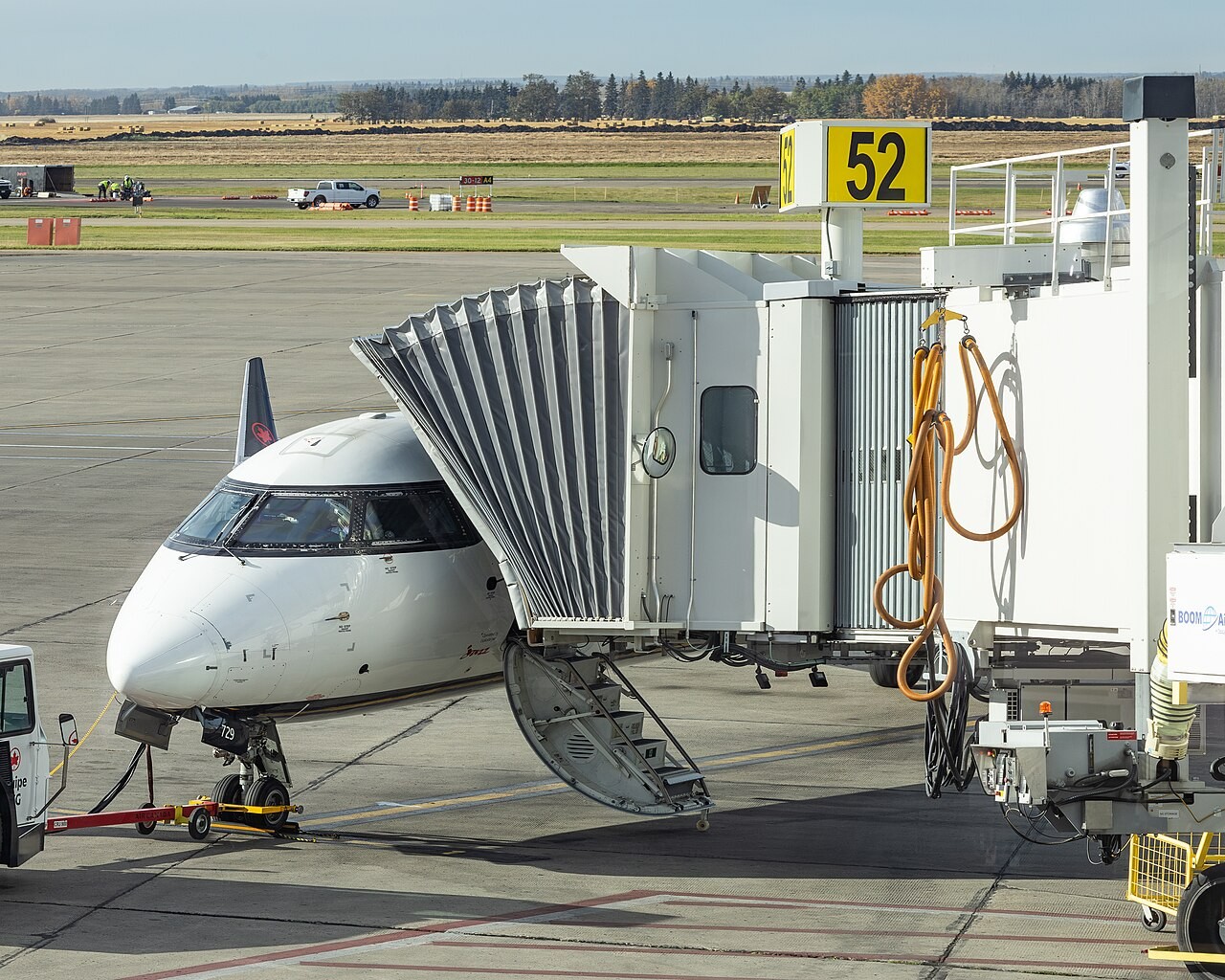
The outer end rests on the elevation system, two parallel steel columns that lift or lower the tunnels with hydraulic cylinders or synchronised electromechanical drives. That is how one bridge serves a regional jet with its door close to the ground and a widebody with its door several metres up. Under the columns sits the traction system, or bogie: a set of solid wheels and motors that drives the whole outer end across the apron.
At the very end is the cab, the part that meets the aircraft. It can rotate independently of the tunnels to square up to a fuselage curving away at an angle. A folding, accordion-like canopy closes around the door to keep the weather out, and a soft bumper protects the aircraft skin. ADELTE fits three proximity sensors inside that bumper plus an ultrasonic sensor that detects the aircraft.
Japanese manufacturer ShinMaywa’s official film shows how its passenger boarding bridges telescope, rise and dock with an aircraft.
Driving the bridge
Someone has to steer all of this. On most bridges the operator stands at a control station inside the cab, with a joystick to drive the bogie and buttons to raise or lower the cab, extend or retract the tunnels and swing the canopy. Cameras and proximity sensors help the operator judge the final few centimetres.
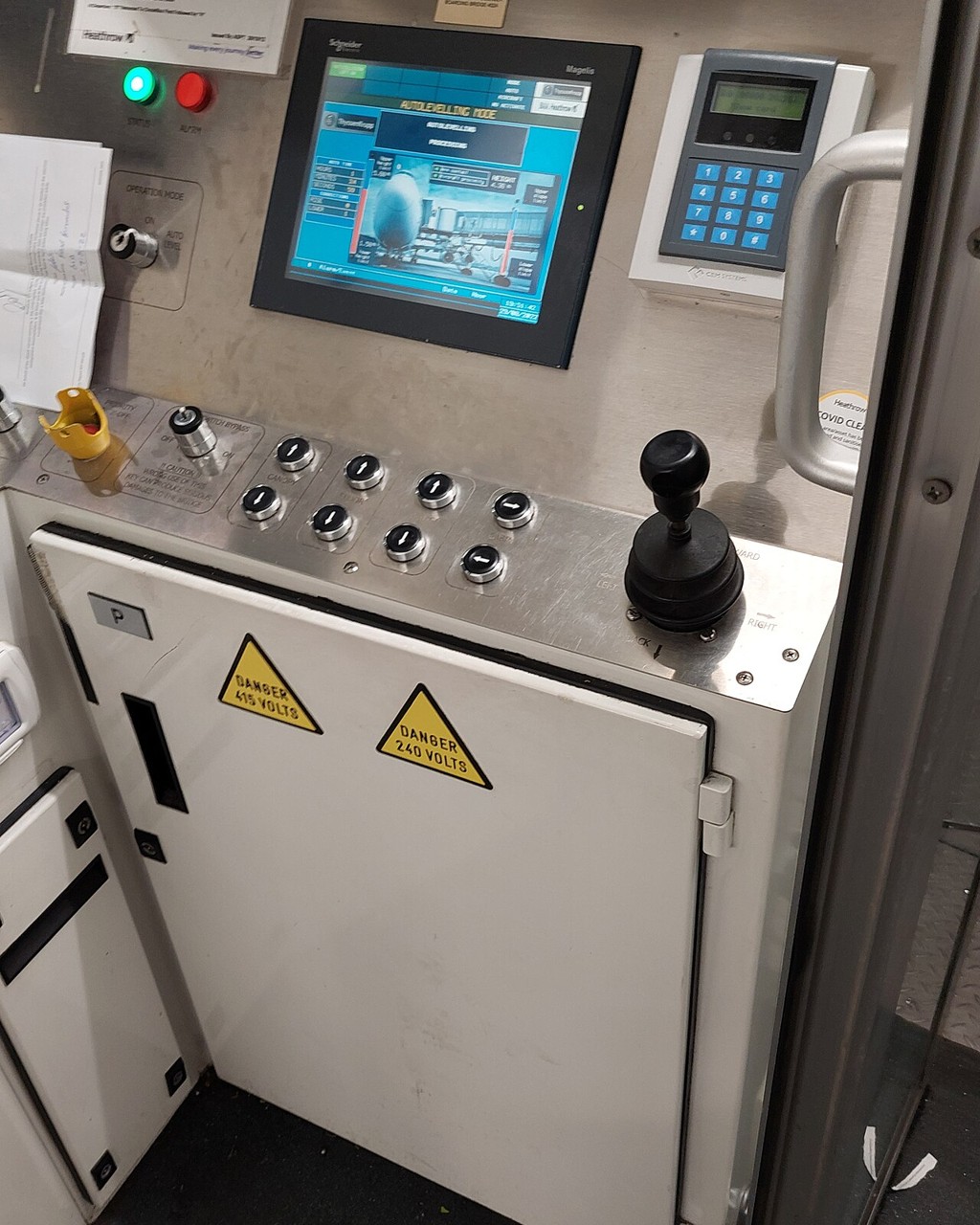
The aircraft parks first, and only then does the bridge move out to meet it. Oshkosh AeroTech lists electronic and mechanical limits on bridge motion, proximity sensors and cab cameras among its safety features, along with compatibility with visual docking guidance systems at the gate.
Increasingly, the operator is a computer. Oshkosh AeroTech says its automatic docking system lets a Jetway bridge locate the passenger door, align itself and dock with the touch of a button, without decals or markings on the fuselage. ADELTE markets ARCOS, which it calls an autonomous remote control operating system for boarding bridges.
More than a corridor
A jet bridge is also a utility mast. Manufacturers design bridges to carry ground power units and pre-conditioned air equipment, so a parked aircraft can be fed electricity and cooled or heated air through hoses and cables slung under the tunnels.
The company that grew into Oshkosh AeroTech says FMC introduced the first point-of-use pre-conditioned air unit, cooling aircraft parked at the gate and reducing fuel consumption and emissions. The bridge itself needs climate control too: ADELTE’s rooftop air-conditioning unit is rated at a cooling capacity of 30.5 kW, ducted through the tunnels.
Who built the first one?
The honest answer is that nobody can say for sure. United Airlines tested an enclosed “Air Dock” in 1954. In 1958 United installed the “Aero-Gangplank”, built by Lockheed Air Terminal, at Chicago O’Hare. The original concept is credited to Frank Der Yuen, an MIT-trained aeronautical engineer from Honolulu.
San Francisco has a claim too. In 1959 American Airlines unveiled an experimental, fully enclosed, retractable loading bridge at the airport’s second storey. John Hill of the SFO Museum told USA TODAY in 2016 that SFO could not definitively claim the first Jetway, but that its 1959 bridge was certainly one of the very earliest.
The company that made the name famous was Pacific Iron and Steel of Los Angeles. According to Garrett Macfarlane of JBT AeroTech, United asked it around 1959 for a passenger gangway like those on cruise ships, but for aircraft, which led to an order for 19 bridges for New York, Los Angeles and San Francisco. Delta Air Lines ordered 17 “Jetways” from the same firm, with two prototypes delivered to Atlanta in July 1959.
Early bridges were expensive. Macfarlane put the 1961 price at about $100,000 per unit, likely an early deterrent for some airlines, but by the 1970s and 1980s most major airports had them. According to ADELTE, the first passenger boarding bridge outside the United States was installed at Amsterdam Schiphol in 1961.
One early decision still shapes every gate you use. According to Flightradar24’s history of the jet bridge, some of the first systems had bridges to both a front and a rear door. The rear bridge was dropped as not worth the cost, which helped make boarding through the forward left-hand door the standard, with aircraft parked nose-in to the terminal to save space.
Two doors, two decks, over the wing
Big airports did not stop at one bridge per aircraft. Many international gates have two or three, letting premium and economy passengers board through different doors at the same time. Amsterdam Schiphol originally fitted most of its widebody gates with a second bridge that reached over the wing, hung from an overhead structure.
Simple Flying looks at the over-wing jet bridges once common at airports such as Amsterdam Schiphol, and where they survive.
The Airbus A380 pushed the idea further, because both of its passenger decks have doors that open to the outside. A dedicated bridge can dock directly with the upper deck, and ADELTE’s A380 apron-drive bridge is built to reach a height of 8 metres. Loading both decks in parallel shortens the turnaround, which matters for airport charges, delays and passenger throughput.
An upper-deck bridge docking with an Emirates A380 at Kuala Lumpur, the second-storey boarding that only the double-decker needs.
Not every bridge is fixed at the terminal end. At Melbourne’s international terminal, and formerly at Hong Kong’s Kai Tak airport, bridges are anchored in the middle and could move at both ends, so the terminal end could rise or fall to serve either the departures level or the arrivals level.
Why some airlines skip the bridge
Jet bridges cost airports money to buy and maintain, and airports often charge more for a stand with a bridge than for a remote stand served by stairs. Low-cost carriers such as Ryanair have avoided them wherever possible, and Jetstar often uses remote stands with buses to the aircraft.
Washington Dulles tried a different answer from the start. Eero Saarinen’s terminal used mobile lounges, raised bus-like vehicles that carried passengers from the main building out to the aircraft. Once jet bridges and the midfield concourses arrived, most of that advantage disappeared, although Dulles still uses mobile lounges today.
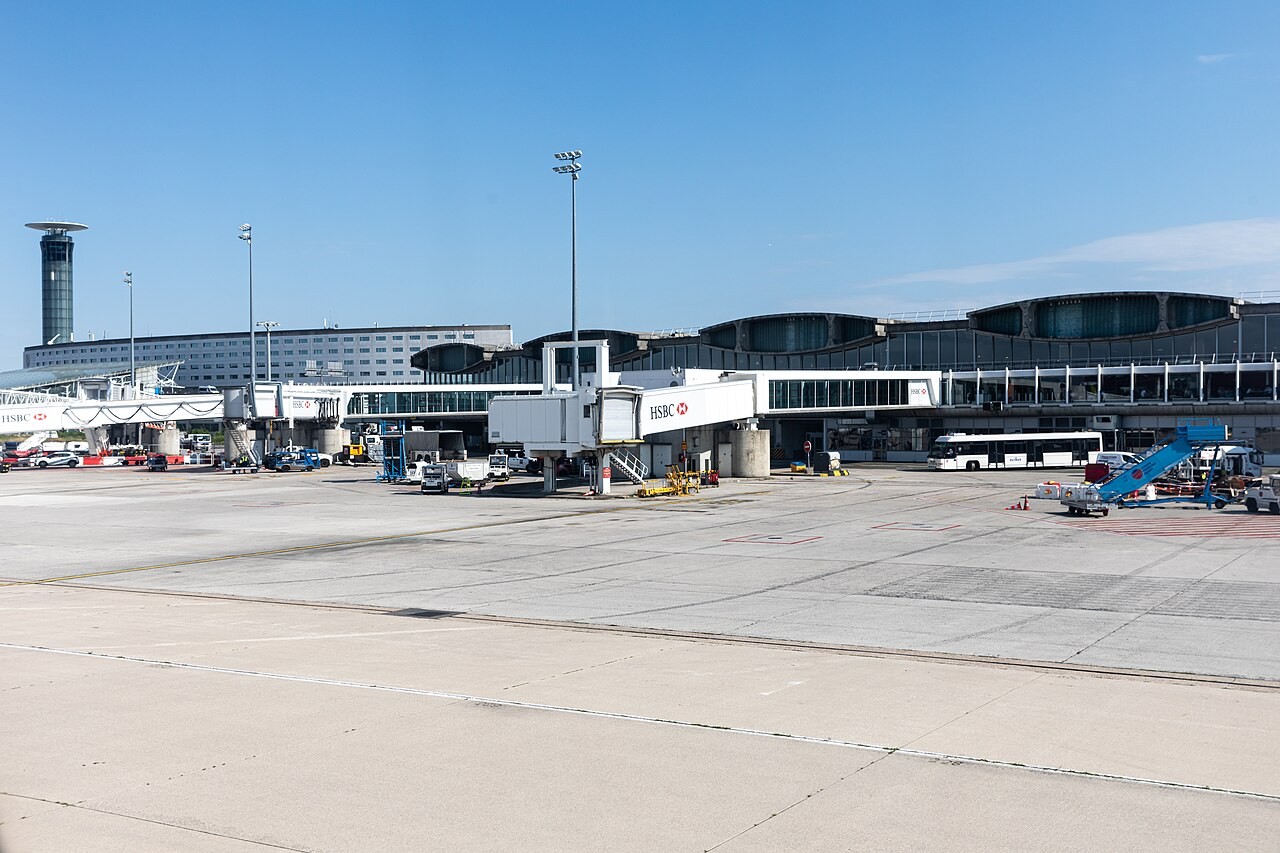
There is one more use most passengers never think about: advertising. In the early 2000s HSBC realised that jet bridges were a global medium nobody had claimed, and bought the rights to jet bridges in major airports across 81 countries and territories.
The jet bridge never got the glamour of the jets it serves. It is too hot in summer, too cold in winter, and always a little too crowded. But it is a self-propelled, height-adjustable, sensor-laden machine that docks with a moving target of a dozen different shapes many times a day. Next time it bounces under your feet, give it a nod.
Sources: ADELTE (passenger boarding bridge components and FAQ), Oshkosh AeroTech (Jetway bridges, JetDock, company history), Harriet Baskas, USA TODAY At the Airport column (2016), Flightradar24, Wikipedia (Jet bridge; Frank Der Yuen; Mobile lounge)
Header photo: Steve Jurvetson / Wikimedia Commons, CC BY 2.0
0 Comments