

Fifteen metres above the Angolan bush, at more than 600 km/h, a small camouflaged jet trainer is hunting. Its pilot is not looking for tanks or trucks today. He is looking up, for the silhouettes of helicopters flying in pairs at a few hundred metres, supplying an army that is running out of everything.
The aircraft is an Atlas Impala Mk II, South Africa’s licence-built version of an Italian trainer designed to teach students how to fly jets. In September 1985, according to the most detailed published account, Impalas of the South African Air Force shot down six Angolan helicopters in two days. It is one of the strangest combat records any trainer has ever earned.
Informations clés
- Aéronef: Atlas Impala, licence-built Aermacchi MB-326
- Impala Mk I: Two-seat MB-326M trainer and light strike jet; licence taken 1964, local production from 1966; 151 acquired
- Impala Mk II: Single-seat MB-326K; 7 delivered from Italy in 1974, 15 kits assembled, 78 licence-built (100 in all)
- Guns: Two 30 mm DEFA cannon (Mk II)
- Constructeur: Atlas Aircraft Corporation, Kempton Park
- Combat: South African Border War, 1975 to 1989, at around 15 m and up to 650 km/h
- Helicopter kills: Six Angolan helicopters on 27 and 29 September 1985, according to the ACIG account
- Display team: Silver Falcons (Impala Mk I)
An Italian trainer for the Highveld
Le Aermacchi MB-326 first flew on 10 December 1957. Designed by Ermanno Bazzocchi around a single Viper turbojet, a straight wing and two seats in tandem, it was built to take a student pilot from the first jet lesson almost to combat-ready standard. More than 800 were built, and Australia, Brazil and South Africa all produced it under licence. Afterburner told its wider story in our MB-326 profile.
South Africa chose the type in 1964 and took a licence to build it. The South African Air Force called its two-seat MB-326M the Impala Mk I. A handful came from Italy or were assembled from Italian kits, and local production at the Atlas Aircraft Corporation started in 1966. In all, 151 Mk Is were acquired, according to South African air force historians.

For a country already facing arms embargoes, building its own jets mattered as much as the jets themselves. Atlas set up a full production works at Kempton Park near Johannesburg, the same company that would later turn French Mirages into the Atlas Cheetah.
The single-seat Impala Mk II
The second Impala was a different animal. The MB-326K was a single-seat light attack version with a strengthened airframe and a more powerful Viper engine. In 1974 Aermacchi delivered seven to South Africa in component form, followed by 15 more kits for local assembly. Atlas then built a further 78 under licence as the Impala Mk II, for a total of 100.
Where the rear seat had been, the Mk II carried two built-in 30 mm DEFA cannon. Under the wings it could carry bombs and rockets. It was slow next to a Mirage, but it was cheap to operate, could fly from rough forward airstrips and could be over a target quickly.
The South African Military History Channel’s footage of an Impala Mk II taking off.
Under the radar in the Border War
From 1975 to 1989 the South African Defence Force fought in southern Angola and South-West Africa against the Angolan army, FAPLA, and its Cuban allies. The Impalas flew close support and strike missions, and the tactic that kept them alive was simple: stay very low and very fast. Pilots typically flew at 550 to 650 km/h at around 15 metres above the ground to stay under Angolan radar and air defences.
In mid-1985 FAPLA launched a large offensive, known as Second Congress, against the UNITA rebel movement around Mavinga in south-eastern Angola. As the advance stalled under South African air strikes, forward Angolan units ran short of fuel and ammunition. The Angolan air force and its allies began supplying them by air, with transport helicopters escorted by gunships and MiG-21s.

Trainers that hunted helicopters
The South Africans noticed that the helicopters flew predictable routes, at predictable times, in pairs. In an account for the Air Combat Information Group, air-war historian Tom Cooper describes how Impala Mk IIs of No. 4 Squadron were sent from Rundu to intercept them: running in at tree-top height, then climbing only when the helicopters were in sight, and attacking from behind and above with their cannon.
On 27 September 1985, according to that account, a pair of Impalas shot down two Mi-24 Hind gunships. Two days later, on 29 September, Impalas caught another formation and shot down two more Mi-24s and two Mi-17 transports, members of the Mi-8 family. Cooper writes that at the time, South Africa and UNITA agreed that UNITA would claim the kills with shoulder-launched missiles.
The account says the helicopter supply flights over the battlefield stopped for the rest of the offensive. The Impala had not been designed for anything like this; it was a trainer and a light strike jet with two guns. But low, fast and unexpected, it had turned the logic of air combat on its head.
A short look at the Impala preserved by the Friends of the SAAF Museum at Ysterplaat, Cape Town.
From combat to the Silver Falcons
The Impala Mk I had a gentler second career. The SAAF’s aerobatic team, the Silver Falcons, flew the two-seater for many years, and generations of South African military pilots learned to fly jets in it.
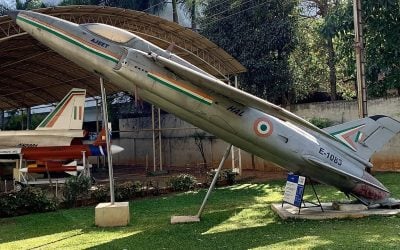
Several Impalas survive in South African museums today, including the SAAF Museum’s collection at Ysterplaat in Cape Town, a reminder of the jet that served the air force as trainer, display aircraft and strike fighter.

The Impala is a reminder that the MB-326 was never just a classroom. It trained pilots on three continents, it flew aerobatics and, over the Angolan bush in 1985, it did something no one at Aermacchi could have planned. For a jet built to forgive student mistakes, that is quite a war record.
Sources: Tom Cooper, Air Combat Information Group (2003); The Unofficial Website on the South African Air Force (saairforce.co.za); Aermacchi; MiGFlug MB-326 flight page
0 Comments