
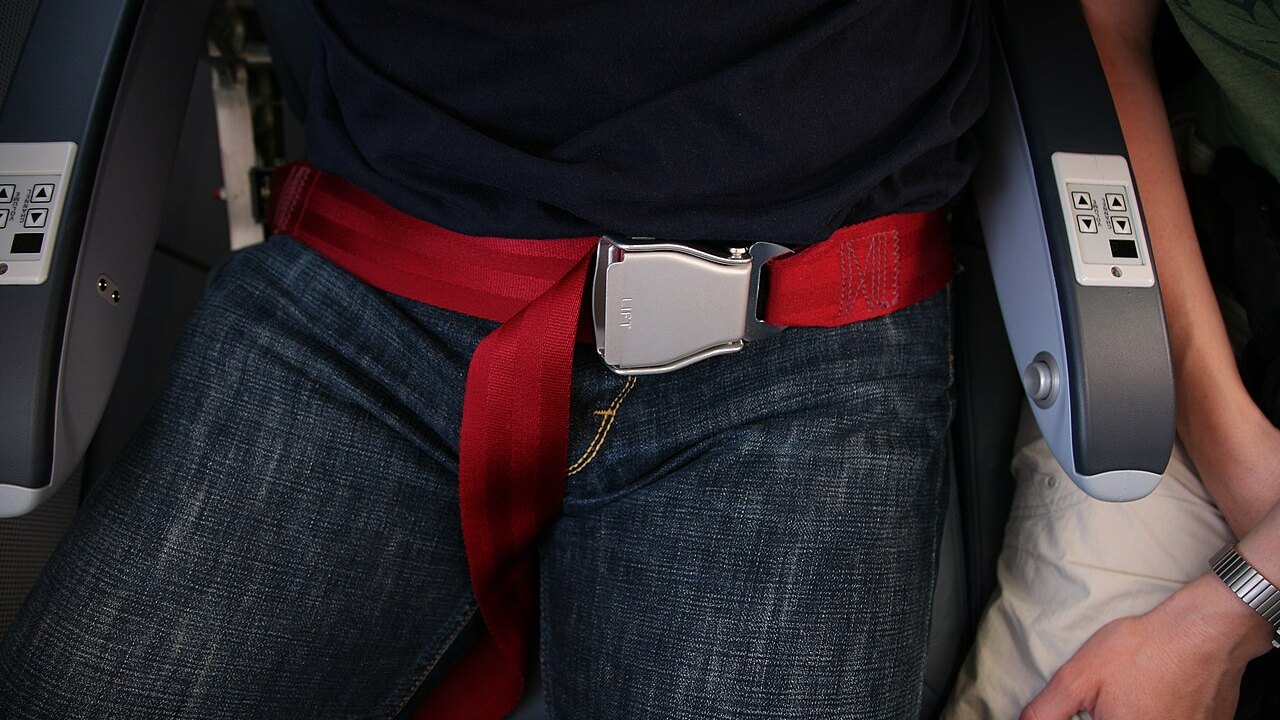
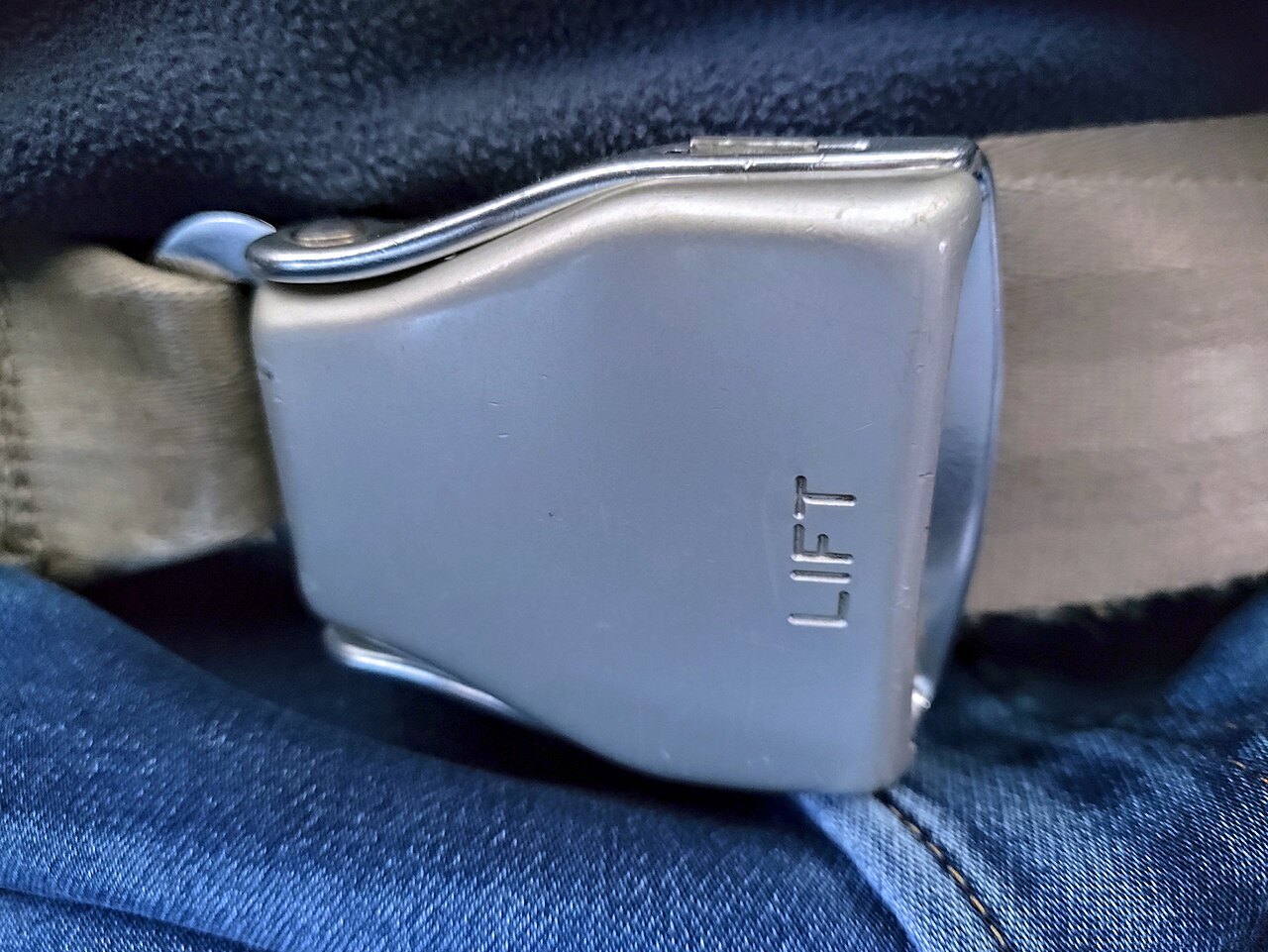
It is the one piece of safety equipment every passenger touches on every flight, and almost nobody thinks about it. A strip of webbing, a metal buckle with a lever that says LIFT, and no shoulder strap at all. In a car, a lap-only belt would feel like a relic of the 1960s. On an airliner, it is the standard.
So what does the law actually say about airplane seat belts? Why is a lap belt considered good enough in economy, when pilots sit strapped into full harnesses a few metres away? And what about the smallest passengers, who are often not belted in at all? The answers are written, in remarkable detail, into the US Federal Aviation Regulations.
Informations clés
- Who needs a seat and belt: Every person on board aged two and over (14 CFR 121.311)
- When it must be fastened: Movement on the ground, take-off, landing, and whenever the seat belt sign is on (121.311, 121.317)
- Seat strength standard: Dynamic tests to 16g forward and 14g downward (14 CFR 25.562)
- 16g seats required: On US airline aircraft manufactured on or after 27 October 2009
- Head protection: Head Injury Criterion of no more than 1,000 where the head can hit structure
- Why no harness: Rules allow a lap belt plus removal of injurious objects within head-strike range instead (25.785)
- Children under two: May sit on an adult’s lap without a restraint; FAA recommends an approved child seat
- Turbulence injuries 2009 to 2024: 40 serious passenger injuries and 166 crew injuries in US airline service (FAA/NTSB data)
What the rules require
Two rules do most of the work. For airlines, 14 CFR 121.311 says an approved seat and an approved safety belt must be available for each person on board who has reached their second birthday, and that everyone must occupy a seat with the belt properly secured during movement on the surface, take-off and landing. For general aviation, 14 CFR 91.107 adds that the pilot in command must make sure every person on board is briefed on how to fasten and unfasten their belt, and is told to fasten it.
The “Fasten Seat Belt” sign has its own rule. Under 14 CFR 121.317, it must be switched on during any movement on the ground, for each take-off and each landing, and at any other time the pilot in command considers necessary. Every passenger seat must also be able to see a sign or placard reading “Fasten Seat Belt While Seated”, which is why you will find that phrase printed above your head or on the seat in front.
The same rule says passengers must comply with crew instructions about the seat belt sign. In other words, when a flight attendant asks you to buckle up, that is not a polite suggestion.
Built for 16g
The belt is only half of the system. The seat it is bolted to must survive a crash too, and since 1988 the FAA has set out exactly how. Under 14 CFR 25.562, each new seat design must pass dynamic tests with a 170-pound crash test dummy. In the forward test, the seat is decelerated from at least 44 feet per second, with a peak floor deceleration of at least 16g reached within 0.09 seconds. A second test simulates a downward impact with a peak of at least 14g.
The pass criteria read like a checklist for survival. The lap belt must stay on the dummy’s pelvis. The seat must stay attached to the floor, even if the structure bends. Leg loads are capped. And wherever the occupant’s head can hit the seat in front or other structure, the impact must not exceed a Head Injury Criterion of 1,000.
A dynamic test centre’s 16g structural test of an aircraft seat, including the floor deformation the regulations require seats to cope with.
For years, older aircraft kept flying with seats certified to earlier, static strength rules. That window has closed for new aircraft: under 14 CFR 121.311(j), any transport category airplane manufactured on or after 27 October 2009 and flown in US airline passenger service must have all passenger and flight attendant seats meeting the 16g standard.
Why economy has no shoulder harness
Here is the clever part. The FAA does not actually demand a shoulder harness for passengers. Under 14 CFR 25.785, the occupant of a forward-facing seat must be protected from head injury by a safety belt plus one of three options: a shoulder harness that stops the head hitting anything injurious, the elimination of any injurious object within the head’s striking radius, or an energy-absorbing rest that supports the arms, shoulders, head and spine.
Economy seats take the second route. Instead of strapping the passenger’s torso to the seat, manufacturers design the seat back in front to be the thing your head meets, and to be soft and energy-absorbing enough to keep that impact below the Head Injury Criterion limit in the 16g test.

The rules get stricter where that logic breaks down. A seat angled more than 18 degrees from the aircraft’s centreline needs a safety belt plus either an energy-absorbing rest for the arms, shoulders, head and spine, or a shoulder harness. And on the flight deck there is no option at all: 14 CFR 121.311 requires a combined safety belt and shoulder harness at every flight deck station on transport category airplanes certificated after 1 January 1958. Pilots have to stay at the controls through whatever happens next.
The smallest passengers
The biggest gap in the system sits on a parent’s knee. Both 91.107 and 121.311 allow a child under two to be held by an adult in an approved seat, as long as the child does not use any restraining device. The so-called belly belts that loop an infant to an adult’s belt are among the devices US airlines may not permit during taxi, take-off and landing.
Parents can instead buy a seat for their child and bring an approved child restraint system. US-made car seats built since February 1985 need a label in red lettering reading “THIS RESTRAINT IS CERTIFIED FOR USE IN MOTOR VEHICLES AND AIRCRAFT”. The FAA is blunt about which option it prefers.
For children aged two and over, a car seat is not required, but the FAA says it strongly recommends one, and it has approved a supplemental restraint called CARES that is used with the existing aircraft seat belt.
Why the sign matters at cruise
Crashes are rare. Turbulence is not. The FAA publishes NTSB data on serious turbulence injuries on US airline flights, and the numbers tell a striking story: from 2009 to 2024, the table lists 40 serious injuries to passengers and 166 to crew members. Flight attendants, working on their feet in the aisles, take the brunt.
“Serious” here means something specific: an injury that needs more than 48 hours in hospital, breaks a bone (simple fractures of fingers, toes or nose excepted), or damages nerves, tendons or internal organs. The FAA’s advice to passengers is simple: keep the belt buckled at all times while seated, not just when the sign is on.
The FAA’s own short video on why passengers should stay buckled up: “Turbulence happens!”
That little lift-lever buckle is designed to open with one hand in a second, so you can get out fast when you need to. The rest of the time, its job is to keep you in your seat while the air does whatever it wants. For more cabin myths, from window seats to denim, read our guide to Seat 11A, jeans and the brace position.
Sources: US Code of Federal Regulations, Title 14 (14 CFR 25.562, 25.785, 91.107, 121.311, 121.317), Federal Aviation Administration, National Transportation Safety Board

0 Comments