
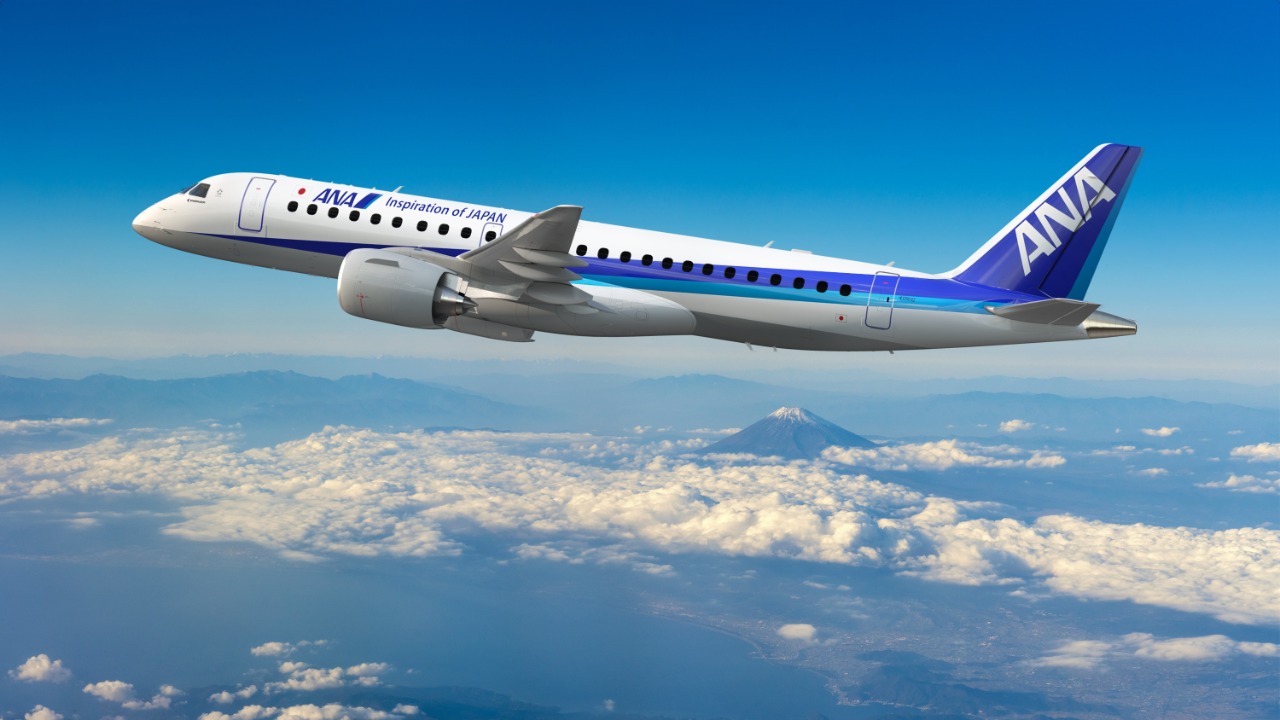
Airlines do not usually order more of an aircraft they have never flown. ANA has just ordered eight.
Embraer announced the deal from Tokyo on 4 September, formalising a decision the ANA Holdings board took on 29 July. It takes ANA’s firm order for the E190-E2 from fifteen to twenty-three, with five options still on the table — and the first aircraft is not due until 2028.
Then there is the part almost nobody has picked up. Those eight jets will not be flown by ANA.
Header image: an Embraer rendering of an E190-E2 in ANA colours over Mount Fuji. No E190-E2 has yet been delivered to ANA, so no photograph of one exists.
Quick Facts — ANA Holdings E190-E2 order
Annunciato: 4 September 2026 (board approval 29 July 2026)
This tranche: 8 firm, no options
Totale azienda: 23, plus 5 options remaining
Baseline: 15 firm signed at the Paris Air Show, June 2025
Prima consegna: 2028
This tranche delivers: FY2029–FY2032
Disclosed value: ~¥105 billion (~US$642m) per ANA’s Tokyo Stock Exchange filing
Motori: 2 × Pratt & Whitney PW1900G geared turbofan
Cabina: “100-seat class”; exact configuration not published
The Aircraft Is for Someone Else
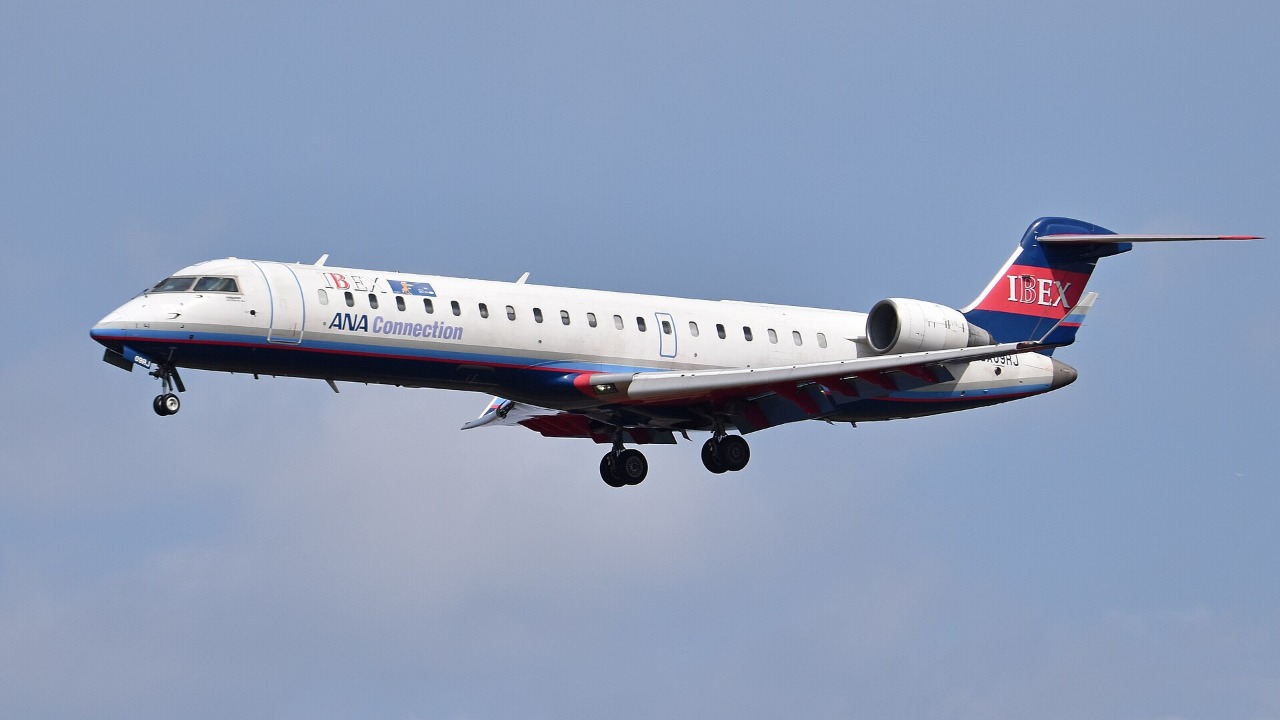
ANA Holdings’ own release is unusually explicit about it. The eight aircraft are being bought to expand an ACMI — aircraft, crew, maintenance and insurance — agreement with IBEX Airlines.
Under the arrangement announced on 29 July, ANA is the marketing carrier: it plans the routes and sells the seats. IBEX is the operating carrier, flying the aircraft with its own crews. Maintenance loops back the other way — IBEX outsources it to ANA. Target start is FY2029, subject to regulatory approval. The two chief executives who signed it were Juichi Hirasawa of All Nippon Airways and Yutaka Maezawa of IBEX Airlines.
ch-aviation reports the aircraft will replace IBEX’s CRJ700 fleet. That detail appears in one outlet and in neither company’s release, so treat it as credible rather than confirmed.
That sentence is doing a lot of work. Japan’s Ministry of Land, Infrastructure, Transport and Tourism published a report on 29 May 2026, through its Expert Panel on the Future of Domestic Aviation, calling for effective use of ACMI agreements as a vital means of balancing supply and demand and keeping the domestic network alive. This is the first major carrier response to that.
Why a 100-Seat Jet, and Why Now
The E190-E2 is the middle child of Embraer’s second-generation E-Jet family: two Pratt & Whitney PW1900G geared turbofans, roughly 36 metres long, a 33.7-metre wing, and the family’s signature two-by-two cabin with no middle seat anywhere. Embraer claims a 25 per cent cut in fuel burn and CO2 against the first-generation E-Jets, and the E2 is certified for blends of up to 50 per cent sustainable aviation fuel.
What it is not is a replacement for ANA’s turboprops or its 737s. ANA Wings operates around two dozen Dash 8-400s and committed to seven more refurbished examples as recently as 2024 — that fleet is being reinforced, not retired. The E190-E2 is a gauge tool: the right size for thin domestic routes that a 737-800 would swamp and a 74-seat turboprop cannot serve at jet speed.
ANA will be Japan’s first E2 operator, though Embraer is hardly a stranger there. The first-generation E-Jets have flown in Japan since 2009: JAL Group operates eighteen E170s and fourteen E190s, and Fuji Dream Airlines runs an all-Embraer fleet of two E170s and thirteen E175s, with two more E175s ordered in July 2026.
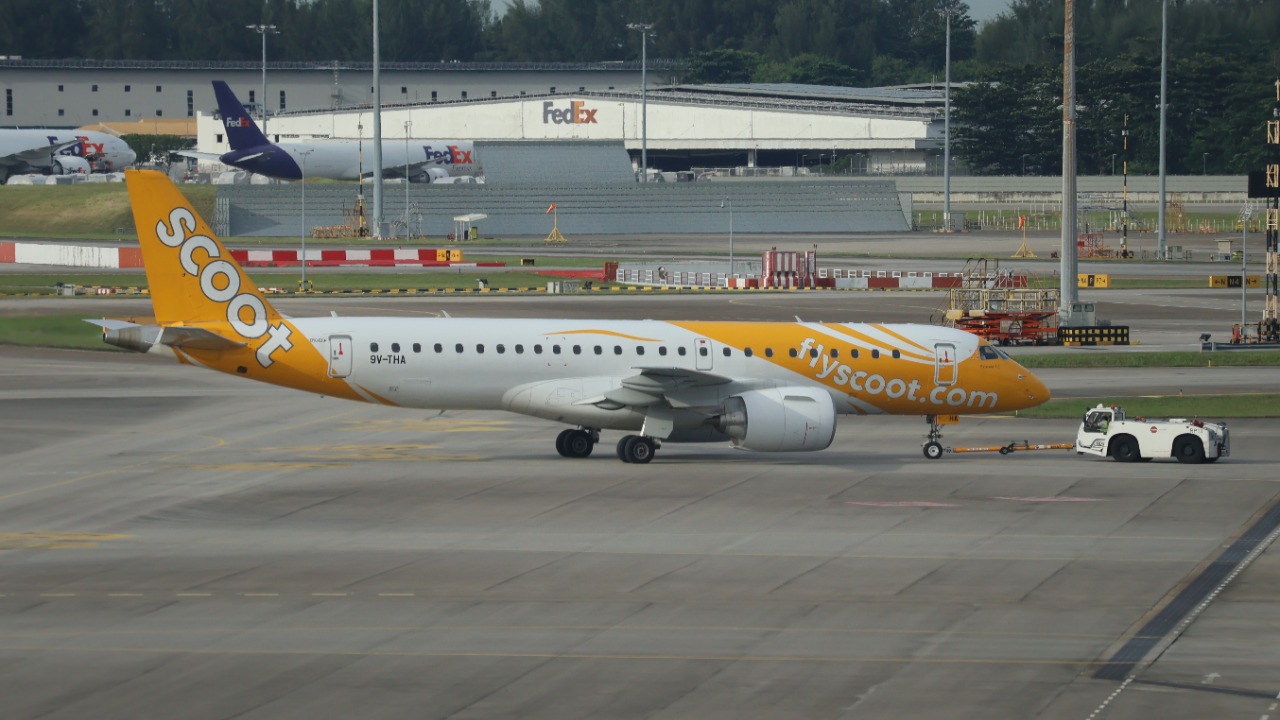
Across the wider region the E2 is still rare. Scoot took the first Asia-Pacific example in April 2024 and completed its nine-aircraft fleet in December 2025. Virgin Australia added the first Australian E190-E2 in September 2025. ANA makes three.
The Aircraft That Should Have Been Japanese
There is a ghost in this order, and it has a name.
The fleet slot the E190-E2 is filling was reserved, for over a decade, for the Mitsubishi Regional Jet. ANA was the launch customer in 2010 with fifteen firm and ten options, expecting the first aircraft in 2014. The programme slipped, was renamed SpaceJet, was suspended in 2020 and was terminated outright in 2023 without a single delivery.
Japan spent roughly fifteen years and an enormous amount of money trying to build a hundred-seat regional jet, and its flag carrier has now bought twenty-three Brazilian ones instead. Embraer, for its part, delivered its 2,000th E-Jet on 2 September, two days before this announcement.
One note on the money. Embraer stopped publishing list prices years ago and disclosed no financial terms here. The figure worth quoting is ANA’s own: roughly ¥105 billion for the eight aircraft, disclosed to the Tokyo Stock Exchange — about US$80 million apiece. That is a company investment figure, not a catalogue price, and it is the only real number in this story.
Embraer’s own walkthrough of the E2 cabin, and the reason regional-jet passengers keep asking for this aircraft by name: there is no middle seat on it.
Domande frequenti
How many E190-E2s has ANA ordered in total?
Who will actually fly ANA’s new E190-E2s?
When will ANA receive its first E190-E2?
How much did the eight aircraft cost?
Is the E190-E2 replacing ANA’s turboprops or its 737s?
Will ANA be the first E2 operator in Japan?
What happened to the Mitsubishi SpaceJet that ANA was going to buy?
Sources: Embraer, ANA Holdings, All Nippon Airways / IBEX Airlines joint release, Tokyo Stock Exchange (TDnet) filing, FlightGlobal, AirlineGeeks, Air Data News, AeroTime, ch-aviation, Japan MLIT.

0 Commenti