
The story usually goes like this. Germany built a wooden night fighter to match the de Havilland Mosquito. It was fast and it worked. Then the RAF bombed the single factory making the special glue that held it together, the substitute adhesive was corrosive, the aeroplanes came apart in the air, and a war-winning design died because of a chemical.
It is a wonderful story. It is roughly half true, and the half that is missing is more interesting.
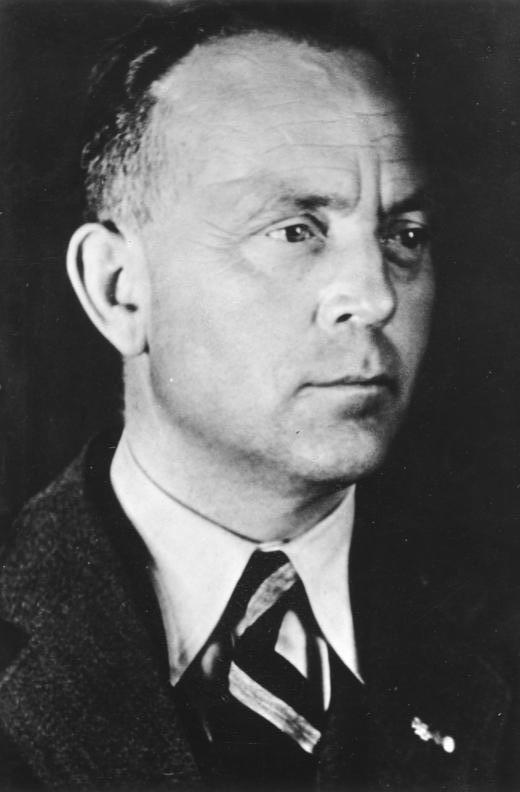
Kurt Tank had already told a conference at the Obersalzberg that the glue problem was unsolved, and Adolf Galland had already said the aircraft did not handle well enough, before anybody bombed anything.
Informazioni rapide
| Aeromobili | Focke-Wulf Ta 154 Moskito, twin-engined night fighter |
| Designer | Kurt Tank; the Ta prefix is his own initial |
| Primo volo | 1 July 1943 |
| Costruito | 28 in total: 3 prototypes, 15 pre-production, 10 production |
| Costruzione | Around 57 percent wood, bonded with Tego-Film phenolic resin adhesive |
| Motori | Two Junkers Jumo 213E inverted V-12s, about 1,750 hp each for take-off |
| Maximum speed | Around 650 km/h (400 mph) at 7,090 m in the A-1 |
| Armamento | MG 151/20 20 mm and MK 108 30 mm cannon, including Schräge Musik upward-firing guns |
| Servizio | A small number with Nachtjagdgeschwader 3; some later used to train jet pilots |
| Annullato | Summer 1944, with accounts differing on the exact sequence |
Why Germany wanted a wooden aeroplane
Two pressures created the Ta 154. The first was the RAF's night bombing campaign and the near-immunity of the Mosquito to interception, which made an urgent case for something faster than the Bf 110 and Ju 88.
The second was aluminium. The Reichsluftfahrtministerium stipulated that more than half the material in the new fighter must be non-strategic, which in 1942 meant wood. Around 57 percent of the finished aircraft was wooden, bonded with a phenolic resin adhesive called Tego-Film, a glue film laid between plies and cured under heat and pressure.
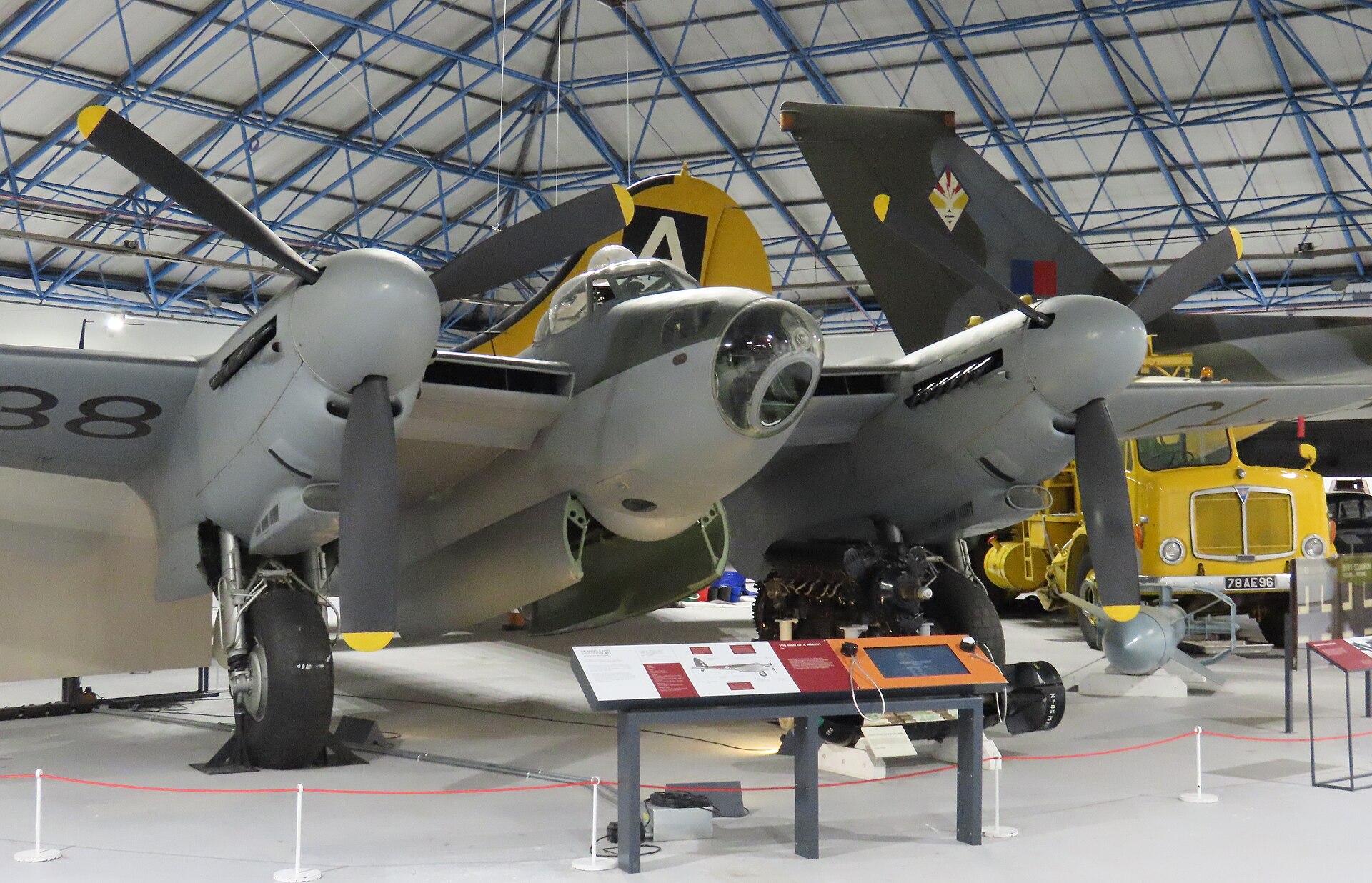
The name Moskito was never official. It was applied informally, and it was as much an acknowledgement of the problem as a description of the solution.
A promising start, and a caveat
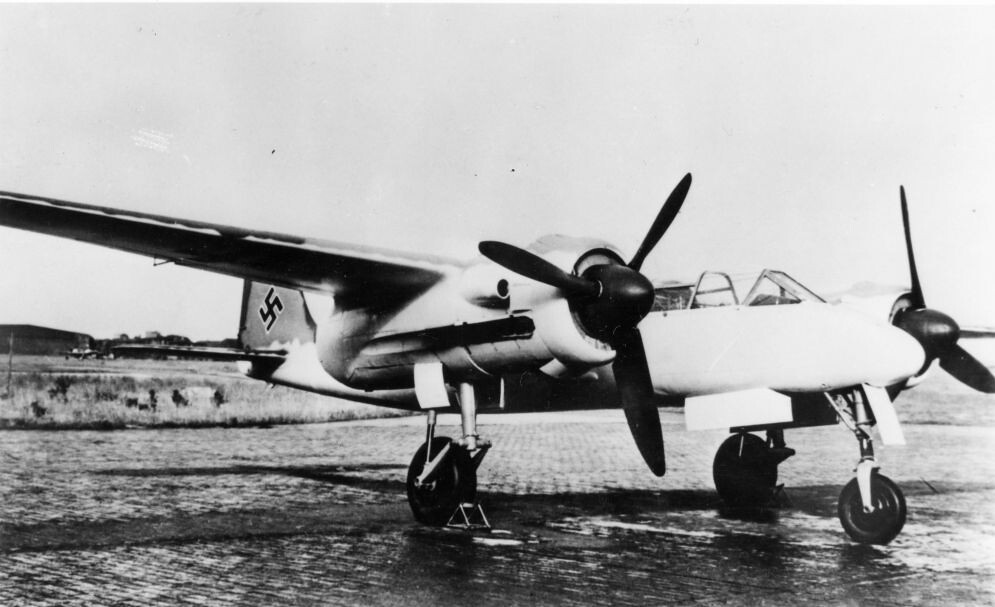
The V1 prototype flew on 1 July 1943. Sources disagree on who was at the controls: some accounts credit Kurt Tank himself with the maiden flight, while others record Focke-Wulf's chief test pilot Hans Sander flying it first on 1 July, with Tank taking it up on 7 July. On both of those first flights the hydraulics failed and the undercarriage had to be lowered by hand, which was an unglamorous omen.
The performance figures are also contested. One account has V1 reaching nearly 700 km/h at Rechlin and comfortably outflying both the Heinkel He 219 and the Junkers Ju 388, with the important caveat that the Ta 154 was carrying neither guns nor radar while its competitors were fully equipped. Another records a disappointing best of 389 mph achieved in September 1943.
What is not disputed is what happened when the equipment went on. The V3, which flew on 23 November 1943, carried guns and the 32-dipole Matratze aerial array of its FuG 212 Lichtenstein radar. The weight and the drag of that antenna forest cost a full 75 km/h. The aircraft was still faster than the He 219, but the margin that had made it exciting was gone.
The pilots were not convinced
This is the part the glue story leaves out. There was never a consensus that the Ta 154 was a good aeroplane to fly.
After a test flight on 29 October 1943, Hauptmann Thierfelder wrote a broadly positive report but complained of excessively high control forces. Oberst Diesing, head of planning at the Air Ministry, told Tank that ordinary squadron pilots would struggle with the aircraft, and noted with some alarm that pieces fell off it when the guns were fired.
Adolf Galland, who flew it himself, reported at a conference in late May 1944 that the handling still left something to be desired and that single-engine performance was not adequate for front-line use. He also raised a point that had already been proved: the wooden crew compartment made even a controlled belly landing dangerous. On 8 May 1944 the V8 had crashed, the fuselage had broken up, and both crew had been killed in an accident that a metal aircraft would probably have survived. Galland flew the Ta 154 again on 2 June at Tank's request and was no more impressed.
Now, the glue
The popular version is repeated in a great many reputable places, and it goes like this.
The replacement adhesive supplied in its place was not as strong, and worse, it was acidic enough to attack the wood it was supposed to bond. In July 1944 several Ta 154 A-1s are reported to have disintegrated in high-speed flight, attributed to delamination of the plywood wing. The same adhesive crisis hit Heinkel's He 162 Volksjäger, where it was eventually solved.
The trouble with the story is the calendar, and the details do not agree between sources. Accounts variously place the Tego-Film plant at Wuppertal or at Posen, and date its destruction anywhere from 1943 to 29 May 1944. And whichever date is correct, Tank had already conceded the problem.
Five days. The designer told the leadership that the bonding was not fixed, and then the factory was hit. A bombing raid did not create the problem; it removed the last chance of solving it.
Everything else was also going wrong
In March 1944 the Jägerstab ordered 37 aircraft by May and projected 250 a month by November. The first eight pre-production Ta 154 A-0s were not finished until August. Subcontractors could not deliver components because the transport network was collapsing, and each airframe was reportedly absorbing around 12,000 man-hours.
The proposed fix for the structural and safety objections was a C-series with a metal fuselage, which would have eliminated the aircraft's entire reason for existing: it used no scarce metal.
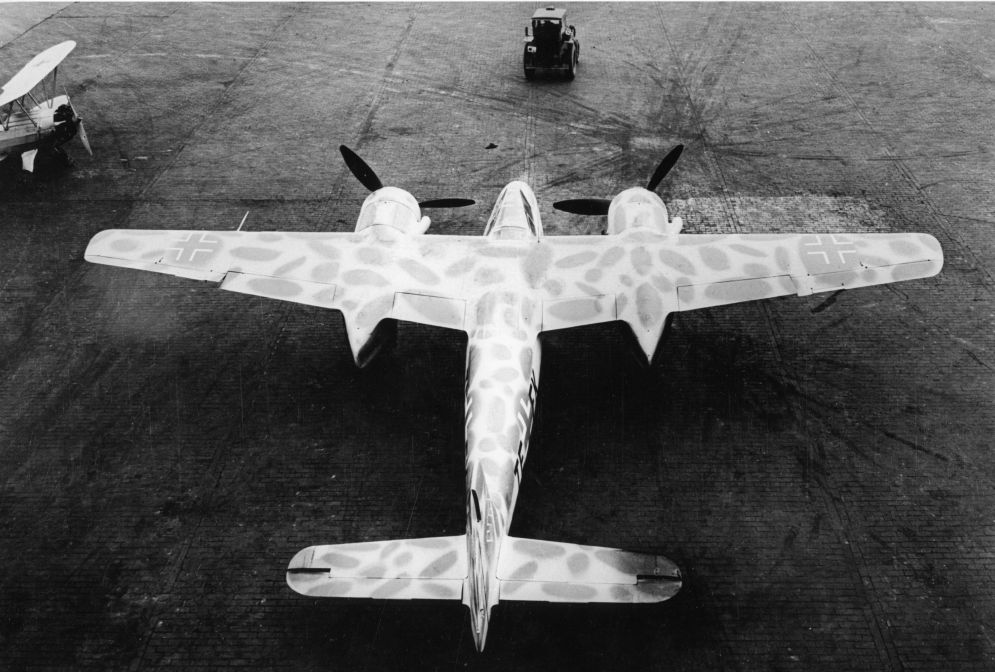
Accounts of the ending differ, and the disagreement is worth stating rather than smoothing over. One version has Erhard Milch announcing on 6 July 1944 that the Ta 154 and its Ta 254 derivative had been struck off the programme, then ordering all work stopped on 2 August, with a warning that burning fuel in the surviving aircraft would be treated as sabotage. Another has production halting in August and the RLM formally cancelling in September, after Milch had lost his position and could no longer shield the project.
Either way it was over by the autumn of 1944. The V1 itself had already been destroyed on the ground at Langenhagen on 5 August, along with six other Ta 154s, when the US Eighth Air Force bombed the airfield. Some testing resumed and dragged on until April 1945. A handful of the aircraft flew with Nachtjagdgeschwader 3, some became jet conversion trainers, and six unfinished airframes were converted into Pulkzerstörer formation destroyers and Mistel composites.
Why the glue story survives
Because it is clean. A single factory, a single bombing raid, a single chemical, and a promising aircraft destroyed by bad luck rather than bad decisions. It also flatters everybody: the designer was right, the aeroplane was good, the enemy simply got lucky.
The messier truth is that the Ta 154 was a reasonable idea being built by an industry that had run out of aluminium, out of transport, out of skilled labour and out of time, to a specification its own test pilots kept complaining about, using a bonding process that was marginal before anybody bombed it.
The de Havilland Mosquito was made of wood too, and it worked beautifully, because Britain had furniture factories, cabinet makers, a mature adhesive supply and the luxury of getting it right in 1940 rather than 1944. The material was never the difference. The circumstances were.
Domande frequenti
Did the Focke-Wulf Ta 154 really fall apart because of glue?
What was Tego-Film?
Was the Ta 154 a copy of the de Havilland Mosquito?
How many Ta 154s were built?
Did the Ta 154 ever fight?
Why did radar slow the Ta 154 down so much?
Why did the Mosquito succeed where the Ta 154 failed?
Sources: historyofwar.org; Vintage Aviation News; William Green, Aircraft of the Third Reich; contemporary RLM and Jägerstab records as reported in the secondary literature.
0 Comments