
A wing optimised for cruising at 500 knots is a bad wing for landing at 140. It is too small, too flat and too efficient. The aeroplane needs a different wing for the last three minutes of the flight, and rather than carry two, it grows one.
That is what flaps and slats are: a mechanism for changing the shape and the size of a wing in flight. On a modern airliner the process adds chord, adds area, adds curvature and completely rearranges the airflow, and it happens in a few seconds on a set of tracks and carriages that are among the most highly loaded moving structures on the aircraft.
Informazioni rapide
What they change: Camber, wing area and the behaviour of the airflow over the upper surface
Trailing edge devices: Plain, split, slotted, Fowler and multi-slotted Fowler flaps
Leading edge devices: Slats, which move out and down, and Krueger flaps, which hinge forward from the lower surface
Typical lift gain: A plain flap adds around 0.9 to the maximum lift coefficient. A triple-slotted Fowler adds roughly 1.9 times the chord ratio
Clean wing: Maximum lift coefficient typically around 1.4 to 1.6
Full landing configuration: Around 3.2 to 3.5 for a wing with triple-slotted flaps and slats
Stall speed effect: Stall speed varies with the inverse square root of maximum lift coefficient, so doubling it cuts stall speed by about 29 per cent
Typical settings: Around 15 to 20 degrees of flap for takeoff, 40 to 60 for landing
Three separate jobs
NASA’s Beginner’s Guide separates the effects cleanly, and it is worth quoting because the wording is precise about which part does what.
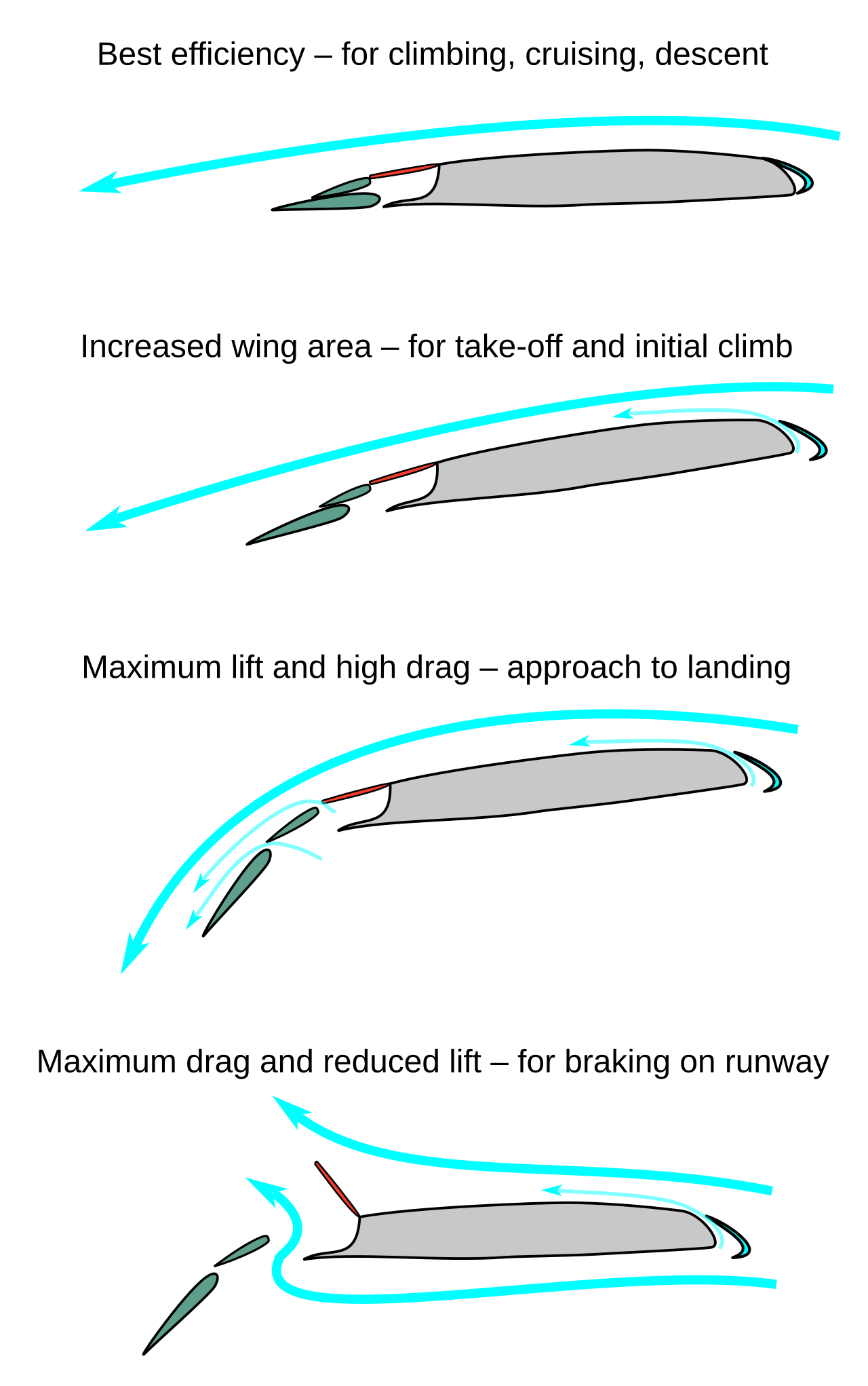
So: sliding the surfaces outward makes the wing bigger. Pivoting them downward makes it more curved, which raises the lift at any given angle of attack. And the large rearward-facing area of a deployed flap increases drag substantially.
That third effect is not a side-effect to be tolerated. It is why takeoff and landing flap settings differ. On takeoff you want extra lift without paying much drag, so the flaps go part way down. On landing you want extra lift E plenty of drag, so that the aircraft can fly a steep, slow, controlled approach with the engines spooled up rather than at idle. NASA frames the split exactly that way.
The family tree
A plain flap is the rear portion of the wing on a simple hinge. It adds camber and nothing else.
A split flap hinges only the lower surface downward, leaving the upper surface in place. It produces a lot of drag for its lift, which is why it largely disappeared.
A slotted flap leaves a carefully shaped gap between itself and the wing when it deploys. Air flows through that slot from the high-pressure side to the upper surface of the flap.
A Fowler flap is the clever one and the reason big aeroplanes land as slowly as they do. It first slides rearward, almost level, increasing chord and therefore wing area, and only then hinges down to add camber. It is, as EUROCONTROL’s SKYbrary puts it, found on most large aircraft. Double and triple-slotted Fowler flaps stack the trick.
At the front, slats move forward and droop, adding both area and camber. Krueger flaps do something different and are often confused with slats: they hinge forward and down from the lower surface, adding camber without adding much area. The Boeing 737 carries both, Kruegers inboard of the engines and slats outboard.
The thing almost everyone gets wrong about slots
Ask why a slot works and you will usually be told that it takes high-energy air from beneath the wing and blasts it over the upper surface to re-energise the boundary layer and delay separation. It is in a great many textbooks and training manuals.
A. M. O. Smith addressed this directly in the canonical paper on high-lift aerodynamics, the 37th Wright Brothers Lecture, published in the Journal of Aircraft in 1975. He quotes two NASA reports making exactly that claim and says there are two things wrong with the statements.
Nor is the slot air high-energy. As Smith points out, all the air outside the actual boundary layers has the same total head. There is no reservoir of energetic air underneath the wing waiting to be tapped.
What actually happens is subtler and, once you see it, more satisfying. Smith identified five effects. The slat effect: circulation around the slat runs counter to the flow at the main wing’s leading edge, reducing its suction peak so there is less pressure to recover. The circulation effect: the downstream element bends the flow at the upstream element’s trailing edge, increasing its circulation and therefore its lift. The dumping effect: the forward element’s boundary layer is discharged at above freestream velocity, so it never has to survive as severe a pressure rise. Off-the-surface pressure recovery: the wake decelerates away from any wall, which is far more effective than decelerating against one. And the fresh boundary layer effect: each element starts its own thin new boundary layer, and thin boundary layers tolerate much stronger adverse pressure gradients than thick ones.
In other words, a multi-element wing is closer to a biplane than to a single wing with a hole in it.
The 737’s leading and trailing edge systems, from the technical channel that documents the type.
What it buys, in numbers
Published increments to maximum lift coefficient run roughly as follows: a plain flap adds about 0.9; a slotted flap about 1.3; a Fowler flap about 1.3 multiplied by the chord extension ratio; a double-slotted Fowler about 1.6 times that ratio; a triple-slotted Fowler about 1.9. At the leading edge, a plain slot adds around 0.2, a Krueger about 0.3, and a slat about 0.4 times the chord ratio.
Stack them and a wing whose clean maximum lift coefficient is somewhere between 1.4 and 1.6 reaches 3.2 to 3.5 in full landing configuration.
The payoff falls straight out of the lift equation. Stall speed varies with the inverse square root of the maximum lift coefficient, so doubling the coefficient reduces stall speed by about 29 per cent. Go from 1.5 clean to 3.3 fully deployed and the reduction is closer to 35 per cent. That is the difference between an airliner needing a three-kilometre runway and needing a very much longer one.
On a real aeroplane
The Boeing 737 is a good worked example. Its leading edge carries four Krueger flaps inboard of the engines and six slats outboard, eight on the NG. The trailing edge was triple-slotted on the Classic generation and double-slotted on the NG.
The systems are interlinked in ways that reward reading the manual. The leading-edge devices extend whenever the trailing-edge flaps are not up. Slats sit at an intermediate position for flaps 1 to 5 and only go fully out beyond flap 5. An autoslat system drives them fully out on its own for stall protection. A flap load limiter will retract the flaps from 40 to 30 if the placard speed is exceeded, which is a polite way of saying the system will overrule the pilot to avoid tearing the flaps off. Placard limits are 175 knots at flap 30 and 162 at flap 40, and flaps may not be extended above 20,000 feet.
Chris Brady, who documents the type, makes a neat observation about the design intent: the Krueger flaps and slats bought the 737 its short-field takeoff performance, while the triple-slotted trailing edge bought its short-field landing performance. Two different problems, two different ends of the wing.
An airline pilot’s walkthrough of the same systems.
None of this is free. High-lift systems are heavy, they are mechanically complex, they need inspection, and every one of those tracks and actuators is a thing that can fail. Aircraft designers have been trying to get rid of them for decades. They have not managed it, because no one has found another way to make one wing behave like two.
Sources: NASA Glenn Research Center, Beginner’s Guide to Aeronautics, “Flaps and Slats”; A. M. O. Smith, “High-Lift Aerodynamics”, Journal of Aircraft Vol. 12 No. 6, 1975; SKYbrary (EUROCONTROL); Engineering LibreTexts, Fundamentals of Aerospace Engineering; the Boeing 737 Technical Site.


0 Comments