
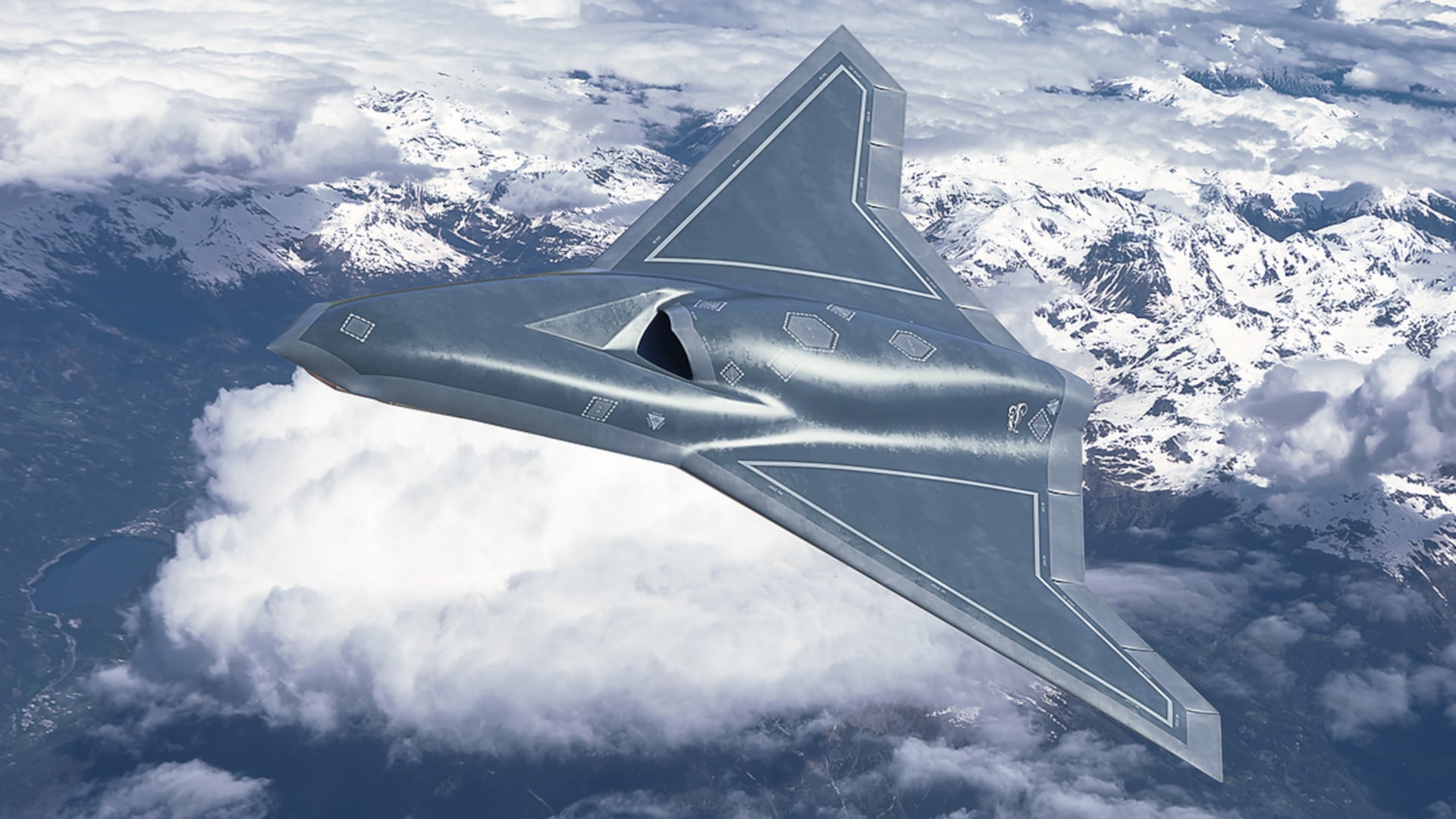
The model on the show floor at National Harbor is 34 feet long and you can walk all the way around it. There is no cockpit, no canopy, no windscreen, nothing for a human head to sit behind. What there is, on top of the fuselage where an intake has no business being, is a long sloping trench that swallows air through a recessed slot. That trench is the thing everyone at the Air, Space & Cyber Conference wanted to look at on 14 September, and it is the first properly new thing Lockheed Martin has shown of the Vectis since the drone was unveiled a year ago.
The bigger news came in the briefing that went with it. Skunk Works is no longer building one Vectis. It is building five.
Informazioni rapide
Aeromobili: Lockheed Martin Vectis collaborative combat aircraft (CCA)
Annunciato: Unveiled September 2025; expansion to five air vehicles announced 14 September 2026
Misurare: Roughly 34 ft long, 38 ft wingspan
Configurazione: Tailless lambda wing, single engine, submerged dorsal inlet, internal weapons bay
Prototype engine: Williams International FJ44-4, rated above 3,600 lb thrust
Primo obiettivo di volo: End of 2027
Finanziamenti: Entirely company-funded. No customer, no contract, no announced unit price
One prototype became five
Ron Fehlen, vice president and general manager of Lockheed Martin Skunk Works, told reporters on a call ahead of the conference that four more airframes are being built on top of the original prototype. Parts are already being cut. He would not put a number on what Lockheed is spending, because there is no customer paying for any of it.
That is an unusual thing for a prime contractor to do. Building one demonstrator on your own money is a sales pitch. Building five is a production line, and production lines are expensive to start and embarrassing to stop. Lockheed is betting that somebody — the U.S. Air Force, the U.S. Navy, or an export customer — will want these badly enough to pay for them later.
It has reason to hurry. Lockheed lost the Air Force’s CCA Increment 1 competition outright; General Atomics and Anduril took that round and were cleared for production in June 2026. Skunk Works reportedly offered a more exquisite, more expensive design and was shown the door. The consolation prize was a slot in the six-vendor pool competing to supply the autonomy software that will fly somebody else’s drones.
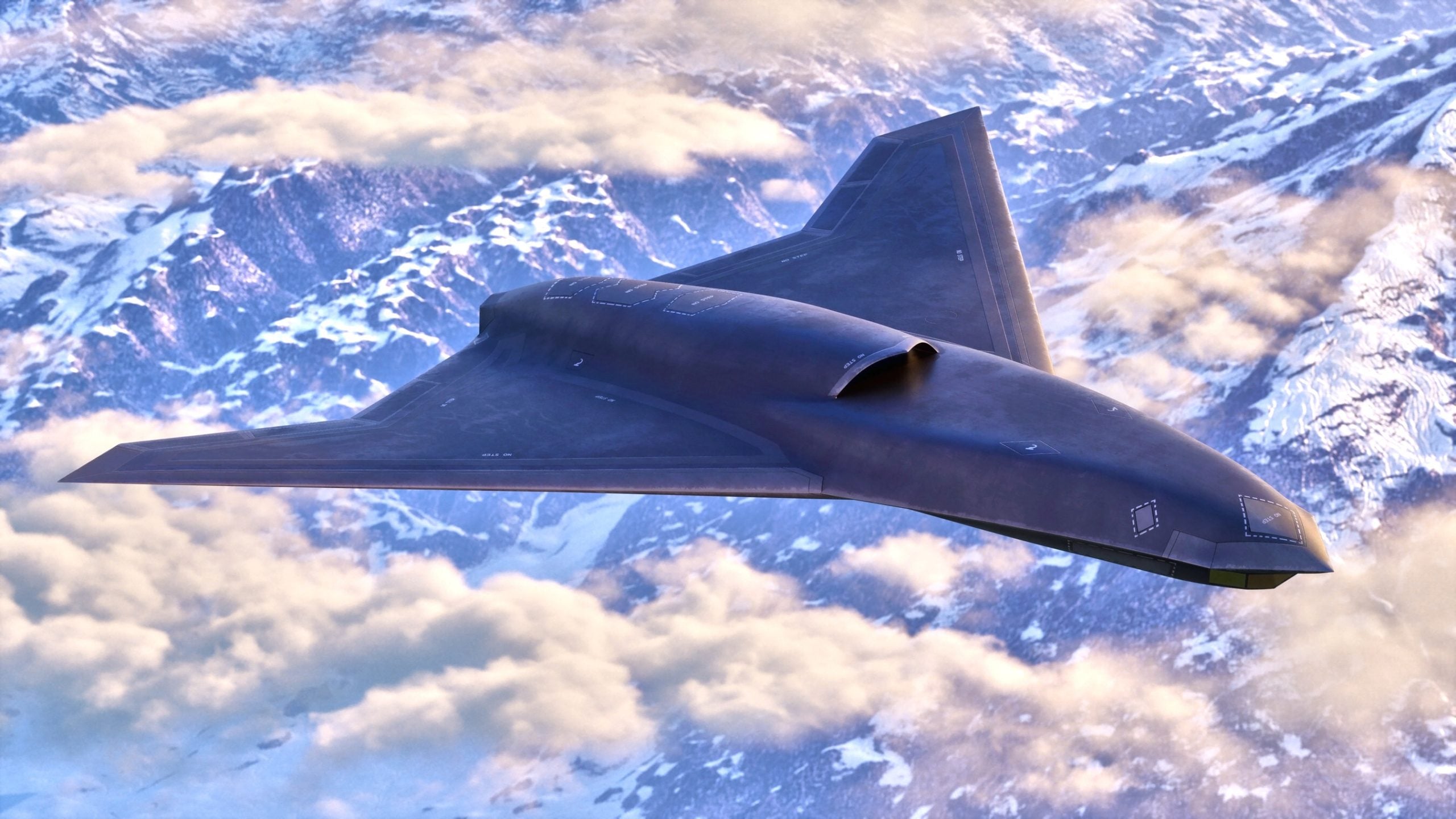
The trench on the spine
The intake is the headline design change, and it is not a small one. Earlier renders and the Farnborough model showed a fairly conventional intake with a saw-toothed lip. What Lockheed showed on 14 September is deeply recessed into the upper fuselage behind a V-shaped channel that slopes down towards it — loosely the same family of ideas as the B-21 Raider, and a long way from anything bolted onto the side of a fighter.
Fehlen insisted the submerged inlet had been in the design from the beginning and simply had not been drawn before. The reasons he gave for it were less about radar than you might expect. Less frontal drag means more range on the same fuel. And an intake on the roof does not eat gravel.
That is Agile Combat Employment talking — the Air Force doctrine of scattering aircraft across rough, half-improvised strips so they cannot all be killed on one ramp. A drone that can operate from a strip nobody has swept is worth more in that world than one that needs a clean runway.
The rest of the shape follows the same logic. Tailless lambda wing, single engine, a chine line running forward to a shovel nose, and an electro-optical turret tucked behind a faceted enclosure under the chin rather than hanging in the breeze. Lockheed will not discuss radar cross-section. Fehlen would only say it will be survivable.
What it carries, and what pushes it
The promo film released with the announcement shows the weapons bay open for the first time. It is long, and it holds at least two weapons: an AIM-120 AMRAAM comes off the rail in one sequence, and a pair of GBU-53/B StormBreaker glide bombs appear in another. Air-to-air and air-to-ground, in other words, which is what Fehlen said when asked directly about mission sets.
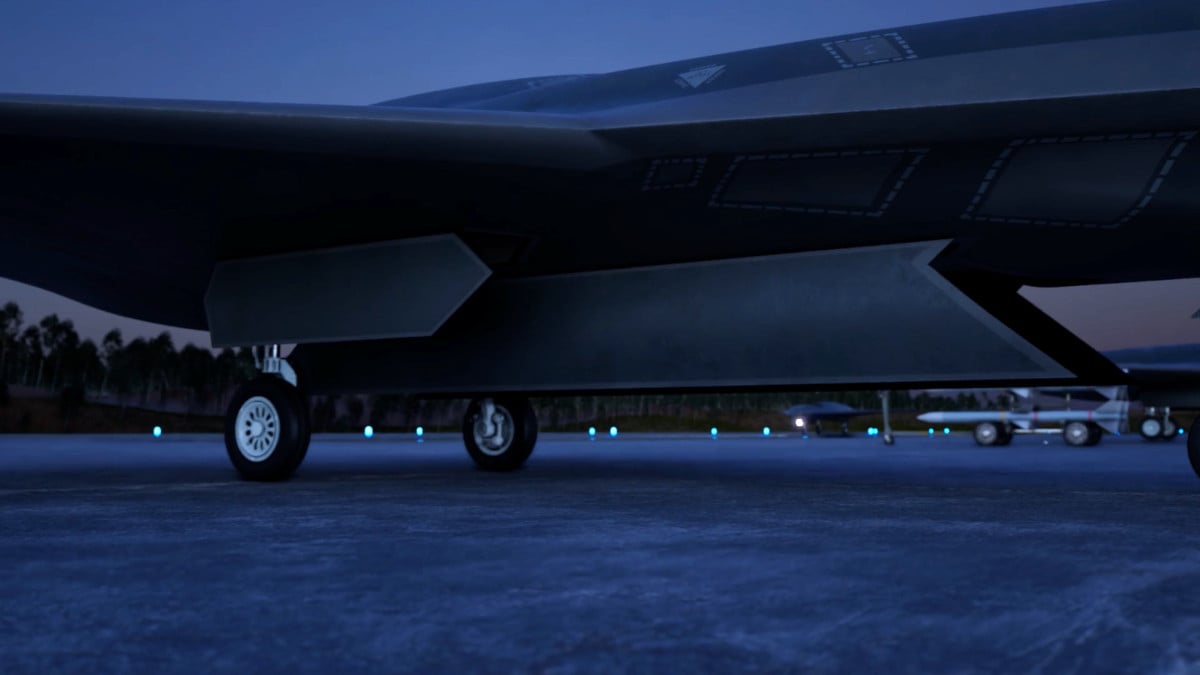
Power comes from a Williams International FJ44-4, the engine Lockheed selected in December 2025 — a twin-spool turbofan rated above 3,600 lb of thrust, chosen because it already exists and already works. That is the prototype engine. What goes into a production Vectis is undecided, and Lockheed has said it is looking at something with more push.
No range figure has ever been published. No maximum weight, no speed, no combat radius, no price. The only thing Lockheed has said about reach is that the endurance is meant to suit the Indo-Pacific, Europe and Central Command. Treat every number you see beyond the 34-by-38-foot dimensions as somebody’s estimate.
Built like flat-pack furniture
The part of the briefing Lockheed seemed proudest of had nothing to do with aerodynamics. Vectis is assembled using what the company calls minimal-tooling determinant assembly — parts machined precisely enough that they locate themselves against each other, rather than being held in position by enormous bespoke jigs. Fehlen reached for an IKEA comparison. The claim is an 80 percent cut in the labour hours needed to put an airframe together.
The design itself moved at a similar pace. Fehlen says it started as a sketch he intends to frame.
Autonomy comes from Lockheed’s MDCX software, the same stack underpinning the Navy’s MQ-25. Earlier in 2026 the company flew the X-62A VISTA testbed through 27 AI-controlled intercepts of a live T-38 across eight sorties, work that feeds straight into this. The drone is meant to fly alone or alongside crewed aircraft, with the F-35 named first among the partners.
A bet with no buyer yet
The Air Force is still writing the requirements for CCA Increment 2. Nine vendors are in a concept-refinement phase with roughly ten months left to run, and as many as six designs could go forward to prototyping. Lockheed will not say whether it is one of the nine, which is the sort of non-answer that usually means yes.
Meanwhile the Navy published its own drone-wingman targets at the end of August, and Fehlen listed it alongside the Air Force and international customers when asked who Vectis is for. His line was that there is no reason to say it is one customer or another.
Five airframes, no contract, and a first flight promised inside fifteen months. Skunk Works has built its reputation on exactly this sort of gamble. It has also, quietly, lost a few.
Lockheed’s new Vectis film, released with the 14 September announcement, is the first to show the weapons bay open.
Domande frequenti
What is the Lockheed Martin Vectis?
How many Vectis aircraft is Lockheed building?
When will the Vectis fly for the first time?
Why does the Vectis have its air intake on top?
What engine does the Vectis use?
Did Lockheed lose the Air Force CCA competition?
How much does a Vectis cost?
Sources: Lockheed Martin Skunk Works; The War Zone; Air & Space Forces Magazine; Breaking Defense; Defense One; Aviation Week; Military Times.



0 Comments