
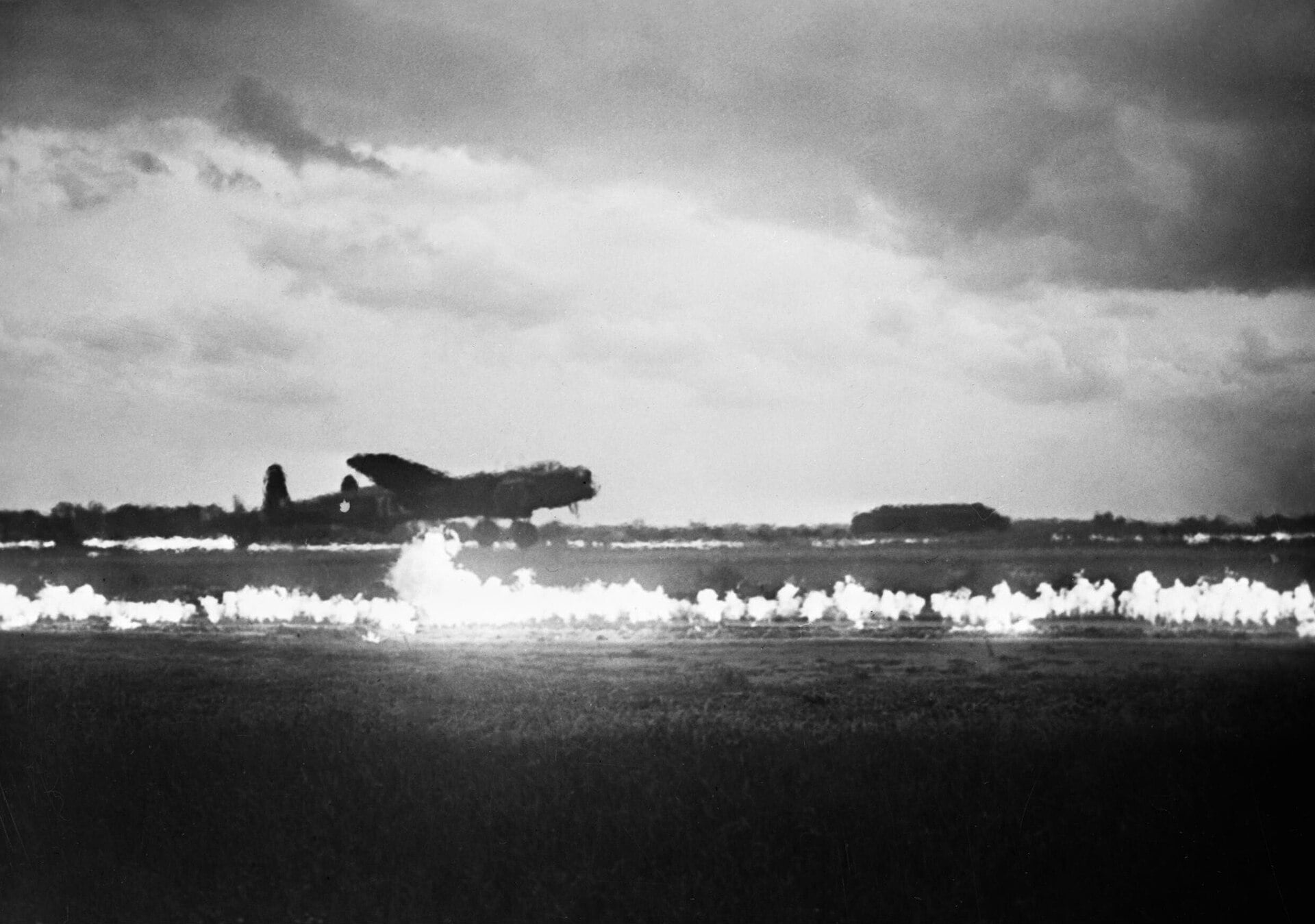
On the night of 16 December 1943, Bomber Command came home to an England that had disappeared. Radiation fog had closed almost every airfield in the east. Crews who had survived Berlin circled above a white nothing until their tanks ran dry. At RAF Bourn alone, twenty-eight men died that night, within sight of home, in aircraft that were undamaged.
There was a system that could have saved most of them. On that night, only three airfields in Britain had it, because it worked by setting the fog on fire.
Informazioni rapide
Nome: FIDO, rendered variously as Fog Investigation and Dispersal Operation and as Fog Intensive Dispersal Of
Cosa ha fatto: Burned petrol in pipelines along both sides of a runway to evaporate fog and open a landing corridor
Ordered by: Winston Churchill, who in 1942 tasked the Petroleum Warfare Department with solving the fog problem
First trial: Moody Down, Hampshire, 4 November 1942. Cleared 200 yards of dense fog to about 80 feet
First operational use: RAF Graveley, night of 19 November 1943, four returning Halifaxes of No. 35 Squadron
Installations: 15 RAF airfields in Britain, plus five overseas sites in France and the United States
Consumo di carburante: Around 100,000 imperial gallons an hour, and reportedly more than double that at long-runway airfields
Claimed result: Roughly 2,500 aircraft landed safely, a figure widely repeated though difficult to trace to a primary source
Fog was killing more men than the Germans
The official Bomber Command statement released after the war put the problem plainly. Blind-approach radio beams could get a pilot down to within a hundred or two hundred feet of the runway. After that he was still flying blind at over a hundred miles an hour, with every prospect of killing himself and his crew, because he could not see to land.
The same statement contained the line that has followed FIDO ever since: that fog over British airfields had become more of a menace than flak over Germany. It is worth noting that the published version carries editorial brackets around part of that phrase, so treat it as very nearly rather than exactly the official wording.
In 1942 Churchill ordered the Petroleum Warfare Department — an organisation whose usual business was burning things deliberately — to find an answer.
How you burn a fog away
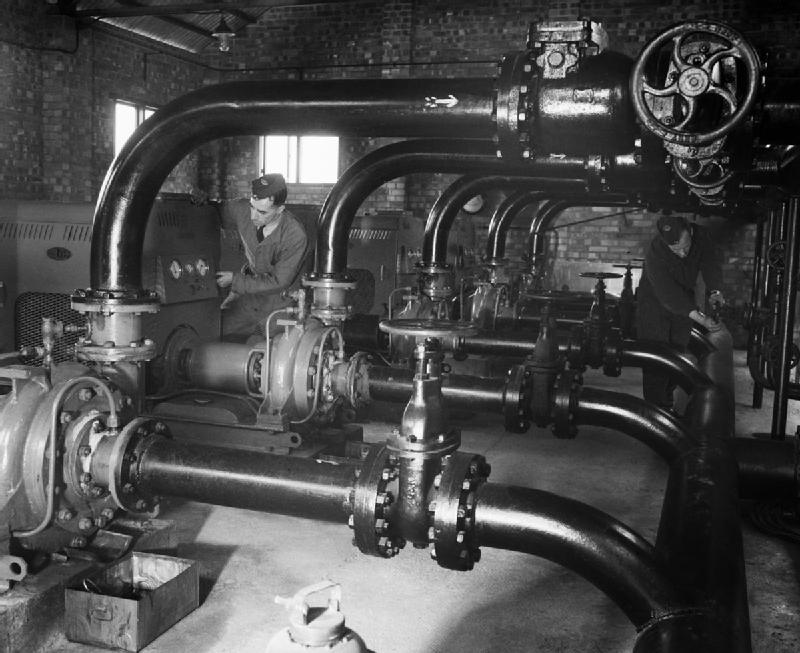
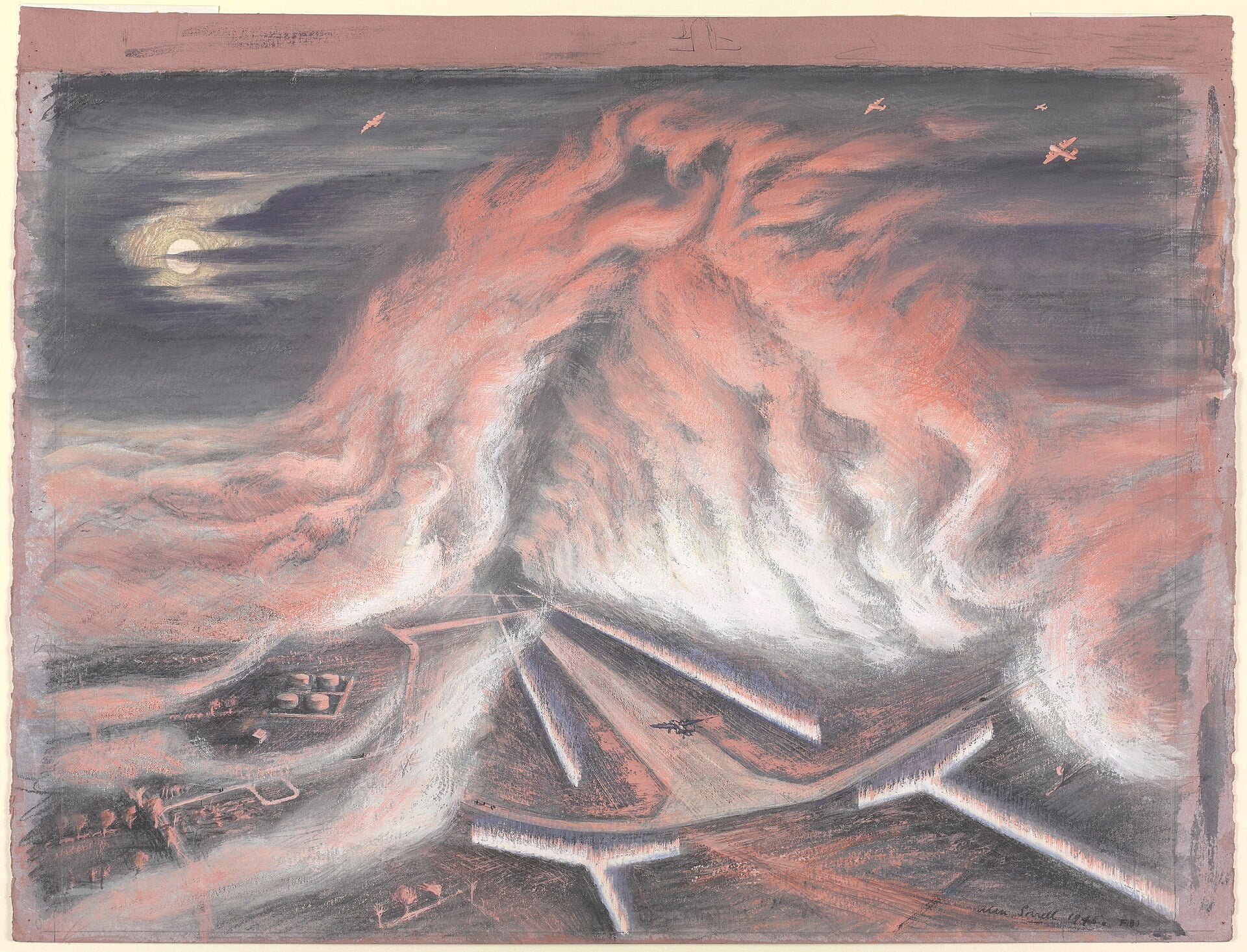
Two pipelines ran the length of the runway, one along each side, fed from tanks at the airfield boundary. Petrol was pumped out through burner jets set at intervals along the pipes and ignited, producing two walls of flame. The heat warmed the air enough to evaporate the suspended water droplets, opening a clear corridor over the runway — and, usefully, the flames themselves marked the runway edges.
Ignition was as agricultural as it sounds. At most installations a Jeep with a flaming brand lashed to the back was driven fast down both sides of the runway. At Graveley, according to No. 35 Squadron’s own account, a man lit the first burner by hand and then ran for his life as the line went up with a whoosh.
The first full-scale test at Graveley in January 1943 brought out most of the fire brigades within a fifty-mile radius, all of them convinced the airfield was ablaze. The squadron history notes that the mess was cleared of beer in record time afterwards.
British Pathé’s 1945 newsreel, showing the burners lit and aircraft landing between the walls of flame.
Who thought of it
This is less settled than you might expect. Arthur Clifford Hartley, chief engineer of the Anglo-Iranian Oil Company, is credited in almost every secondary account and holds a FIDO patent granted in 1949. But Wikipedia records that the invention is formally attributed to Dr John David Main-Smith, principal scientific officer in the chemistry department at Farnborough, on the strength of a post-war Air Ministry letter held privately by his son. Both names deserve to be in the story; neither can be presented as the sole answer.
The development work was done at the University of Birmingham’s department of chemical engineering, and the installation engineering was worked out at Hartford Bridge Flats, later Blackbushe.
Flying between the flames
Air Vice-Marshal Don Bennett, who commanded the Pathfinder Force, made the first landing with the burners lit. He was not a man given to poetic description, which makes his account of it more enjoyable.
Accounts differ on the date and the aircraft: Bennett says a Lancaster, and dates it to January 1943, while No. 35 Squadron’s archive puts it on 18 February 1943 in a Stirling. His own memoir is probably the better guide to what he was flying.
The night that mattered came later. On 19 November 1943 four Halifaxes of No. 35 Squadron came back from operations to find Graveley under radiation fog, visibility down to a hundred yards at fifty feet. FIDO was lit. Within ten minutes the burners had opened a lane along the runway in which effective visibility was two to four miles, and all four landed without difficulty. Their captains were Flight Lieutenant Muller, Flight Lieutenant Rowe, Flying Officer Jones and Lieutenant Hoverstad.
It was the first time aircraft returning from a raid had landed in artificially dispersed fog. The Minister of Petroleum Warfare signalled Churchill, who was abroad, and Churchill sent his congratulations to all concerned.
The arithmetic of setting fuel on fire
FIDO consumed something in the order of 100,000 imperial gallons of petrol per hour of operation — roughly 455,000 litres — and at airfields with long runways such as Carnaby, sources suggest more than double that. Graveley held half a million gallons in reserve for it. Every use had to be reported to the Air Minister because of the expense.
Against that, the usual claim is that around 2,500 aircraft landed safely using FIDO between 1943 and 1945, saving some 10,000 aircrew. Those numbers are repeated by Shell and the RAF Museum but are hard to trace to a primary document, and Main-Smith’s family put the figure of men saved nearer 11,000. What is firmly documented is smaller and more convincing: 183 aircraft landed or took off at Graveley alone in fog or very poor visibility.
Coverage was always thin. Fifteen British airfields had it by the end, but as late as December 1943 only three were operational — which is precisely why Black Thursday cost what it did.
Why it went away
Three things killed FIDO, and only one of them was cost.
The first was that no civil operator could justify burning a hundred thousand gallons of petrol to land an airliner. The second was that instrument landing systems and proper runway lighting arrived and did the same job without the pyrotechnics. The third is the one people forget: the fog itself went away. The Clean Air Act of 1956, passed after the London smog of 1952, removed the dense industrial pea-soupers that FIDO had been designed to beat. As Main-Smith’s son put it, it is difficult for a modern reader to grasp what wartime British fogs were like — it was not uncommon to be unable to see your own outstretched hand.
RAF Manston kept an installation available for emergencies as late as 1952. Heathrow had a FIDO system designed and the trenches dug along Runway 1, but the pipes were never laid.
It remains one of the least elegant and most effective ideas of the war: confronted with weather that could not be flown through, Britain simply set fire to it.
British Pathé’s archive of wartime aviation film. Contains contemporary newsreel footage.
Domande frequenti
What was FIDO?
Who invented FIDO?
Did Churchill order FIDO?
How much fuel did FIDO burn?
When was FIDO first used operationally?
How many aircraft were saved by FIDO?
Why was FIDO abandoned after the war?
Sources: Imperial War Museum; RAF Museum; Shell aviation history; RAF Pathfinders Archive; No. 35 Squadron association records; D. C. T. Bennett, Pathfinder; British Pathé.
0 Comments