
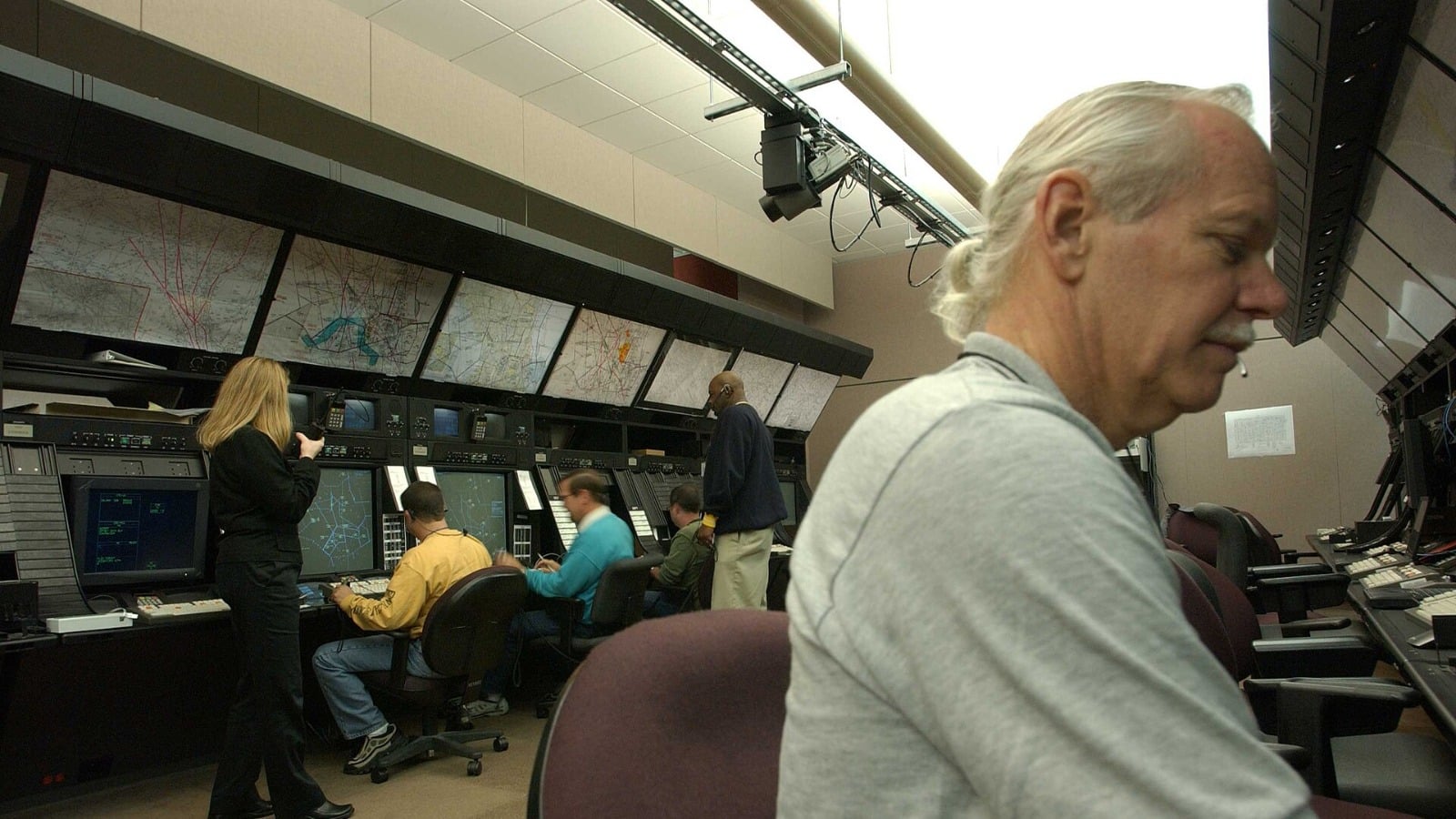
Ask an American air traffic controller whether they work a forty-hour week and you will get a straight answer: yes. Five shifts, eight hours each, exactly as the contract says.
Then ask when those forty hours happen. The common answer is that all five shifts are packed into eighty-eight hours of wall clock, each one starting earlier than the last, with the final shift beginning at ten at night on the same calendar day the previous one ended at two in the afternoon. The schedule has a name inside the profession. It is called the rattler, and the US Federal Aviation Administration uses that word in its own reports.
It is not a scandal. It is a trade. Understanding what is being traded, and what fifteen years of fatigue research has had to say about it, turns out to explain a great deal about why American air traffic control keeps making headlines.
Informazioni rapide
- Contractual week: eight consecutive hours a day, five consecutive days, set by the FAA and NATCA collective bargaining agreement
- The 2-2-1 roster: two evenings, two days, one midnight, rotating counter-clockwise
- Compression: five shifts inside about 88 hours, against roughly 104 for a conventional week
- The quick turns: 9 hours off before the first day shift, 8 hours off before the midnight shift
- Measured sleep before a midnight shift: 3.25 hours (NASA field study, 2012)
- Rest rule today: 10 hours between all shifts and 12 hours after a midnight shift. The 12 hours Prima a midnight shift is suspended for all of 2026
- Hours actually worked: about 74 per cent of controllers averaged 40 hours a week or less in early 2024. The other 26 per cent averaged 40 to 60
The answer is yes, and the answer is no
The forty-hour week is real and it is written down. Article 34 of the 2016 collective bargaining agreement between the FAA and the National Air Traffic Controllers Association says a full-time employee’s basic workday shall consist of eight consecutive hours and the basic workweek shall consist of five consecutive days. That is the baseline, and for most controllers most of the time it holds.
Then the FAA went and counted. In 2024 a scientific expert panel convened by the agency pulled the payroll records of 10,363 controllers across the first ten weeks of the year, more than 700,000 hours of work. Just under 74 per cent of them averaged forty hours a week or fewer. The remaining 26 per cent averaged between forty and sixty. About a quarter of shifts ran between eight and ten hours.
So the honest answer to the question in the headline is that the forty-hour week is true for roughly three controllers in four, and not true for the fourth. What is far more interesting is the shape of those forty hours.
Backwards through the clock
The dominant American pattern is called 2-2-1: two evening shifts, two day shifts, one midnight shift. What makes it unusual is the direction. Each shift starts earlier than the one before it, rotating counter-clockwise, backwards through the clock. Industrial shift-work research has generally preferred the opposite, because the human circadian clock stretches more easily than it compresses.
The FAA’s generic version, reproduced by the Department of Transportation’s Inspector General, runs like this. Evening, three in the afternoon until eleven at night. Evening again, two until ten. Day, seven in the morning until three. Day again, six until two. Then the midnight shift, ten at night until six the following morning, beginning on the same calendar day the fourth shift ended.
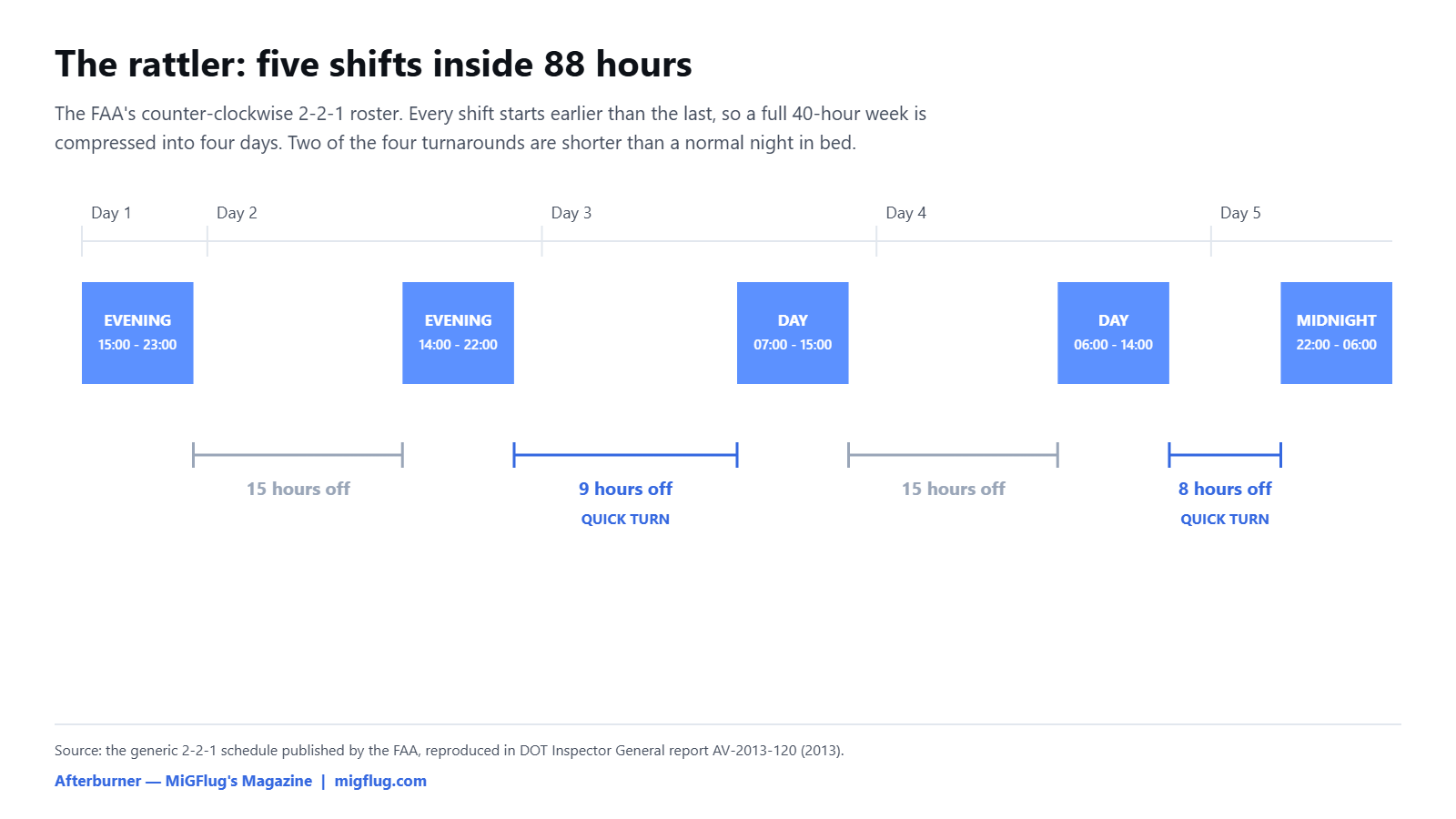
Count the gaps and the trade becomes obvious. Between the last evening shift and the first day shift there are nine hours off. Between the last day shift and the midnight shift there are eight. The Inspector General calls these quick turns, and they are not an accident of the roster. They are the whole point of it.
Five eight-hour shifts inside eighty-eight hours instead of the hundred and four a conventional week would take means the controller walks out at six in the morning on day five with roughly eighty hours of continuous time off in front of them. Three and a half days. The Inspector General found that controllers like the schedule precisely because of that, and the Transportation Research Board reached the same conclusion. You buy a long weekend with two bad nights.
The FAA’s own expert panel is sceptical that it is as popular as everyone says. It notes that data from the agency’s Civil Aerospace Medical Institute, going back to a survey of more than four thousand controllers in 2001, found fatigue or sleep problems named as the single most common disadvantage of the shift system by 86.5 per cent of respondents. More than a hundred and sixty wrote in the same complaint unprompted: quick turnarounds, eight hours between shifts, causes fatigue and is dangerous.
Three hours and fifteen minutes
In 2012 NASA Ames Research Center published the study that still anchors this argument. Researchers put wrist actigraphs on 211 controllers at 30 facilities for fourteen days, logged their sleep, and had them take a five-minute reaction-time test three times per shift. This was measured sleep, not remembered sleep.
Across the work week the average was 5.8 hours a night. Broken down by shift the picture is much sharper. Before an afternoon shift, 6.94 hours. Before a mid-day shift, 6.41. Before an early morning shift, 5.4. And before a midnight shift, at the end of an eight or nine hour quick turn, 3.25 hours, taken in the afternoon.
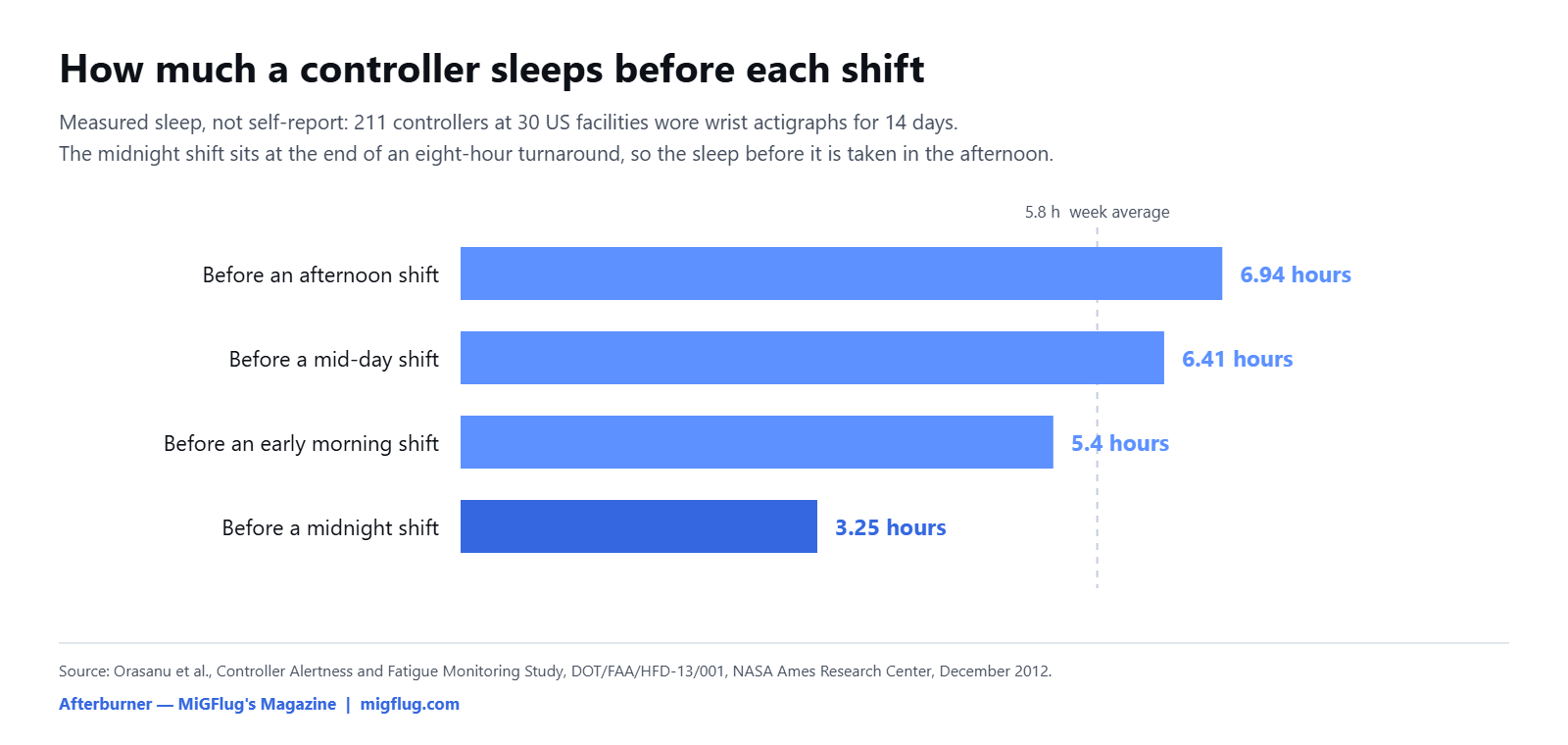
The reaction-time data follows exactly where you would expect. Responses were slowest and lapses most frequent during midnight shifts compared with day or afternoon shifts, and both got worse as the week progressed. As sleep duration fell, lapses rose. The study also found that the sample was significantly more fatigued than a comparable group of controllers surveyed in 1999, and more fatigued on the chronic fatigue scale than a normative comparison group of nurses and industrial shift workers.
One self-reported figure is worth sitting with. Asked whether they had caught themselves about to doze off during work duties in the previous year, 61 per cent of all respondents said yes. Among those with regularly scheduled midnight shifts it was 70 per cent.
The night the tower did not answer
None of this was a secret in 2011, but that was the year it stopped being an internal conversation. On the night of 23 March, two airliners approaching Ronald Reagan Washington National Airport could not raise the tower. Neither could the controllers at Potomac Terminal Radar Approach Control. The supervisory controller working alone in the cab had fallen asleep. He was on his fourth consecutive midnight shift. Both aircraft landed without him.
Then it kept happening. A controller at Knoxville had slept for about five hours on a radar-room floor in February, having made a bed from break-room cushions, while a colleague tried to wake him. In April a controller at Reno was unresponsive for roughly sixteen minutes at two in the morning while a medical flight was inbound. Another was found asleep at Miami Center, the facility handling high-altitude traffic across much of Florida, the Atlantic and the Caribbean. Two were fired. Several were suspended.
On 14 April 2011 Hank Krakowski, the chief operating officer of the FAA’s Air Traffic Organization, resigned. Babbitt, announcing it, added a line that has aged well: we are all responsible and accountable for safety, from senior FAA leadership to the controller in the tower.
Eight became nine, and nine did nothing
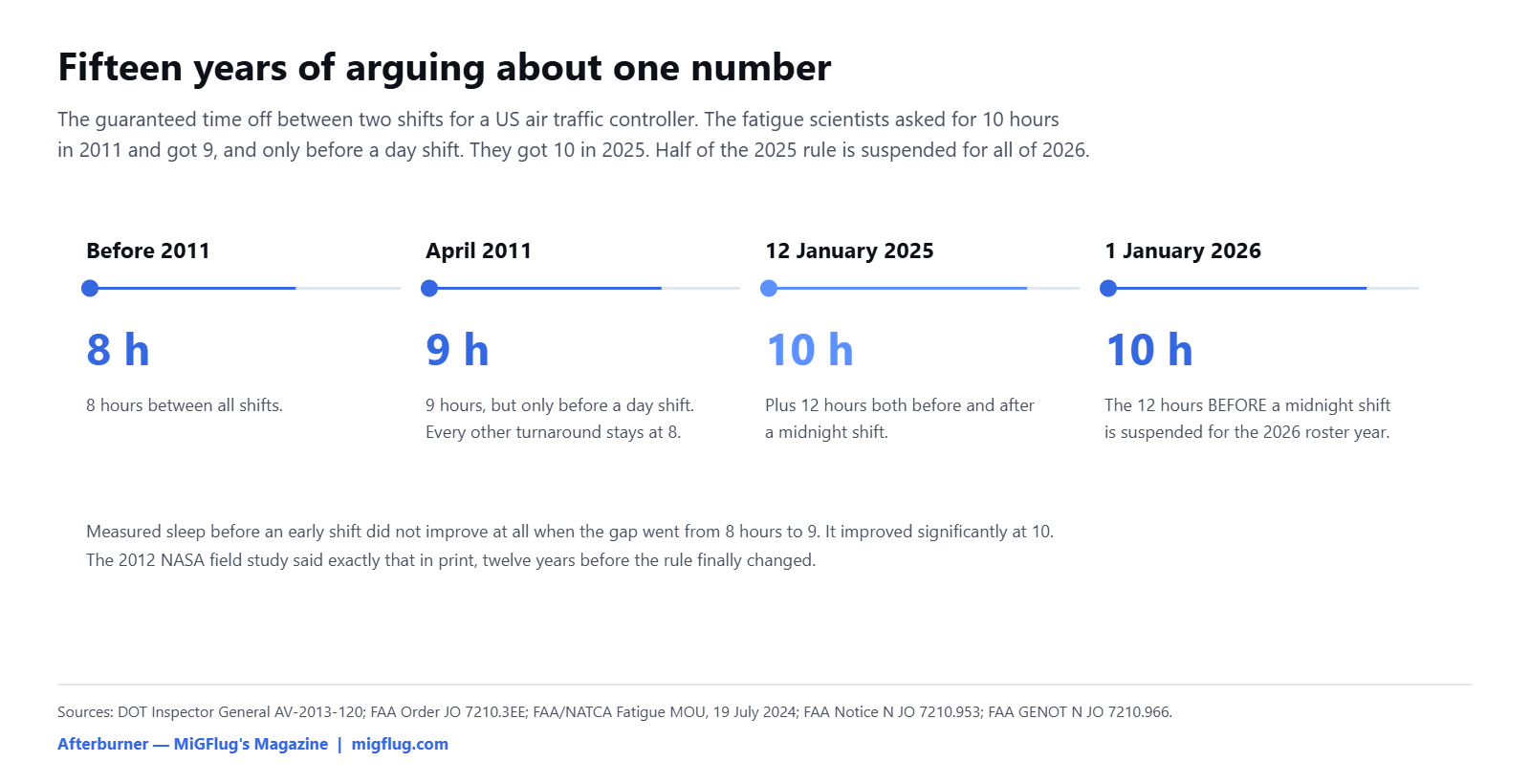
The FAA responded quickly. A second controller was added to the midnight shift at thirty facilities that had been running one. Controllers were barred from switching into an unscheduled midnight shift after a day off. Supervisory coverage was increased in the early-morning and late-night hours. And the minimum rest period between shifts was raised from eight hours to nine.
That last one is the most commonly misreported fact in the whole story, and it deserves care. The nine-hour minimum was later amended to apply only to the time off before a day shift. The floor before every other shift, including the midnight shift that had just caused the problem, stayed at eight. FAA Order JO 7210.3EE still carries that text.
There is a second detail in the Inspector General’s footnotes that is almost painful in hindsight. The working group that produced the change had originally planned to recommend ten hours of rest between all shifts. It was cut to nine, before day shifts only, on the basis that going from eight to nine delivered the greatest marginal benefit.
The NASA data says it delivered none. Analysing turns of between eight and twelve hours before early-morning shifts, the researchers found no difference in the amount of sleep or in alertness between eight hours off and nine. Significantly more sleep was obtained only when the time off increased from nine to ten hours and beyond.
Ten hours, twelve hours, and then not
It took thirteen years to adopt what had been recommended in 2011. On 19 April 2024, after the expert panel reported, FAA Administrator Mike Whitaker said he would require ten hours off between shifts and twelve hours off before a midnight shift. The National Transportation Safety Board, which had been asking for action on controller fatigue for the better part of two decades, welcomed it in unusually direct terms.
The binding instrument arrived on 19 July 2024 as a memorandum of understanding between the FAA and NATCA, and it took effect with the 2025 roster year on 12 January 2025: ten hours between all shifts, twelve hours both before and after a midnight shift, with a midnight shift defined as one where most of the hours fall between 10:30 at night and 6:30 in the morning.
And then, quietly, half of it was switched off. A general notice signed in August 2025 and effective on 1 January 2026 states that the requirement for a twelve-hour off-duty period prior to a midnight shift has been suspended for the period covered by the 2026 basic watch schedule. NATCA told its members the parties had agreed to it, citing staffing levels and the difficulty of implementation, and confirmed that the twelve hours of rest Dopo a midnight shift remains.
So as this is written, in October 2026, the rule is ten hours between all shifts and twelve hours after a midnight shift, and nothing in particular before one. The suspending notice expires on 31 December 2026. What happens to the 2027 roster year is not, as far as we can establish from published documents, yet public. Several articles still describe the twelve-hour pre-midnight rule as current. It is not.
And then there is the sixth day
All of the above describes a five-day week. A good number of controllers are not working one. This is the part of the story where the figures get slippery, so it is worth being careful about which number means what.
The most defensible comes from a 2025 National Academies review, which reports that controllers at 40 per cent of FAA facilities worked six days in a row at least once a month in the 2022 financial year, and that several facilities required six-day weeks regularly. Overtime per full-time equivalent rose by 308 per cent between 2010 and 2024. A widely circulated claim that 41 per cent of controllers work ten-hour days six days a week traces back to a union figure relayed in a congressional letter, and appears to be the facilities number with the denominator swapped. Treat it accordingly.
The FAA’s own expert panel found individual cases that need no spin at all. Four controllers worked thirty or more consecutive days in January 2024. One of them worked all seventy calendar days of the first ten weeks of the year. Two of the four were working almost entirely midnight shifts. The panel noted, drily, that these schedules are allowable under current policy.
The agency does not pretend otherwise. Its own Controller Workforce Plan for 2026 to 2028 states that overtime levels reached in the 2023 to 2025 financial years far exceed any reasonable use of mandatory overtime, and that chronic use of overtime leads to fatigue, controller burnout and ultimately loss of retention. As of April 2026 the FAA counted roughly 11,000 certified professional controllers on position, with about 4,000 more somewhere in a training pipeline that the Government Accountability Office says can take between two and six years to clear from application to full certification.
How everyone else does it
It is tempting to reach for a European comparison here, and it is worth doing carefully, because the obvious version of it is wrong. European Union regulations do not set numbers. EASA says so plainly: none of the relevant texts provides prescriptive values on the working or rest time of controllers, because there was no consensus when they were drafted. What the rules require is that each air navigation service provider specify its own limits across eight rostering parameters.
What EASA did do, in a 2024 action plan, was survey 36 European providers and publish what they actually do. The observed average minimum rest period came out at 11.6 hours at area control centres and 12.0 hours at aerodromes. The average minimum rest after a night duty was between roughly 18 and 22 hours. Those are averages of practice, not legal floors, and that distinction matters. But they sit against an American requirement of ten hours, on a roster that until recently tolerated turnarounds of eight.
There is one more comparison worth a line. A 2022 peer-reviewed review of controller rostering notes that Airways New Zealand and Airservices Australia run three-on-three-off and four-on-two-off patterns, while the FAA runs five-on-two-off. The same hours, spread over fewer consecutive days.
Here is the thing that lingers. The FAA, in the 2024 agreement, committed a working group to brief the Administrator and the NATCA president by the end of that year with alternatives to the counter-clockwise 2-2-1 schedule, with the explicit goal of eliminating its use, starting with the 2026 roster year. We could find no FAA or NATCA document announcing that this has happened. The 2026 roster year arrived with the pre-midnight rest rule suspended instead.
Which leaves the rattler more or less where it has been since the 1990s: a schedule everybody can see the problem with, defended by the people who work it because of the three and a half days at the end, and kept alive by a staffing shortfall that makes any alternative harder to roster. Notably, almost every serving controller quoted on the subject in recent American coverage speaks anonymously. That is also part of the story.
Sources: FAA and NATCA collective bargaining agreement, 2016, Articles 32 and 34; FAA Scientific Expert Panel, Assessing Fatigue Risk in FAA Air Traffic Operations, 19 April 2024; Department of Transportation Office of Inspector General, AV-2013-120 and AV2023035; Orasanu et al., Controller Alertness and Fatigue Monitoring Study, DOT/FAA/HFD-13/001, NASA Ames Research Center, 2012; FAA Order JO 7210.3EE; FAA and NATCA Fatigue Memorandum of Understanding, 19 July 2024; FAA Notice N JO 7210.953 and GENOT N JO 7210.966; NTSB press release NR20240419; National Academies, The Air Traffic Controller Workforce Imperative, 2025; FAA Controller Workforce Plan 2026-2028; GAO-26-107320; EASA Action Plan on ATCO Fatigue, 7 June 2024; Terenzi, Ricciardi and Di Nocera, International Journal of Environmental Research and Public Health 19(8), 2022.


0 Comments