
About seven minutes before Apollo 11’s third stage fired to send it to the Moon on 16 July 1969, the spacecraft was over the open Pacific, far from any ground station. Houston was still talking to the crew, through a modified Air Force jet flying somewhere below. Its call sign was ARIA 3.
A post on Instagram tells the story of these Apollo Range Instrumentation Aircraft well. Two details need correcting: who answered the radio check, and which aircraft is in the museum.
Informazioni rapide
- Nome: Apollo Range Instrumentation Aircraft (ARIA), later Advanced Range Instrumentation Aircraft
- Aeromobili: Boeing EC-135N, converted from C-135A transports
- Flotta: 8 aircraft, modified 1966 by McDonnell Douglas and Bendix
- Operational: 1 January 1968
- Antenna: Steerable 7 ft dish in a 10 ft “Droop Snoot” radome
- Operatore: US Air Force (Eastern Test Range, Patrick AFB, at the time of Apollo 11)
- Apollo 11 role: Voice relay and telemetry recording over the Pacific before TLI
Why Apollo Needed Flying Antennas
After reaching Earth orbit, Apollo crews had to restart the Saturn V’s third stage for trans-lunar injection, the burn that sent them to the Moon. Where that burn happened depended on launch time and on which orbit the crew used, and it often fell over the Pacific between ground stations. Tracking ships could be placed in advance but could not move quickly. Aircraft could. NASA and the Defense Department had eight C-135 transports converted, initially planning for twelve but settling on six on station plus two spares.
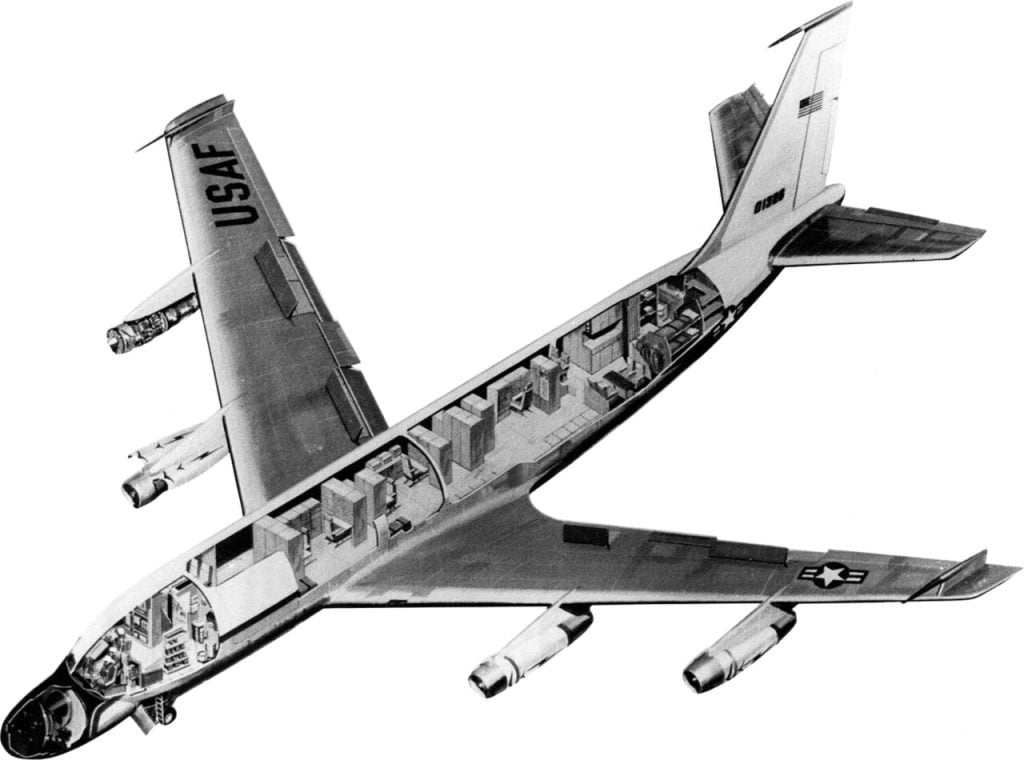
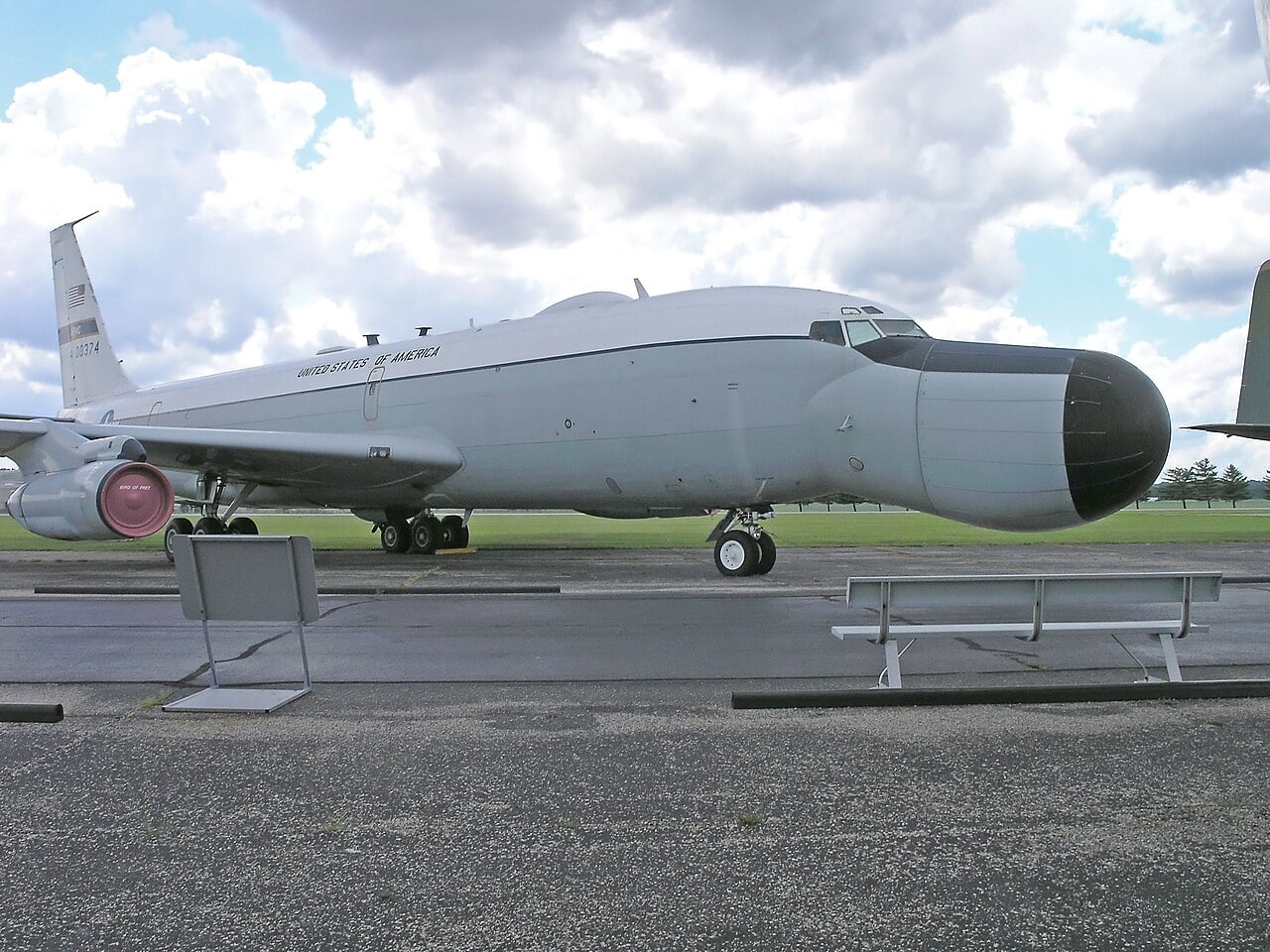
The most obvious change was the nose: a bulbous radome about ten feet long, nicknamed “Droop Snoot” or “Snoopy Nose”, housing a seven-foot steerable dish that tracked the spacecraft’s signal. Behind it, operators, receivers and tape recorders filled the cabin. The aircraft relayed voice between the astronauts and Houston and recorded telemetry on magnetic tape for later analysis.
“Much Clearer”: The Apollo 11 Radio Check
According to NASA’s commentary, Apollo 11’s trans-lunar injection burn would take place near the Gilbert Islands, roughly halfway between Australia and Hawaii, in the gap between the Carnarvon station in Western Australia and the tracking ship Redstone. Several ARIAs covered it. The first contact through ARIA 4 was scratchy, with static. Then capcom Bruce McCandless tried again.
A moment later the crew added that this was a lot better than the static they had had before. The caption says it was Neil Armstrong who answered. The original 1969 NASA transcript does mark the reply as the commander, but the Apollo Flight Journal, which re-checked the audio, attributes it to Buzz Aldrin. The safe version is simply that the crew answered.
After Apollo
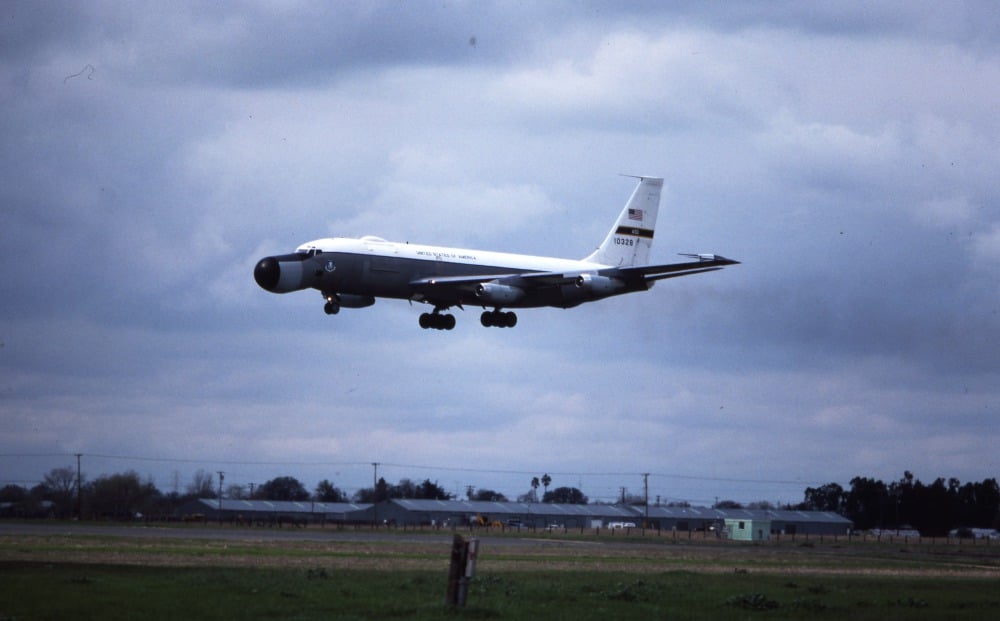
The ARIAs flew their first mission on Apollo 4 in November 1967 and became operational on 1 January 1968. When Apollo ended in 1972 they were renamed Advanced Range Instrumentation Aircraft and went on supporting missile and space tests, moving to the 4950th Test Wing at Wright-Patterson in 1975 and later to Edwards. Re-engined examples became EC-135Es, and ex-airline Boeing 707s converted as EC-18Bs joined the fleet in the 1980s. The last EC-135E retired in 2000 and the programme ended in 2001.
The aircraft in the National Museum of the US Air Force in Dayton is EC-135E 60-0374, one of the original Apollo ARIAs, which flew to the museum on 3 November 2000. The caption’s photo credit points to the museum aircraft correctly, but some online sources confuse it with 60-0375, which was scrapped in 2013.
Visualizza questo post su Instagram
Sources: Apollo Flight Journal (Apollo 11, Earth orbit and TLI); Spacelog Apollo 11 technical air-to-ground transcript; National Museum of the US Air Force fact sheet, Boeing EC-135E ARIA; Cape Canaveral Space Force Museum; Museum of Aviation, Robins AFB; flyaria.com aircraft histories; Anderson, “NASA’s Apollo Airborne Fire Brigade” (2022); The Aviationist (2020)

0 Comments